⭐ EXPERT-REVIEWED  |  ✅ UPDATED 2026  |  🔒 NO SPONSORED BIAS  |  📚 EVIDENCE-BASED

Author: admin

  • How to Retire Early: The FIRE Movement Complete Guide 2026

    How to Retire Early: The FIRE Movement Complete Guide 2026

    🏷️ Retirement Planning

    FIRE movement guide 2026

    ⭐ Key Takeaways

    • ✅ FIRE = Financial Independence, Retire Early — achieve it in 10-20 years on average income
    • ✅ The 4% rule: your portfolio can sustainably fund 4% withdrawals annually in retirement
    • ✅ Savings rate matters more than income — a 70% savings rate reaches FI in about 8-9 years
    • ✅ ‘Lean FIRE’ ($25K-40K/yr) vs ‘Fat FIRE’ ($100K+/yr) represent different lifestyle choices
    • ✅ Healthcare is the #1 logistical challenge for early retirees not yet Medicare-eligible at 65

    The 4% Rule: How Much Do You Need?

    Annual Spending 4% Rule Portfolio Target Monthly Savings Needed to Hit Target in 15yrs
    $30,000 $750,000 $2,400/mo at 10% return
    $40,000 $1,000,000 $3,200/mo at 10% return
    $60,000 $1,500,000 $4,800/mo at 10% return
    $80,000 $2,000,000 $6,400/mo at 10% return
    $100,000 $2,500,000 $8,000/mo at 10% return

    FIRE Savings Rate vs Time to FI

    Savings Rate Years to Financial Independence
    10% ~43 years
    25% ~32 years
    40% ~22 years
    50% ~17 years
    60% ~12 years
    70% ~8-9 years

    Your savings rate is the most powerful lever. Increasing from 20% to 50% cuts your working years nearly in half.

    FIRE Variations

    Lean FIRE

    Living frugally on $25,000-$40,000/year. Portfolio target: $625K-$1M. Achievable faster but requires ongoing frugality.

    Fat FIRE

    Living comfortably on $80,000-$150,000/year. Portfolio target: $2M-$3.75M. Requires high income or very long accumulation.

    Barista FIRE

    Semi-retire — cover basic expenses with part-time work, let portfolio grow without withdrawals. Best of both worlds.

    ❓ Frequently Asked Questions

    ❓ Is the 4% rule still valid in 2026?

    Research supports it for 30-year retirements. For 40-50 year early retirements, some researchers recommend 3-3.5% to increase safety margin. Higher stock allocation (90%+) also supports longer withdrawal periods.

    ❓ What about healthcare before 65?

    ACA marketplace plans are available. Keeping income below 400% of the federal poverty level qualifies you for significant subsidies. Many early retirees manage to pay $0-$200/month in premiums through careful income management.

    our editorial team

    Personal Finance Content Researchers

    Our team researches personal finance topics using publicly available data to help you make informed financial decisions.

    ⚠️ Disclaimer: Educational purposes only. Not professional financial, tax, or investment advice. All investing involves risk. Consult a qualified financial professional before making decisions.

    Building Real Wealth: Evidence-Based Financial Strategies

    Wealth building is not complicated, but it is demanding. It requires consistent behaviour over long periods of time, discipline during market downturns and lifestyle inflation pressure, and a clear understanding of the fundamental principles that separate households that build lasting wealth from those that earn well but arrive at retirement with little to show for it. The principles themselves are not secrets — they are widely known. The challenge is applying them consistently across decades of real life with its competing demands, temptations, and disruptions.

    The first principle is spending less than you earn — consistently, not occasionally. This sounds obvious but runs counter to powerful cultural forces that normalise lifestyle expansion proportional to income growth. Every raise, bonus, and windfall represents an opportunity either to accelerate wealth building or to inflate lifestyle. Households that consistently direct a meaningful portion of income increases to savings and investment rather than consumption build wealth at rates that surprise even financially sophisticated observers when compounded over 20-30 years.

    The second principle is investing early and consistently. The mathematics of compound growth reward early investors with an advantage that later savers cannot overcome through higher savings rates alone. A 25-year-old who invests $500 per month until age 65 at a 7% annual return accumulates approximately $1.3 million. A 35-year-old making the same monthly investment accumulates approximately $600,000 — less than half, despite investing for only 10 fewer years. Time in the market is the most powerful wealth-building variable available, and every year of delay is extremely costly in terminal wealth terms.

    The third principle is minimising fees, taxes, and financial mistakes. Every percentage point of annual fees reduces terminal wealth by approximately 20-25% over a 30-year investment horizon. Tax-advantaged accounts (401k, IRA, Roth IRA, HSA) provide legally guaranteed returns in the form of tax savings that no market investment can match. Avoiding common financial mistakes — panic selling during market downturns, chasing recent performance, taking on consumer debt for depreciating purchases, cashing out retirement accounts early — protects the wealth that good habits create. The wealth destroyed by financial mistakes often exceeds the wealth created by investment returns for households that have not developed financial discipline.

    Investment Fundamentals: What Every Investor Needs to Know

    The investment landscape is complex and intimidating to many people, but the core principles that drive long-term investment success are straightforward. Diversification — spreading investment across multiple asset classes, geographies, and securities — reduces risk without proportionally reducing expected return. A globally diversified portfolio of low-cost index funds captures essentially all available market returns while eliminating the company-specific and sector-specific risks that concentrate in undiversified portfolios.

    Asset allocation — the division of your portfolio between stocks, bonds, and other asset classes — is the most important investment decision you will make, responsible for the majority of long-term portfolio performance variation. Your optimal asset allocation depends on your time horizon, risk tolerance, and specific financial goals. Generally, longer time horizons and higher risk tolerance support higher equity allocations (which provide higher expected returns but greater short-term volatility), while shorter time horizons and lower risk tolerance support more conservative allocations with greater bond and cash components.

    Rebalancing — periodically returning your portfolio to its target allocation as market movements cause drift — is a mechanical discipline that forces you to buy assets that have become relatively cheaper (underperformed recently) and sell assets that have become relatively more expensive (outperformed recently). Annual or semi-annual rebalancing, or threshold-based rebalancing when allocations drift more than 5-10 percentage points from targets, maintains your intended risk profile and can modestly improve long-term returns through the systematic buy-low-sell-high discipline it enforces.

    Market timing — attempting to predict short-term market movements to buy before rises and sell before falls — is one of the most thoroughly debunked strategies in investment research. Decades of academic and practitioner research consistently show that active market timing destroys rather than creates value for virtually all investors, including professional fund managers. The investors who achieve the best long-term outcomes are those who maintain their target allocation consistently through market cycles rather than reacting emotionally to short-term price movements.

    Dollar-cost averaging — investing a fixed amount at regular intervals regardless of market conditions — is both a practical discipline for regular investors and a psychological strategy that reduces the paralysing anxiety of “is now a good time to invest?” by making the answer irrelevant. Investing $500 every month regardless of market conditions produces better long-term outcomes for most investors than attempting to time optimal entry points, primarily because it ensures that investing happens consistently rather than being perpetually delayed waiting for better conditions that may never arrive.

    Debt Management: A Strategic Framework

    Not all debt is created equal. Debt that finances appreciating assets or generates income (mortgages on well-located properties, business loans with positive ROI, student loans for high-earning careers) is categorically different from debt that finances consumption (credit cards, personal loans, car loans for vehicles beyond your means). Conflating these categories leads to either excessive debt aversion that forgoes valuable leverage or insufficient debt concern that allows high-cost consumer debt to compound into a serious financial drag.

    High-interest consumer debt — credit cards typically charging 18-25% APR — is the most financially destructive force in personal finance. At 20% APR, a $10,000 balance doubles to $20,000 in less than four years without additional borrowing. Eliminating high-interest debt is the highest guaranteed return available — paying off a 20% credit card balance is equivalent to earning a guaranteed 20% return on that amount. No investment consistently matches this return, making debt elimination the highest-priority use of available cash flow for anyone carrying significant high-interest balances.

    The debt avalanche method — targeting the highest-interest debt first regardless of balance size — minimises total interest paid and is mathematically optimal. The debt snowball method — targeting the smallest balance first regardless of interest rate — pays more total interest but provides quicker psychological wins that improve motivation and adherence for some people. Both are effective strategies for debt elimination; choose the one you will actually stick with. The worst approach is paying minimum balances on everything while making no systematic progress on elimination.

    Mortgage debt requires a more nuanced analysis. Mortgages at current rates may be worth accelerating payoff if the emotional value of being debt-free is significant, if you are near retirement and want to eliminate the largest fixed expense before income drops, or if the mortgage rate exceeds the expected after-tax return on alternative investments. At historically low mortgage rates, however, the mathematical case for prioritising mortgage payoff over investment is weak — the expected return of a diversified investment portfolio typically exceeds the after-tax cost of a low-rate mortgage over long horizons. This is an individual decision that depends on your specific interest rate, tax situation, risk tolerance, and values.

    Retirement Planning: Building the Income You Will Need

    Retirement planning requires answering three fundamental questions: How much will I need? How much will I have? And how do I bridge any gap? The answers to all three are uncertain, but developing reasonable estimates based on current data is essential for knowing whether you are on track and what adjustments are needed.

    Estimating retirement income needs starts with your current expenses adjusted for anticipated retirement lifestyle changes. Expenses that decrease in retirement include work-related costs (commuting, professional clothing, eating out near work), mortgage payments (if paid off), and potentially income taxes (if retirement income is lower than working income). Expenses that may increase include healthcare (the single largest wildcard in retirement planning), leisure and travel, and potentially housing modifications for aging in place. A widely used starting estimate is 70-80% of pre-retirement income, but this varies significantly by individual — some people spend more in retirement than during their working years if travel and activities increase.

    The 4% rule — withdrawing 4% of your portfolio in the first year of retirement and adjusting for inflation annually — is a widely cited guideline suggesting that a portfolio can sustain 30 years of withdrawals at this rate with high probability. It implies that to fund $60,000 of annual retirement spending, you need approximately $1.5 million in investable assets. This is a planning heuristic, not a guarantee — sequence of returns risk (experiencing poor market returns early in retirement) can significantly affect outcomes, and lower expected future returns than the historical period underlying the 4% rule may warrant a more conservative withdrawal rate.

    Social Security optimisation is one of the highest-value retirement planning decisions available. Claiming at 62 (the earliest eligibility) versus 70 (when benefits max out) results in approximately a 76% difference in monthly benefit — benefits increase by approximately 6-8% for each year of delay between 62 and 70. For people in good health with reasonable life expectancy, delaying Social Security as long as possible while drawing down investable assets is often the mathematically superior strategy, effectively purchasing longevity insurance at favourable rates.

    Key Takeaways and Your Financial Action Plan

    Financial security is built through consistent application of proven principles over time — not through exceptional investment picks, market timing, or financial complexity. The households that achieve genuine wealth independence are those that automate saving, invest consistently in diversified low-cost portfolios, manage debt strategically, protect their assets with appropriate insurance, and review their financial plan regularly to ensure it remains aligned with their evolving goals and circumstances.

    Start where you are. If you have no emergency fund, build one first — three to six months of expenses in a high-yield savings account, insulating you from the financial shocks that derail long-term wealth building plans. If you have high-interest debt, eliminate it systematically. If you are not maximising your employer 401(k) match, do it immediately — the match is a 50-100% guaranteed return on that contribution that no other investment can match. Then work progressively toward maximising tax-advantaged accounts, building taxable investments, and protecting what you build with appropriate insurance and estate planning.

    The financial decisions you make in the next year will compound for decades. Every dollar saved and invested wisely today will be worth many times that amount at retirement. Every dollar of high-interest debt eliminated today saves multiple dollars of future interest. The mathematics are unambiguous and in your favour — if you act consistently and patiently. Build the habits, automate the behaviours, and let time do what it does best: compound your progress into a financial future that reflects the decisions you are making right now.

    This article provides general financial information for educational purposes only. Individual circumstances vary significantly. Always consult a qualified financial advisor for personalised guidance tailored to your specific financial situation and goals.

    Tax Strategy: Keeping More of What You Earn

    Tax optimisation is one of the highest-return financial activities available to households at virtually every income level. The difference between a tax-aware and a tax-unaware investor of similar income can compound to hundreds of thousands of dollars over a working lifetime. This is not about tax avoidance schemes or aggressive strategies that invite scrutiny — it is about fully utilising the tax-advantaged structures that the tax code explicitly provides and making investment decisions that minimise unnecessary tax drag on your wealth building.

    The hierarchy of tax-advantaged savings — the order in which to direct investment dollars for maximum tax efficiency — starts with employer 401(k) contributions up to the employer match (free money, 50-100% instant return), then HSA contributions if enrolled in a qualifying health plan (triple tax advantage: deductible contributions, tax-free growth, tax-free withdrawals for medical expenses), then maximum Roth IRA contributions if income-eligible (tax-free growth and withdrawals, no required minimum distributions), then maximum 401(k) contributions up to the annual limit, and finally taxable investment accounts for any additional savings capacity.

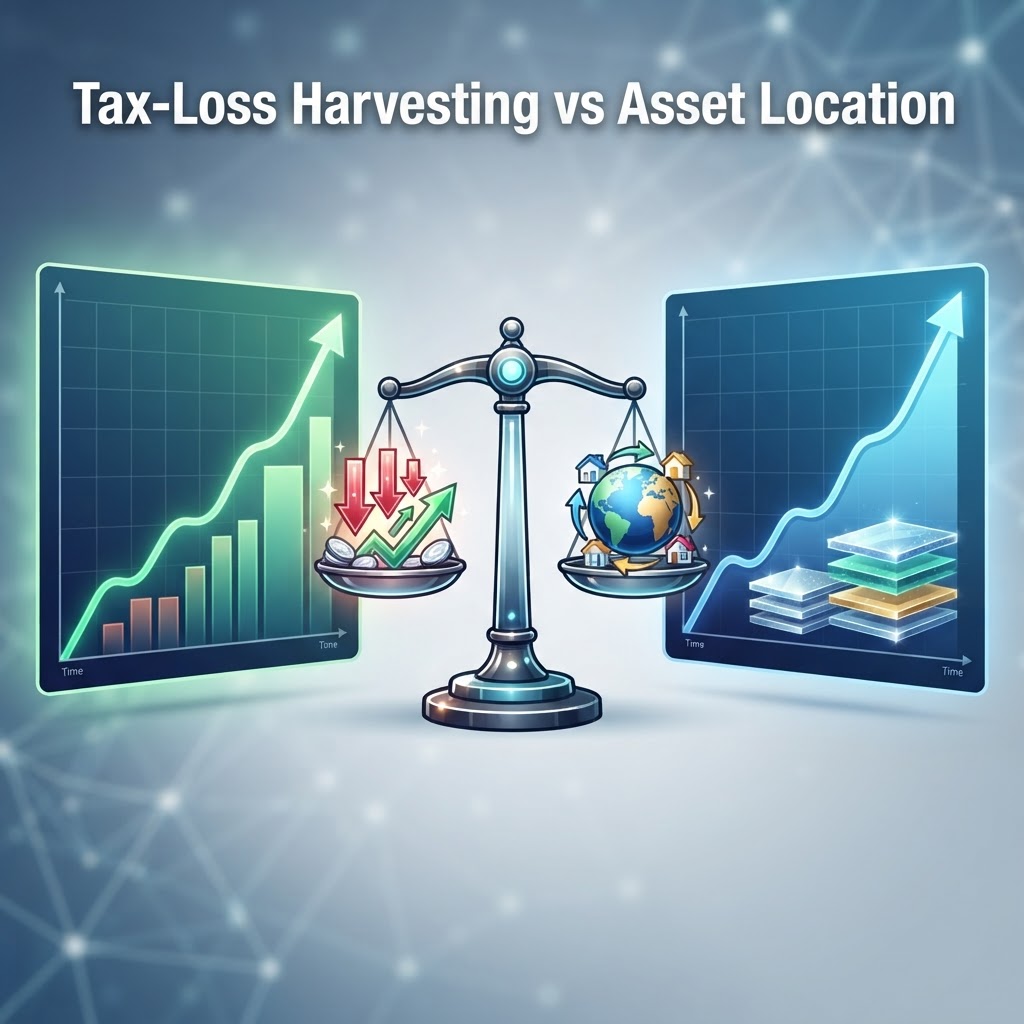
    Tax-loss harvesting in taxable accounts — selling investments that have declined in value to realise losses that offset capital gains — reduces current tax liability while maintaining market exposure through replacement with similar (but not identical) investments. Done systematically, tax-loss harvesting can improve after-tax returns by 0.5-1.5% annually without any change to investment risk or expected returns. Robo-advisors and some brokerage platforms offer automated tax-loss harvesting; alternatively, it can be done manually with attention to the wash-sale rules that prohibit repurchasing substantially identical securities within 30 days of a loss sale.

    Asset location — placing different types of investments in accounts based on their tax efficiency — further optimises after-tax returns. Tax-inefficient assets (bonds, REITs, actively managed funds with high turnover) belong in tax-advantaged accounts where their income is sheltered from annual taxation. Tax-efficient assets (broadly diversified equity index funds, growth stocks held long-term) are better suited to taxable accounts where they generate minimal taxable income and benefit from lower long-term capital gains rates when eventually sold. Proper asset location can add meaningfully to after-tax wealth without changing your overall investment strategy or risk profile.

    Protecting Your Wealth: Insurance and Estate Planning

    Wealth protection is as important as wealth building — perhaps more so, because the same consistent effort that builds wealth over decades can be undermined in a moment by an uninsured catastrophic event. Adequate insurance coverage — life, disability, liability, property, and potentially long-term care — creates the financial safety net that allows wealth building to continue uninterrupted through the inevitable adverse events that life produces.

    Disability insurance is chronically undervalued relative to its importance. The probability of a working-age adult experiencing a disability lasting 90 days or more before retirement is approximately 25-30% — far higher than the probability of premature death that drives most people’s life insurance purchases. A disability that eliminates or dramatically reduces your income for months or years has potentially more severe long-term financial consequences than death (which at least triggers life insurance), yet most people have no individual disability coverage beyond whatever their employer provides. Individual disability policies covering 60-70% of income with own-occupation definitions (paying if you cannot perform your specific occupation, not just any work) provide the most valuable income protection available.

    Estate planning — wills, beneficiary designations, powers of attorney, healthcare directives — is not just for the wealthy. Without a will, your assets pass according to state intestacy laws that may not reflect your wishes. Without beneficiary designations on retirement accounts and life insurance (which pass outside the probate estate regardless of your will), these assets may go to unintended recipients. Without a durable power of attorney and healthcare directive, your family may lack the legal authority to manage your affairs if you become incapacitated. These documents cost relatively little to prepare but provide enormous value at moments of maximum vulnerability. Every adult with any assets or dependents should have them.

    Frequently Asked Questions About Personal Finance

    How much should I have in an emergency fund? Three to six months of essential living expenses in a readily accessible, FDIC-insured high-yield savings account. Self-employed individuals, those with variable income, or households with a single income earner should target the higher end of this range. The emergency fund is not an investment — its purpose is stability and accessibility, not return.

    Should I pay off debt or invest? Generally: always capture your employer 401(k) match first (it is a guaranteed return that beats any debt payoff). Then eliminate high-interest debt (above ~6-7%). Then invest. For debt below 6-7% interest rate, the mathematical case for investing rather than accelerating payoff is solid, though the psychological value of being debt-free is real and legitimate for many people.

    How do I start investing if I have very little money? Start with whatever you can consistently invest, however small. Many brokerages now offer fractional shares and no-minimum accounts. Even $50 per month invested consistently in a diversified low-cost index fund is a meaningful start — both for the wealth it builds over time and for establishing the habit of consistent investing that becomes the foundation of financial independence.

    What is the best investment for beginners? A target-date retirement fund or a three-fund portfolio (total US market index fund, total international index fund, total bond market index fund) in your employer 401(k) or IRA provides instant diversification, professional rebalancing, and very low costs. These straightforward approaches outperform the vast majority of active strategies over long time horizons and require minimal investment knowledge or ongoing attention to implement effectively.

    This article provides general financial information for educational purposes. Financial circumstances vary significantly by individual. Always consult a qualified financial advisor for guidance specific to your situation.

    Financial independence is not reserved for the wealthy or the lucky — it is built systematically by ordinary people who make consistently good financial decisions over long periods of time. The principles that drive this outcome are not complicated. Spend less than you earn. Invest the difference early and consistently in diversified low-cost assets. Minimise fees, taxes, and financial mistakes. Protect what you build with appropriate insurance and estate planning. Review and adjust regularly as your circumstances evolve.

    These principles, applied consistently over 20-30 years of working life, produce financial outcomes that seem remarkable from the outside but are entirely predictable from the inside. The person who saves and invests 15-20% of income from their mid-20s through their 60s, maintains a diversified low-cost portfolio through market cycles without panic selling, minimises lifestyle inflation, and uses tax-advantaged accounts efficiently will almost certainly achieve financial independence — regardless of their income level, their investment genius, or their market timing.

    Start now. Whatever your current financial situation, the next best time to begin making better financial decisions is today. Open that investment account, increase your savings rate by 1%, eliminate that high-interest debt, review your insurance coverage, write that will. Each action is small on its own and transformative in aggregate. Your financial future is built one consistent decision at a time — starting with the decision you make right now.

    Wealth is not built overnight, but it is built reliably by those who commit to sound financial principles and apply them consistently. Every dollar saved today is an investment in your future freedom. Every debt eliminated reduces the friction slowing your progress. Every wise investment decision compounds quietly in the background, building toward the financial independence that makes every other life goal more achievable. The path is clear. The tools are available. The only ingredient you need to supply is consistent, patient action — starting today and continuing for as long as it takes to reach the financial life you are building toward.

    Your Financial Future Starts Now

    The gap between where you are financially and where you want to be is bridged by one thing: consistent, informed action taken over time. Not perfect action. Not genius-level investment decisions. Not exceptional income. Just consistent, patient application of the principles that have proven to build wealth reliably across generations, economic cycles, and wildly different individual circumstances.

    Automate your savings so the decision is made once and executed automatically every month. Build your emergency fund so that unexpected expenses do not derail your investment plan. Eliminate high-interest debt systematically so that compound interest works for you rather than against you. Invest consistently in diversified, low-cost index funds so that market growth accumulates in your portfolio over decades. Maximise tax-advantaged accounts so that you keep the maximum share of your investment returns. Protect what you build with appropriate insurance and estate planning so that a single adverse event cannot undo years of careful work.

    These steps are not glamorous. They will not make headlines or generate dinner party conversation. But they work — reliably, predictably, for anyone who applies them with patience and discipline. The evidence from millions of households over decades is unambiguous: the path to financial independence is straightforward, even if it is not always easy.

    Review your financial situation quarterly. Adjust your plan when circumstances change. Celebrate genuine progress, however modest it seems in the moment. And remember that every financial decision you make today is an investment in the freedom, security, and opportunity that your future self will either have or wish you had built. Make those decisions count. Your financial future is being built right now, one consistent choice at a time.

    This article provides general financial information for educational purposes only. Individual financial circumstances vary significantly. Always consult a qualified financial advisor for personalised guidance tailored to your specific situation and goals.

    Making It Happen: Practical Next Steps

    Knowledge without action produces no results. The most important financial decision you will make today is not which investment to choose or which account to open — it is the decision to act rather than continue planning. Imperfect action taken now beats perfect planning that never gets implemented. Open the account, make the first contribution, set up the automatic transfer, call the insurance broker, schedule the appointment with the financial advisor. Whatever the next concrete step is for your situation, take it today.

    Financial progress is self-reinforcing. The first months of consistent saving and investing feel slow and the amounts feel insignificant. But each month builds on the last, the habit strengthens, and the motivation grows as you begin to see your net worth increasing and your goals getting closer. This is the psychological momentum that sustains long-term financial discipline — not heroic willpower but the reinforcing feedback of visible progress toward goals that genuinely matter to you.

    Track your net worth monthly — assets minus liabilities — as your primary financial health metric. Watching this number grow, even slowly at first, is one of the most motivating financial practices available. Free tools make this easier than ever. Set an annual date to review your complete financial picture: income, spending, savings rate, investment performance, insurance coverage, estate planning documents, and progress toward your major financial goals. That annual review, taken seriously, is worth more than any investment tip or financial trick you will ever encounter.

    Build the life you want by building the financial foundation it requires. The strategies in this article give you a clear, evidence-based path. The rest is up to you — and you are more capable of walking it than you probably realise. Start today. Keep going tomorrow. Let the years do their work.

  • How to Invest in the Stock Market for Complete Beginners 2026

    How to Invest in the Stock Market for Complete Beginners 2026

    🏷️ Investing

    How to invest in stock market beginners

    ⭐ Key Takeaways

    • ✅ You can start investing with $1 — there’s no minimum at Fidelity, Schwab, or Vanguard
    • ✅ The stock market has never delivered a negative 20-year return in US history
    • ✅ Dollar-cost averaging (investing fixed amounts regularly) beats trying to time the market
    • ✅ Your 401k and IRA are investing accounts — you control what they invest in
    • ✅ The biggest investing mistake is waiting for the ‘perfect’ time — time in market beats timing

    How to Start in 5 Steps

    Step 1: Open a brokerage account

    Fidelity, Schwab, and Vanguard are all excellent — free accounts, no minimums, no fees.

    Step 2: Start with your retirement accounts

    401k (employer) and Roth IRA (individual) first — tax advantages are enormous.

    Step 3: Choose your first investment

    A single total market ETF (FZROX, VTI, SCHB) gives instant diversification across 3,000+ companies.

    Step 4: Set up automatic investing

    Weekly or monthly auto-invest removes emotion from the process. Set it and let compound interest work.

    Step 5: Don’t check daily

    Long-term investors who check portfolios less frequently make better decisions. Set quarterly reviews.

    Beginner Portfolio Options

    Option Holdings Best For
    One-fund: VT Total world stocks Simplest possible portfolio
    Two-fund: FZROX + FZILX US + international Slight control over allocation
    Three-fund: Stocks+Intl+Bonds Stocks + bonds Adding stability near retirement
    Target date fund Automatic age-based mix Hands-off investors

    ❓ Frequently Asked Questions

    ❓ How much money do I need to start?

    $0 at Fidelity (ZERO funds) or $1 at Schwab (fractional shares of any ETF). There is no minimum required to begin.

    ❓ Is the stock market risky?

    Short-term: yes — markets can drop 20-40% in downturns. Long-term: very low risk. The S&P 500 has never delivered a negative return over any 20-year period in history.

    our editorial team

    Personal Finance Content Researchers

    Our team researches personal finance topics using publicly available data to help you make informed financial decisions.

    ⚠️ Disclaimer: Educational purposes only. Not professional financial, tax, or investment advice. All investing involves risk. Consult a qualified financial professional before making decisions.

    Building Real Wealth: Evidence-Based Financial Strategies

    Wealth building is not complicated, but it is demanding. It requires consistent behaviour over long periods of time, discipline during market downturns and lifestyle inflation pressure, and a clear understanding of the fundamental principles that separate households that build lasting wealth from those that earn well but arrive at retirement with little to show for it. The principles themselves are not secrets — they are widely known. The challenge is applying them consistently across decades of real life with its competing demands, temptations, and disruptions.

    The first principle is spending less than you earn — consistently, not occasionally. This sounds obvious but runs counter to powerful cultural forces that normalise lifestyle expansion proportional to income growth. Every raise, bonus, and windfall represents an opportunity either to accelerate wealth building or to inflate lifestyle. Households that consistently direct a meaningful portion of income increases to savings and investment rather than consumption build wealth at rates that surprise even financially sophisticated observers when compounded over 20-30 years.

    The second principle is investing early and consistently. The mathematics of compound growth reward early investors with an advantage that later savers cannot overcome through higher savings rates alone. A 25-year-old who invests $500 per month until age 65 at a 7% annual return accumulates approximately $1.3 million. A 35-year-old making the same monthly investment accumulates approximately $600,000 — less than half, despite investing for only 10 fewer years. Time in the market is the most powerful wealth-building variable available, and every year of delay is extremely costly in terminal wealth terms.

    The third principle is minimising fees, taxes, and financial mistakes. Every percentage point of annual fees reduces terminal wealth by approximately 20-25% over a 30-year investment horizon. Tax-advantaged accounts (401k, IRA, Roth IRA, HSA) provide legally guaranteed returns in the form of tax savings that no market investment can match. Avoiding common financial mistakes — panic selling during market downturns, chasing recent performance, taking on consumer debt for depreciating purchases, cashing out retirement accounts early — protects the wealth that good habits create. The wealth destroyed by financial mistakes often exceeds the wealth created by investment returns for households that have not developed financial discipline.

    Investment Fundamentals: What Every Investor Needs to Know

    The investment landscape is complex and intimidating to many people, but the core principles that drive long-term investment success are straightforward. Diversification — spreading investment across multiple asset classes, geographies, and securities — reduces risk without proportionally reducing expected return. A globally diversified portfolio of low-cost index funds captures essentially all available market returns while eliminating the company-specific and sector-specific risks that concentrate in undiversified portfolios.

    Asset allocation — the division of your portfolio between stocks, bonds, and other asset classes — is the most important investment decision you will make, responsible for the majority of long-term portfolio performance variation. Your optimal asset allocation depends on your time horizon, risk tolerance, and specific financial goals. Generally, longer time horizons and higher risk tolerance support higher equity allocations (which provide higher expected returns but greater short-term volatility), while shorter time horizons and lower risk tolerance support more conservative allocations with greater bond and cash components.

    Rebalancing — periodically returning your portfolio to its target allocation as market movements cause drift — is a mechanical discipline that forces you to buy assets that have become relatively cheaper (underperformed recently) and sell assets that have become relatively more expensive (outperformed recently). Annual or semi-annual rebalancing, or threshold-based rebalancing when allocations drift more than 5-10 percentage points from targets, maintains your intended risk profile and can modestly improve long-term returns through the systematic buy-low-sell-high discipline it enforces.

    Market timing — attempting to predict short-term market movements to buy before rises and sell before falls — is one of the most thoroughly debunked strategies in investment research. Decades of academic and practitioner research consistently show that active market timing destroys rather than creates value for virtually all investors, including professional fund managers. The investors who achieve the best long-term outcomes are those who maintain their target allocation consistently through market cycles rather than reacting emotionally to short-term price movements.

    Dollar-cost averaging — investing a fixed amount at regular intervals regardless of market conditions — is both a practical discipline for regular investors and a psychological strategy that reduces the paralysing anxiety of “is now a good time to invest?” by making the answer irrelevant. Investing $500 every month regardless of market conditions produces better long-term outcomes for most investors than attempting to time optimal entry points, primarily because it ensures that investing happens consistently rather than being perpetually delayed waiting for better conditions that may never arrive.

    Debt Management: A Strategic Framework

    Not all debt is created equal. Debt that finances appreciating assets or generates income (mortgages on well-located properties, business loans with positive ROI, student loans for high-earning careers) is categorically different from debt that finances consumption (credit cards, personal loans, car loans for vehicles beyond your means). Conflating these categories leads to either excessive debt aversion that forgoes valuable leverage or insufficient debt concern that allows high-cost consumer debt to compound into a serious financial drag.

    High-interest consumer debt — credit cards typically charging 18-25% APR — is the most financially destructive force in personal finance. At 20% APR, a $10,000 balance doubles to $20,000 in less than four years without additional borrowing. Eliminating high-interest debt is the highest guaranteed return available — paying off a 20% credit card balance is equivalent to earning a guaranteed 20% return on that amount. No investment consistently matches this return, making debt elimination the highest-priority use of available cash flow for anyone carrying significant high-interest balances.

    The debt avalanche method — targeting the highest-interest debt first regardless of balance size — minimises total interest paid and is mathematically optimal. The debt snowball method — targeting the smallest balance first regardless of interest rate — pays more total interest but provides quicker psychological wins that improve motivation and adherence for some people. Both are effective strategies for debt elimination; choose the one you will actually stick with. The worst approach is paying minimum balances on everything while making no systematic progress on elimination.

    Mortgage debt requires a more nuanced analysis. Mortgages at current rates may be worth accelerating payoff if the emotional value of being debt-free is significant, if you are near retirement and want to eliminate the largest fixed expense before income drops, or if the mortgage rate exceeds the expected after-tax return on alternative investments. At historically low mortgage rates, however, the mathematical case for prioritising mortgage payoff over investment is weak — the expected return of a diversified investment portfolio typically exceeds the after-tax cost of a low-rate mortgage over long horizons. This is an individual decision that depends on your specific interest rate, tax situation, risk tolerance, and values.

    Retirement Planning: Building the Income You Will Need

    Retirement planning requires answering three fundamental questions: How much will I need? How much will I have? And how do I bridge any gap? The answers to all three are uncertain, but developing reasonable estimates based on current data is essential for knowing whether you are on track and what adjustments are needed.

    Estimating retirement income needs starts with your current expenses adjusted for anticipated retirement lifestyle changes. Expenses that decrease in retirement include work-related costs (commuting, professional clothing, eating out near work), mortgage payments (if paid off), and potentially income taxes (if retirement income is lower than working income). Expenses that may increase include healthcare (the single largest wildcard in retirement planning), leisure and travel, and potentially housing modifications for aging in place. A widely used starting estimate is 70-80% of pre-retirement income, but this varies significantly by individual — some people spend more in retirement than during their working years if travel and activities increase.

    The 4% rule — withdrawing 4% of your portfolio in the first year of retirement and adjusting for inflation annually — is a widely cited guideline suggesting that a portfolio can sustain 30 years of withdrawals at this rate with high probability. It implies that to fund $60,000 of annual retirement spending, you need approximately $1.5 million in investable assets. This is a planning heuristic, not a guarantee — sequence of returns risk (experiencing poor market returns early in retirement) can significantly affect outcomes, and lower expected future returns than the historical period underlying the 4% rule may warrant a more conservative withdrawal rate.

    Social Security optimisation is one of the highest-value retirement planning decisions available. Claiming at 62 (the earliest eligibility) versus 70 (when benefits max out) results in approximately a 76% difference in monthly benefit — benefits increase by approximately 6-8% for each year of delay between 62 and 70. For people in good health with reasonable life expectancy, delaying Social Security as long as possible while drawing down investable assets is often the mathematically superior strategy, effectively purchasing longevity insurance at favourable rates.

    Key Takeaways and Your Financial Action Plan

    Financial security is built through consistent application of proven principles over time — not through exceptional investment picks, market timing, or financial complexity. The households that achieve genuine wealth independence are those that automate saving, invest consistently in diversified low-cost portfolios, manage debt strategically, protect their assets with appropriate insurance, and review their financial plan regularly to ensure it remains aligned with their evolving goals and circumstances.

    Start where you are. If you have no emergency fund, build one first — three to six months of expenses in a high-yield savings account, insulating you from the financial shocks that derail long-term wealth building plans. If you have high-interest debt, eliminate it systematically. If you are not maximising your employer 401(k) match, do it immediately — the match is a 50-100% guaranteed return on that contribution that no other investment can match. Then work progressively toward maximising tax-advantaged accounts, building taxable investments, and protecting what you build with appropriate insurance and estate planning.

    The financial decisions you make in the next year will compound for decades. Every dollar saved and invested wisely today will be worth many times that amount at retirement. Every dollar of high-interest debt eliminated today saves multiple dollars of future interest. The mathematics are unambiguous and in your favour — if you act consistently and patiently. Build the habits, automate the behaviours, and let time do what it does best: compound your progress into a financial future that reflects the decisions you are making right now.

    This article provides general financial information for educational purposes only. Individual circumstances vary significantly. Always consult a qualified financial advisor for personalised guidance tailored to your specific financial situation and goals.

    Tax Strategy: Keeping More of What You Earn

    Tax optimisation is one of the highest-return financial activities available to households at virtually every income level. The difference between a tax-aware and a tax-unaware investor of similar income can compound to hundreds of thousands of dollars over a working lifetime. This is not about tax avoidance schemes or aggressive strategies that invite scrutiny — it is about fully utilising the tax-advantaged structures that the tax code explicitly provides and making investment decisions that minimise unnecessary tax drag on your wealth building.

    The hierarchy of tax-advantaged savings — the order in which to direct investment dollars for maximum tax efficiency — starts with employer 401(k) contributions up to the employer match (free money, 50-100% instant return), then HSA contributions if enrolled in a qualifying health plan (triple tax advantage: deductible contributions, tax-free growth, tax-free withdrawals for medical expenses), then maximum Roth IRA contributions if income-eligible (tax-free growth and withdrawals, no required minimum distributions), then maximum 401(k) contributions up to the annual limit, and finally taxable investment accounts for any additional savings capacity.

    Tax-loss harvesting in taxable accounts — selling investments that have declined in value to realise losses that offset capital gains — reduces current tax liability while maintaining market exposure through replacement with similar (but not identical) investments. Done systematically, tax-loss harvesting can improve after-tax returns by 0.5-1.5% annually without any change to investment risk or expected returns. Robo-advisors and some brokerage platforms offer automated tax-loss harvesting; alternatively, it can be done manually with attention to the wash-sale rules that prohibit repurchasing substantially identical securities within 30 days of a loss sale.

    Asset location — placing different types of investments in accounts based on their tax efficiency — further optimises after-tax returns. Tax-inefficient assets (bonds, REITs, actively managed funds with high turnover) belong in tax-advantaged accounts where their income is sheltered from annual taxation. Tax-efficient assets (broadly diversified equity index funds, growth stocks held long-term) are better suited to taxable accounts where they generate minimal taxable income and benefit from lower long-term capital gains rates when eventually sold. Proper asset location can add meaningfully to after-tax wealth without changing your overall investment strategy or risk profile.

    Protecting Your Wealth: Insurance and Estate Planning

    Wealth protection is as important as wealth building — perhaps more so, because the same consistent effort that builds wealth over decades can be undermined in a moment by an uninsured catastrophic event. Adequate insurance coverage — life, disability, liability, property, and potentially long-term care — creates the financial safety net that allows wealth building to continue uninterrupted through the inevitable adverse events that life produces.

    Disability insurance is chronically undervalued relative to its importance. The probability of a working-age adult experiencing a disability lasting 90 days or more before retirement is approximately 25-30% — far higher than the probability of premature death that drives most people’s life insurance purchases. A disability that eliminates or dramatically reduces your income for months or years has potentially more severe long-term financial consequences than death (which at least triggers life insurance), yet most people have no individual disability coverage beyond whatever their employer provides. Individual disability policies covering 60-70% of income with own-occupation definitions (paying if you cannot perform your specific occupation, not just any work) provide the most valuable income protection available.

    Estate planning — wills, beneficiary designations, powers of attorney, healthcare directives — is not just for the wealthy. Without a will, your assets pass according to state intestacy laws that may not reflect your wishes. Without beneficiary designations on retirement accounts and life insurance (which pass outside the probate estate regardless of your will), these assets may go to unintended recipients. Without a durable power of attorney and healthcare directive, your family may lack the legal authority to manage your affairs if you become incapacitated. These documents cost relatively little to prepare but provide enormous value at moments of maximum vulnerability. Every adult with any assets or dependents should have them.

    Frequently Asked Questions About Personal Finance

    How much should I have in an emergency fund? Three to six months of essential living expenses in a readily accessible, FDIC-insured high-yield savings account. Self-employed individuals, those with variable income, or households with a single income earner should target the higher end of this range. The emergency fund is not an investment — its purpose is stability and accessibility, not return.

    Should I pay off debt or invest? Generally: always capture your employer 401(k) match first (it is a guaranteed return that beats any debt payoff). Then eliminate high-interest debt (above ~6-7%). Then invest. For debt below 6-7% interest rate, the mathematical case for investing rather than accelerating payoff is solid, though the psychological value of being debt-free is real and legitimate for many people.

    How do I start investing if I have very little money? Start with whatever you can consistently invest, however small. Many brokerages now offer fractional shares and no-minimum accounts. Even $50 per month invested consistently in a diversified low-cost index fund is a meaningful start — both for the wealth it builds over time and for establishing the habit of consistent investing that becomes the foundation of financial independence.

    What is the best investment for beginners? A target-date retirement fund or a three-fund portfolio (total US market index fund, total international index fund, total bond market index fund) in your employer 401(k) or IRA provides instant diversification, professional rebalancing, and very low costs. These straightforward approaches outperform the vast majority of active strategies over long time horizons and require minimal investment knowledge or ongoing attention to implement effectively.

    This article provides general financial information for educational purposes. Financial circumstances vary significantly by individual. Always consult a qualified financial advisor for guidance specific to your situation.

    Financial independence is not reserved for the wealthy or the lucky — it is built systematically by ordinary people who make consistently good financial decisions over long periods of time. The principles that drive this outcome are not complicated. Spend less than you earn. Invest the difference early and consistently in diversified low-cost assets. Minimise fees, taxes, and financial mistakes. Protect what you build with appropriate insurance and estate planning. Review and adjust regularly as your circumstances evolve.

    These principles, applied consistently over 20-30 years of working life, produce financial outcomes that seem remarkable from the outside but are entirely predictable from the inside. The person who saves and invests 15-20% of income from their mid-20s through their 60s, maintains a diversified low-cost portfolio through market cycles without panic selling, minimises lifestyle inflation, and uses tax-advantaged accounts efficiently will almost certainly achieve financial independence — regardless of their income level, their investment genius, or their market timing.

    Start now. Whatever your current financial situation, the next best time to begin making better financial decisions is today. Open that investment account, increase your savings rate by 1%, eliminate that high-interest debt, review your insurance coverage, write that will. Each action is small on its own and transformative in aggregate. Your financial future is built one consistent decision at a time — starting with the decision you make right now.

    Wealth is not built overnight, but it is built reliably by those who commit to sound financial principles and apply them consistently. Every dollar saved today is an investment in your future freedom. Every debt eliminated reduces the friction slowing your progress. Every wise investment decision compounds quietly in the background, building toward the financial independence that makes every other life goal more achievable. The path is clear. The tools are available. The only ingredient you need to supply is consistent, patient action — starting today and continuing for as long as it takes to reach the financial life you are building toward.

    Your Financial Future Starts Now

    The gap between where you are financially and where you want to be is bridged by one thing: consistent, informed action taken over time. Not perfect action. Not genius-level investment decisions. Not exceptional income. Just consistent, patient application of the principles that have proven to build wealth reliably across generations, economic cycles, and wildly different individual circumstances.

    Automate your savings so the decision is made once and executed automatically every month. Build your emergency fund so that unexpected expenses do not derail your investment plan. Eliminate high-interest debt systematically so that compound interest works for you rather than against you. Invest consistently in diversified, low-cost index funds so that market growth accumulates in your portfolio over decades. Maximise tax-advantaged accounts so that you keep the maximum share of your investment returns. Protect what you build with appropriate insurance and estate planning so that a single adverse event cannot undo years of careful work.

    These steps are not glamorous. They will not make headlines or generate dinner party conversation. But they work — reliably, predictably, for anyone who applies them with patience and discipline. The evidence from millions of households over decades is unambiguous: the path to financial independence is straightforward, even if it is not always easy.

    Review your financial situation quarterly. Adjust your plan when circumstances change. Celebrate genuine progress, however modest it seems in the moment. And remember that every financial decision you make today is an investment in the freedom, security, and opportunity that your future self will either have or wish you had built. Make those decisions count. Your financial future is being built right now, one consistent choice at a time.

    This article provides general financial information for educational purposes only. Individual financial circumstances vary significantly. Always consult a qualified financial advisor for personalised guidance tailored to your specific situation and goals.

    Making It Happen: Practical Next Steps

    Knowledge without action produces no results. The most important financial decision you will make today is not which investment to choose or which account to open — it is the decision to act rather than continue planning. Imperfect action taken now beats perfect planning that never gets implemented. Open the account, make the first contribution, set up the automatic transfer, call the insurance broker, schedule the appointment with the financial advisor. Whatever the next concrete step is for your situation, take it today.

    Financial progress is self-reinforcing. The first months of consistent saving and investing feel slow and the amounts feel insignificant. But each month builds on the last, the habit strengthens, and the motivation grows as you begin to see your net worth increasing and your goals getting closer. This is the psychological momentum that sustains long-term financial discipline — not heroic willpower but the reinforcing feedback of visible progress toward goals that genuinely matter to you.

    Track your net worth monthly — assets minus liabilities — as your primary financial health metric. Watching this number grow, even slowly at first, is one of the most motivating financial practices available. Free tools make this easier than ever. Set an annual date to review your complete financial picture: income, spending, savings rate, investment performance, insurance coverage, estate planning documents, and progress toward your major financial goals. That annual review, taken seriously, is worth more than any investment tip or financial trick you will ever encounter.

    Build the life you want by building the financial foundation it requires. The strategies in this article give you a clear, evidence-based path. The rest is up to you — and you are more capable of walking it than you probably realise. Start today. Keep going tomorrow. Let the years do their work.

  • How to Create Multiple Income Streams and Reduce Financial Risk

    How to Create Multiple Income Streams and Reduce Financial Risk

    How to Create Multiple Income Streams: Build Wealth Faster & Reduce Risk

    Relying on a single paycheck is risky. Job loss, layoffs, industry downturns — one income stream can dry up overnight. Creating multiple income streams isn’t just for entrepreneurs. It’s a practical wealth-building strategy for anyone who wants financial security and accelerated savings.

    This guide shows you 7 income streams you can start with limited capital and knowledge, plus how to stack them for real impact.

    Why Multiple Income Streams Matter

    Security: If one income dries up, others keep flowing.

    Speed: Save $10k/year from your job? Add a side gig earning $500/month = $16k/year saved (60% faster progress).

    Wealth building: Multiple streams = compound growth on multiple fronts.

    7 Income Streams You Can Start Today

    1. Freelancing (Your Skills)

    • What: Offer services (writing, design, coding, virtual assistance) on platforms like Upwork, Fiverr, or directly to clients.
    • Time to first earnings: 1–2 weeks
    • Realistic earnings: $500–$5,000/month (depends on skill level)
    • Startup cost: $0 (free to sign up on platforms)
    • Best for: Anyone with a marketable skill

    2. Affiliate Marketing (Passive-ish)

    • What: Write reviews or blog posts about products, include affiliate links, earn commission when people buy.
    • Time to first earnings: 2–6 months (needs traffic)
    • Realistic earnings: $50–$1,000+/month (scales with audience)
    • Startup cost: $12–$50 (domain + hosting)
    • Best for: Writers, content creators, or those willing to build an audience

    3. Online Courses / Ebooks (Passive after creation)

    • What: Create a course teaching a skill (Udemy, Teachable) or write an ebook (Amazon KDP).
    • Time to first earnings: 1–3 months (for basic course/ebook)
    • Realistic earnings: $100–$5,000+/month
    • Startup cost: $0–$500 (depends on platform)
    • Best for: Experts in a niche, teachers, coaches

    4. Gig Work (Delivery, Rideshare, Tasks)

    • What: Drive for Uber/Lyft, deliver for DoorDash/Instacart, complete tasks on TaskRabbit.
    • Time to first earnings: 1–2 weeks (after approval)
    • Realistic earnings: $300–$2,000/month (depends on hours)
    • Startup cost: $0–$1,000 (vehicle-dependent)
    • Best for: Those with time to spare and a vehicle (optional for some tasks)

    5. Selling Digital Products (Passive)

    • What: Create and sell templates, graphics, music, fonts, or designs on Etsy, Gumroad, Creative Market.
    • Time to first earnings: 2–4 weeks (after setup)
    • Realistic earnings: $100–$2,000+/month (scales with catalog)
    • Startup cost: $20–$100 (platform fees)
    • Best for: Designers, photographers, artists

    6. Dropshipping / Print-on-Demand (Low inventory)

    • What: Create an online store selling products you don’t hold inventory for (print-on-demand, dropshipping).
    • Time to first earnings: 1–2 months (after marketing effort)
    • Realistic earnings: $200–$3,000+/month (highly variable)
    • Startup cost: $100–$500 (platform setup + ads)
    • Best for: People willing to market and optimize

    7. Dividend Investing (Ultra-passive)

    • What: Invest in dividend-paying stocks or funds. Earnings are paid quarterly/annually.
    • Time to first earnings: Immediate (after purchase)
    • Realistic earnings: 3–5% annual yield on investment (~$300–$500/year on $10,000 invested)
    • Startup cost: Investment capital ($1,000+ to make it meaningful)
    • Best for: Long-term passive wealth builders

    The Income Stack Strategy

    Month 1–3: Start 1–2 income streams

    • Pick the easiest: Gig work or freelancing (quickest payoff)
    • Set a realistic target: $200–$300/month
    • Goal: Prove to yourself that extra income is possible

    Month 4–6: Add a second stream

    • Start building a passive stream: blog with affiliate links, or create a digital product
    • Keep gig work going ($200–$300/month)
    • New target: $100–$200/month from passive stream
    • Combined: $300–$500/month from side income

    Month 7–12: Let passive streams work, add dividend investing**

    • Gig work: $200–$300/month (automated habit)
    • Passive streams: Growing to $300–$500/month (requires less active work)
    • Invest $2,000–$5,000 in dividend stocks (generates $50–$250/year)
    • Combined: $500–$1,000+/month

    Year 2+: Scale or automate

    • Gig work: Reduce hours (you now have passive income)
    • Scale affiliate/course: Get 10x more traffic or create adjacent courses
    • Increase dividend portfolio: Reinvest passive income to compound growth
    • Combined: $1,500–$3,000+/month (many reach this in 12–24 months)

    How to Choose Your First Stream

    If You Have… Start With… Then Add…
    A skill (writing, design, coding) Freelancing Online course
    A vehicle Gig work (Uber/DoorDash) Affiliate blog
    Savings to invest Dividend stocks Reinvest dividends
    Spare time Gig work or freelancing Build affiliate site
    Creative talent Sell digital products (Etsy) Affiliate marketing

    Real Example: From $0 to $1,500/month

    January: Start freelancing

    • Sign up on Upwork, do small projects, earn $200/month

    March: Start a blog with affiliate links

    • Write 20 posts on a niche topic, grow to 500 visitors/month, earn $50/month in affiliate commissions
    • Total: $250/month

    June: Launch a simple ebook

    • Self-publish on Amazon KDP, price at $9.99, sell 30 copies = $150/month
    • Total: $400/month

    September: Start gig work**

    • DoorDash 10 hours/week, earn $600/month
    • Total: $1,000/month

    December: Invest dividends

    • Take $3,000 from side income, invest in dividend ETF (3.5% yield = $105/year or $8.75/month)
    • Total: $1,008/month

    Year 2: Scale freelancing + reinvest

    • Raise freelance rates (now $300/month), reduce hours (5 hrs/week instead of 10)
    • Blog grows to 2,000 visitors, affiliate income $200/month
    • Ebook now earns $250/month (30 copies)
    • DoorDash $600/month
    • Dividend portfolio: $200/month reinvested, compounds to $15k by end of year
    • Total: $1,450/month (year 2) + $15k growing in dividends

    Common Mistakes

    1. Starting too many streams at once
    Burnout by month 3. Start 1, master it, then add the next.

    2. Not reinvesting income**
    Earn $500/month, spend all $500. Instead, reinvest $250 to scale faster.

    3. Ignoring taxes**
    Side income is taxable. Set aside 25–30% for taxes, or you’ll owe a big bill in April.

    4. Waiting for perfection**
    Your first freelance project won’t be perfect. Your blog won’t have 10k visitors day 1. Start anyway.

    FAQ

    Q: Can I really make $1,000/month in side income?
    A: Yes. Many people make $2,000+/month with 2–3 stacked income streams working 10–20 hrs/week.

    Q: What’s the fastest income stream to start?
    A: Gig work (Uber, DoorDash) or freelancing. You can have money in 1–2 weeks.

    Q: Do I need a business license?
    A: Check your local laws. Most gig work and freelancing don’t require it. If you start an LLC or S-corp, yes.

    The Bottom Line

    Multiple income streams aren’t a luxury — they’re a buffer against job loss and a speedway to wealth. Start with one stream (freelance or gig work), add a second in 3 months (passive), and let compound growth do the heavy lifting. By year 2, you’ll have $1,000+/month in side income with much less active work.

    Start today. Pick stream #1. Commit to 30 days.

    Building Real Wealth: Evidence-Based Financial Strategies

    Wealth building is not complicated, but it is demanding. It requires consistent behaviour over long periods of time, discipline during market downturns and lifestyle inflation pressure, and a clear understanding of the fundamental principles that separate households that build lasting wealth from those that earn well but arrive at retirement with little to show for it. The principles themselves are not secrets — they are widely known. The challenge is applying them consistently across decades of real life with its competing demands, temptations, and disruptions.

    The first principle is spending less than you earn — consistently, not occasionally. This sounds obvious but runs counter to powerful cultural forces that normalise lifestyle expansion proportional to income growth. Every raise, bonus, and windfall represents an opportunity either to accelerate wealth building or to inflate lifestyle. Households that consistently direct a meaningful portion of income increases to savings and investment rather than consumption build wealth at rates that surprise even financially sophisticated observers when compounded over 20-30 years.

    The second principle is investing early and consistently. The mathematics of compound growth reward early investors with an advantage that later savers cannot overcome through higher savings rates alone. A 25-year-old who invests $500 per month until age 65 at a 7% annual return accumulates approximately $1.3 million. A 35-year-old making the same monthly investment accumulates approximately $600,000 — less than half, despite investing for only 10 fewer years. Time in the market is the most powerful wealth-building variable available, and every year of delay is extremely costly in terminal wealth terms.

    The third principle is minimising fees, taxes, and financial mistakes. Every percentage point of annual fees reduces terminal wealth by approximately 20-25% over a 30-year investment horizon. Tax-advantaged accounts (401k, IRA, Roth IRA, HSA) provide legally guaranteed returns in the form of tax savings that no market investment can match. Avoiding common financial mistakes — panic selling during market downturns, chasing recent performance, taking on consumer debt for depreciating purchases, cashing out retirement accounts early — protects the wealth that good habits create. The wealth destroyed by financial mistakes often exceeds the wealth created by investment returns for households that have not developed financial discipline.

    Investment Fundamentals: What Every Investor Needs to Know

    The investment landscape is complex and intimidating to many people, but the core principles that drive long-term investment success are straightforward. Diversification — spreading investment across multiple asset classes, geographies, and securities — reduces risk without proportionally reducing expected return. A globally diversified portfolio of low-cost index funds captures essentially all available market returns while eliminating the company-specific and sector-specific risks that concentrate in undiversified portfolios.

    Asset allocation — the division of your portfolio between stocks, bonds, and other asset classes — is the most important investment decision you will make, responsible for the majority of long-term portfolio performance variation. Your optimal asset allocation depends on your time horizon, risk tolerance, and specific financial goals. Generally, longer time horizons and higher risk tolerance support higher equity allocations (which provide higher expected returns but greater short-term volatility), while shorter time horizons and lower risk tolerance support more conservative allocations with greater bond and cash components.

    Rebalancing — periodically returning your portfolio to its target allocation as market movements cause drift — is a mechanical discipline that forces you to buy assets that have become relatively cheaper (underperformed recently) and sell assets that have become relatively more expensive (outperformed recently). Annual or semi-annual rebalancing, or threshold-based rebalancing when allocations drift more than 5-10 percentage points from targets, maintains your intended risk profile and can modestly improve long-term returns through the systematic buy-low-sell-high discipline it enforces.

    Market timing — attempting to predict short-term market movements to buy before rises and sell before falls — is one of the most thoroughly debunked strategies in investment research. Decades of academic and practitioner research consistently show that active market timing destroys rather than creates value for virtually all investors, including professional fund managers. The investors who achieve the best long-term outcomes are those who maintain their target allocation consistently through market cycles rather than reacting emotionally to short-term price movements.

    Dollar-cost averaging — investing a fixed amount at regular intervals regardless of market conditions — is both a practical discipline for regular investors and a psychological strategy that reduces the paralysing anxiety of “is now a good time to invest?” by making the answer irrelevant. Investing $500 every month regardless of market conditions produces better long-term outcomes for most investors than attempting to time optimal entry points, primarily because it ensures that investing happens consistently rather than being perpetually delayed waiting for better conditions that may never arrive.

    Debt Management: A Strategic Framework

    Not all debt is created equal. Debt that finances appreciating assets or generates income (mortgages on well-located properties, business loans with positive ROI, student loans for high-earning careers) is categorically different from debt that finances consumption (credit cards, personal loans, car loans for vehicles beyond your means). Conflating these categories leads to either excessive debt aversion that forgoes valuable leverage or insufficient debt concern that allows high-cost consumer debt to compound into a serious financial drag.

    High-interest consumer debt — credit cards typically charging 18-25% APR — is the most financially destructive force in personal finance. At 20% APR, a $10,000 balance doubles to $20,000 in less than four years without additional borrowing. Eliminating high-interest debt is the highest guaranteed return available — paying off a 20% credit card balance is equivalent to earning a guaranteed 20% return on that amount. No investment consistently matches this return, making debt elimination the highest-priority use of available cash flow for anyone carrying significant high-interest balances.

    The debt avalanche method — targeting the highest-interest debt first regardless of balance size — minimises total interest paid and is mathematically optimal. The debt snowball method — targeting the smallest balance first regardless of interest rate — pays more total interest but provides quicker psychological wins that improve motivation and adherence for some people. Both are effective strategies for debt elimination; choose the one you will actually stick with. The worst approach is paying minimum balances on everything while making no systematic progress on elimination.

    Mortgage debt requires a more nuanced analysis. Mortgages at current rates may be worth accelerating payoff if the emotional value of being debt-free is significant, if you are near retirement and want to eliminate the largest fixed expense before income drops, or if the mortgage rate exceeds the expected after-tax return on alternative investments. At historically low mortgage rates, however, the mathematical case for prioritising mortgage payoff over investment is weak — the expected return of a diversified investment portfolio typically exceeds the after-tax cost of a low-rate mortgage over long horizons. This is an individual decision that depends on your specific interest rate, tax situation, risk tolerance, and values.

    Retirement Planning: Building the Income You Will Need

    Retirement planning requires answering three fundamental questions: How much will I need? How much will I have? And how do I bridge any gap? The answers to all three are uncertain, but developing reasonable estimates based on current data is essential for knowing whether you are on track and what adjustments are needed.

    Estimating retirement income needs starts with your current expenses adjusted for anticipated retirement lifestyle changes. Expenses that decrease in retirement include work-related costs (commuting, professional clothing, eating out near work), mortgage payments (if paid off), and potentially income taxes (if retirement income is lower than working income). Expenses that may increase include healthcare (the single largest wildcard in retirement planning), leisure and travel, and potentially housing modifications for aging in place. A widely used starting estimate is 70-80% of pre-retirement income, but this varies significantly by individual — some people spend more in retirement than during their working years if travel and activities increase.

    The 4% rule — withdrawing 4% of your portfolio in the first year of retirement and adjusting for inflation annually — is a widely cited guideline suggesting that a portfolio can sustain 30 years of withdrawals at this rate with high probability. It implies that to fund $60,000 of annual retirement spending, you need approximately $1.5 million in investable assets. This is a planning heuristic, not a guarantee — sequence of returns risk (experiencing poor market returns early in retirement) can significantly affect outcomes, and lower expected future returns than the historical period underlying the 4% rule may warrant a more conservative withdrawal rate.

    Social Security optimisation is one of the highest-value retirement planning decisions available. Claiming at 62 (the earliest eligibility) versus 70 (when benefits max out) results in approximately a 76% difference in monthly benefit — benefits increase by approximately 6-8% for each year of delay between 62 and 70. For people in good health with reasonable life expectancy, delaying Social Security as long as possible while drawing down investable assets is often the mathematically superior strategy, effectively purchasing longevity insurance at favourable rates.

    Key Takeaways and Your Financial Action Plan

    Financial security is built through consistent application of proven principles over time — not through exceptional investment picks, market timing, or financial complexity. The households that achieve genuine wealth independence are those that automate saving, invest consistently in diversified low-cost portfolios, manage debt strategically, protect their assets with appropriate insurance, and review their financial plan regularly to ensure it remains aligned with their evolving goals and circumstances.

    Start where you are. If you have no emergency fund, build one first — three to six months of expenses in a high-yield savings account, insulating you from the financial shocks that derail long-term wealth building plans. If you have high-interest debt, eliminate it systematically. If you are not maximising your employer 401(k) match, do it immediately — the match is a 50-100% guaranteed return on that contribution that no other investment can match. Then work progressively toward maximising tax-advantaged accounts, building taxable investments, and protecting what you build with appropriate insurance and estate planning.

    The financial decisions you make in the next year will compound for decades. Every dollar saved and invested wisely today will be worth many times that amount at retirement. Every dollar of high-interest debt eliminated today saves multiple dollars of future interest. The mathematics are unambiguous and in your favour — if you act consistently and patiently. Build the habits, automate the behaviours, and let time do what it does best: compound your progress into a financial future that reflects the decisions you are making right now.

    This article provides general financial information for educational purposes only. Individual circumstances vary significantly. Always consult a qualified financial advisor for personalised guidance tailored to your specific financial situation and goals.

    Tax Strategy: Keeping More of What You Earn

    Tax optimisation is one of the highest-return financial activities available to households at virtually every income level. The difference between a tax-aware and a tax-unaware investor of similar income can compound to hundreds of thousands of dollars over a working lifetime. This is not about tax avoidance schemes or aggressive strategies that invite scrutiny — it is about fully utilising the tax-advantaged structures that the tax code explicitly provides and making investment decisions that minimise unnecessary tax drag on your wealth building.

    The hierarchy of tax-advantaged savings — the order in which to direct investment dollars for maximum tax efficiency — starts with employer 401(k) contributions up to the employer match (free money, 50-100% instant return), then HSA contributions if enrolled in a qualifying health plan (triple tax advantage: deductible contributions, tax-free growth, tax-free withdrawals for medical expenses), then maximum Roth IRA contributions if income-eligible (tax-free growth and withdrawals, no required minimum distributions), then maximum 401(k) contributions up to the annual limit, and finally taxable investment accounts for any additional savings capacity.

    Tax-loss harvesting in taxable accounts — selling investments that have declined in value to realise losses that offset capital gains — reduces current tax liability while maintaining market exposure through replacement with similar (but not identical) investments. Done systematically, tax-loss harvesting can improve after-tax returns by 0.5-1.5% annually without any change to investment risk or expected returns. Robo-advisors and some brokerage platforms offer automated tax-loss harvesting; alternatively, it can be done manually with attention to the wash-sale rules that prohibit repurchasing substantially identical securities within 30 days of a loss sale.

    Asset location — placing different types of investments in accounts based on their tax efficiency — further optimises after-tax returns. Tax-inefficient assets (bonds, REITs, actively managed funds with high turnover) belong in tax-advantaged accounts where their income is sheltered from annual taxation. Tax-efficient assets (broadly diversified equity index funds, growth stocks held long-term) are better suited to taxable accounts where they generate minimal taxable income and benefit from lower long-term capital gains rates when eventually sold. Proper asset location can add meaningfully to after-tax wealth without changing your overall investment strategy or risk profile.

    Protecting Your Wealth: Insurance and Estate Planning

    Wealth protection is as important as wealth building — perhaps more so, because the same consistent effort that builds wealth over decades can be undermined in a moment by an uninsured catastrophic event. Adequate insurance coverage — life, disability, liability, property, and potentially long-term care — creates the financial safety net that allows wealth building to continue uninterrupted through the inevitable adverse events that life produces.

    Disability insurance is chronically undervalued relative to its importance. The probability of a working-age adult experiencing a disability lasting 90 days or more before retirement is approximately 25-30% — far higher than the probability of premature death that drives most people’s life insurance purchases. A disability that eliminates or dramatically reduces your income for months or years has potentially more severe long-term financial consequences than death (which at least triggers life insurance), yet most people have no individual disability coverage beyond whatever their employer provides. Individual disability policies covering 60-70% of income with own-occupation definitions (paying if you cannot perform your specific occupation, not just any work) provide the most valuable income protection available.

    Estate planning — wills, beneficiary designations, powers of attorney, healthcare directives — is not just for the wealthy. Without a will, your assets pass according to state intestacy laws that may not reflect your wishes. Without beneficiary designations on retirement accounts and life insurance (which pass outside the probate estate regardless of your will), these assets may go to unintended recipients. Without a durable power of attorney and healthcare directive, your family may lack the legal authority to manage your affairs if you become incapacitated. These documents cost relatively little to prepare but provide enormous value at moments of maximum vulnerability. Every adult with any assets or dependents should have them.

    Frequently Asked Questions About Personal Finance

    How much should I have in an emergency fund? Three to six months of essential living expenses in a readily accessible, FDIC-insured high-yield savings account. Self-employed individuals, those with variable income, or households with a single income earner should target the higher end of this range. The emergency fund is not an investment — its purpose is stability and accessibility, not return.

    Should I pay off debt or invest? Generally: always capture your employer 401(k) match first (it is a guaranteed return that beats any debt payoff). Then eliminate high-interest debt (above ~6-7%). Then invest. For debt below 6-7% interest rate, the mathematical case for investing rather than accelerating payoff is solid, though the psychological value of being debt-free is real and legitimate for many people.

    How do I start investing if I have very little money? Start with whatever you can consistently invest, however small. Many brokerages now offer fractional shares and no-minimum accounts. Even $50 per month invested consistently in a diversified low-cost index fund is a meaningful start — both for the wealth it builds over time and for establishing the habit of consistent investing that becomes the foundation of financial independence.

    What is the best investment for beginners? A target-date retirement fund or a three-fund portfolio (total US market index fund, total international index fund, total bond market index fund) in your employer 401(k) or IRA provides instant diversification, professional rebalancing, and very low costs. These straightforward approaches outperform the vast majority of active strategies over long time horizons and require minimal investment knowledge or ongoing attention to implement effectively.

    This article provides general financial information for educational purposes. Financial circumstances vary significantly by individual. Always consult a qualified financial advisor for guidance specific to your situation.

    Financial independence is not reserved for the wealthy or the lucky — it is built systematically by ordinary people who make consistently good financial decisions over long periods of time. The principles that drive this outcome are not complicated. Spend less than you earn. Invest the difference early and consistently in diversified low-cost assets. Minimise fees, taxes, and financial mistakes. Protect what you build with appropriate insurance and estate planning. Review and adjust regularly as your circumstances evolve.

    These principles, applied consistently over 20-30 years of working life, produce financial outcomes that seem remarkable from the outside but are entirely predictable from the inside. The person who saves and invests 15-20% of income from their mid-20s through their 60s, maintains a diversified low-cost portfolio through market cycles without panic selling, minimises lifestyle inflation, and uses tax-advantaged accounts efficiently will almost certainly achieve financial independence — regardless of their income level, their investment genius, or their market timing.

    Start now. Whatever your current financial situation, the next best time to begin making better financial decisions is today. Open that investment account, increase your savings rate by 1%, eliminate that high-interest debt, review your insurance coverage, write that will. Each action is small on its own and transformative in aggregate. Your financial future is built one consistent decision at a time — starting with the decision you make right now.

    Wealth is not built overnight, but it is built reliably by those who commit to sound financial principles and apply them consistently. Every dollar saved today is an investment in your future freedom. Every debt eliminated reduces the friction slowing your progress. Every wise investment decision compounds quietly in the background, building toward the financial independence that makes every other life goal more achievable. The path is clear. The tools are available. The only ingredient you need to supply is consistent, patient action — starting today and continuing for as long as it takes to reach the financial life you are building toward.

  • Net Worth by Age: What’s Normal and How to Build Yours Faster

    Net Worth by Age: What’s Normal and How to Build Yours Faster

    🏷️ Budgeting

    Net worth by age guide

    ⭐ Key Takeaways

    • ✅ Net worth = assets minus liabilities — the only true measure of financial health
    • ✅ Use median net worth by age (not average) — billionaires make averages misleading
    • ✅ Fidelity recommends 3x salary by 40, 6x by 50, 10x by retirement at 67
    • ✅ Maximizing 401k contributions is the #1 net worth builder for most Americans
    • ✅ Every dollar of high-interest debt eliminated improves net worth instantly

    Median Net Worth by Age (2026)

    Age Group Median Net Worth Fidelity Savings Target
    Under 35 $39,000 1x annual salary
    35-44 $135,000 2-3x annual salary
    45-54 $247,000 5-6x annual salary
    55-64 $364,000 7-8x annual salary
    65+ $409,000 10x annual salary at retirement

    IMPORTANT: Use median, not average. The average is dramatically skewed by billionaires. Median = 50th percentile — what a typical person actually has.

    How to Accelerate Net Worth Growth

    Maximize retirement contributions

    $23,500/year to a 401k at 10% for 30 years = $4.1M. These accounts are the primary wealth vehicle for most Americans.

    Eliminate high-interest debt

    A $20,000 credit card at 22% APR: $4,400/year drained from net worth. Eliminating it instantly adds $20,000 AND stops $4,400/year in losses.

    Avoid depreciating asset traps

    Cars lose 20-30% of value in year one. Buy what you need and invest the difference.

    Increase income aggressively

    Every $10,000 income increase, even half saved, adds $5,000/year to net worth.

    ❓ Frequently Asked Questions

    ❓ Is my house part of my net worth?

    Yes — home equity (market value minus mortgage balance) is a major asset. However, financial advisors often calculate ‘investable net worth’ separately since a home is illiquid.

    ❓ How do I calculate my net worth?

    List all assets (bank accounts, investments, retirement accounts, home equity, vehicles). List all liabilities (mortgage balance, car loans, student loans, credit cards). Subtract liabilities from assets.

    our editorial team

    Personal Finance Content Researchers

    Our team researches personal finance topics using publicly available data to help you make informed financial decisions.

    ⚠️ Disclaimer: Educational purposes only. Not professional financial, tax, or investment advice. All investing involves risk. Consult a qualified financial professional before making decisions.

    Building Real Wealth: Evidence-Based Financial Strategies

    Wealth building is not complicated, but it is demanding. It requires consistent behaviour over long periods of time, discipline during market downturns and lifestyle inflation pressure, and a clear understanding of the fundamental principles that separate households that build lasting wealth from those that earn well but arrive at retirement with little to show for it. The principles themselves are not secrets — they are widely known. The challenge is applying them consistently across decades of real life with its competing demands, temptations, and disruptions.

    The first principle is spending less than you earn — consistently, not occasionally. This sounds obvious but runs counter to powerful cultural forces that normalise lifestyle expansion proportional to income growth. Every raise, bonus, and windfall represents an opportunity either to accelerate wealth building or to inflate lifestyle. Households that consistently direct a meaningful portion of income increases to savings and investment rather than consumption build wealth at rates that surprise even financially sophisticated observers when compounded over 20-30 years.

    The second principle is investing early and consistently. The mathematics of compound growth reward early investors with an advantage that later savers cannot overcome through higher savings rates alone. A 25-year-old who invests $500 per month until age 65 at a 7% annual return accumulates approximately $1.3 million. A 35-year-old making the same monthly investment accumulates approximately $600,000 — less than half, despite investing for only 10 fewer years. Time in the market is the most powerful wealth-building variable available, and every year of delay is extremely costly in terminal wealth terms.

    The third principle is minimising fees, taxes, and financial mistakes. Every percentage point of annual fees reduces terminal wealth by approximately 20-25% over a 30-year investment horizon. Tax-advantaged accounts (401k, IRA, Roth IRA, HSA) provide legally guaranteed returns in the form of tax savings that no market investment can match. Avoiding common financial mistakes — panic selling during market downturns, chasing recent performance, taking on consumer debt for depreciating purchases, cashing out retirement accounts early — protects the wealth that good habits create. The wealth destroyed by financial mistakes often exceeds the wealth created by investment returns for households that have not developed financial discipline.

    Investment Fundamentals: What Every Investor Needs to Know

    The investment landscape is complex and intimidating to many people, but the core principles that drive long-term investment success are straightforward. Diversification — spreading investment across multiple asset classes, geographies, and securities — reduces risk without proportionally reducing expected return. A globally diversified portfolio of low-cost index funds captures essentially all available market returns while eliminating the company-specific and sector-specific risks that concentrate in undiversified portfolios.

    Asset allocation — the division of your portfolio between stocks, bonds, and other asset classes — is the most important investment decision you will make, responsible for the majority of long-term portfolio performance variation. Your optimal asset allocation depends on your time horizon, risk tolerance, and specific financial goals. Generally, longer time horizons and higher risk tolerance support higher equity allocations (which provide higher expected returns but greater short-term volatility), while shorter time horizons and lower risk tolerance support more conservative allocations with greater bond and cash components.

    Rebalancing — periodically returning your portfolio to its target allocation as market movements cause drift — is a mechanical discipline that forces you to buy assets that have become relatively cheaper (underperformed recently) and sell assets that have become relatively more expensive (outperformed recently). Annual or semi-annual rebalancing, or threshold-based rebalancing when allocations drift more than 5-10 percentage points from targets, maintains your intended risk profile and can modestly improve long-term returns through the systematic buy-low-sell-high discipline it enforces.

    Market timing — attempting to predict short-term market movements to buy before rises and sell before falls — is one of the most thoroughly debunked strategies in investment research. Decades of academic and practitioner research consistently show that active market timing destroys rather than creates value for virtually all investors, including professional fund managers. The investors who achieve the best long-term outcomes are those who maintain their target allocation consistently through market cycles rather than reacting emotionally to short-term price movements.

    Dollar-cost averaging — investing a fixed amount at regular intervals regardless of market conditions — is both a practical discipline for regular investors and a psychological strategy that reduces the paralysing anxiety of “is now a good time to invest?” by making the answer irrelevant. Investing $500 every month regardless of market conditions produces better long-term outcomes for most investors than attempting to time optimal entry points, primarily because it ensures that investing happens consistently rather than being perpetually delayed waiting for better conditions that may never arrive.

    Debt Management: A Strategic Framework

    Not all debt is created equal. Debt that finances appreciating assets or generates income (mortgages on well-located properties, business loans with positive ROI, student loans for high-earning careers) is categorically different from debt that finances consumption (credit cards, personal loans, car loans for vehicles beyond your means). Conflating these categories leads to either excessive debt aversion that forgoes valuable leverage or insufficient debt concern that allows high-cost consumer debt to compound into a serious financial drag.

    High-interest consumer debt — credit cards typically charging 18-25% APR — is the most financially destructive force in personal finance. At 20% APR, a $10,000 balance doubles to $20,000 in less than four years without additional borrowing. Eliminating high-interest debt is the highest guaranteed return available — paying off a 20% credit card balance is equivalent to earning a guaranteed 20% return on that amount. No investment consistently matches this return, making debt elimination the highest-priority use of available cash flow for anyone carrying significant high-interest balances.

    The debt avalanche method — targeting the highest-interest debt first regardless of balance size — minimises total interest paid and is mathematically optimal. The debt snowball method — targeting the smallest balance first regardless of interest rate — pays more total interest but provides quicker psychological wins that improve motivation and adherence for some people. Both are effective strategies for debt elimination; choose the one you will actually stick with. The worst approach is paying minimum balances on everything while making no systematic progress on elimination.

    Mortgage debt requires a more nuanced analysis. Mortgages at current rates may be worth accelerating payoff if the emotional value of being debt-free is significant, if you are near retirement and want to eliminate the largest fixed expense before income drops, or if the mortgage rate exceeds the expected after-tax return on alternative investments. At historically low mortgage rates, however, the mathematical case for prioritising mortgage payoff over investment is weak — the expected return of a diversified investment portfolio typically exceeds the after-tax cost of a low-rate mortgage over long horizons. This is an individual decision that depends on your specific interest rate, tax situation, risk tolerance, and values.

    Retirement Planning: Building the Income You Will Need

    Retirement planning requires answering three fundamental questions: How much will I need? How much will I have? And how do I bridge any gap? The answers to all three are uncertain, but developing reasonable estimates based on current data is essential for knowing whether you are on track and what adjustments are needed.

    Estimating retirement income needs starts with your current expenses adjusted for anticipated retirement lifestyle changes. Expenses that decrease in retirement include work-related costs (commuting, professional clothing, eating out near work), mortgage payments (if paid off), and potentially income taxes (if retirement income is lower than working income). Expenses that may increase include healthcare (the single largest wildcard in retirement planning), leisure and travel, and potentially housing modifications for aging in place. A widely used starting estimate is 70-80% of pre-retirement income, but this varies significantly by individual — some people spend more in retirement than during their working years if travel and activities increase.

    The 4% rule — withdrawing 4% of your portfolio in the first year of retirement and adjusting for inflation annually — is a widely cited guideline suggesting that a portfolio can sustain 30 years of withdrawals at this rate with high probability. It implies that to fund $60,000 of annual retirement spending, you need approximately $1.5 million in investable assets. This is a planning heuristic, not a guarantee — sequence of returns risk (experiencing poor market returns early in retirement) can significantly affect outcomes, and lower expected future returns than the historical period underlying the 4% rule may warrant a more conservative withdrawal rate.

    Social Security optimisation is one of the highest-value retirement planning decisions available. Claiming at 62 (the earliest eligibility) versus 70 (when benefits max out) results in approximately a 76% difference in monthly benefit — benefits increase by approximately 6-8% for each year of delay between 62 and 70. For people in good health with reasonable life expectancy, delaying Social Security as long as possible while drawing down investable assets is often the mathematically superior strategy, effectively purchasing longevity insurance at favourable rates.

    Key Takeaways and Your Financial Action Plan

    Financial security is built through consistent application of proven principles over time — not through exceptional investment picks, market timing, or financial complexity. The households that achieve genuine wealth independence are those that automate saving, invest consistently in diversified low-cost portfolios, manage debt strategically, protect their assets with appropriate insurance, and review their financial plan regularly to ensure it remains aligned with their evolving goals and circumstances.

    Start where you are. If you have no emergency fund, build one first — three to six months of expenses in a high-yield savings account, insulating you from the financial shocks that derail long-term wealth building plans. If you have high-interest debt, eliminate it systematically. If you are not maximising your employer 401(k) match, do it immediately — the match is a 50-100% guaranteed return on that contribution that no other investment can match. Then work progressively toward maximising tax-advantaged accounts, building taxable investments, and protecting what you build with appropriate insurance and estate planning.

    The financial decisions you make in the next year will compound for decades. Every dollar saved and invested wisely today will be worth many times that amount at retirement. Every dollar of high-interest debt eliminated today saves multiple dollars of future interest. The mathematics are unambiguous and in your favour — if you act consistently and patiently. Build the habits, automate the behaviours, and let time do what it does best: compound your progress into a financial future that reflects the decisions you are making right now.

    This article provides general financial information for educational purposes only. Individual circumstances vary significantly. Always consult a qualified financial advisor for personalised guidance tailored to your specific financial situation and goals.

    Tax Strategy: Keeping More of What You Earn

    Tax optimisation is one of the highest-return financial activities available to households at virtually every income level. The difference between a tax-aware and a tax-unaware investor of similar income can compound to hundreds of thousands of dollars over a working lifetime. This is not about tax avoidance schemes or aggressive strategies that invite scrutiny — it is about fully utilising the tax-advantaged structures that the tax code explicitly provides and making investment decisions that minimise unnecessary tax drag on your wealth building.

    The hierarchy of tax-advantaged savings — the order in which to direct investment dollars for maximum tax efficiency — starts with employer 401(k) contributions up to the employer match (free money, 50-100% instant return), then HSA contributions if enrolled in a qualifying health plan (triple tax advantage: deductible contributions, tax-free growth, tax-free withdrawals for medical expenses), then maximum Roth IRA contributions if income-eligible (tax-free growth and withdrawals, no required minimum distributions), then maximum 401(k) contributions up to the annual limit, and finally taxable investment accounts for any additional savings capacity.

    Tax-loss harvesting in taxable accounts — selling investments that have declined in value to realise losses that offset capital gains — reduces current tax liability while maintaining market exposure through replacement with similar (but not identical) investments. Done systematically, tax-loss harvesting can improve after-tax returns by 0.5-1.5% annually without any change to investment risk or expected returns. Robo-advisors and some brokerage platforms offer automated tax-loss harvesting; alternatively, it can be done manually with attention to the wash-sale rules that prohibit repurchasing substantially identical securities within 30 days of a loss sale.

    Asset location — placing different types of investments in accounts based on their tax efficiency — further optimises after-tax returns. Tax-inefficient assets (bonds, REITs, actively managed funds with high turnover) belong in tax-advantaged accounts where their income is sheltered from annual taxation. Tax-efficient assets (broadly diversified equity index funds, growth stocks held long-term) are better suited to taxable accounts where they generate minimal taxable income and benefit from lower long-term capital gains rates when eventually sold. Proper asset location can add meaningfully to after-tax wealth without changing your overall investment strategy or risk profile.

    Protecting Your Wealth: Insurance and Estate Planning

    Wealth protection is as important as wealth building — perhaps more so, because the same consistent effort that builds wealth over decades can be undermined in a moment by an uninsured catastrophic event. Adequate insurance coverage — life, disability, liability, property, and potentially long-term care — creates the financial safety net that allows wealth building to continue uninterrupted through the inevitable adverse events that life produces.

    Disability insurance is chronically undervalued relative to its importance. The probability of a working-age adult experiencing a disability lasting 90 days or more before retirement is approximately 25-30% — far higher than the probability of premature death that drives most people’s life insurance purchases. A disability that eliminates or dramatically reduces your income for months or years has potentially more severe long-term financial consequences than death (which at least triggers life insurance), yet most people have no individual disability coverage beyond whatever their employer provides. Individual disability policies covering 60-70% of income with own-occupation definitions (paying if you cannot perform your specific occupation, not just any work) provide the most valuable income protection available.

    Estate planning — wills, beneficiary designations, powers of attorney, healthcare directives — is not just for the wealthy. Without a will, your assets pass according to state intestacy laws that may not reflect your wishes. Without beneficiary designations on retirement accounts and life insurance (which pass outside the probate estate regardless of your will), these assets may go to unintended recipients. Without a durable power of attorney and healthcare directive, your family may lack the legal authority to manage your affairs if you become incapacitated. These documents cost relatively little to prepare but provide enormous value at moments of maximum vulnerability. Every adult with any assets or dependents should have them.

    Frequently Asked Questions About Personal Finance

    How much should I have in an emergency fund? Three to six months of essential living expenses in a readily accessible, FDIC-insured high-yield savings account. Self-employed individuals, those with variable income, or households with a single income earner should target the higher end of this range. The emergency fund is not an investment — its purpose is stability and accessibility, not return.

    Should I pay off debt or invest? Generally: always capture your employer 401(k) match first (it is a guaranteed return that beats any debt payoff). Then eliminate high-interest debt (above ~6-7%). Then invest. For debt below 6-7% interest rate, the mathematical case for investing rather than accelerating payoff is solid, though the psychological value of being debt-free is real and legitimate for many people.

    How do I start investing if I have very little money? Start with whatever you can consistently invest, however small. Many brokerages now offer fractional shares and no-minimum accounts. Even $50 per month invested consistently in a diversified low-cost index fund is a meaningful start — both for the wealth it builds over time and for establishing the habit of consistent investing that becomes the foundation of financial independence.

    What is the best investment for beginners? A target-date retirement fund or a three-fund portfolio (total US market index fund, total international index fund, total bond market index fund) in your employer 401(k) or IRA provides instant diversification, professional rebalancing, and very low costs. These straightforward approaches outperform the vast majority of active strategies over long time horizons and require minimal investment knowledge or ongoing attention to implement effectively.

    This article provides general financial information for educational purposes. Financial circumstances vary significantly by individual. Always consult a qualified financial advisor for guidance specific to your situation.

    Financial independence is not reserved for the wealthy or the lucky — it is built systematically by ordinary people who make consistently good financial decisions over long periods of time. The principles that drive this outcome are not complicated. Spend less than you earn. Invest the difference early and consistently in diversified low-cost assets. Minimise fees, taxes, and financial mistakes. Protect what you build with appropriate insurance and estate planning. Review and adjust regularly as your circumstances evolve.

    These principles, applied consistently over 20-30 years of working life, produce financial outcomes that seem remarkable from the outside but are entirely predictable from the inside. The person who saves and invests 15-20% of income from their mid-20s through their 60s, maintains a diversified low-cost portfolio through market cycles without panic selling, minimises lifestyle inflation, and uses tax-advantaged accounts efficiently will almost certainly achieve financial independence — regardless of their income level, their investment genius, or their market timing.

    Start now. Whatever your current financial situation, the next best time to begin making better financial decisions is today. Open that investment account, increase your savings rate by 1%, eliminate that high-interest debt, review your insurance coverage, write that will. Each action is small on its own and transformative in aggregate. Your financial future is built one consistent decision at a time — starting with the decision you make right now.

    Wealth is not built overnight, but it is built reliably by those who commit to sound financial principles and apply them consistently. Every dollar saved today is an investment in your future freedom. Every debt eliminated reduces the friction slowing your progress. Every wise investment decision compounds quietly in the background, building toward the financial independence that makes every other life goal more achievable. The path is clear. The tools are available. The only ingredient you need to supply is consistent, patient action — starting today and continuing for as long as it takes to reach the financial life you are building toward.

    Your Financial Future Starts Now

    The gap between where you are financially and where you want to be is bridged by one thing: consistent, informed action taken over time. Not perfect action. Not genius-level investment decisions. Not exceptional income. Just consistent, patient application of the principles that have proven to build wealth reliably across generations, economic cycles, and wildly different individual circumstances.

    Automate your savings so the decision is made once and executed automatically every month. Build your emergency fund so that unexpected expenses do not derail your investment plan. Eliminate high-interest debt systematically so that compound interest works for you rather than against you. Invest consistently in diversified, low-cost index funds so that market growth accumulates in your portfolio over decades. Maximise tax-advantaged accounts so that you keep the maximum share of your investment returns. Protect what you build with appropriate insurance and estate planning so that a single adverse event cannot undo years of careful work.

    These steps are not glamorous. They will not make headlines or generate dinner party conversation. But they work — reliably, predictably, for anyone who applies them with patience and discipline. The evidence from millions of households over decades is unambiguous: the path to financial independence is straightforward, even if it is not always easy.

    Review your financial situation quarterly. Adjust your plan when circumstances change. Celebrate genuine progress, however modest it seems in the moment. And remember that every financial decision you make today is an investment in the freedom, security, and opportunity that your future self will either have or wish you had built. Make those decisions count. Your financial future is being built right now, one consistent choice at a time.

    This article provides general financial information for educational purposes only. Individual financial circumstances vary significantly. Always consult a qualified financial advisor for personalised guidance tailored to your specific situation and goals.

    Making It Happen: Practical Next Steps

    Knowledge without action produces no results. The most important financial decision you will make today is not which investment to choose or which account to open — it is the decision to act rather than continue planning. Imperfect action taken now beats perfect planning that never gets implemented. Open the account, make the first contribution, set up the automatic transfer, call the insurance broker, schedule the appointment with the financial advisor. Whatever the next concrete step is for your situation, take it today.

    Financial progress is self-reinforcing. The first months of consistent saving and investing feel slow and the amounts feel insignificant. But each month builds on the last, the habit strengthens, and the motivation grows as you begin to see your net worth increasing and your goals getting closer. This is the psychological momentum that sustains long-term financial discipline — not heroic willpower but the reinforcing feedback of visible progress toward goals that genuinely matter to you.

    Track your net worth monthly — assets minus liabilities — as your primary financial health metric. Watching this number grow, even slowly at first, is one of the most motivating financial practices available. Free tools make this easier than ever. Set an annual date to review your complete financial picture: income, spending, savings rate, investment performance, insurance coverage, estate planning documents, and progress toward your major financial goals. That annual review, taken seriously, is worth more than any investment tip or financial trick you will ever encounter.

    Build the life you want by building the financial foundation it requires. The strategies in this article give you a clear, evidence-based path. The rest is up to you — and you are more capable of walking it than you probably realise. Start today. Keep going tomorrow. Let the years do their work.

  • Budgeting for Couples: Manage Money Together Without Fighting

    Budgeting for Couples: Manage Money Together Without Fighting

    🏷️ Budgeting

    Budgeting for couples

    ⭐ Key Takeaways

    • ✅ Money is the #1 cause of relationship conflict — a clear system prevents most arguments
    • ✅ The hybrid system (joint for shared + individual accounts) works for most couples
    • ✅ Proportional contributions based on income are fairer than strict 50/50 when incomes differ
    • ✅ Monthly financial check-ins (30 minutes) prevent problems from becoming crises
    • ✅ Shared financial goals create partnership energy around money rather than conflict

    The 3 Money Systems for Couples

    System How It Works Best For
    Full joint accounts All money shared High trust, aligned spending habits
    Full separate accounts Each manages own money Strong independence, similar incomes
    Hybrid (recommended) Joint for shared + personal ‘freedom’ accounts Most couples — best of both worlds

    How to Have the Money Talk Without Fighting

    Schedule a dedicated meeting

    Don’t discuss money mid-argument. Set a specific time when you’re both calm and not exhausted.

    Start with values, not numbers

    Ask: What does financial security mean to you? What’s your biggest financial fear? Values reveal why you disagree about specifics.

    Use data, not blame

    ‘Our dining spending is $600/month’ is factual. ‘You spend too much on restaurants’ starts a fight.

    Agree on non-negotiables first

    Emergency fund, retirement savings, mortgage — agree on these before discussing discretionary spending.

    Setting Up the Hybrid System

    1. Calculate total monthly household expenses. 2. Each contributes proportionally to income (if Partner A earns 60%, they contribute 60% of household costs). 3. Remaining income goes to individual accounts — spend freely, no questions asked.

    Category Account
    Rent, utilities, groceries Joint checking (proportional)
    Date nights, shared travel Joint checking or savings
    Personal shopping, hobbies Individual account — no questions asked
    Shared savings goals Joint savings account

    ❓ Frequently Asked Questions

    ❓ Should couples combine all finances?

    Research shows couples combining at least some finances report higher relationship satisfaction. The hybrid system captures the benefits of both approaches.

    ❓ What if we have very different spending habits?

    Individual ‘freedom’ accounts eliminate judgment about personal purchases while maintaining alignment on shared goals.

    our editorial team

    Personal Finance Content Researchers

    Our team researches personal finance topics using publicly available data to help you make informed financial decisions.

    ⚠️ Disclaimer: Educational purposes only. Not professional financial, tax, or investment advice. All investing involves risk. Consult a qualified financial professional before making decisions.

    Building Real Wealth: Evidence-Based Financial Strategies

    Wealth building is not complicated, but it is demanding. It requires consistent behaviour over long periods of time, discipline during market downturns and lifestyle inflation pressure, and a clear understanding of the fundamental principles that separate households that build lasting wealth from those that earn well but arrive at retirement with little to show for it. The principles themselves are not secrets — they are widely known. The challenge is applying them consistently across decades of real life with its competing demands, temptations, and disruptions.

    The first principle is spending less than you earn — consistently, not occasionally. This sounds obvious but runs counter to powerful cultural forces that normalise lifestyle expansion proportional to income growth. Every raise, bonus, and windfall represents an opportunity either to accelerate wealth building or to inflate lifestyle. Households that consistently direct a meaningful portion of income increases to savings and investment rather than consumption build wealth at rates that surprise even financially sophisticated observers when compounded over 20-30 years.

    The second principle is investing early and consistently. The mathematics of compound growth reward early investors with an advantage that later savers cannot overcome through higher savings rates alone. A 25-year-old who invests $500 per month until age 65 at a 7% annual return accumulates approximately $1.3 million. A 35-year-old making the same monthly investment accumulates approximately $600,000 — less than half, despite investing for only 10 fewer years. Time in the market is the most powerful wealth-building variable available, and every year of delay is extremely costly in terminal wealth terms.

    The third principle is minimising fees, taxes, and financial mistakes. Every percentage point of annual fees reduces terminal wealth by approximately 20-25% over a 30-year investment horizon. Tax-advantaged accounts (401k, IRA, Roth IRA, HSA) provide legally guaranteed returns in the form of tax savings that no market investment can match. Avoiding common financial mistakes — panic selling during market downturns, chasing recent performance, taking on consumer debt for depreciating purchases, cashing out retirement accounts early — protects the wealth that good habits create. The wealth destroyed by financial mistakes often exceeds the wealth created by investment returns for households that have not developed financial discipline.

    Investment Fundamentals: What Every Investor Needs to Know

    The investment landscape is complex and intimidating to many people, but the core principles that drive long-term investment success are straightforward. Diversification — spreading investment across multiple asset classes, geographies, and securities — reduces risk without proportionally reducing expected return. A globally diversified portfolio of low-cost index funds captures essentially all available market returns while eliminating the company-specific and sector-specific risks that concentrate in undiversified portfolios.

    Asset allocation — the division of your portfolio between stocks, bonds, and other asset classes — is the most important investment decision you will make, responsible for the majority of long-term portfolio performance variation. Your optimal asset allocation depends on your time horizon, risk tolerance, and specific financial goals. Generally, longer time horizons and higher risk tolerance support higher equity allocations (which provide higher expected returns but greater short-term volatility), while shorter time horizons and lower risk tolerance support more conservative allocations with greater bond and cash components.

    Rebalancing — periodically returning your portfolio to its target allocation as market movements cause drift — is a mechanical discipline that forces you to buy assets that have become relatively cheaper (underperformed recently) and sell assets that have become relatively more expensive (outperformed recently). Annual or semi-annual rebalancing, or threshold-based rebalancing when allocations drift more than 5-10 percentage points from targets, maintains your intended risk profile and can modestly improve long-term returns through the systematic buy-low-sell-high discipline it enforces.

    Market timing — attempting to predict short-term market movements to buy before rises and sell before falls — is one of the most thoroughly debunked strategies in investment research. Decades of academic and practitioner research consistently show that active market timing destroys rather than creates value for virtually all investors, including professional fund managers. The investors who achieve the best long-term outcomes are those who maintain their target allocation consistently through market cycles rather than reacting emotionally to short-term price movements.

    Dollar-cost averaging — investing a fixed amount at regular intervals regardless of market conditions — is both a practical discipline for regular investors and a psychological strategy that reduces the paralysing anxiety of “is now a good time to invest?” by making the answer irrelevant. Investing $500 every month regardless of market conditions produces better long-term outcomes for most investors than attempting to time optimal entry points, primarily because it ensures that investing happens consistently rather than being perpetually delayed waiting for better conditions that may never arrive.

    Debt Management: A Strategic Framework

    Not all debt is created equal. Debt that finances appreciating assets or generates income (mortgages on well-located properties, business loans with positive ROI, student loans for high-earning careers) is categorically different from debt that finances consumption (credit cards, personal loans, car loans for vehicles beyond your means). Conflating these categories leads to either excessive debt aversion that forgoes valuable leverage or insufficient debt concern that allows high-cost consumer debt to compound into a serious financial drag.

    High-interest consumer debt — credit cards typically charging 18-25% APR — is the most financially destructive force in personal finance. At 20% APR, a $10,000 balance doubles to $20,000 in less than four years without additional borrowing. Eliminating high-interest debt is the highest guaranteed return available — paying off a 20% credit card balance is equivalent to earning a guaranteed 20% return on that amount. No investment consistently matches this return, making debt elimination the highest-priority use of available cash flow for anyone carrying significant high-interest balances.

    The debt avalanche method — targeting the highest-interest debt first regardless of balance size — minimises total interest paid and is mathematically optimal. The debt snowball method — targeting the smallest balance first regardless of interest rate — pays more total interest but provides quicker psychological wins that improve motivation and adherence for some people. Both are effective strategies for debt elimination; choose the one you will actually stick with. The worst approach is paying minimum balances on everything while making no systematic progress on elimination.

    Mortgage debt requires a more nuanced analysis. Mortgages at current rates may be worth accelerating payoff if the emotional value of being debt-free is significant, if you are near retirement and want to eliminate the largest fixed expense before income drops, or if the mortgage rate exceeds the expected after-tax return on alternative investments. At historically low mortgage rates, however, the mathematical case for prioritising mortgage payoff over investment is weak — the expected return of a diversified investment portfolio typically exceeds the after-tax cost of a low-rate mortgage over long horizons. This is an individual decision that depends on your specific interest rate, tax situation, risk tolerance, and values.

    Retirement Planning: Building the Income You Will Need

    Retirement planning requires answering three fundamental questions: How much will I need? How much will I have? And how do I bridge any gap? The answers to all three are uncertain, but developing reasonable estimates based on current data is essential for knowing whether you are on track and what adjustments are needed.

    Estimating retirement income needs starts with your current expenses adjusted for anticipated retirement lifestyle changes. Expenses that decrease in retirement include work-related costs (commuting, professional clothing, eating out near work), mortgage payments (if paid off), and potentially income taxes (if retirement income is lower than working income). Expenses that may increase include healthcare (the single largest wildcard in retirement planning), leisure and travel, and potentially housing modifications for aging in place. A widely used starting estimate is 70-80% of pre-retirement income, but this varies significantly by individual — some people spend more in retirement than during their working years if travel and activities increase.

    The 4% rule — withdrawing 4% of your portfolio in the first year of retirement and adjusting for inflation annually — is a widely cited guideline suggesting that a portfolio can sustain 30 years of withdrawals at this rate with high probability. It implies that to fund $60,000 of annual retirement spending, you need approximately $1.5 million in investable assets. This is a planning heuristic, not a guarantee — sequence of returns risk (experiencing poor market returns early in retirement) can significantly affect outcomes, and lower expected future returns than the historical period underlying the 4% rule may warrant a more conservative withdrawal rate.

    Social Security optimisation is one of the highest-value retirement planning decisions available. Claiming at 62 (the earliest eligibility) versus 70 (when benefits max out) results in approximately a 76% difference in monthly benefit — benefits increase by approximately 6-8% for each year of delay between 62 and 70. For people in good health with reasonable life expectancy, delaying Social Security as long as possible while drawing down investable assets is often the mathematically superior strategy, effectively purchasing longevity insurance at favourable rates.

    Key Takeaways and Your Financial Action Plan

    Financial security is built through consistent application of proven principles over time — not through exceptional investment picks, market timing, or financial complexity. The households that achieve genuine wealth independence are those that automate saving, invest consistently in diversified low-cost portfolios, manage debt strategically, protect their assets with appropriate insurance, and review their financial plan regularly to ensure it remains aligned with their evolving goals and circumstances.

    Start where you are. If you have no emergency fund, build one first — three to six months of expenses in a high-yield savings account, insulating you from the financial shocks that derail long-term wealth building plans. If you have high-interest debt, eliminate it systematically. If you are not maximising your employer 401(k) match, do it immediately — the match is a 50-100% guaranteed return on that contribution that no other investment can match. Then work progressively toward maximising tax-advantaged accounts, building taxable investments, and protecting what you build with appropriate insurance and estate planning.

    The financial decisions you make in the next year will compound for decades. Every dollar saved and invested wisely today will be worth many times that amount at retirement. Every dollar of high-interest debt eliminated today saves multiple dollars of future interest. The mathematics are unambiguous and in your favour — if you act consistently and patiently. Build the habits, automate the behaviours, and let time do what it does best: compound your progress into a financial future that reflects the decisions you are making right now.

    This article provides general financial information for educational purposes only. Individual circumstances vary significantly. Always consult a qualified financial advisor for personalised guidance tailored to your specific financial situation and goals.

    Tax Strategy: Keeping More of What You Earn

    Tax optimisation is one of the highest-return financial activities available to households at virtually every income level. The difference between a tax-aware and a tax-unaware investor of similar income can compound to hundreds of thousands of dollars over a working lifetime. This is not about tax avoidance schemes or aggressive strategies that invite scrutiny — it is about fully utilising the tax-advantaged structures that the tax code explicitly provides and making investment decisions that minimise unnecessary tax drag on your wealth building.

    The hierarchy of tax-advantaged savings — the order in which to direct investment dollars for maximum tax efficiency — starts with employer 401(k) contributions up to the employer match (free money, 50-100% instant return), then HSA contributions if enrolled in a qualifying health plan (triple tax advantage: deductible contributions, tax-free growth, tax-free withdrawals for medical expenses), then maximum Roth IRA contributions if income-eligible (tax-free growth and withdrawals, no required minimum distributions), then maximum 401(k) contributions up to the annual limit, and finally taxable investment accounts for any additional savings capacity.

    Tax-loss harvesting in taxable accounts — selling investments that have declined in value to realise losses that offset capital gains — reduces current tax liability while maintaining market exposure through replacement with similar (but not identical) investments. Done systematically, tax-loss harvesting can improve after-tax returns by 0.5-1.5% annually without any change to investment risk or expected returns. Robo-advisors and some brokerage platforms offer automated tax-loss harvesting; alternatively, it can be done manually with attention to the wash-sale rules that prohibit repurchasing substantially identical securities within 30 days of a loss sale.

    Asset location — placing different types of investments in accounts based on their tax efficiency — further optimises after-tax returns. Tax-inefficient assets (bonds, REITs, actively managed funds with high turnover) belong in tax-advantaged accounts where their income is sheltered from annual taxation. Tax-efficient assets (broadly diversified equity index funds, growth stocks held long-term) are better suited to taxable accounts where they generate minimal taxable income and benefit from lower long-term capital gains rates when eventually sold. Proper asset location can add meaningfully to after-tax wealth without changing your overall investment strategy or risk profile.

    Protecting Your Wealth: Insurance and Estate Planning

    Wealth protection is as important as wealth building — perhaps more so, because the same consistent effort that builds wealth over decades can be undermined in a moment by an uninsured catastrophic event. Adequate insurance coverage — life, disability, liability, property, and potentially long-term care — creates the financial safety net that allows wealth building to continue uninterrupted through the inevitable adverse events that life produces.

    Disability insurance is chronically undervalued relative to its importance. The probability of a working-age adult experiencing a disability lasting 90 days or more before retirement is approximately 25-30% — far higher than the probability of premature death that drives most people’s life insurance purchases. A disability that eliminates or dramatically reduces your income for months or years has potentially more severe long-term financial consequences than death (which at least triggers life insurance), yet most people have no individual disability coverage beyond whatever their employer provides. Individual disability policies covering 60-70% of income with own-occupation definitions (paying if you cannot perform your specific occupation, not just any work) provide the most valuable income protection available.

    Estate planning — wills, beneficiary designations, powers of attorney, healthcare directives — is not just for the wealthy. Without a will, your assets pass according to state intestacy laws that may not reflect your wishes. Without beneficiary designations on retirement accounts and life insurance (which pass outside the probate estate regardless of your will), these assets may go to unintended recipients. Without a durable power of attorney and healthcare directive, your family may lack the legal authority to manage your affairs if you become incapacitated. These documents cost relatively little to prepare but provide enormous value at moments of maximum vulnerability. Every adult with any assets or dependents should have them.

    Frequently Asked Questions About Personal Finance

    How much should I have in an emergency fund? Three to six months of essential living expenses in a readily accessible, FDIC-insured high-yield savings account. Self-employed individuals, those with variable income, or households with a single income earner should target the higher end of this range. The emergency fund is not an investment — its purpose is stability and accessibility, not return.

    Should I pay off debt or invest? Generally: always capture your employer 401(k) match first (it is a guaranteed return that beats any debt payoff). Then eliminate high-interest debt (above ~6-7%). Then invest. For debt below 6-7% interest rate, the mathematical case for investing rather than accelerating payoff is solid, though the psychological value of being debt-free is real and legitimate for many people.

    How do I start investing if I have very little money? Start with whatever you can consistently invest, however small. Many brokerages now offer fractional shares and no-minimum accounts. Even $50 per month invested consistently in a diversified low-cost index fund is a meaningful start — both for the wealth it builds over time and for establishing the habit of consistent investing that becomes the foundation of financial independence.

    What is the best investment for beginners? A target-date retirement fund or a three-fund portfolio (total US market index fund, total international index fund, total bond market index fund) in your employer 401(k) or IRA provides instant diversification, professional rebalancing, and very low costs. These straightforward approaches outperform the vast majority of active strategies over long time horizons and require minimal investment knowledge or ongoing attention to implement effectively.

    This article provides general financial information for educational purposes. Financial circumstances vary significantly by individual. Always consult a qualified financial advisor for guidance specific to your situation.

    Financial independence is not reserved for the wealthy or the lucky — it is built systematically by ordinary people who make consistently good financial decisions over long periods of time. The principles that drive this outcome are not complicated. Spend less than you earn. Invest the difference early and consistently in diversified low-cost assets. Minimise fees, taxes, and financial mistakes. Protect what you build with appropriate insurance and estate planning. Review and adjust regularly as your circumstances evolve.

    These principles, applied consistently over 20-30 years of working life, produce financial outcomes that seem remarkable from the outside but are entirely predictable from the inside. The person who saves and invests 15-20% of income from their mid-20s through their 60s, maintains a diversified low-cost portfolio through market cycles without panic selling, minimises lifestyle inflation, and uses tax-advantaged accounts efficiently will almost certainly achieve financial independence — regardless of their income level, their investment genius, or their market timing.

    Start now. Whatever your current financial situation, the next best time to begin making better financial decisions is today. Open that investment account, increase your savings rate by 1%, eliminate that high-interest debt, review your insurance coverage, write that will. Each action is small on its own and transformative in aggregate. Your financial future is built one consistent decision at a time — starting with the decision you make right now.

    Wealth is not built overnight, but it is built reliably by those who commit to sound financial principles and apply them consistently. Every dollar saved today is an investment in your future freedom. Every debt eliminated reduces the friction slowing your progress. Every wise investment decision compounds quietly in the background, building toward the financial independence that makes every other life goal more achievable. The path is clear. The tools are available. The only ingredient you need to supply is consistent, patient action — starting today and continuing for as long as it takes to reach the financial life you are building toward.

    Your Financial Future Starts Now

    The gap between where you are financially and where you want to be is bridged by one thing: consistent, informed action taken over time. Not perfect action. Not genius-level investment decisions. Not exceptional income. Just consistent, patient application of the principles that have proven to build wealth reliably across generations, economic cycles, and wildly different individual circumstances.

    Automate your savings so the decision is made once and executed automatically every month. Build your emergency fund so that unexpected expenses do not derail your investment plan. Eliminate high-interest debt systematically so that compound interest works for you rather than against you. Invest consistently in diversified, low-cost index funds so that market growth accumulates in your portfolio over decades. Maximise tax-advantaged accounts so that you keep the maximum share of your investment returns. Protect what you build with appropriate insurance and estate planning so that a single adverse event cannot undo years of careful work.

    These steps are not glamorous. They will not make headlines or generate dinner party conversation. But they work — reliably, predictably, for anyone who applies them with patience and discipline. The evidence from millions of households over decades is unambiguous: the path to financial independence is straightforward, even if it is not always easy.

    Review your financial situation quarterly. Adjust your plan when circumstances change. Celebrate genuine progress, however modest it seems in the moment. And remember that every financial decision you make today is an investment in the freedom, security, and opportunity that your future self will either have or wish you had built. Make those decisions count. Your financial future is being built right now, one consistent choice at a time.

    This article provides general financial information for educational purposes only. Individual financial circumstances vary significantly. Always consult a qualified financial advisor for personalised guidance tailored to your specific situation and goals.

    Making It Happen: Practical Next Steps

    Knowledge without action produces no results. The most important financial decision you will make today is not which investment to choose or which account to open — it is the decision to act rather than continue planning. Imperfect action taken now beats perfect planning that never gets implemented. Open the account, make the first contribution, set up the automatic transfer, call the insurance broker, schedule the appointment with the financial advisor. Whatever the next concrete step is for your situation, take it today.

    Financial progress is self-reinforcing. The first months of consistent saving and investing feel slow and the amounts feel insignificant. But each month builds on the last, the habit strengthens, and the motivation grows as you begin to see your net worth increasing and your goals getting closer. This is the psychological momentum that sustains long-term financial discipline — not heroic willpower but the reinforcing feedback of visible progress toward goals that genuinely matter to you.

    Track your net worth monthly — assets minus liabilities — as your primary financial health metric. Watching this number grow, even slowly at first, is one of the most motivating financial practices available. Free tools make this easier than ever. Set an annual date to review your complete financial picture: income, spending, savings rate, investment performance, insurance coverage, estate planning documents, and progress toward your major financial goals. That annual review, taken seriously, is worth more than any investment tip or financial trick you will ever encounter.

    Build the life you want by building the financial foundation it requires. The strategies in this article give you a clear, evidence-based path. The rest is up to you — and you are more capable of walking it than you probably realise. Start today. Keep going tomorrow. Let the years do their work.

  • Real Estate vs Stocks: Which Builds More Wealth Long-Term?

    Real Estate vs Stocks: Which Builds More Wealth Long-Term?

    🏷️ Investing

    Real estate vs stocks investing

    ⭐ Key Takeaways

    • ✅ Both stocks and real estate have returned ~10-11% annually over 50 years
    • ✅ Real estate’s edge comes from leverage — which also amplifies risk
    • ✅ Stocks win on passivity, liquidity, and zero barriers to entry
    • ✅ REITs give you real estate returns with stock market convenience
    • ✅ The best portfolio for most people includes both: index funds + REITs

    Historical Returns Compared

    Investment Avg Annual Return (50yr) Key Factor
    US Stock Market (S&P 500) ~10.7% No leverage assumed, fully passive
    Real Estate (with leverage) ~15-20% on equity Mortgage amplifies returns AND risk
    REITs (publicly traded) ~11-12% Includes dividends, passive as stocks
    Real Estate (no leverage) ~4-5% Appreciation only, no rental income assumed

    When Stocks Win

    • ✅ True passivity — index fund investing requires minutes per year
    • ✅ Instant liquidity — sell any amount in seconds at market price
    • ✅ Diversification — one ETF holds 3,000+ companies
    • ✅ No management — no tenants, repairs, vacancies, or landlord duties
    • ✅ Better in tax-advantaged accounts (Roth IRA, 401k)
    • ✅ $0 minimum — anyone can start today

    When Real Estate Wins

    • ✅ Leverage — control a $400K asset with $80K down payment, amplifying returns
    • ✅ Multiple return sources: appreciation + cash flow + tax benefits + mortgage paydown
    • ✅ Depreciation deduction reduces taxable income even on profitable properties
    • ✅ Tangible asset you can see and control
    • ✅ Inflation hedge — rents and values rise with inflation

    ❓ Frequently Asked Questions

    ❓ Is real estate always a good investment?

    No. Real estate in declining areas, at overpriced purchase prices, or with negative cash flow can destroy wealth. Location, price, and financing matter enormously.

    ❓ What about house hacking?

    One of the best young investor strategies: live in one unit of a multi-family property while renting the others. Often the rental income covers the entire mortgage payment.

    our editorial team

    Personal Finance Content Researchers

    Our team researches personal finance topics using publicly available data to help you make informed financial decisions.

    ⚠️ Disclaimer: Educational purposes only. Not professional financial, tax, or investment advice. All investing involves risk. Consult a qualified financial professional before making decisions.

    Building Real Wealth: Evidence-Based Financial Strategies

    Wealth building is not complicated, but it is demanding. It requires consistent behaviour over long periods of time, discipline during market downturns and lifestyle inflation pressure, and a clear understanding of the fundamental principles that separate households that build lasting wealth from those that earn well but arrive at retirement with little to show for it. The principles themselves are not secrets — they are widely known. The challenge is applying them consistently across decades of real life with its competing demands, temptations, and disruptions.

    The first principle is spending less than you earn — consistently, not occasionally. This sounds obvious but runs counter to powerful cultural forces that normalise lifestyle expansion proportional to income growth. Every raise, bonus, and windfall represents an opportunity either to accelerate wealth building or to inflate lifestyle. Households that consistently direct a meaningful portion of income increases to savings and investment rather than consumption build wealth at rates that surprise even financially sophisticated observers when compounded over 20-30 years.

    The second principle is investing early and consistently. The mathematics of compound growth reward early investors with an advantage that later savers cannot overcome through higher savings rates alone. A 25-year-old who invests $500 per month until age 65 at a 7% annual return accumulates approximately $1.3 million. A 35-year-old making the same monthly investment accumulates approximately $600,000 — less than half, despite investing for only 10 fewer years. Time in the market is the most powerful wealth-building variable available, and every year of delay is extremely costly in terminal wealth terms.

    The third principle is minimising fees, taxes, and financial mistakes. Every percentage point of annual fees reduces terminal wealth by approximately 20-25% over a 30-year investment horizon. Tax-advantaged accounts (401k, IRA, Roth IRA, HSA) provide legally guaranteed returns in the form of tax savings that no market investment can match. Avoiding common financial mistakes — panic selling during market downturns, chasing recent performance, taking on consumer debt for depreciating purchases, cashing out retirement accounts early — protects the wealth that good habits create. The wealth destroyed by financial mistakes often exceeds the wealth created by investment returns for households that have not developed financial discipline.

    Investment Fundamentals: What Every Investor Needs to Know

    The investment landscape is complex and intimidating to many people, but the core principles that drive long-term investment success are straightforward. Diversification — spreading investment across multiple asset classes, geographies, and securities — reduces risk without proportionally reducing expected return. A globally diversified portfolio of low-cost index funds captures essentially all available market returns while eliminating the company-specific and sector-specific risks that concentrate in undiversified portfolios.

    Asset allocation — the division of your portfolio between stocks, bonds, and other asset classes — is the most important investment decision you will make, responsible for the majority of long-term portfolio performance variation. Your optimal asset allocation depends on your time horizon, risk tolerance, and specific financial goals. Generally, longer time horizons and higher risk tolerance support higher equity allocations (which provide higher expected returns but greater short-term volatility), while shorter time horizons and lower risk tolerance support more conservative allocations with greater bond and cash components.

    Rebalancing — periodically returning your portfolio to its target allocation as market movements cause drift — is a mechanical discipline that forces you to buy assets that have become relatively cheaper (underperformed recently) and sell assets that have become relatively more expensive (outperformed recently). Annual or semi-annual rebalancing, or threshold-based rebalancing when allocations drift more than 5-10 percentage points from targets, maintains your intended risk profile and can modestly improve long-term returns through the systematic buy-low-sell-high discipline it enforces.

    Market timing — attempting to predict short-term market movements to buy before rises and sell before falls — is one of the most thoroughly debunked strategies in investment research. Decades of academic and practitioner research consistently show that active market timing destroys rather than creates value for virtually all investors, including professional fund managers. The investors who achieve the best long-term outcomes are those who maintain their target allocation consistently through market cycles rather than reacting emotionally to short-term price movements.

    Dollar-cost averaging — investing a fixed amount at regular intervals regardless of market conditions — is both a practical discipline for regular investors and a psychological strategy that reduces the paralysing anxiety of “is now a good time to invest?” by making the answer irrelevant. Investing $500 every month regardless of market conditions produces better long-term outcomes for most investors than attempting to time optimal entry points, primarily because it ensures that investing happens consistently rather than being perpetually delayed waiting for better conditions that may never arrive.

    Debt Management: A Strategic Framework

    Not all debt is created equal. Debt that finances appreciating assets or generates income (mortgages on well-located properties, business loans with positive ROI, student loans for high-earning careers) is categorically different from debt that finances consumption (credit cards, personal loans, car loans for vehicles beyond your means). Conflating these categories leads to either excessive debt aversion that forgoes valuable leverage or insufficient debt concern that allows high-cost consumer debt to compound into a serious financial drag.

    High-interest consumer debt — credit cards typically charging 18-25% APR — is the most financially destructive force in personal finance. At 20% APR, a $10,000 balance doubles to $20,000 in less than four years without additional borrowing. Eliminating high-interest debt is the highest guaranteed return available — paying off a 20% credit card balance is equivalent to earning a guaranteed 20% return on that amount. No investment consistently matches this return, making debt elimination the highest-priority use of available cash flow for anyone carrying significant high-interest balances.

    The debt avalanche method — targeting the highest-interest debt first regardless of balance size — minimises total interest paid and is mathematically optimal. The debt snowball method — targeting the smallest balance first regardless of interest rate — pays more total interest but provides quicker psychological wins that improve motivation and adherence for some people. Both are effective strategies for debt elimination; choose the one you will actually stick with. The worst approach is paying minimum balances on everything while making no systematic progress on elimination.

    Mortgage debt requires a more nuanced analysis. Mortgages at current rates may be worth accelerating payoff if the emotional value of being debt-free is significant, if you are near retirement and want to eliminate the largest fixed expense before income drops, or if the mortgage rate exceeds the expected after-tax return on alternative investments. At historically low mortgage rates, however, the mathematical case for prioritising mortgage payoff over investment is weak — the expected return of a diversified investment portfolio typically exceeds the after-tax cost of a low-rate mortgage over long horizons. This is an individual decision that depends on your specific interest rate, tax situation, risk tolerance, and values.

    Retirement Planning: Building the Income You Will Need

    Retirement planning requires answering three fundamental questions: How much will I need? How much will I have? And how do I bridge any gap? The answers to all three are uncertain, but developing reasonable estimates based on current data is essential for knowing whether you are on track and what adjustments are needed.

    Estimating retirement income needs starts with your current expenses adjusted for anticipated retirement lifestyle changes. Expenses that decrease in retirement include work-related costs (commuting, professional clothing, eating out near work), mortgage payments (if paid off), and potentially income taxes (if retirement income is lower than working income). Expenses that may increase include healthcare (the single largest wildcard in retirement planning), leisure and travel, and potentially housing modifications for aging in place. A widely used starting estimate is 70-80% of pre-retirement income, but this varies significantly by individual — some people spend more in retirement than during their working years if travel and activities increase.

    The 4% rule — withdrawing 4% of your portfolio in the first year of retirement and adjusting for inflation annually — is a widely cited guideline suggesting that a portfolio can sustain 30 years of withdrawals at this rate with high probability. It implies that to fund $60,000 of annual retirement spending, you need approximately $1.5 million in investable assets. This is a planning heuristic, not a guarantee — sequence of returns risk (experiencing poor market returns early in retirement) can significantly affect outcomes, and lower expected future returns than the historical period underlying the 4% rule may warrant a more conservative withdrawal rate.

    Social Security optimisation is one of the highest-value retirement planning decisions available. Claiming at 62 (the earliest eligibility) versus 70 (when benefits max out) results in approximately a 76% difference in monthly benefit — benefits increase by approximately 6-8% for each year of delay between 62 and 70. For people in good health with reasonable life expectancy, delaying Social Security as long as possible while drawing down investable assets is often the mathematically superior strategy, effectively purchasing longevity insurance at favourable rates.

    Key Takeaways and Your Financial Action Plan

    Financial security is built through consistent application of proven principles over time — not through exceptional investment picks, market timing, or financial complexity. The households that achieve genuine wealth independence are those that automate saving, invest consistently in diversified low-cost portfolios, manage debt strategically, protect their assets with appropriate insurance, and review their financial plan regularly to ensure it remains aligned with their evolving goals and circumstances.

    Start where you are. If you have no emergency fund, build one first — three to six months of expenses in a high-yield savings account, insulating you from the financial shocks that derail long-term wealth building plans. If you have high-interest debt, eliminate it systematically. If you are not maximising your employer 401(k) match, do it immediately — the match is a 50-100% guaranteed return on that contribution that no other investment can match. Then work progressively toward maximising tax-advantaged accounts, building taxable investments, and protecting what you build with appropriate insurance and estate planning.

    The financial decisions you make in the next year will compound for decades. Every dollar saved and invested wisely today will be worth many times that amount at retirement. Every dollar of high-interest debt eliminated today saves multiple dollars of future interest. The mathematics are unambiguous and in your favour — if you act consistently and patiently. Build the habits, automate the behaviours, and let time do what it does best: compound your progress into a financial future that reflects the decisions you are making right now.

    This article provides general financial information for educational purposes only. Individual circumstances vary significantly. Always consult a qualified financial advisor for personalised guidance tailored to your specific financial situation and goals.

    Tax Strategy: Keeping More of What You Earn

    Tax optimisation is one of the highest-return financial activities available to households at virtually every income level. The difference between a tax-aware and a tax-unaware investor of similar income can compound to hundreds of thousands of dollars over a working lifetime. This is not about tax avoidance schemes or aggressive strategies that invite scrutiny — it is about fully utilising the tax-advantaged structures that the tax code explicitly provides and making investment decisions that minimise unnecessary tax drag on your wealth building.

    The hierarchy of tax-advantaged savings — the order in which to direct investment dollars for maximum tax efficiency — starts with employer 401(k) contributions up to the employer match (free money, 50-100% instant return), then HSA contributions if enrolled in a qualifying health plan (triple tax advantage: deductible contributions, tax-free growth, tax-free withdrawals for medical expenses), then maximum Roth IRA contributions if income-eligible (tax-free growth and withdrawals, no required minimum distributions), then maximum 401(k) contributions up to the annual limit, and finally taxable investment accounts for any additional savings capacity.

    Tax-loss harvesting in taxable accounts — selling investments that have declined in value to realise losses that offset capital gains — reduces current tax liability while maintaining market exposure through replacement with similar (but not identical) investments. Done systematically, tax-loss harvesting can improve after-tax returns by 0.5-1.5% annually without any change to investment risk or expected returns. Robo-advisors and some brokerage platforms offer automated tax-loss harvesting; alternatively, it can be done manually with attention to the wash-sale rules that prohibit repurchasing substantially identical securities within 30 days of a loss sale.

    Asset location — placing different types of investments in accounts based on their tax efficiency — further optimises after-tax returns. Tax-inefficient assets (bonds, REITs, actively managed funds with high turnover) belong in tax-advantaged accounts where their income is sheltered from annual taxation. Tax-efficient assets (broadly diversified equity index funds, growth stocks held long-term) are better suited to taxable accounts where they generate minimal taxable income and benefit from lower long-term capital gains rates when eventually sold. Proper asset location can add meaningfully to after-tax wealth without changing your overall investment strategy or risk profile.

    Protecting Your Wealth: Insurance and Estate Planning

    Wealth protection is as important as wealth building — perhaps more so, because the same consistent effort that builds wealth over decades can be undermined in a moment by an uninsured catastrophic event. Adequate insurance coverage — life, disability, liability, property, and potentially long-term care — creates the financial safety net that allows wealth building to continue uninterrupted through the inevitable adverse events that life produces.

    Disability insurance is chronically undervalued relative to its importance. The probability of a working-age adult experiencing a disability lasting 90 days or more before retirement is approximately 25-30% — far higher than the probability of premature death that drives most people’s life insurance purchases. A disability that eliminates or dramatically reduces your income for months or years has potentially more severe long-term financial consequences than death (which at least triggers life insurance), yet most people have no individual disability coverage beyond whatever their employer provides. Individual disability policies covering 60-70% of income with own-occupation definitions (paying if you cannot perform your specific occupation, not just any work) provide the most valuable income protection available.

    Estate planning — wills, beneficiary designations, powers of attorney, healthcare directives — is not just for the wealthy. Without a will, your assets pass according to state intestacy laws that may not reflect your wishes. Without beneficiary designations on retirement accounts and life insurance (which pass outside the probate estate regardless of your will), these assets may go to unintended recipients. Without a durable power of attorney and healthcare directive, your family may lack the legal authority to manage your affairs if you become incapacitated. These documents cost relatively little to prepare but provide enormous value at moments of maximum vulnerability. Every adult with any assets or dependents should have them.

    Frequently Asked Questions About Personal Finance

    How much should I have in an emergency fund? Three to six months of essential living expenses in a readily accessible, FDIC-insured high-yield savings account. Self-employed individuals, those with variable income, or households with a single income earner should target the higher end of this range. The emergency fund is not an investment — its purpose is stability and accessibility, not return.

    Should I pay off debt or invest? Generally: always capture your employer 401(k) match first (it is a guaranteed return that beats any debt payoff). Then eliminate high-interest debt (above ~6-7%). Then invest. For debt below 6-7% interest rate, the mathematical case for investing rather than accelerating payoff is solid, though the psychological value of being debt-free is real and legitimate for many people.

    How do I start investing if I have very little money? Start with whatever you can consistently invest, however small. Many brokerages now offer fractional shares and no-minimum accounts. Even $50 per month invested consistently in a diversified low-cost index fund is a meaningful start — both for the wealth it builds over time and for establishing the habit of consistent investing that becomes the foundation of financial independence.

    What is the best investment for beginners? A target-date retirement fund or a three-fund portfolio (total US market index fund, total international index fund, total bond market index fund) in your employer 401(k) or IRA provides instant diversification, professional rebalancing, and very low costs. These straightforward approaches outperform the vast majority of active strategies over long time horizons and require minimal investment knowledge or ongoing attention to implement effectively.

    This article provides general financial information for educational purposes. Financial circumstances vary significantly by individual. Always consult a qualified financial advisor for guidance specific to your situation.

    Financial independence is not reserved for the wealthy or the lucky — it is built systematically by ordinary people who make consistently good financial decisions over long periods of time. The principles that drive this outcome are not complicated. Spend less than you earn. Invest the difference early and consistently in diversified low-cost assets. Minimise fees, taxes, and financial mistakes. Protect what you build with appropriate insurance and estate planning. Review and adjust regularly as your circumstances evolve.

    These principles, applied consistently over 20-30 years of working life, produce financial outcomes that seem remarkable from the outside but are entirely predictable from the inside. The person who saves and invests 15-20% of income from their mid-20s through their 60s, maintains a diversified low-cost portfolio through market cycles without panic selling, minimises lifestyle inflation, and uses tax-advantaged accounts efficiently will almost certainly achieve financial independence — regardless of their income level, their investment genius, or their market timing.

    Start now. Whatever your current financial situation, the next best time to begin making better financial decisions is today. Open that investment account, increase your savings rate by 1%, eliminate that high-interest debt, review your insurance coverage, write that will. Each action is small on its own and transformative in aggregate. Your financial future is built one consistent decision at a time — starting with the decision you make right now.

    Wealth is not built overnight, but it is built reliably by those who commit to sound financial principles and apply them consistently. Every dollar saved today is an investment in your future freedom. Every debt eliminated reduces the friction slowing your progress. Every wise investment decision compounds quietly in the background, building toward the financial independence that makes every other life goal more achievable. The path is clear. The tools are available. The only ingredient you need to supply is consistent, patient action — starting today and continuing for as long as it takes to reach the financial life you are building toward.

    Your Financial Future Starts Now

    The gap between where you are financially and where you want to be is bridged by one thing: consistent, informed action taken over time. Not perfect action. Not genius-level investment decisions. Not exceptional income. Just consistent, patient application of the principles that have proven to build wealth reliably across generations, economic cycles, and wildly different individual circumstances.

    Automate your savings so the decision is made once and executed automatically every month. Build your emergency fund so that unexpected expenses do not derail your investment plan. Eliminate high-interest debt systematically so that compound interest works for you rather than against you. Invest consistently in diversified, low-cost index funds so that market growth accumulates in your portfolio over decades. Maximise tax-advantaged accounts so that you keep the maximum share of your investment returns. Protect what you build with appropriate insurance and estate planning so that a single adverse event cannot undo years of careful work.

    These steps are not glamorous. They will not make headlines or generate dinner party conversation. But they work — reliably, predictably, for anyone who applies them with patience and discipline. The evidence from millions of households over decades is unambiguous: the path to financial independence is straightforward, even if it is not always easy.

    Review your financial situation quarterly. Adjust your plan when circumstances change. Celebrate genuine progress, however modest it seems in the moment. And remember that every financial decision you make today is an investment in the freedom, security, and opportunity that your future self will either have or wish you had built. Make those decisions count. Your financial future is being built right now, one consistent choice at a time.

    This article provides general financial information for educational purposes only. Individual financial circumstances vary significantly. Always consult a qualified financial advisor for personalised guidance tailored to your specific situation and goals.

    Making It Happen: Practical Next Steps

    Knowledge without action produces no results. The most important financial decision you will make today is not which investment to choose or which account to open — it is the decision to act rather than continue planning. Imperfect action taken now beats perfect planning that never gets implemented. Open the account, make the first contribution, set up the automatic transfer, call the insurance broker, schedule the appointment with the financial advisor. Whatever the next concrete step is for your situation, take it today.

    Financial progress is self-reinforcing. The first months of consistent saving and investing feel slow and the amounts feel insignificant. But each month builds on the last, the habit strengthens, and the motivation grows as you begin to see your net worth increasing and your goals getting closer. This is the psychological momentum that sustains long-term financial discipline — not heroic willpower but the reinforcing feedback of visible progress toward goals that genuinely matter to you.

    Track your net worth monthly — assets minus liabilities — as your primary financial health metric. Watching this number grow, even slowly at first, is one of the most motivating financial practices available. Free tools make this easier than ever. Set an annual date to review your complete financial picture: income, spending, savings rate, investment performance, insurance coverage, estate planning documents, and progress toward your major financial goals. That annual review, taken seriously, is worth more than any investment tip or financial trick you will ever encounter.

    Build the life you want by building the financial foundation it requires. The strategies in this article give you a clear, evidence-based path. The rest is up to you — and you are more capable of walking it than you probably realise. Start today. Keep going tomorrow. Let the years do their work.

  • How to Negotiate Your Salary: Scripts That Get Results in 2026

    How to Negotiate Your Salary: Scripts That Get Results in 2026

    🏷️ Saving Money

    How to negotiate salary

    ⭐ Key Takeaways

    • ✅ Workers who negotiate receive raises 70% of the time with an average 7% increase
    • ✅ A $5,000 salary increase compounding over 30 years adds $300,000+ to lifetime earnings
    • ✅ Offers are almost never rescinded for politely negotiating
    • ✅ First salary at a new job anchors every future raise — negotiate hard at hiring
    • ✅ Always negotiate total compensation: salary, bonus, equity, vacation, remote work

    Salary Research Tools

    Tool Best For Data Quality
    Glassdoor Salary Company-specific salaries High
    LinkedIn Salary Market rate by title/location High
    Levels.fyi Tech compensation (total comp) Very High
    Bureau of Labor Statistics Official wage data by occupation High
    PayScale Detailed by industry/years exp Medium

    Exact Scripts That Work

    For a job offer

    ‘Thank you for the offer — I’m excited about this role. Based on my research of market rates and my X years of experience, I was expecting closer to [15-20% above their offer]. Is there flexibility?’

    For annual review

    ‘I wanted to discuss my compensation. This year I [achievement 1], [achievement 2], contributing [specific value]. Based on market data and my contributions, I’d like to discuss an increase to [specific number].’

    When they say the salary is fixed

    ‘I understand the base is set. Can we discuss a signing bonus / extra vacation days / earlier performance review / professional development budget / remote work flexibility?’

    ❓ Frequently Asked Questions

    ❓ Is negotiating rude?

    No — 73% of hiring managers expect negotiation. The only unprofessional approach is making ultimatums or being dishonest about competing offers.

    ❓ What if I don’t have competing offers?

    You don’t need them. Market data from Glassdoor and LinkedIn is legitimate justification: ‘Based on market rates for this role, I’d expect [X].’ Facts beat competing offers.

    our editorial team

    Personal Finance Content Researchers

    Our team researches personal finance topics using publicly available data to help you make informed financial decisions.

    ⚠️ Disclaimer: Educational purposes only. Not professional financial, tax, or investment advice. All investing involves risk. Consult a qualified financial professional before making decisions.

    Building Real Wealth: Evidence-Based Financial Strategies

    Wealth building is not complicated, but it is demanding. It requires consistent behaviour over long periods of time, discipline during market downturns and lifestyle inflation pressure, and a clear understanding of the fundamental principles that separate households that build lasting wealth from those that earn well but arrive at retirement with little to show for it. The principles themselves are not secrets — they are widely known. The challenge is applying them consistently across decades of real life with its competing demands, temptations, and disruptions.

    The first principle is spending less than you earn — consistently, not occasionally. This sounds obvious but runs counter to powerful cultural forces that normalise lifestyle expansion proportional to income growth. Every raise, bonus, and windfall represents an opportunity either to accelerate wealth building or to inflate lifestyle. Households that consistently direct a meaningful portion of income increases to savings and investment rather than consumption build wealth at rates that surprise even financially sophisticated observers when compounded over 20-30 years.

    The second principle is investing early and consistently. The mathematics of compound growth reward early investors with an advantage that later savers cannot overcome through higher savings rates alone. A 25-year-old who invests $500 per month until age 65 at a 7% annual return accumulates approximately $1.3 million. A 35-year-old making the same monthly investment accumulates approximately $600,000 — less than half, despite investing for only 10 fewer years. Time in the market is the most powerful wealth-building variable available, and every year of delay is extremely costly in terminal wealth terms.

    The third principle is minimising fees, taxes, and financial mistakes. Every percentage point of annual fees reduces terminal wealth by approximately 20-25% over a 30-year investment horizon. Tax-advantaged accounts (401k, IRA, Roth IRA, HSA) provide legally guaranteed returns in the form of tax savings that no market investment can match. Avoiding common financial mistakes — panic selling during market downturns, chasing recent performance, taking on consumer debt for depreciating purchases, cashing out retirement accounts early — protects the wealth that good habits create. The wealth destroyed by financial mistakes often exceeds the wealth created by investment returns for households that have not developed financial discipline.

    Investment Fundamentals: What Every Investor Needs to Know

    The investment landscape is complex and intimidating to many people, but the core principles that drive long-term investment success are straightforward. Diversification — spreading investment across multiple asset classes, geographies, and securities — reduces risk without proportionally reducing expected return. A globally diversified portfolio of low-cost index funds captures essentially all available market returns while eliminating the company-specific and sector-specific risks that concentrate in undiversified portfolios.

    Asset allocation — the division of your portfolio between stocks, bonds, and other asset classes — is the most important investment decision you will make, responsible for the majority of long-term portfolio performance variation. Your optimal asset allocation depends on your time horizon, risk tolerance, and specific financial goals. Generally, longer time horizons and higher risk tolerance support higher equity allocations (which provide higher expected returns but greater short-term volatility), while shorter time horizons and lower risk tolerance support more conservative allocations with greater bond and cash components.

    Rebalancing — periodically returning your portfolio to its target allocation as market movements cause drift — is a mechanical discipline that forces you to buy assets that have become relatively cheaper (underperformed recently) and sell assets that have become relatively more expensive (outperformed recently). Annual or semi-annual rebalancing, or threshold-based rebalancing when allocations drift more than 5-10 percentage points from targets, maintains your intended risk profile and can modestly improve long-term returns through the systematic buy-low-sell-high discipline it enforces.

    Market timing — attempting to predict short-term market movements to buy before rises and sell before falls — is one of the most thoroughly debunked strategies in investment research. Decades of academic and practitioner research consistently show that active market timing destroys rather than creates value for virtually all investors, including professional fund managers. The investors who achieve the best long-term outcomes are those who maintain their target allocation consistently through market cycles rather than reacting emotionally to short-term price movements.

    Dollar-cost averaging — investing a fixed amount at regular intervals regardless of market conditions — is both a practical discipline for regular investors and a psychological strategy that reduces the paralysing anxiety of “is now a good time to invest?” by making the answer irrelevant. Investing $500 every month regardless of market conditions produces better long-term outcomes for most investors than attempting to time optimal entry points, primarily because it ensures that investing happens consistently rather than being perpetually delayed waiting for better conditions that may never arrive.

    Debt Management: A Strategic Framework

    Not all debt is created equal. Debt that finances appreciating assets or generates income (mortgages on well-located properties, business loans with positive ROI, student loans for high-earning careers) is categorically different from debt that finances consumption (credit cards, personal loans, car loans for vehicles beyond your means). Conflating these categories leads to either excessive debt aversion that forgoes valuable leverage or insufficient debt concern that allows high-cost consumer debt to compound into a serious financial drag.

    High-interest consumer debt — credit cards typically charging 18-25% APR — is the most financially destructive force in personal finance. At 20% APR, a $10,000 balance doubles to $20,000 in less than four years without additional borrowing. Eliminating high-interest debt is the highest guaranteed return available — paying off a 20% credit card balance is equivalent to earning a guaranteed 20% return on that amount. No investment consistently matches this return, making debt elimination the highest-priority use of available cash flow for anyone carrying significant high-interest balances.

    The debt avalanche method — targeting the highest-interest debt first regardless of balance size — minimises total interest paid and is mathematically optimal. The debt snowball method — targeting the smallest balance first regardless of interest rate — pays more total interest but provides quicker psychological wins that improve motivation and adherence for some people. Both are effective strategies for debt elimination; choose the one you will actually stick with. The worst approach is paying minimum balances on everything while making no systematic progress on elimination.

    Mortgage debt requires a more nuanced analysis. Mortgages at current rates may be worth accelerating payoff if the emotional value of being debt-free is significant, if you are near retirement and want to eliminate the largest fixed expense before income drops, or if the mortgage rate exceeds the expected after-tax return on alternative investments. At historically low mortgage rates, however, the mathematical case for prioritising mortgage payoff over investment is weak — the expected return of a diversified investment portfolio typically exceeds the after-tax cost of a low-rate mortgage over long horizons. This is an individual decision that depends on your specific interest rate, tax situation, risk tolerance, and values.

    Retirement Planning: Building the Income You Will Need

    Retirement planning requires answering three fundamental questions: How much will I need? How much will I have? And how do I bridge any gap? The answers to all three are uncertain, but developing reasonable estimates based on current data is essential for knowing whether you are on track and what adjustments are needed.

    Estimating retirement income needs starts with your current expenses adjusted for anticipated retirement lifestyle changes. Expenses that decrease in retirement include work-related costs (commuting, professional clothing, eating out near work), mortgage payments (if paid off), and potentially income taxes (if retirement income is lower than working income). Expenses that may increase include healthcare (the single largest wildcard in retirement planning), leisure and travel, and potentially housing modifications for aging in place. A widely used starting estimate is 70-80% of pre-retirement income, but this varies significantly by individual — some people spend more in retirement than during their working years if travel and activities increase.

    The 4% rule — withdrawing 4% of your portfolio in the first year of retirement and adjusting for inflation annually — is a widely cited guideline suggesting that a portfolio can sustain 30 years of withdrawals at this rate with high probability. It implies that to fund $60,000 of annual retirement spending, you need approximately $1.5 million in investable assets. This is a planning heuristic, not a guarantee — sequence of returns risk (experiencing poor market returns early in retirement) can significantly affect outcomes, and lower expected future returns than the historical period underlying the 4% rule may warrant a more conservative withdrawal rate.

    Social Security optimisation is one of the highest-value retirement planning decisions available. Claiming at 62 (the earliest eligibility) versus 70 (when benefits max out) results in approximately a 76% difference in monthly benefit — benefits increase by approximately 6-8% for each year of delay between 62 and 70. For people in good health with reasonable life expectancy, delaying Social Security as long as possible while drawing down investable assets is often the mathematically superior strategy, effectively purchasing longevity insurance at favourable rates.

    Key Takeaways and Your Financial Action Plan

    Financial security is built through consistent application of proven principles over time — not through exceptional investment picks, market timing, or financial complexity. The households that achieve genuine wealth independence are those that automate saving, invest consistently in diversified low-cost portfolios, manage debt strategically, protect their assets with appropriate insurance, and review their financial plan regularly to ensure it remains aligned with their evolving goals and circumstances.

    Start where you are. If you have no emergency fund, build one first — three to six months of expenses in a high-yield savings account, insulating you from the financial shocks that derail long-term wealth building plans. If you have high-interest debt, eliminate it systematically. If you are not maximising your employer 401(k) match, do it immediately — the match is a 50-100% guaranteed return on that contribution that no other investment can match. Then work progressively toward maximising tax-advantaged accounts, building taxable investments, and protecting what you build with appropriate insurance and estate planning.

    The financial decisions you make in the next year will compound for decades. Every dollar saved and invested wisely today will be worth many times that amount at retirement. Every dollar of high-interest debt eliminated today saves multiple dollars of future interest. The mathematics are unambiguous and in your favour — if you act consistently and patiently. Build the habits, automate the behaviours, and let time do what it does best: compound your progress into a financial future that reflects the decisions you are making right now.

    This article provides general financial information for educational purposes only. Individual circumstances vary significantly. Always consult a qualified financial advisor for personalised guidance tailored to your specific financial situation and goals.

    Tax Strategy: Keeping More of What You Earn

    Tax optimisation is one of the highest-return financial activities available to households at virtually every income level. The difference between a tax-aware and a tax-unaware investor of similar income can compound to hundreds of thousands of dollars over a working lifetime. This is not about tax avoidance schemes or aggressive strategies that invite scrutiny — it is about fully utilising the tax-advantaged structures that the tax code explicitly provides and making investment decisions that minimise unnecessary tax drag on your wealth building.

    The hierarchy of tax-advantaged savings — the order in which to direct investment dollars for maximum tax efficiency — starts with employer 401(k) contributions up to the employer match (free money, 50-100% instant return), then HSA contributions if enrolled in a qualifying health plan (triple tax advantage: deductible contributions, tax-free growth, tax-free withdrawals for medical expenses), then maximum Roth IRA contributions if income-eligible (tax-free growth and withdrawals, no required minimum distributions), then maximum 401(k) contributions up to the annual limit, and finally taxable investment accounts for any additional savings capacity.

    Tax-loss harvesting in taxable accounts — selling investments that have declined in value to realise losses that offset capital gains — reduces current tax liability while maintaining market exposure through replacement with similar (but not identical) investments. Done systematically, tax-loss harvesting can improve after-tax returns by 0.5-1.5% annually without any change to investment risk or expected returns. Robo-advisors and some brokerage platforms offer automated tax-loss harvesting; alternatively, it can be done manually with attention to the wash-sale rules that prohibit repurchasing substantially identical securities within 30 days of a loss sale.

    Asset location — placing different types of investments in accounts based on their tax efficiency — further optimises after-tax returns. Tax-inefficient assets (bonds, REITs, actively managed funds with high turnover) belong in tax-advantaged accounts where their income is sheltered from annual taxation. Tax-efficient assets (broadly diversified equity index funds, growth stocks held long-term) are better suited to taxable accounts where they generate minimal taxable income and benefit from lower long-term capital gains rates when eventually sold. Proper asset location can add meaningfully to after-tax wealth without changing your overall investment strategy or risk profile.

    Protecting Your Wealth: Insurance and Estate Planning

    Wealth protection is as important as wealth building — perhaps more so, because the same consistent effort that builds wealth over decades can be undermined in a moment by an uninsured catastrophic event. Adequate insurance coverage — life, disability, liability, property, and potentially long-term care — creates the financial safety net that allows wealth building to continue uninterrupted through the inevitable adverse events that life produces.

    Disability insurance is chronically undervalued relative to its importance. The probability of a working-age adult experiencing a disability lasting 90 days or more before retirement is approximately 25-30% — far higher than the probability of premature death that drives most people’s life insurance purchases. A disability that eliminates or dramatically reduces your income for months or years has potentially more severe long-term financial consequences than death (which at least triggers life insurance), yet most people have no individual disability coverage beyond whatever their employer provides. Individual disability policies covering 60-70% of income with own-occupation definitions (paying if you cannot perform your specific occupation, not just any work) provide the most valuable income protection available.

    Estate planning — wills, beneficiary designations, powers of attorney, healthcare directives — is not just for the wealthy. Without a will, your assets pass according to state intestacy laws that may not reflect your wishes. Without beneficiary designations on retirement accounts and life insurance (which pass outside the probate estate regardless of your will), these assets may go to unintended recipients. Without a durable power of attorney and healthcare directive, your family may lack the legal authority to manage your affairs if you become incapacitated. These documents cost relatively little to prepare but provide enormous value at moments of maximum vulnerability. Every adult with any assets or dependents should have them.

    Frequently Asked Questions About Personal Finance

    How much should I have in an emergency fund? Three to six months of essential living expenses in a readily accessible, FDIC-insured high-yield savings account. Self-employed individuals, those with variable income, or households with a single income earner should target the higher end of this range. The emergency fund is not an investment — its purpose is stability and accessibility, not return.

    Should I pay off debt or invest? Generally: always capture your employer 401(k) match first (it is a guaranteed return that beats any debt payoff). Then eliminate high-interest debt (above ~6-7%). Then invest. For debt below 6-7% interest rate, the mathematical case for investing rather than accelerating payoff is solid, though the psychological value of being debt-free is real and legitimate for many people.

    How do I start investing if I have very little money? Start with whatever you can consistently invest, however small. Many brokerages now offer fractional shares and no-minimum accounts. Even $50 per month invested consistently in a diversified low-cost index fund is a meaningful start — both for the wealth it builds over time and for establishing the habit of consistent investing that becomes the foundation of financial independence.

    What is the best investment for beginners? A target-date retirement fund or a three-fund portfolio (total US market index fund, total international index fund, total bond market index fund) in your employer 401(k) or IRA provides instant diversification, professional rebalancing, and very low costs. These straightforward approaches outperform the vast majority of active strategies over long time horizons and require minimal investment knowledge or ongoing attention to implement effectively.

    This article provides general financial information for educational purposes. Financial circumstances vary significantly by individual. Always consult a qualified financial advisor for guidance specific to your situation.

    Financial independence is not reserved for the wealthy or the lucky — it is built systematically by ordinary people who make consistently good financial decisions over long periods of time. The principles that drive this outcome are not complicated. Spend less than you earn. Invest the difference early and consistently in diversified low-cost assets. Minimise fees, taxes, and financial mistakes. Protect what you build with appropriate insurance and estate planning. Review and adjust regularly as your circumstances evolve.

    These principles, applied consistently over 20-30 years of working life, produce financial outcomes that seem remarkable from the outside but are entirely predictable from the inside. The person who saves and invests 15-20% of income from their mid-20s through their 60s, maintains a diversified low-cost portfolio through market cycles without panic selling, minimises lifestyle inflation, and uses tax-advantaged accounts efficiently will almost certainly achieve financial independence — regardless of their income level, their investment genius, or their market timing.

    Start now. Whatever your current financial situation, the next best time to begin making better financial decisions is today. Open that investment account, increase your savings rate by 1%, eliminate that high-interest debt, review your insurance coverage, write that will. Each action is small on its own and transformative in aggregate. Your financial future is built one consistent decision at a time — starting with the decision you make right now.

    Wealth is not built overnight, but it is built reliably by those who commit to sound financial principles and apply them consistently. Every dollar saved today is an investment in your future freedom. Every debt eliminated reduces the friction slowing your progress. Every wise investment decision compounds quietly in the background, building toward the financial independence that makes every other life goal more achievable. The path is clear. The tools are available. The only ingredient you need to supply is consistent, patient action — starting today and continuing for as long as it takes to reach the financial life you are building toward.

    Your Financial Future Starts Now

    The gap between where you are financially and where you want to be is bridged by one thing: consistent, informed action taken over time. Not perfect action. Not genius-level investment decisions. Not exceptional income. Just consistent, patient application of the principles that have proven to build wealth reliably across generations, economic cycles, and wildly different individual circumstances.

    Automate your savings so the decision is made once and executed automatically every month. Build your emergency fund so that unexpected expenses do not derail your investment plan. Eliminate high-interest debt systematically so that compound interest works for you rather than against you. Invest consistently in diversified, low-cost index funds so that market growth accumulates in your portfolio over decades. Maximise tax-advantaged accounts so that you keep the maximum share of your investment returns. Protect what you build with appropriate insurance and estate planning so that a single adverse event cannot undo years of careful work.

    These steps are not glamorous. They will not make headlines or generate dinner party conversation. But they work — reliably, predictably, for anyone who applies them with patience and discipline. The evidence from millions of households over decades is unambiguous: the path to financial independence is straightforward, even if it is not always easy.

    Review your financial situation quarterly. Adjust your plan when circumstances change. Celebrate genuine progress, however modest it seems in the moment. And remember that every financial decision you make today is an investment in the freedom, security, and opportunity that your future self will either have or wish you had built. Make those decisions count. Your financial future is being built right now, one consistent choice at a time.

    This article provides general financial information for educational purposes only. Individual financial circumstances vary significantly. Always consult a qualified financial advisor for personalised guidance tailored to your specific situation and goals.

    Making It Happen: Practical Next Steps

    Knowledge without action produces no results. The most important financial decision you will make today is not which investment to choose or which account to open — it is the decision to act rather than continue planning. Imperfect action taken now beats perfect planning that never gets implemented. Open the account, make the first contribution, set up the automatic transfer, call the insurance broker, schedule the appointment with the financial advisor. Whatever the next concrete step is for your situation, take it today.

    Financial progress is self-reinforcing. The first months of consistent saving and investing feel slow and the amounts feel insignificant. But each month builds on the last, the habit strengthens, and the motivation grows as you begin to see your net worth increasing and your goals getting closer. This is the psychological momentum that sustains long-term financial discipline — not heroic willpower but the reinforcing feedback of visible progress toward goals that genuinely matter to you.

    Track your net worth monthly — assets minus liabilities — as your primary financial health metric. Watching this number grow, even slowly at first, is one of the most motivating financial practices available. Free tools make this easier than ever. Set an annual date to review your complete financial picture: income, spending, savings rate, investment performance, insurance coverage, estate planning documents, and progress toward your major financial goals. That annual review, taken seriously, is worth more than any investment tip or financial trick you will ever encounter.

    Build the life you want by building the financial foundation it requires. The strategies in this article give you a clear, evidence-based path. The rest is up to you — and you are more capable of walking it than you probably realise. Start today. Keep going tomorrow. Let the years do their work.

  • Social Security: When Should You Start Collecting? Complete 2026 Guide

    Social Security: When Should You Start Collecting? Complete 2026 Guide

    🏷️ Retirement Planning

    Social Security claiming guide 2026

    ⭐ Key Takeaways

    • ✅ Claiming at 62 vs 70 can reduce your monthly benefit by 40%
    • ✅ For couples, the higher earner delaying to 70 maximizes the survivor benefit
    • ✅ Break-even for delaying 62→67 is approximately age 79 — most people live past this
    • ✅ Social Security is inflation-adjusted — it grows with CPI every year in retirement
    • ✅ You have 12 months after claiming to withdraw and repay benefits, and restart at a higher rate

    Benefit by Claiming Age

    Claiming Age Benefit vs Full Retirement Age Best If You…
    62 (earliest) 75% of full benefit Have health issues or need income now
    67 (Full Retirement Age) 100% of full benefit Average health, moderate longevity
    70 (maximum) 124-132% of full benefit Excellent health, long life expectancy

    Break-Even Analysis

    Full benefit: $2,000/month. Claiming at 62 gives $1,500/month. Delay to 67 gives $2,000/month — you collect $500 more per month. Break-even at about age 79. If you live past 79 (likely), delaying to 67 wins.

    Claiming at 67 vs 70: $2,000 vs $2,640/month. Break-even at approximately age 82. A 65-year-old woman today has a 50% chance of living to 87 — delay usually wins for healthy individuals.

    Couples Strategy

    • ✅ Higher earner delays to 70 — maximizes the survivor benefit the spouse receives for life
    • ✅ Lower earner claims early (62-67) to provide household income while higher earner waits
    • ✅ Spousal benefit: you may receive up to 50% of your spouse’s full benefit
    • ✅ Survivor benefit: widowed spouse receives the higher of their own or deceased spouse’s full benefit

    ❓ Frequently Asked Questions

    ❓ Does working while collecting reduce my benefit?

    Before FRA (67): earning above $22,320 (2026) reduces benefit $1 for every $2 earned above the limit. After reaching FRA: you can earn unlimited income with no Social Security reduction.

    ❓ Is Social Security going broke?

    The trust fund faces a shortfall around 2033 that could reduce benefits to ~77% without Congressional action. Most analysts expect Congress to act before this happens, as the political cost of benefit cuts would be enormous.

    our editorial team

    Personal Finance Content Researchers

    Our team researches personal finance topics using publicly available data to help you make informed financial decisions.

    ⚠️ Disclaimer: Educational purposes only. Not professional financial, tax, or investment advice. All investing involves risk. Consult a qualified financial professional before making decisions.

    Building Real Wealth: Evidence-Based Financial Strategies

    Wealth building is not complicated, but it is demanding. It requires consistent behaviour over long periods of time, discipline during market downturns and lifestyle inflation pressure, and a clear understanding of the fundamental principles that separate households that build lasting wealth from those that earn well but arrive at retirement with little to show for it. The principles themselves are not secrets — they are widely known. The challenge is applying them consistently across decades of real life with its competing demands, temptations, and disruptions.

    The first principle is spending less than you earn — consistently, not occasionally. This sounds obvious but runs counter to powerful cultural forces that normalise lifestyle expansion proportional to income growth. Every raise, bonus, and windfall represents an opportunity either to accelerate wealth building or to inflate lifestyle. Households that consistently direct a meaningful portion of income increases to savings and investment rather than consumption build wealth at rates that surprise even financially sophisticated observers when compounded over 20-30 years.

    The second principle is investing early and consistently. The mathematics of compound growth reward early investors with an advantage that later savers cannot overcome through higher savings rates alone. A 25-year-old who invests $500 per month until age 65 at a 7% annual return accumulates approximately $1.3 million. A 35-year-old making the same monthly investment accumulates approximately $600,000 — less than half, despite investing for only 10 fewer years. Time in the market is the most powerful wealth-building variable available, and every year of delay is extremely costly in terminal wealth terms.

    The third principle is minimising fees, taxes, and financial mistakes. Every percentage point of annual fees reduces terminal wealth by approximately 20-25% over a 30-year investment horizon. Tax-advantaged accounts (401k, IRA, Roth IRA, HSA) provide legally guaranteed returns in the form of tax savings that no market investment can match. Avoiding common financial mistakes — panic selling during market downturns, chasing recent performance, taking on consumer debt for depreciating purchases, cashing out retirement accounts early — protects the wealth that good habits create. The wealth destroyed by financial mistakes often exceeds the wealth created by investment returns for households that have not developed financial discipline.

    Investment Fundamentals: What Every Investor Needs to Know

    The investment landscape is complex and intimidating to many people, but the core principles that drive long-term investment success are straightforward. Diversification — spreading investment across multiple asset classes, geographies, and securities — reduces risk without proportionally reducing expected return. A globally diversified portfolio of low-cost index funds captures essentially all available market returns while eliminating the company-specific and sector-specific risks that concentrate in undiversified portfolios.

    Asset allocation — the division of your portfolio between stocks, bonds, and other asset classes — is the most important investment decision you will make, responsible for the majority of long-term portfolio performance variation. Your optimal asset allocation depends on your time horizon, risk tolerance, and specific financial goals. Generally, longer time horizons and higher risk tolerance support higher equity allocations (which provide higher expected returns but greater short-term volatility), while shorter time horizons and lower risk tolerance support more conservative allocations with greater bond and cash components.

    Rebalancing — periodically returning your portfolio to its target allocation as market movements cause drift — is a mechanical discipline that forces you to buy assets that have become relatively cheaper (underperformed recently) and sell assets that have become relatively more expensive (outperformed recently). Annual or semi-annual rebalancing, or threshold-based rebalancing when allocations drift more than 5-10 percentage points from targets, maintains your intended risk profile and can modestly improve long-term returns through the systematic buy-low-sell-high discipline it enforces.

    Market timing — attempting to predict short-term market movements to buy before rises and sell before falls — is one of the most thoroughly debunked strategies in investment research. Decades of academic and practitioner research consistently show that active market timing destroys rather than creates value for virtually all investors, including professional fund managers. The investors who achieve the best long-term outcomes are those who maintain their target allocation consistently through market cycles rather than reacting emotionally to short-term price movements.

    Dollar-cost averaging — investing a fixed amount at regular intervals regardless of market conditions — is both a practical discipline for regular investors and a psychological strategy that reduces the paralysing anxiety of “is now a good time to invest?” by making the answer irrelevant. Investing $500 every month regardless of market conditions produces better long-term outcomes for most investors than attempting to time optimal entry points, primarily because it ensures that investing happens consistently rather than being perpetually delayed waiting for better conditions that may never arrive.

    Debt Management: A Strategic Framework

    Not all debt is created equal. Debt that finances appreciating assets or generates income (mortgages on well-located properties, business loans with positive ROI, student loans for high-earning careers) is categorically different from debt that finances consumption (credit cards, personal loans, car loans for vehicles beyond your means). Conflating these categories leads to either excessive debt aversion that forgoes valuable leverage or insufficient debt concern that allows high-cost consumer debt to compound into a serious financial drag.

    High-interest consumer debt — credit cards typically charging 18-25% APR — is the most financially destructive force in personal finance. At 20% APR, a $10,000 balance doubles to $20,000 in less than four years without additional borrowing. Eliminating high-interest debt is the highest guaranteed return available — paying off a 20% credit card balance is equivalent to earning a guaranteed 20% return on that amount. No investment consistently matches this return, making debt elimination the highest-priority use of available cash flow for anyone carrying significant high-interest balances.

    The debt avalanche method — targeting the highest-interest debt first regardless of balance size — minimises total interest paid and is mathematically optimal. The debt snowball method — targeting the smallest balance first regardless of interest rate — pays more total interest but provides quicker psychological wins that improve motivation and adherence for some people. Both are effective strategies for debt elimination; choose the one you will actually stick with. The worst approach is paying minimum balances on everything while making no systematic progress on elimination.

    Mortgage debt requires a more nuanced analysis. Mortgages at current rates may be worth accelerating payoff if the emotional value of being debt-free is significant, if you are near retirement and want to eliminate the largest fixed expense before income drops, or if the mortgage rate exceeds the expected after-tax return on alternative investments. At historically low mortgage rates, however, the mathematical case for prioritising mortgage payoff over investment is weak — the expected return of a diversified investment portfolio typically exceeds the after-tax cost of a low-rate mortgage over long horizons. This is an individual decision that depends on your specific interest rate, tax situation, risk tolerance, and values.

    Retirement Planning: Building the Income You Will Need

    Retirement planning requires answering three fundamental questions: How much will I need? How much will I have? And how do I bridge any gap? The answers to all three are uncertain, but developing reasonable estimates based on current data is essential for knowing whether you are on track and what adjustments are needed.

    Estimating retirement income needs starts with your current expenses adjusted for anticipated retirement lifestyle changes. Expenses that decrease in retirement include work-related costs (commuting, professional clothing, eating out near work), mortgage payments (if paid off), and potentially income taxes (if retirement income is lower than working income). Expenses that may increase include healthcare (the single largest wildcard in retirement planning), leisure and travel, and potentially housing modifications for aging in place. A widely used starting estimate is 70-80% of pre-retirement income, but this varies significantly by individual — some people spend more in retirement than during their working years if travel and activities increase.

    The 4% rule — withdrawing 4% of your portfolio in the first year of retirement and adjusting for inflation annually — is a widely cited guideline suggesting that a portfolio can sustain 30 years of withdrawals at this rate with high probability. It implies that to fund $60,000 of annual retirement spending, you need approximately $1.5 million in investable assets. This is a planning heuristic, not a guarantee — sequence of returns risk (experiencing poor market returns early in retirement) can significantly affect outcomes, and lower expected future returns than the historical period underlying the 4% rule may warrant a more conservative withdrawal rate.

    Social Security optimisation is one of the highest-value retirement planning decisions available. Claiming at 62 (the earliest eligibility) versus 70 (when benefits max out) results in approximately a 76% difference in monthly benefit — benefits increase by approximately 6-8% for each year of delay between 62 and 70. For people in good health with reasonable life expectancy, delaying Social Security as long as possible while drawing down investable assets is often the mathematically superior strategy, effectively purchasing longevity insurance at favourable rates.

    Key Takeaways and Your Financial Action Plan

    Financial security is built through consistent application of proven principles over time — not through exceptional investment picks, market timing, or financial complexity. The households that achieve genuine wealth independence are those that automate saving, invest consistently in diversified low-cost portfolios, manage debt strategically, protect their assets with appropriate insurance, and review their financial plan regularly to ensure it remains aligned with their evolving goals and circumstances.

    Start where you are. If you have no emergency fund, build one first — three to six months of expenses in a high-yield savings account, insulating you from the financial shocks that derail long-term wealth building plans. If you have high-interest debt, eliminate it systematically. If you are not maximising your employer 401(k) match, do it immediately — the match is a 50-100% guaranteed return on that contribution that no other investment can match. Then work progressively toward maximising tax-advantaged accounts, building taxable investments, and protecting what you build with appropriate insurance and estate planning.

    The financial decisions you make in the next year will compound for decades. Every dollar saved and invested wisely today will be worth many times that amount at retirement. Every dollar of high-interest debt eliminated today saves multiple dollars of future interest. The mathematics are unambiguous and in your favour — if you act consistently and patiently. Build the habits, automate the behaviours, and let time do what it does best: compound your progress into a financial future that reflects the decisions you are making right now.

    This article provides general financial information for educational purposes only. Individual circumstances vary significantly. Always consult a qualified financial advisor for personalised guidance tailored to your specific financial situation and goals.

    Tax Strategy: Keeping More of What You Earn

    Tax optimisation is one of the highest-return financial activities available to households at virtually every income level. The difference between a tax-aware and a tax-unaware investor of similar income can compound to hundreds of thousands of dollars over a working lifetime. This is not about tax avoidance schemes or aggressive strategies that invite scrutiny — it is about fully utilising the tax-advantaged structures that the tax code explicitly provides and making investment decisions that minimise unnecessary tax drag on your wealth building.

    The hierarchy of tax-advantaged savings — the order in which to direct investment dollars for maximum tax efficiency — starts with employer 401(k) contributions up to the employer match (free money, 50-100% instant return), then HSA contributions if enrolled in a qualifying health plan (triple tax advantage: deductible contributions, tax-free growth, tax-free withdrawals for medical expenses), then maximum Roth IRA contributions if income-eligible (tax-free growth and withdrawals, no required minimum distributions), then maximum 401(k) contributions up to the annual limit, and finally taxable investment accounts for any additional savings capacity.

    Tax-loss harvesting in taxable accounts — selling investments that have declined in value to realise losses that offset capital gains — reduces current tax liability while maintaining market exposure through replacement with similar (but not identical) investments. Done systematically, tax-loss harvesting can improve after-tax returns by 0.5-1.5% annually without any change to investment risk or expected returns. Robo-advisors and some brokerage platforms offer automated tax-loss harvesting; alternatively, it can be done manually with attention to the wash-sale rules that prohibit repurchasing substantially identical securities within 30 days of a loss sale.

    Asset location — placing different types of investments in accounts based on their tax efficiency — further optimises after-tax returns. Tax-inefficient assets (bonds, REITs, actively managed funds with high turnover) belong in tax-advantaged accounts where their income is sheltered from annual taxation. Tax-efficient assets (broadly diversified equity index funds, growth stocks held long-term) are better suited to taxable accounts where they generate minimal taxable income and benefit from lower long-term capital gains rates when eventually sold. Proper asset location can add meaningfully to after-tax wealth without changing your overall investment strategy or risk profile.

    Protecting Your Wealth: Insurance and Estate Planning

    Wealth protection is as important as wealth building — perhaps more so, because the same consistent effort that builds wealth over decades can be undermined in a moment by an uninsured catastrophic event. Adequate insurance coverage — life, disability, liability, property, and potentially long-term care — creates the financial safety net that allows wealth building to continue uninterrupted through the inevitable adverse events that life produces.

    Disability insurance is chronically undervalued relative to its importance. The probability of a working-age adult experiencing a disability lasting 90 days or more before retirement is approximately 25-30% — far higher than the probability of premature death that drives most people’s life insurance purchases. A disability that eliminates or dramatically reduces your income for months or years has potentially more severe long-term financial consequences than death (which at least triggers life insurance), yet most people have no individual disability coverage beyond whatever their employer provides. Individual disability policies covering 60-70% of income with own-occupation definitions (paying if you cannot perform your specific occupation, not just any work) provide the most valuable income protection available.

    Estate planning — wills, beneficiary designations, powers of attorney, healthcare directives — is not just for the wealthy. Without a will, your assets pass according to state intestacy laws that may not reflect your wishes. Without beneficiary designations on retirement accounts and life insurance (which pass outside the probate estate regardless of your will), these assets may go to unintended recipients. Without a durable power of attorney and healthcare directive, your family may lack the legal authority to manage your affairs if you become incapacitated. These documents cost relatively little to prepare but provide enormous value at moments of maximum vulnerability. Every adult with any assets or dependents should have them.

    Frequently Asked Questions About Personal Finance

    How much should I have in an emergency fund? Three to six months of essential living expenses in a readily accessible, FDIC-insured high-yield savings account. Self-employed individuals, those with variable income, or households with a single income earner should target the higher end of this range. The emergency fund is not an investment — its purpose is stability and accessibility, not return.

    Should I pay off debt or invest? Generally: always capture your employer 401(k) match first (it is a guaranteed return that beats any debt payoff). Then eliminate high-interest debt (above ~6-7%). Then invest. For debt below 6-7% interest rate, the mathematical case for investing rather than accelerating payoff is solid, though the psychological value of being debt-free is real and legitimate for many people.

    How do I start investing if I have very little money? Start with whatever you can consistently invest, however small. Many brokerages now offer fractional shares and no-minimum accounts. Even $50 per month invested consistently in a diversified low-cost index fund is a meaningful start — both for the wealth it builds over time and for establishing the habit of consistent investing that becomes the foundation of financial independence.

    What is the best investment for beginners? A target-date retirement fund or a three-fund portfolio (total US market index fund, total international index fund, total bond market index fund) in your employer 401(k) or IRA provides instant diversification, professional rebalancing, and very low costs. These straightforward approaches outperform the vast majority of active strategies over long time horizons and require minimal investment knowledge or ongoing attention to implement effectively.

    This article provides general financial information for educational purposes. Financial circumstances vary significantly by individual. Always consult a qualified financial advisor for guidance specific to your situation.

    Financial independence is not reserved for the wealthy or the lucky — it is built systematically by ordinary people who make consistently good financial decisions over long periods of time. The principles that drive this outcome are not complicated. Spend less than you earn. Invest the difference early and consistently in diversified low-cost assets. Minimise fees, taxes, and financial mistakes. Protect what you build with appropriate insurance and estate planning. Review and adjust regularly as your circumstances evolve.

    These principles, applied consistently over 20-30 years of working life, produce financial outcomes that seem remarkable from the outside but are entirely predictable from the inside. The person who saves and invests 15-20% of income from their mid-20s through their 60s, maintains a diversified low-cost portfolio through market cycles without panic selling, minimises lifestyle inflation, and uses tax-advantaged accounts efficiently will almost certainly achieve financial independence — regardless of their income level, their investment genius, or their market timing.

    Start now. Whatever your current financial situation, the next best time to begin making better financial decisions is today. Open that investment account, increase your savings rate by 1%, eliminate that high-interest debt, review your insurance coverage, write that will. Each action is small on its own and transformative in aggregate. Your financial future is built one consistent decision at a time — starting with the decision you make right now.

    Wealth is not built overnight, but it is built reliably by those who commit to sound financial principles and apply them consistently. Every dollar saved today is an investment in your future freedom. Every debt eliminated reduces the friction slowing your progress. Every wise investment decision compounds quietly in the background, building toward the financial independence that makes every other life goal more achievable. The path is clear. The tools are available. The only ingredient you need to supply is consistent, patient action — starting today and continuing for as long as it takes to reach the financial life you are building toward.

    Your Financial Future Starts Now

    The gap between where you are financially and where you want to be is bridged by one thing: consistent, informed action taken over time. Not perfect action. Not genius-level investment decisions. Not exceptional income. Just consistent, patient application of the principles that have proven to build wealth reliably across generations, economic cycles, and wildly different individual circumstances.

    Automate your savings so the decision is made once and executed automatically every month. Build your emergency fund so that unexpected expenses do not derail your investment plan. Eliminate high-interest debt systematically so that compound interest works for you rather than against you. Invest consistently in diversified, low-cost index funds so that market growth accumulates in your portfolio over decades. Maximise tax-advantaged accounts so that you keep the maximum share of your investment returns. Protect what you build with appropriate insurance and estate planning so that a single adverse event cannot undo years of careful work.

    These steps are not glamorous. They will not make headlines or generate dinner party conversation. But they work — reliably, predictably, for anyone who applies them with patience and discipline. The evidence from millions of households over decades is unambiguous: the path to financial independence is straightforward, even if it is not always easy.

    Review your financial situation quarterly. Adjust your plan when circumstances change. Celebrate genuine progress, however modest it seems in the moment. And remember that every financial decision you make today is an investment in the freedom, security, and opportunity that your future self will either have or wish you had built. Make those decisions count. Your financial future is being built right now, one consistent choice at a time.

    This article provides general financial information for educational purposes only. Individual financial circumstances vary significantly. Always consult a qualified financial advisor for personalised guidance tailored to your specific situation and goals.

    Making It Happen: Practical Next Steps

    Knowledge without action produces no results. The most important financial decision you will make today is not which investment to choose or which account to open — it is the decision to act rather than continue planning. Imperfect action taken now beats perfect planning that never gets implemented. Open the account, make the first contribution, set up the automatic transfer, call the insurance broker, schedule the appointment with the financial advisor. Whatever the next concrete step is for your situation, take it today.

    Financial progress is self-reinforcing. The first months of consistent saving and investing feel slow and the amounts feel insignificant. But each month builds on the last, the habit strengthens, and the motivation grows as you begin to see your net worth increasing and your goals getting closer. This is the psychological momentum that sustains long-term financial discipline — not heroic willpower but the reinforcing feedback of visible progress toward goals that genuinely matter to you.

    Track your net worth monthly — assets minus liabilities — as your primary financial health metric. Watching this number grow, even slowly at first, is one of the most motivating financial practices available. Free tools make this easier than ever. Set an annual date to review your complete financial picture: income, spending, savings rate, investment performance, insurance coverage, estate planning documents, and progress toward your major financial goals. That annual review, taken seriously, is worth more than any investment tip or financial trick you will ever encounter.

    Build the life you want by building the financial foundation it requires. The strategies in this article give you a clear, evidence-based path. The rest is up to you — and you are more capable of walking it than you probably realise. Start today. Keep going tomorrow. Let the years do their work.

  • How to Build Wealth in Your 30s: 7 Financial Moves That Matter Most

    How to Build Wealth in Your 30s: 7 Financial Moves That Matter Most

    How to Build Wealth in Your 30s: 7 Strategic Financial Moves

    Your 30s are the golden decade for wealth building. You have experience in your career, enough income to save meaningfully, and 30+ years for compound growth. Yet many people waste this decade on lifestyle inflation instead of building wealth.

    This guide breaks down the 7 moves that actually accelerate wealth in your 30s — and what happens if you skip them.

    Why Your 30s Matter (The Math)

    A dollar invested at 30 has 35 years to grow (until 65). Assume 7% annual returns:

    • $1 invested at 30 = $10.68 by retirement
    • $1 invested at 40 = $4.74 by retirement
    • $1 invested at 50 = $2.10 by retirement

    Every dollar you invest in your 30s is worth MORE than $2 invested in your 50s. The math is relentless.

    Real example: Invest $10,000/year from age 30–40, then stop (10 years of investment). At retirement (65), that $100,000 invested grows to $1.07 million (assuming 7% returns). If you waited until 40 to start, you’d need to invest $21,000/year for 25 years to reach the same $1.07 million.

    The 7 Wealth-Building Moves for Your 30s

    Move 1: Max Out Retirement Contributions (401k + IRA)**

    • Target: Save at least 15% of gross income toward retirement
    • Minimum: Hit your employer 401k match (free money — it’s a raise)
    • Then: Max Roth IRA ($7,000/year) for tax-free growth
    • Then: Max 401k ($23,500/year) if you have extra
    • Math: At 30, invest $15,000/year for 10 years = $150,000. By 65, that becomes $1.6 million (7% returns).
    • Most important: Start NOW, even if it’s just the employer match.

    Move 2: Pay Off High-Interest Debt (Credit Cards, Personal Loans)**

    • Target: 0% credit card debt by age 35
    • Why: Credit card interest (18–25% APR) destroys wealth faster than you can build it
    • Strategy: List all debt by interest rate. Attack highest-rate debt first (debt avalanche) or smallest balance first (debt snowball for psychology).
    • Example: $10,000 credit card at 22% costs $183/month in interest alone. Eliminate that, redirect $183/month to investing = $2,196/year starting to compound.

    Move 3: Build an Emergency Fund (6 Months of Expenses)**

    • Target: By 33, have 6 months of living expenses in a high-yield savings account
    • Why: Prevents you from raiding retirement accounts or running up credit card debt when life happens (car repair, job loss, medical emergency)
    • Example: $4,000/month expenses = $24,000 emergency fund. Invest this in a HYSA earning 4.5% = $1,080/year in interest.
    • Benefit: Massive psychological safety net. You can take calculated risks (side business, career change) without panic.

    Move 4: Negotiate Your Salary (Every 2–3 Years)**

    • Target: 5–10% raise every 2 years (or move to a higher-paying role every 3–4 years)
    • Why: Salary is the biggest lever for wealth. A $5,000 raise + invested for 35 years = $300,000+ growth.
    • Example: $60k salary at 30 → negotiate to $65k (+8.3%) → redirect $417/month to savings = $5,000/year extra invested = $53,000+ by retirement.
    • Reality: Most people don’t negotiate and leave $500k–$1M on the table over their lifetime.

    Move 5: Start Investing Outside Retirement Accounts (Taxable Brokerage)**

    • Target: Once retirement accounts are maxed, open a taxable brokerage account
    • Why: Retirement accounts have contribution limits ($23,500/401k, $7,000 IRA). If you want to save $30k+/year, use taxable.
    • Strategy: Invest in low-cost index funds (Vanguard, Fidelity). Examples: VTI (total US stock market), VXUS (international), BND (bonds).
    • Example: Invest $10,000/year in taxable brokerage from age 30–40 (10 years). By 65, that grows to $600k+ (7% returns).

    Move 6: Buy a Home (If It Makes Sense for Your Life)**

    • Target: Home purchase by 35 (if aligned with your goals)
    • Why: Building home equity is wealth-building. Rent = no equity. Mortgage = you own it by retirement.
    • Example: $300k home, 20% down ($60k), 30-year mortgage at 6% = $1,440/month. By 65, you own a $500k+ asset free and clear (if house appreciates 3%/year).
    • Caveat: Only if you’re staying 5+ years (buying/selling costs 5–10% of price). Rent if you expect to move.

    Move 7: Start a Side Business or Develop a High-Income Skill**

    • Target: By 35, have a side income generating $500–$1,000/month (or a higher-income skill that increases your salary)
    • Why: Salary growth plateaus. Side income compounds faster and provides safety net.
    • Example: Freelance work 5 hrs/week earning $600/month = $7,200/year extra. Invested for 30 years at 7% = $750k+.
    • Bonus: Side income can become full-time (escape soul-crushing job).

    The 7-Move Timeline for Your 30s**

    Age 30–31: Foundation**

    • Start: Max employer 401k match. Open Roth IRA. Start emergency fund.
    • Stop: Credit card debt. Cancel unused subscriptions.
    • Invest: At least 10% of gross income.

    Age 31–33: Acceleration**

    • Achieve: 6-month emergency fund complete
    • Do: Negotiate a raise (5–10%). Eliminate credit card debt.
    • Invest: 15% of gross income (includes retirement + taxable).

    Age 33–35: Ownership**

    • Buy: Home (if it fits your life plan). Or continue renting while investing heavily.
    • Do: Start side income or develop high-income skill. Negotiate another raise.
    • Invest: 20% of gross income (or more if side income kicks in).

    Age 35–40: Wealth Acceleration**

    • Wealth: Begin to compound dramatically. Net worth should be $200k–$500k+ (depending on income).
    • Do: Max all retirement accounts. Keep side income going. Invest aggressively in stock market.
    • Invest: 20–30% of gross income.

    Net Worth Benchmarks for Your 30s**

    By income level (assumes you start at age 30):**

    Income Level Age 30 Age 35 Age 40
    $50k/year $50k $150k $350k
    $80k/year $80k $250k $600k
    $120k/year $120k $400k $1M+

    What If You’re Behind? (You’re not alone)**

    Age 32, no retirement saved yet:

    • Start NOW. You have 33 years until 65.
    • Invest $10,000/year from 32–65 = $330,000 invested → $3.5M by retirement (7% returns).
    • You’re behind, but not doomed. Start immediately and stay consistent.

    Age 35, $100k debt + no savings:**

    • Priority 1: Eliminate high-interest debt in 2–3 years
    • Priority 2: Start emergency fund and retirement contributions
    • Reality: You’ll be behind, but you can catch up with aggressive saving/investing in your 40s and 50s.

    FAQ

    Q: Should I buy a home or invest in stock market?
    A: Both. Max retirement account first (guaranteed return + tax break). Then, buy a home if you’re staying 5+ years. Then, invest extra in taxable accounts.

    Q: Is side income necessary?
    A: No, but it dramatically accelerates wealth. If you can save 15% of salary + 10% side income, you’ll build wealth 2x faster.

    Q: What if I hate my job?
    A: Build a side income or skill in your early 30s (while employed). By 35–40, you can transition to higher income or full-time side business from a position of strength (not desperation).

    The Bottom Line

    Your 30s are wealth-building years. Max retirement accounts. Kill high-interest debt. Build an emergency fund. Negotiate raises. Start investing beyond retirement limits. Consider buying a home. Start a side income. These 7 moves compound for 30+ years and can turn you into a millionaire by 65 — or earlier if income is high.

    Start today. Implement Move 1 (max employer match). Then move to Move 2. Progress > perfection.

    Building Real Wealth: Evidence-Based Financial Strategies

    Wealth building is not complicated, but it is demanding. It requires consistent behaviour over long periods of time, discipline during market downturns and lifestyle inflation pressure, and a clear understanding of the fundamental principles that separate households that build lasting wealth from those that earn well but arrive at retirement with little to show for it. The principles themselves are not secrets — they are widely known. The challenge is applying them consistently across decades of real life with its competing demands, temptations, and disruptions.

    The first principle is spending less than you earn — consistently, not occasionally. This sounds obvious but runs counter to powerful cultural forces that normalise lifestyle expansion proportional to income growth. Every raise, bonus, and windfall represents an opportunity either to accelerate wealth building or to inflate lifestyle. Households that consistently direct a meaningful portion of income increases to savings and investment rather than consumption build wealth at rates that surprise even financially sophisticated observers when compounded over 20-30 years.

    The second principle is investing early and consistently. The mathematics of compound growth reward early investors with an advantage that later savers cannot overcome through higher savings rates alone. A 25-year-old who invests $500 per month until age 65 at a 7% annual return accumulates approximately $1.3 million. A 35-year-old making the same monthly investment accumulates approximately $600,000 — less than half, despite investing for only 10 fewer years. Time in the market is the most powerful wealth-building variable available, and every year of delay is extremely costly in terminal wealth terms.

    The third principle is minimising fees, taxes, and financial mistakes. Every percentage point of annual fees reduces terminal wealth by approximately 20-25% over a 30-year investment horizon. Tax-advantaged accounts (401k, IRA, Roth IRA, HSA) provide legally guaranteed returns in the form of tax savings that no market investment can match. Avoiding common financial mistakes — panic selling during market downturns, chasing recent performance, taking on consumer debt for depreciating purchases, cashing out retirement accounts early — protects the wealth that good habits create. The wealth destroyed by financial mistakes often exceeds the wealth created by investment returns for households that have not developed financial discipline.

    Investment Fundamentals: What Every Investor Needs to Know

    The investment landscape is complex and intimidating to many people, but the core principles that drive long-term investment success are straightforward. Diversification — spreading investment across multiple asset classes, geographies, and securities — reduces risk without proportionally reducing expected return. A globally diversified portfolio of low-cost index funds captures essentially all available market returns while eliminating the company-specific and sector-specific risks that concentrate in undiversified portfolios.

    Asset allocation — the division of your portfolio between stocks, bonds, and other asset classes — is the most important investment decision you will make, responsible for the majority of long-term portfolio performance variation. Your optimal asset allocation depends on your time horizon, risk tolerance, and specific financial goals. Generally, longer time horizons and higher risk tolerance support higher equity allocations (which provide higher expected returns but greater short-term volatility), while shorter time horizons and lower risk tolerance support more conservative allocations with greater bond and cash components.

    Rebalancing — periodically returning your portfolio to its target allocation as market movements cause drift — is a mechanical discipline that forces you to buy assets that have become relatively cheaper (underperformed recently) and sell assets that have become relatively more expensive (outperformed recently). Annual or semi-annual rebalancing, or threshold-based rebalancing when allocations drift more than 5-10 percentage points from targets, maintains your intended risk profile and can modestly improve long-term returns through the systematic buy-low-sell-high discipline it enforces.

    Market timing — attempting to predict short-term market movements to buy before rises and sell before falls — is one of the most thoroughly debunked strategies in investment research. Decades of academic and practitioner research consistently show that active market timing destroys rather than creates value for virtually all investors, including professional fund managers. The investors who achieve the best long-term outcomes are those who maintain their target allocation consistently through market cycles rather than reacting emotionally to short-term price movements.

    Dollar-cost averaging — investing a fixed amount at regular intervals regardless of market conditions — is both a practical discipline for regular investors and a psychological strategy that reduces the paralysing anxiety of “is now a good time to invest?” by making the answer irrelevant. Investing $500 every month regardless of market conditions produces better long-term outcomes for most investors than attempting to time optimal entry points, primarily because it ensures that investing happens consistently rather than being perpetually delayed waiting for better conditions that may never arrive.

    Debt Management: A Strategic Framework

    Not all debt is created equal. Debt that finances appreciating assets or generates income (mortgages on well-located properties, business loans with positive ROI, student loans for high-earning careers) is categorically different from debt that finances consumption (credit cards, personal loans, car loans for vehicles beyond your means). Conflating these categories leads to either excessive debt aversion that forgoes valuable leverage or insufficient debt concern that allows high-cost consumer debt to compound into a serious financial drag.

    High-interest consumer debt — credit cards typically charging 18-25% APR — is the most financially destructive force in personal finance. At 20% APR, a $10,000 balance doubles to $20,000 in less than four years without additional borrowing. Eliminating high-interest debt is the highest guaranteed return available — paying off a 20% credit card balance is equivalent to earning a guaranteed 20% return on that amount. No investment consistently matches this return, making debt elimination the highest-priority use of available cash flow for anyone carrying significant high-interest balances.

    The debt avalanche method — targeting the highest-interest debt first regardless of balance size — minimises total interest paid and is mathematically optimal. The debt snowball method — targeting the smallest balance first regardless of interest rate — pays more total interest but provides quicker psychological wins that improve motivation and adherence for some people. Both are effective strategies for debt elimination; choose the one you will actually stick with. The worst approach is paying minimum balances on everything while making no systematic progress on elimination.

    Mortgage debt requires a more nuanced analysis. Mortgages at current rates may be worth accelerating payoff if the emotional value of being debt-free is significant, if you are near retirement and want to eliminate the largest fixed expense before income drops, or if the mortgage rate exceeds the expected after-tax return on alternative investments. At historically low mortgage rates, however, the mathematical case for prioritising mortgage payoff over investment is weak — the expected return of a diversified investment portfolio typically exceeds the after-tax cost of a low-rate mortgage over long horizons. This is an individual decision that depends on your specific interest rate, tax situation, risk tolerance, and values.

    Retirement Planning: Building the Income You Will Need

    Retirement planning requires answering three fundamental questions: How much will I need? How much will I have? And how do I bridge any gap? The answers to all three are uncertain, but developing reasonable estimates based on current data is essential for knowing whether you are on track and what adjustments are needed.

    Estimating retirement income needs starts with your current expenses adjusted for anticipated retirement lifestyle changes. Expenses that decrease in retirement include work-related costs (commuting, professional clothing, eating out near work), mortgage payments (if paid off), and potentially income taxes (if retirement income is lower than working income). Expenses that may increase include healthcare (the single largest wildcard in retirement planning), leisure and travel, and potentially housing modifications for aging in place. A widely used starting estimate is 70-80% of pre-retirement income, but this varies significantly by individual — some people spend more in retirement than during their working years if travel and activities increase.

    The 4% rule — withdrawing 4% of your portfolio in the first year of retirement and adjusting for inflation annually — is a widely cited guideline suggesting that a portfolio can sustain 30 years of withdrawals at this rate with high probability. It implies that to fund $60,000 of annual retirement spending, you need approximately $1.5 million in investable assets. This is a planning heuristic, not a guarantee — sequence of returns risk (experiencing poor market returns early in retirement) can significantly affect outcomes, and lower expected future returns than the historical period underlying the 4% rule may warrant a more conservative withdrawal rate.

    Social Security optimisation is one of the highest-value retirement planning decisions available. Claiming at 62 (the earliest eligibility) versus 70 (when benefits max out) results in approximately a 76% difference in monthly benefit — benefits increase by approximately 6-8% for each year of delay between 62 and 70. For people in good health with reasonable life expectancy, delaying Social Security as long as possible while drawing down investable assets is often the mathematically superior strategy, effectively purchasing longevity insurance at favourable rates.

    Key Takeaways and Your Financial Action Plan

    Financial security is built through consistent application of proven principles over time — not through exceptional investment picks, market timing, or financial complexity. The households that achieve genuine wealth independence are those that automate saving, invest consistently in diversified low-cost portfolios, manage debt strategically, protect their assets with appropriate insurance, and review their financial plan regularly to ensure it remains aligned with their evolving goals and circumstances.

    Start where you are. If you have no emergency fund, build one first — three to six months of expenses in a high-yield savings account, insulating you from the financial shocks that derail long-term wealth building plans. If you have high-interest debt, eliminate it systematically. If you are not maximising your employer 401(k) match, do it immediately — the match is a 50-100% guaranteed return on that contribution that no other investment can match. Then work progressively toward maximising tax-advantaged accounts, building taxable investments, and protecting what you build with appropriate insurance and estate planning.

    The financial decisions you make in the next year will compound for decades. Every dollar saved and invested wisely today will be worth many times that amount at retirement. Every dollar of high-interest debt eliminated today saves multiple dollars of future interest. The mathematics are unambiguous and in your favour — if you act consistently and patiently. Build the habits, automate the behaviours, and let time do what it does best: compound your progress into a financial future that reflects the decisions you are making right now.

    This article provides general financial information for educational purposes only. Individual circumstances vary significantly. Always consult a qualified financial advisor for personalised guidance tailored to your specific financial situation and goals.

    Tax Strategy: Keeping More of What You Earn

    Tax optimisation is one of the highest-return financial activities available to households at virtually every income level. The difference between a tax-aware and a tax-unaware investor of similar income can compound to hundreds of thousands of dollars over a working lifetime. This is not about tax avoidance schemes or aggressive strategies that invite scrutiny — it is about fully utilising the tax-advantaged structures that the tax code explicitly provides and making investment decisions that minimise unnecessary tax drag on your wealth building.

    The hierarchy of tax-advantaged savings — the order in which to direct investment dollars for maximum tax efficiency — starts with employer 401(k) contributions up to the employer match (free money, 50-100% instant return), then HSA contributions if enrolled in a qualifying health plan (triple tax advantage: deductible contributions, tax-free growth, tax-free withdrawals for medical expenses), then maximum Roth IRA contributions if income-eligible (tax-free growth and withdrawals, no required minimum distributions), then maximum 401(k) contributions up to the annual limit, and finally taxable investment accounts for any additional savings capacity.

    Tax-loss harvesting in taxable accounts — selling investments that have declined in value to realise losses that offset capital gains — reduces current tax liability while maintaining market exposure through replacement with similar (but not identical) investments. Done systematically, tax-loss harvesting can improve after-tax returns by 0.5-1.5% annually without any change to investment risk or expected returns. Robo-advisors and some brokerage platforms offer automated tax-loss harvesting; alternatively, it can be done manually with attention to the wash-sale rules that prohibit repurchasing substantially identical securities within 30 days of a loss sale.

    Asset location — placing different types of investments in accounts based on their tax efficiency — further optimises after-tax returns. Tax-inefficient assets (bonds, REITs, actively managed funds with high turnover) belong in tax-advantaged accounts where their income is sheltered from annual taxation. Tax-efficient assets (broadly diversified equity index funds, growth stocks held long-term) are better suited to taxable accounts where they generate minimal taxable income and benefit from lower long-term capital gains rates when eventually sold. Proper asset location can add meaningfully to after-tax wealth without changing your overall investment strategy or risk profile.

    Protecting Your Wealth: Insurance and Estate Planning

    Wealth protection is as important as wealth building — perhaps more so, because the same consistent effort that builds wealth over decades can be undermined in a moment by an uninsured catastrophic event. Adequate insurance coverage — life, disability, liability, property, and potentially long-term care — creates the financial safety net that allows wealth building to continue uninterrupted through the inevitable adverse events that life produces.

    Disability insurance is chronically undervalued relative to its importance. The probability of a working-age adult experiencing a disability lasting 90 days or more before retirement is approximately 25-30% — far higher than the probability of premature death that drives most people’s life insurance purchases. A disability that eliminates or dramatically reduces your income for months or years has potentially more severe long-term financial consequences than death (which at least triggers life insurance), yet most people have no individual disability coverage beyond whatever their employer provides. Individual disability policies covering 60-70% of income with own-occupation definitions (paying if you cannot perform your specific occupation, not just any work) provide the most valuable income protection available.

    Estate planning — wills, beneficiary designations, powers of attorney, healthcare directives — is not just for the wealthy. Without a will, your assets pass according to state intestacy laws that may not reflect your wishes. Without beneficiary designations on retirement accounts and life insurance (which pass outside the probate estate regardless of your will), these assets may go to unintended recipients. Without a durable power of attorney and healthcare directive, your family may lack the legal authority to manage your affairs if you become incapacitated. These documents cost relatively little to prepare but provide enormous value at moments of maximum vulnerability. Every adult with any assets or dependents should have them.

    Frequently Asked Questions About Personal Finance

    How much should I have in an emergency fund? Three to six months of essential living expenses in a readily accessible, FDIC-insured high-yield savings account. Self-employed individuals, those with variable income, or households with a single income earner should target the higher end of this range. The emergency fund is not an investment — its purpose is stability and accessibility, not return.

    Should I pay off debt or invest? Generally: always capture your employer 401(k) match first (it is a guaranteed return that beats any debt payoff). Then eliminate high-interest debt (above ~6-7%). Then invest. For debt below 6-7% interest rate, the mathematical case for investing rather than accelerating payoff is solid, though the psychological value of being debt-free is real and legitimate for many people.

    How do I start investing if I have very little money? Start with whatever you can consistently invest, however small. Many brokerages now offer fractional shares and no-minimum accounts. Even $50 per month invested consistently in a diversified low-cost index fund is a meaningful start — both for the wealth it builds over time and for establishing the habit of consistent investing that becomes the foundation of financial independence.

    What is the best investment for beginners? A target-date retirement fund or a three-fund portfolio (total US market index fund, total international index fund, total bond market index fund) in your employer 401(k) or IRA provides instant diversification, professional rebalancing, and very low costs. These straightforward approaches outperform the vast majority of active strategies over long time horizons and require minimal investment knowledge or ongoing attention to implement effectively.

    This article provides general financial information for educational purposes. Financial circumstances vary significantly by individual. Always consult a qualified financial advisor for guidance specific to your situation.

    Financial independence is not reserved for the wealthy or the lucky — it is built systematically by ordinary people who make consistently good financial decisions over long periods of time. The principles that drive this outcome are not complicated. Spend less than you earn. Invest the difference early and consistently in diversified low-cost assets. Minimise fees, taxes, and financial mistakes. Protect what you build with appropriate insurance and estate planning. Review and adjust regularly as your circumstances evolve.

    These principles, applied consistently over 20-30 years of working life, produce financial outcomes that seem remarkable from the outside but are entirely predictable from the inside. The person who saves and invests 15-20% of income from their mid-20s through their 60s, maintains a diversified low-cost portfolio through market cycles without panic selling, minimises lifestyle inflation, and uses tax-advantaged accounts efficiently will almost certainly achieve financial independence — regardless of their income level, their investment genius, or their market timing.

    Start now. Whatever your current financial situation, the next best time to begin making better financial decisions is today. Open that investment account, increase your savings rate by 1%, eliminate that high-interest debt, review your insurance coverage, write that will. Each action is small on its own and transformative in aggregate. Your financial future is built one consistent decision at a time — starting with the decision you make right now.

  • Tax Deductions Most People Miss: Save Thousands in 2026

    Tax Deductions Most People Miss: Save Thousands in 2026

    Tax Deductions Most People Miss: Save Thousands in 2026

    The average American leaves $5,000–$15,000 in deductions on the table every year. Not because the deductions don’t exist — but because people either don’t know about them or aren’t organized enough to claim them.

    This guide covers the deductions that most people miss, plus how to track them for 2026.

    Why Deductions Matter (Quick Math)

    Each $1,000 in deductions saves you money equal to your tax bracket.

    Tax Bracket $5,000 in deductions saves… $10,000 in deductions saves…
    12% $600 $1,200
    22% $1,100 $2,200
    32% $1,600 $3,200

    Finding an extra $5,000 in deductions is like getting a tax-free raise.

    12 Deductions Most People Miss

    1. Home Office (If You Work From Home)**

    • Deductible: Portion of rent, mortgage interest, utilities, office furniture, equipment
    • How to calculate: (Home office sq ft / Total home sq ft) × home expenses
    • Example: 200 sq ft office / 2,000 sq ft home = 10% of all home expenses
    • If your home costs: $15,000/year (utilities + mortgage interest) → 10% = $1,500 deduction
    • Requirement: Office must be used regularly and exclusively for work

    2. Business Mileage (If Self-Employed or Gig Worker)**

    • Deductible: Business miles (client meetings, deliveries, job sites)
    • NOT deductible: Commute to regular job (drive to office daily)
    • 2026 rate: ~$0.70/mile (rates increase yearly)
    • Example: 500 business miles × $0.70 = $350 deduction
    • Tracking: Keep a mileage log or use apps (Everlance, Stride Health)

    3. Meals & Entertainment (Self-Employed Only)**

    • Deductible: 50% of meals with clients/employees for business purposes
    • Example: $100 client lunch = $50 deduction
    • Requirement: Must have a business purpose (not just entertainment). Keep receipts + notes on who you met with.
    • 2026 update: 50% rule applies (Congress may change this, check current year)

    4. Professional Development & Training**

    • Deductible: Courses, conferences, certifications, books, webinars related to your job/business
    • Example: $2,000 accounting certification course = $2,000 deduction (if self-employed)
    • Note: W-2 employees can only claim if used for same job (limited deductibility)

    5. Medical Expenses (If You Itemize)**

    • Deductible: Medical, dental, vision, therapy, prescriptions (only amount exceeding 7.5% of AGI)
    • Example: AGI = $60,000 × 7.5% = $4,500 threshold. Medical expenses = $6,000. Deduction = $6,000 – $4,500 = $1,500
    • Note: Only deductible if you itemize (not if you take standard deduction)

    6. Charitable Donations (If You Itemize)**

    • Deductible: Cash donations + non-cash donations (clothing, household items, etc.)
    • Valuating non-cash: Use Goodwill/Salvation Army guidelines. A coat = $10–$30, furniture = $50–$200.
    • Example: Donate 10 items worth $500 total + $200 cash = $700 deduction
    • Requirement: Must itemize (standard deduction currently higher for most people, but this could change)

    7. State & Local Taxes (SALT Cap = $10,000)**

    • Deductible: State income tax + property taxes (combined cap: $10,000/year)
    • High-tax states (CA, NY, NJ): Many people hit the cap immediately
    • Strategy: If you’re close to the standard deduction anyway, itemizing SALT gives you the full deduction.

    8. Student Loan Interest (Even If You Don’t Itemize)**

    • Deductible: Up to $2,500 in student loan interest per year
    • Income limits: Phases out at $75k (single) / $150k (married)
    • Example: Paying $200/month in interest = $2,400/year deduction
    • Automatic: You can claim this WITHOUT itemizing

    9. Dependent Care Expenses (Child Care / Elder Care)**

    • Deductible: Child care, preschool, day camp (so parents can work)
    • Limit: Up to $3,000 in expenses per year
    • Example: $12,000/year in day care → claim $3,000 deduction
    • Tax credit: May be better than deduction (check dependent care credit)

    10. Educator Expenses**

    • If you’re a teacher: Deduct up to $300/year for classroom supplies, books, software
    • Doesn’t require itemizing
    • Example: Buy $300 in whiteboard markers, paper, etc. = $300 deduction

    11. Tax Preparation Fees & CPA Costs**

    • Deductible: Cost to prepare your taxes (only if you itemize)
    • Example: $500 CPA fee = $500 deduction (if itemizing and over SALT threshold)

    12. Investment Expenses (Less Common)**

    • Deductible: Fees for investment advice, financial planning, broker fees (if you itemize)
    • Less common now due to higher standard deduction

    Should You Itemize or Take the Standard Deduction?**

    Filing Status Standard Deduction (2026) Should Itemize If…
    Single $14,600 Deductions exceed $14,600
    Married filing jointly $29,200 Deductions exceed $29,200
    Head of household $21,900 Deductions exceed $21,900

    Quick test: Add up SALT (capped at $10,000) + charitable + medical (above 7.5%) + mortgage interest + other deductions. If total > standard deduction, itemize. Otherwise, take standard.

    Tracking Deductions Throughout 2026**

    1. Create a tracking spreadsheet**

    • Columns: Date | Category | Amount | Receipt (keep files digitally)
    • Categories: Business mileage | Meals | Education | Supplies | etc.

    2. Keep receipts (digital or physical)**

    • IRS requires documentation if audited
    • Apps: Expensify, Wave, Receipt Bank (auto-scan receipts)

    3. Use apps for categories**

    • Mileage: Stride Health, MileIQ
    • Business expenses: Wave (free), FreshBooks
    • Charitable: Daffy (tracks donations)

    4. Review quarterly**

    • Every 3 months, add up deductions and see if you’re on track to itemize
    • If yes, continue tracking carefully
    • If no, focus on the highest-value deductions

    FAQ

    Q: Will deductions trigger an audit?
    A: Not if they’re legitimate and documented. Home office, mileage, education are common. Avoid extreme deductions (claiming 100% of your home as office).

    Q: Can I claim deductions if I don’t have receipts?
    A: The IRS requires documentation. Without receipts, you’re vulnerable if audited. Keep receipts for at least 3 years (some suggest 7).

    Q: Is it worth hiring a CPA to find deductions I missed?
    A: If you’re self-employed or have complex income (investments, rental property), yes. Cost: $500–$2,000. Potential savings: $3,000–$10,000+. ROI is usually positive.

    The Bottom Line

    Most people claim the standard deduction and leave money on the table. If you’re self-employed, work from home, have high medical expenses, or live in a high-tax state, calculate itemized deductions. The difference could be $1,000–$5,000+ in taxes saved.

    Start tracking deductions today. Use apps. Keep receipts. Review quarterly. Let your CPA know you want to maximize every legal deduction — they’ll help.

    Building Real Wealth: Evidence-Based Financial Strategies

    Wealth building is not complicated, but it is demanding. It requires consistent behaviour over long periods of time, discipline during market downturns and lifestyle inflation pressure, and a clear understanding of the fundamental principles that separate households that build lasting wealth from those that earn well but arrive at retirement with little to show for it. The principles themselves are not secrets — they are widely known. The challenge is applying them consistently across decades of real life with its competing demands, temptations, and disruptions.

    The first principle is spending less than you earn — consistently, not occasionally. This sounds obvious but runs counter to powerful cultural forces that normalise lifestyle expansion proportional to income growth. Every raise, bonus, and windfall represents an opportunity either to accelerate wealth building or to inflate lifestyle. Households that consistently direct a meaningful portion of income increases to savings and investment rather than consumption build wealth at rates that surprise even financially sophisticated observers when compounded over 20-30 years.

    The second principle is investing early and consistently. The mathematics of compound growth reward early investors with an advantage that later savers cannot overcome through higher savings rates alone. A 25-year-old who invests $500 per month until age 65 at a 7% annual return accumulates approximately $1.3 million. A 35-year-old making the same monthly investment accumulates approximately $600,000 — less than half, despite investing for only 10 fewer years. Time in the market is the most powerful wealth-building variable available, and every year of delay is extremely costly in terminal wealth terms.

    The third principle is minimising fees, taxes, and financial mistakes. Every percentage point of annual fees reduces terminal wealth by approximately 20-25% over a 30-year investment horizon. Tax-advantaged accounts (401k, IRA, Roth IRA, HSA) provide legally guaranteed returns in the form of tax savings that no market investment can match. Avoiding common financial mistakes — panic selling during market downturns, chasing recent performance, taking on consumer debt for depreciating purchases, cashing out retirement accounts early — protects the wealth that good habits create. The wealth destroyed by financial mistakes often exceeds the wealth created by investment returns for households that have not developed financial discipline.

    Investment Fundamentals: What Every Investor Needs to Know

    The investment landscape is complex and intimidating to many people, but the core principles that drive long-term investment success are straightforward. Diversification — spreading investment across multiple asset classes, geographies, and securities — reduces risk without proportionally reducing expected return. A globally diversified portfolio of low-cost index funds captures essentially all available market returns while eliminating the company-specific and sector-specific risks that concentrate in undiversified portfolios.

    Asset allocation — the division of your portfolio between stocks, bonds, and other asset classes — is the most important investment decision you will make, responsible for the majority of long-term portfolio performance variation. Your optimal asset allocation depends on your time horizon, risk tolerance, and specific financial goals. Generally, longer time horizons and higher risk tolerance support higher equity allocations (which provide higher expected returns but greater short-term volatility), while shorter time horizons and lower risk tolerance support more conservative allocations with greater bond and cash components.

    Rebalancing — periodically returning your portfolio to its target allocation as market movements cause drift — is a mechanical discipline that forces you to buy assets that have become relatively cheaper (underperformed recently) and sell assets that have become relatively more expensive (outperformed recently). Annual or semi-annual rebalancing, or threshold-based rebalancing when allocations drift more than 5-10 percentage points from targets, maintains your intended risk profile and can modestly improve long-term returns through the systematic buy-low-sell-high discipline it enforces.

    Market timing — attempting to predict short-term market movements to buy before rises and sell before falls — is one of the most thoroughly debunked strategies in investment research. Decades of academic and practitioner research consistently show that active market timing destroys rather than creates value for virtually all investors, including professional fund managers. The investors who achieve the best long-term outcomes are those who maintain their target allocation consistently through market cycles rather than reacting emotionally to short-term price movements.

    Dollar-cost averaging — investing a fixed amount at regular intervals regardless of market conditions — is both a practical discipline for regular investors and a psychological strategy that reduces the paralysing anxiety of “is now a good time to invest?” by making the answer irrelevant. Investing $500 every month regardless of market conditions produces better long-term outcomes for most investors than attempting to time optimal entry points, primarily because it ensures that investing happens consistently rather than being perpetually delayed waiting for better conditions that may never arrive.

    Debt Management: A Strategic Framework

    Not all debt is created equal. Debt that finances appreciating assets or generates income (mortgages on well-located properties, business loans with positive ROI, student loans for high-earning careers) is categorically different from debt that finances consumption (credit cards, personal loans, car loans for vehicles beyond your means). Conflating these categories leads to either excessive debt aversion that forgoes valuable leverage or insufficient debt concern that allows high-cost consumer debt to compound into a serious financial drag.

    High-interest consumer debt — credit cards typically charging 18-25% APR — is the most financially destructive force in personal finance. At 20% APR, a $10,000 balance doubles to $20,000 in less than four years without additional borrowing. Eliminating high-interest debt is the highest guaranteed return available — paying off a 20% credit card balance is equivalent to earning a guaranteed 20% return on that amount. No investment consistently matches this return, making debt elimination the highest-priority use of available cash flow for anyone carrying significant high-interest balances.

    The debt avalanche method — targeting the highest-interest debt first regardless of balance size — minimises total interest paid and is mathematically optimal. The debt snowball method — targeting the smallest balance first regardless of interest rate — pays more total interest but provides quicker psychological wins that improve motivation and adherence for some people. Both are effective strategies for debt elimination; choose the one you will actually stick with. The worst approach is paying minimum balances on everything while making no systematic progress on elimination.

    Mortgage debt requires a more nuanced analysis. Mortgages at current rates may be worth accelerating payoff if the emotional value of being debt-free is significant, if you are near retirement and want to eliminate the largest fixed expense before income drops, or if the mortgage rate exceeds the expected after-tax return on alternative investments. At historically low mortgage rates, however, the mathematical case for prioritising mortgage payoff over investment is weak — the expected return of a diversified investment portfolio typically exceeds the after-tax cost of a low-rate mortgage over long horizons. This is an individual decision that depends on your specific interest rate, tax situation, risk tolerance, and values.

    Retirement Planning: Building the Income You Will Need

    Retirement planning requires answering three fundamental questions: How much will I need? How much will I have? And how do I bridge any gap? The answers to all three are uncertain, but developing reasonable estimates based on current data is essential for knowing whether you are on track and what adjustments are needed.

    Estimating retirement income needs starts with your current expenses adjusted for anticipated retirement lifestyle changes. Expenses that decrease in retirement include work-related costs (commuting, professional clothing, eating out near work), mortgage payments (if paid off), and potentially income taxes (if retirement income is lower than working income). Expenses that may increase include healthcare (the single largest wildcard in retirement planning), leisure and travel, and potentially housing modifications for aging in place. A widely used starting estimate is 70-80% of pre-retirement income, but this varies significantly by individual — some people spend more in retirement than during their working years if travel and activities increase.

    The 4% rule — withdrawing 4% of your portfolio in the first year of retirement and adjusting for inflation annually — is a widely cited guideline suggesting that a portfolio can sustain 30 years of withdrawals at this rate with high probability. It implies that to fund $60,000 of annual retirement spending, you need approximately $1.5 million in investable assets. This is a planning heuristic, not a guarantee — sequence of returns risk (experiencing poor market returns early in retirement) can significantly affect outcomes, and lower expected future returns than the historical period underlying the 4% rule may warrant a more conservative withdrawal rate.

    Social Security optimisation is one of the highest-value retirement planning decisions available. Claiming at 62 (the earliest eligibility) versus 70 (when benefits max out) results in approximately a 76% difference in monthly benefit — benefits increase by approximately 6-8% for each year of delay between 62 and 70. For people in good health with reasonable life expectancy, delaying Social Security as long as possible while drawing down investable assets is often the mathematically superior strategy, effectively purchasing longevity insurance at favourable rates.

    Key Takeaways and Your Financial Action Plan

    Financial security is built through consistent application of proven principles over time — not through exceptional investment picks, market timing, or financial complexity. The households that achieve genuine wealth independence are those that automate saving, invest consistently in diversified low-cost portfolios, manage debt strategically, protect their assets with appropriate insurance, and review their financial plan regularly to ensure it remains aligned with their evolving goals and circumstances.

    Start where you are. If you have no emergency fund, build one first — three to six months of expenses in a high-yield savings account, insulating you from the financial shocks that derail long-term wealth building plans. If you have high-interest debt, eliminate it systematically. If you are not maximising your employer 401(k) match, do it immediately — the match is a 50-100% guaranteed return on that contribution that no other investment can match. Then work progressively toward maximising tax-advantaged accounts, building taxable investments, and protecting what you build with appropriate insurance and estate planning.

    The financial decisions you make in the next year will compound for decades. Every dollar saved and invested wisely today will be worth many times that amount at retirement. Every dollar of high-interest debt eliminated today saves multiple dollars of future interest. The mathematics are unambiguous and in your favour — if you act consistently and patiently. Build the habits, automate the behaviours, and let time do what it does best: compound your progress into a financial future that reflects the decisions you are making right now.

    This article provides general financial information for educational purposes only. Individual circumstances vary significantly. Always consult a qualified financial advisor for personalised guidance tailored to your specific financial situation and goals.

    Tax Strategy: Keeping More of What You Earn

    Tax optimisation is one of the highest-return financial activities available to households at virtually every income level. The difference between a tax-aware and a tax-unaware investor of similar income can compound to hundreds of thousands of dollars over a working lifetime. This is not about tax avoidance schemes or aggressive strategies that invite scrutiny — it is about fully utilising the tax-advantaged structures that the tax code explicitly provides and making investment decisions that minimise unnecessary tax drag on your wealth building.

    The hierarchy of tax-advantaged savings — the order in which to direct investment dollars for maximum tax efficiency — starts with employer 401(k) contributions up to the employer match (free money, 50-100% instant return), then HSA contributions if enrolled in a qualifying health plan (triple tax advantage: deductible contributions, tax-free growth, tax-free withdrawals for medical expenses), then maximum Roth IRA contributions if income-eligible (tax-free growth and withdrawals, no required minimum distributions), then maximum 401(k) contributions up to the annual limit, and finally taxable investment accounts for any additional savings capacity.

    Tax-loss harvesting in taxable accounts — selling investments that have declined in value to realise losses that offset capital gains — reduces current tax liability while maintaining market exposure through replacement with similar (but not identical) investments. Done systematically, tax-loss harvesting can improve after-tax returns by 0.5-1.5% annually without any change to investment risk or expected returns. Robo-advisors and some brokerage platforms offer automated tax-loss harvesting; alternatively, it can be done manually with attention to the wash-sale rules that prohibit repurchasing substantially identical securities within 30 days of a loss sale.

    Asset location — placing different types of investments in accounts based on their tax efficiency — further optimises after-tax returns. Tax-inefficient assets (bonds, REITs, actively managed funds with high turnover) belong in tax-advantaged accounts where their income is sheltered from annual taxation. Tax-efficient assets (broadly diversified equity index funds, growth stocks held long-term) are better suited to taxable accounts where they generate minimal taxable income and benefit from lower long-term capital gains rates when eventually sold. Proper asset location can add meaningfully to after-tax wealth without changing your overall investment strategy or risk profile.

    Protecting Your Wealth: Insurance and Estate Planning

    Wealth protection is as important as wealth building — perhaps more so, because the same consistent effort that builds wealth over decades can be undermined in a moment by an uninsured catastrophic event. Adequate insurance coverage — life, disability, liability, property, and potentially long-term care — creates the financial safety net that allows wealth building to continue uninterrupted through the inevitable adverse events that life produces.

    Disability insurance is chronically undervalued relative to its importance. The probability of a working-age adult experiencing a disability lasting 90 days or more before retirement is approximately 25-30% — far higher than the probability of premature death that drives most people’s life insurance purchases. A disability that eliminates or dramatically reduces your income for months or years has potentially more severe long-term financial consequences than death (which at least triggers life insurance), yet most people have no individual disability coverage beyond whatever their employer provides. Individual disability policies covering 60-70% of income with own-occupation definitions (paying if you cannot perform your specific occupation, not just any work) provide the most valuable income protection available.

    Estate planning — wills, beneficiary designations, powers of attorney, healthcare directives — is not just for the wealthy. Without a will, your assets pass according to state intestacy laws that may not reflect your wishes. Without beneficiary designations on retirement accounts and life insurance (which pass outside the probate estate regardless of your will), these assets may go to unintended recipients. Without a durable power of attorney and healthcare directive, your family may lack the legal authority to manage your affairs if you become incapacitated. These documents cost relatively little to prepare but provide enormous value at moments of maximum vulnerability. Every adult with any assets or dependents should have them.

    Frequently Asked Questions About Personal Finance

    How much should I have in an emergency fund? Three to six months of essential living expenses in a readily accessible, FDIC-insured high-yield savings account. Self-employed individuals, those with variable income, or households with a single income earner should target the higher end of this range. The emergency fund is not an investment — its purpose is stability and accessibility, not return.

    Should I pay off debt or invest? Generally: always capture your employer 401(k) match first (it is a guaranteed return that beats any debt payoff). Then eliminate high-interest debt (above ~6-7%). Then invest. For debt below 6-7% interest rate, the mathematical case for investing rather than accelerating payoff is solid, though the psychological value of being debt-free is real and legitimate for many people.

    How do I start investing if I have very little money? Start with whatever you can consistently invest, however small. Many brokerages now offer fractional shares and no-minimum accounts. Even $50 per month invested consistently in a diversified low-cost index fund is a meaningful start — both for the wealth it builds over time and for establishing the habit of consistent investing that becomes the foundation of financial independence.

    What is the best investment for beginners? A target-date retirement fund or a three-fund portfolio (total US market index fund, total international index fund, total bond market index fund) in your employer 401(k) or IRA provides instant diversification, professional rebalancing, and very low costs. These straightforward approaches outperform the vast majority of active strategies over long time horizons and require minimal investment knowledge or ongoing attention to implement effectively.

    This article provides general financial information for educational purposes. Financial circumstances vary significantly by individual. Always consult a qualified financial advisor for guidance specific to your situation.

    Financial independence is not reserved for the wealthy or the lucky — it is built systematically by ordinary people who make consistently good financial decisions over long periods of time. The principles that drive this outcome are not complicated. Spend less than you earn. Invest the difference early and consistently in diversified low-cost assets. Minimise fees, taxes, and financial mistakes. Protect what you build with appropriate insurance and estate planning. Review and adjust regularly as your circumstances evolve.

    These principles, applied consistently over 20-30 years of working life, produce financial outcomes that seem remarkable from the outside but are entirely predictable from the inside. The person who saves and invests 15-20% of income from their mid-20s through their 60s, maintains a diversified low-cost portfolio through market cycles without panic selling, minimises lifestyle inflation, and uses tax-advantaged accounts efficiently will almost certainly achieve financial independence — regardless of their income level, their investment genius, or their market timing.

    Start now. Whatever your current financial situation, the next best time to begin making better financial decisions is today. Open that investment account, increase your savings rate by 1%, eliminate that high-interest debt, review your insurance coverage, write that will. Each action is small on its own and transformative in aggregate. Your financial future is built one consistent decision at a time — starting with the decision you make right now.

    Wealth is not built overnight, but it is built reliably by those who commit to sound financial principles and apply them consistently. Every dollar saved today is an investment in your future freedom. Every debt eliminated reduces the friction slowing your progress. Every wise investment decision compounds quietly in the background, building toward the financial independence that makes every other life goal more achievable. The path is clear. The tools are available. The only ingredient you need to supply is consistent, patient action — starting today and continuing for as long as it takes to reach the financial life you are building toward.