
⭐ EXPERT-REVIEWED  |  ✅ UPDATED 2026  |  🔒 NO SPONSORED BIAS  |  📚 EVIDENCE-BASED

Category: Saving Money

  • HSA Investing: The Triple-Tax Advantage for Long-Term Wealth

    HSA Investing: The Triple-Tax Advantage for Long-Term Wealth

    Key Takeaways

    • A health savings account (HSA) offers a unique triple-tax advantage that remains unmatched by most other retirement vehicles.
    • To maximize wealth, you must view your HSA as a long-term investment account rather than a simple vehicle for immediate medical expenses.
    • HSA eligibility is strictly tied to enrollment in a High Deductible Health Plan (HDHP).
    • Transitioning your account into an investment vehicle requires active management and a focus on long-term portfolio growth.
    • Prioritizing an HSA over a 401k depends on employer matching, tax brackets, and your current health care expenditure needs.

    For many, a health savings account (HSA) is seen merely as a convenient way to pay for deductibles and prescription co-pays. However, astute investors have long recognized that this account type is arguably the most powerful tool for building wealth in the modern financial landscape. By treating the HSA not as a short-term spending account but as a tax-advantaged investment engine, individuals can create a significant financial cushion for their golden years. This guide explores the mechanics of HSA investing, providing the actionable insights needed to leverage this account for long-term financial independence.

    What Is an HSA and Why Is It More Than a Savings Account

    At its core, a health savings account is a tax-advantaged financial product designed for individuals who have a high-deductible health plan (HDHP). Unlike a traditional flexible spending account (FSA), which often operates on a “use it or lose it” basis, an HSA stays with you for life. The funds in your account roll over from year to year, allowing the balance to grow indefinitely. While many people open these accounts specifically to cover the out-of-pocket costs associated with their health insurance plan, the true potential of an HSA lies in its ability to function as an investment vehicle.

    When you use an HSA strictly for immediate medical expenses, you are capturing only a fraction of its value. To truly maximize your wealth, you must shift your perspective. Think of your HSA as a specialized retirement account that just happens to be earmarked for health-related costs. Because medical expenses often become a significant portion of an individual’s budget during retirement, having a dedicated, tax-free reservoir of funds is a major strategic advantage.

    The transition from a “savings account” to an “investment vehicle” happens when you begin to contribute more than you spend on current medical needs. Once your balance reaches a certain threshold—often set by the account provider—many institutions allow you to invest those funds in stocks, bonds, and mutual funds. Over several decades, the power of compounding interest transforms these contributions into a substantial nest egg. By paying for current out-of-pocket medical costs with out-of-pocket cash instead of HSA funds, you allow your HSA balance to remain untouched and grow in the market. This is the hallmark of sophisticated wealth building. You are effectively using your HSA as a “supercharged” IRA that provides extra flexibility when you reach retirement age.

    Furthermore, an HSA is portable. It is not tied to your current employer. If you change jobs, the account moves with you. This stability allows you to cultivate a long-term strategy without worrying about administrative disruption. As you mature in your career, the account acts as a secondary layer of financial security. If you ever face a significant health event, you have the liquidity to handle it without dipping into your 401k or brokerage accounts. If you remain healthy, the funds continue to accumulate until you eventually withdraw them for any purpose—or for qualified medical expenses—at which point you enjoy the full benefit of your earlier patience and disciplined investing.

    Understanding the Triple-Tax Advantage Explained

    The “triple-tax advantage” is the cornerstone of why experts frequently cite the HSA as the most efficient tax-advantaged account available today. This three-pronged benefit applies to contributions, growth, and withdrawals, creating a cycle of tax efficiency that is difficult to replicate in other investment vehicles. Understanding these three pillars is essential for anyone interested in building wealth through an HSA.

    First, contributions are made on a pre-tax or tax-deductible basis. If your employer offers a payroll deduction for an HSA, those funds are taken out before federal income taxes are applied. This reduces your overall taxable income for the year, effectively lowering the cost of your contribution. If you contribute individually, you can deduct those contributions from your gross income when you file your taxes, providing a similar benefit. This initial tax shield means you are investing “more” of your dollar because less of it was diverted to taxes in the first place.

    Second, the account benefits from tax-deferred or tax-free growth. Just like a 401k or an IRA, the assets held within your HSA are not subject to capital gains taxes or dividend taxes while they remain in the account. This is a critical component of wealth building. In a standard brokerage account, you might pay taxes every time a dividend is paid or whenever you rebalance your portfolio by selling an asset. In an HSA, these transactions occur behind a tax-protected wall. This allows your dividends and capital gains to be reinvested in full, significantly accelerating the compounding process over twenty or thirty years. The difference between taxed and tax-free compounding is substantial over long horizons.

    Third, withdrawals for qualified medical expenses are entirely tax-free. This is the final piece of the puzzle. When you reach retirement, you can use your accumulated wealth to pay for medical care, prescription drugs, or long-term care premiums without owing a single cent to the IRS. While most retirement accounts (like traditional 401ks) tax your distributions as ordinary income, the HSA allows you to access your money tax-free for healthcare. Even if you choose to withdraw funds for non-medical reasons after the age of 65, you simply pay standard income tax on the withdrawal, effectively treating the account like a traditional IRA. This inherent flexibility—combined with the primary tax-free medical benefit—is why so many investors prioritize their HSA contributions as a central pillar of their long-term financial health.

    HSA Eligibility: Who Can Open and Contribute to an Account

    While the benefits are undeniably attractive, not everyone is eligible to open or contribute to a health savings account. Eligibility is strictly governed by the IRS and is tied to your health insurance coverage. To be considered an “eligible individual,” you must be covered by a High Deductible Health Plan (HDHP). The IRS sets specific annual minimum deductibles and maximum out-of-pocket limits that determine whether a plan qualifies as an HDHP.

    Beyond being enrolled in an HDHP, there are a few other essential criteria. First, you cannot be covered by any other “non-HDHP” health insurance, such as a spouse’s traditional plan or a general-purpose flexible spending account. This rule is designed to ensure that the HSA is used exclusively by those who bear a higher degree of immediate financial responsibility for their healthcare. Second, you generally cannot be enrolled in Medicare. Once you become eligible for Medicare—typically at age 65—you can no longer make new contributions to your HSA, though you can continue to use the funds already in the account for qualified medical expenses. Finally, you cannot be claimed as a dependent on someone else’s tax return.

    It is important to keep track of these eligibility rules annually. Your health insurance status can change due to employment shifts, open enrollment selections, or life events. If you are only eligible for part of the year, you may be subject to prorated contribution limits. Staying within the IRS-mandated limits is crucial to avoid tax penalties or unnecessary administrative hurdles. Most employers or HSA custodians will provide documentation confirming your eligibility or reminding you of the contribution ceilings for the tax year.

    For those who are eligible, the contribution process is straightforward. You can contribute up to the annual limit established by the IRS, which is adjusted for inflation periodically. It is often wise to check these limits every January to ensure you are maximizing your tax advantage. Some employers also provide an “employer contribution” to your HSA as part of your benefits package. This is essentially free money—an immediate return on your investment—and it should be factored into your total financial planning. If you are eligible, prioritizing this account can serve as a foundational step toward a more secure financial future, providing both immediate tax savings and a long-term growth engine for your retirement years.

    How to Transition Your HSA From Savings to Investment Vehicle

    Transitioning your HSA from a stagnant savings account to a dynamic investment vehicle is a tactical shift that separates casual savers from serious wealth builders. Most HSAs begin as cash-heavy accounts, often earning negligible interest that barely keeps pace with inflation. If you want to build genuine wealth, you must move that capital into the financial markets. The transition typically involves three distinct stages: meeting the threshold, selecting your investment strategy, and managing the long-term allocation.

    Most HSA providers require that you maintain a minimum cash balance (often $1,000 to $2,000) before you are permitted to invest the remaining funds. Your first goal should be to reach this minimum balance as quickly as possible. Once you pass that hurdle, you should enable the investment feature within your custodian’s portal. Many modern HSA providers have simplified this process, allowing you to choose from a selection of low-cost index funds or target-date retirement funds similar to those found in a 401k or IRA.

    When selecting investments, consider your timeline. If you are decades away from retirement, a growth-oriented approach with a higher percentage of total stock market index funds is typically recommended. Because the HSA is a long-term play, you can afford to ride out the volatility of the stock market. You should view this account as a complement to your other assets. If your 401k is heavily invested in domestic equities, you might consider adding international exposure to your HSA to ensure your overall net worth remains well-diversified.

    Automation is your greatest ally in this transition. Just as you contribute to your 401k through automatic payroll deductions, you should automate your HSA contributions. Many providers also allow you to “auto-invest” any amount above your threshold. This means that as your contributions accrue, the funds are automatically moved from your cash balance into your selected investments. This “set it and forget it” strategy ensures that you aren’t leaving money on the table in a low-interest cash account. Periodically, perhaps once or twice a year, you should log in to rebalance your holdings, ensuring that your HSA remains aligned with your overall risk tolerance and wealth goals.

    Account Type Core Benefit Best For
    HSA Triple-tax advantage High-deductible health plan enrollees
    401k Employer matching Employees with company matches
    Roth IRA Tax-free growth and access Diversifying tax exposure in retirement

    HSA vs 401k: Which Account Should You Prioritize First

    Deciding whether to prioritize an HSA or a 401k is a common dilemma for investors looking to optimize their retirement contributions. While both are powerful, they serve different primary purposes. The general rule of thumb for most financial professionals is to secure any “free money” first. If your employer offers a match on your 401k contributions, you should always contribute enough to capture that full match before turning your attention to other accounts. That match represents an immediate 100% return on your investment, which is mathematically superior to any tax benefit you might find elsewhere.

    Once you have secured the full employer match, the comparison between an HSA and a 401k becomes more nuanced. If you are in a high tax bracket and looking to lower your current taxable income, both accounts are effective. However, the HSA has a slight edge because of the triple-tax advantage. While 401k withdrawals are taxed as ordinary income in retirement, HSA withdrawals for medical expenses are completely tax-free. This creates a more favorable long-term tax environment. If you are planning to cover your future healthcare costs with your savings, the HSA is the undisputed winner.

    Another factor to consider is the nature of the funds. A 401k is strictly for retirement, and withdrawing before the age of 59 ½ usually carries a 10% penalty plus taxes. An HSA is more flexible; while it is intended for health expenses, you can technically withdraw funds for non-medical reasons after 65 without the penalty (though you will owe income tax). This provides a “safety valve” that the 401k does not offer. Additionally, if you have significant, immediate out-of-pocket medical expenses, the HSA allows you to pay for those with pre-tax dollars today, effectively giving you a discount on your healthcare.

    Consider your personal health profile when deciding your priority. If you have recurring, predictable medical costs, maxing out your HSA contributions annually is an excellent way to cover those costs with tax-advantaged money. Conversely, if your goal is primarily to reach a large lump sum for general retirement living, the higher contribution limits of the 401k might be more attractive. For most individuals, the ideal approach is a balanced one: contribute enough to your 401k to get the full match, then prioritize the HSA up to the maximum limit, and finally circle back to the 401k if you have additional income to invest. By utilizing both accounts effectively, you create a robust, tax-efficient foundation for long-term wealth.

    Investment Strategies for Long-Term HSA Growth

    When you transition from treating your Health Savings Account (HSA) as a mere checking account for medical bills to viewing it as a vehicle for building long-term wealth, your entire financial trajectory changes. Because the funds in an HSA are triple-tax-advantaged—tax-free contributions, tax-free growth, and tax-free withdrawals for qualified medical expenses—they serve as an elite tier of investment accounts. To maximize this growth, you must adopt a strategic approach to asset allocation.

    The primary goal for long-term HSA growth is to mirror the strategies used in retirement accounts like a 401(k) or IRA. Since an HSA does not have the same forced distribution schedules as many other retirement accounts, your investment horizon can be significantly longer. For investors who are decades away from retirement, a portfolio heavily weighted toward diversified low-cost index funds or Exchange-Traded Funds (ETFs) is often recommended. By focusing on broad market exposure—such as total stock market index funds—you capture the long-term growth of the global economy while minimizing the risks associated with picking individual stocks.

    Another essential strategy involves liquidity management. Many investors fail to invest their HSA because they fear they will need the cash immediately for an unexpected medical emergency. A proven strategy is to keep a small “buffer” in cash within your HSA—perhaps enough to cover your annual out-of-pocket maximum—and invest the remainder of the balance. This ensures that you aren’t forced to sell assets during a market downturn to cover a routine doctor’s visit, allowing your core investments to remain untouched and compounding over the long haul.

    Consider the tax-efficiency of your asset placement as well. Because HSAs grow entirely tax-free, they are actually superior to taxable brokerage accounts. Therefore, prioritizing growth-oriented assets within your HSA can be more beneficial than holding bonds or dividend-heavy stocks, which might be better suited for other accounts or strategies depending on your personal tax bracket. By treating the HSA as a long-term equity-focused portfolio, you effectively harness the power of compound interest to build a significant medical retirement nest egg.

    Common HSA Investing Mistakes to Avoid

    Building wealth through an HSA is a powerful strategy, but it is easy to stumble if you aren’t aware of common pitfalls. The most frequent error is simply leaving your contributions in a zero-interest cash account. Because inflation erodes the purchasing power of idle cash, leaving money uninvested in an HSA is effectively losing money over time. If your HSA provider offers a low-cost brokerage interface, prioritize moving your idle funds into diversified investment vehicles as soon as the account balance reaches a threshold that makes investing practical.

    Another significant mistake is failing to account for the impact of fees. Just like with a 401(k), the fees associated with your HSA provider can eat into your long-term returns. Some providers charge monthly maintenance fees or high transaction costs for trading stocks. Before choosing an HSA, research the fee structure thoroughly. If your current employer-sponsored HSA has high fees and limited investment options, check if you are permitted to conduct a partial rollover of your funds into a more cost-effective, standalone HSA provider that offers better investment choices.

    Many individuals also treat their HSA as a short-term savings account for routine, predictable healthcare costs. While this is the intended purpose of the account, it defeats the purpose of the triple-tax advantage if you deplete your balance every year. If your financial situation allows, aim to pay for current medical expenses out-of-pocket using taxable savings, while letting the HSA balance stay invested. This keeps your medical “capital” growing in the tax-advantaged account, ensuring that you have significantly more wealth available to cover larger expenses in the future.

    Finally, failing to keep adequate documentation is a major oversight. Because the tax-free withdrawal benefit is contingent upon using funds for qualified medical expenses, the burden of proof lies with you in the event of an audit. Losing track of receipts or invoices for medical procedures can make it difficult to justify your withdrawals, potentially leading to unnecessary tax complications. Implementing a digital filing system for all medical receipts is a fundamental step in protecting your wealth and ensuring compliance.

    Tracking Medical Expenses for Tax-Free Withdrawals

    One of the most misunderstood aspects of HSA investing is the “delayed withdrawal” strategy. The IRS does not require you to reimburse yourself for a medical expense immediately. You can pay for an expense today, save the receipt, and withdraw the funds from your HSA years or even decades later. This allows your investment balance to compound for years while you keep your out-of-pocket cash accessible, effectively acting as an emergency fund that is secretly tax-advantaged.

    To master this strategy, you must be disciplined with your record-keeping. Start by creating a dedicated folder—digital or physical—specifically for “HSA Reimbursable Expenses.” Every time you incur an expense, whether it is a co-pay, a dental procedure, or even qualifying over-the-counter medications, ensure you have an itemized receipt. It is not enough to have a bank statement; you need a receipt that clearly indicates the date, the patient, the service provider, the type of service, and the amount paid.

    Some investors use spreadsheet software or specialized apps to track these expenses, creating a running total of the amount they are “owed” by their HSA. This gives you a clear snapshot of your liquidity. If you ever face a financial hardship, you know exactly how much you can withdraw from your HSA tax-free without needing to wait for a current medical event. This creates a flexible, secondary layer of financial security that helps protect your overall wealth.

    Remember that there is no time limit on when you can reimburse yourself for a medical expense, provided the expense was incurred after your HSA was established. Whether you are 30 or 60, those receipts from a decade ago are still valid for a tax-free withdrawal. Maintaining this historical record is arguably the most effective way to optimize the utility of your HSA throughout your life.

    Account Type Tax Deduction Withdrawal Rules Best For
    HSA Yes (Triple Tax Advantage) Tax-free for medical; taxable penalty otherwise Long-term wealth & health costs
    401(k) Yes (Traditional) Taxable as income in retirement Employer matching & retirement income
    Roth IRA No (After-tax) Tax-free in retirement Tax-free growth & flexibility

    How to Use Your HSA for Retirement Income After 65

    Once you reach the age of 65, the HSA undergoes a transformation in how it is treated by the IRS. While you can continue to use the funds tax-free for qualified medical expenses—and there are many types of care covered, including Medicare premiums—the HSA also begins to function much like a traditional IRA. If you withdraw funds for non-medical expenses, you will owe ordinary income tax, but the 20% penalty for non-qualified withdrawals is permanently waived.

    This makes the HSA an incredibly versatile retirement tool. At 65, your HSA effectively becomes a “super-IRA.” If you have been diligent about investing your HSA funds throughout your career, you may find yourself with a significant portfolio that can supplement your Social Security and other retirement accounts. Even if you have very few medical expenses in retirement, you can withdraw funds for general living expenses and pay only the income tax you would have paid anyway, essentially mimicking a traditional 401(k) withdrawal but with the added potential for massive, tax-free medical coverage if needed.

    Furthermore, because you can use HSA funds to pay for Medicare Part B and Part D premiums, as well as Medicare Advantage premiums and long-term care insurance premiums, your HSA becomes a critical buffer against the rising costs of healthcare in your later years. Many retirees find that healthcare is their single largest expense; having an HSA specifically funded and grown over decades can provide peace of mind that a health crisis will not erode their retirement savings.

    The key to this strategy is the long-term investment horizon. By resisting the urge to spend your HSA contributions on small, current medical bills, you allow the assets to grow through decades of market cycles. By the time you reach 65, your HSA is no longer just a savings account for an annual check-up—it is a cornerstone of your retirement wealth strategy.

    Frequently Asked Questions

    Can I invest my HSA money if I don’t have a large balance?

    Many providers allow you to begin investing once you have reached a minimum cash balance, often ranging from $1,000 to $2,000. It is best to check with your specific HSA administrator to see their minimum requirements for opening a brokerage or investment account within the HSA.

    Is an HSA better than a 401(k) for retirement?

    The HSA offers a triple-tax advantage that the 401(k) cannot match, specifically regarding the tax-free status of withdrawals for medical expenses. While a 401(k) is usually better for accessing employer matching funds, an HSA is often considered the most efficient account for long-term wealth building once the employer match has been captured.

    What happens to my HSA if I change jobs?

    Your HSA belongs to you, not your employer. If you change jobs, the account remains yours to manage. You can leave it where it is, roll it over to a new HSA provider, or simply stop contributing and let the existing balance continue to grow through investments.

    Can I use my HSA to pay for my spouse’s medical expenses?

    Yes, you can use your HSA funds to pay for qualified medical expenses for yourself, your spouse, and your tax dependents, even if they are not covered by the high-deductible health plan associated with your HSA.

    What are considered “qualified” medical expenses?

    Qualified medical expenses include a wide range of costs, such as doctor visits, dental care, vision exams, prescription drugs, and many medical devices. The IRS provides a full list of eligible expenses in Publication 502, which is a valuable resource for identifying what your HSA can pay for.

    What happens to my HSA if I pass away?

    If you designate your spouse as the beneficiary, the HSA becomes their HSA upon your death. If you designate someone other than your spouse, the account ceases to be an HSA and the fair market value becomes taxable income for the beneficiary in the year of your death.

    Conclusion

    The HSA is far more than a simple medical expense account; it is a sophisticated financial instrument that serves as a cornerstone for long-term wealth. By leveraging the triple-tax advantage—tax-deductible contributions, tax-deferred growth, and tax-free withdrawals—you can build a substantial nest egg designed to cover both future healthcare needs and retirement income. The shift from using the account for day-to-day medical bills to investing in a diversified portfolio is the defining move of a savvy long-term investor.

    As you move forward, prioritize consistency. Treat your HSA contributions with the same urgency as your retirement savings. Keep meticulous records of your medical spending to maintain your future flexibility, and resist the temptation to tap into these assets prematurely. By viewing your health savings account through the lens of long-term growth, you are taking a definitive step toward achieving lasting financial security and building genuine wealth.

    Start today by reviewing your current HSA provider’s investment options and ensuring your funds are working as hard as you are. If you aren’t currently investing your HSA balance, now is the time to start.

    By wealthsimplyput Editorial Team

    This article is for informational purposes only and does not constitute financial advice. Consult a qualified financial professional before making financial decisions.
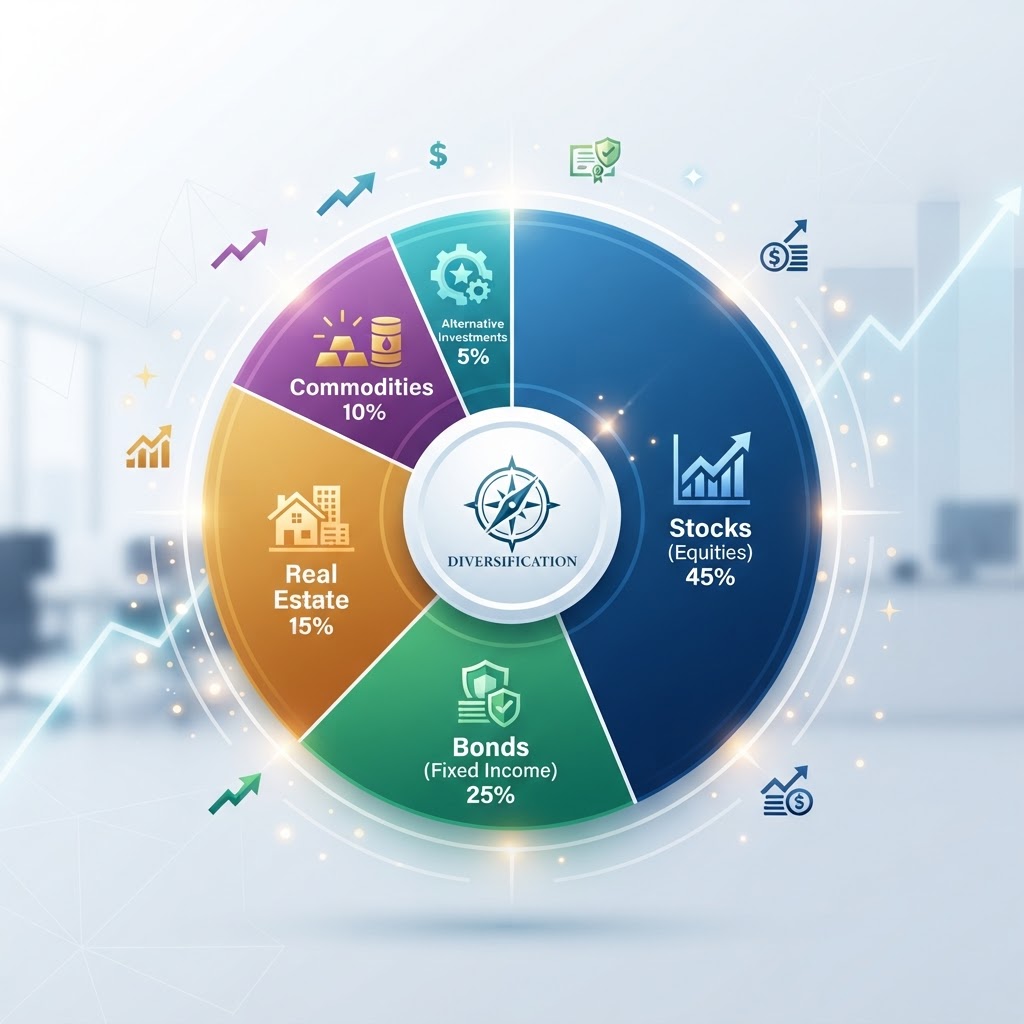

  • Asset Allocation Strategy: How to Balance Risk for Wealth Growth

    Asset Allocation Strategy: How to Balance Risk for Wealth Growth

    Key Takeaways

    • Asset allocation is the most significant driver of portfolio returns, often outweighing individual security selection.
    • Risk management begins with understanding your unique time horizon and emotional capacity for market volatility.
    • Diversification across non-correlated asset classes is essential for protecting wealth during economic downturns.
    • Portfolio rebalancing ensures your investment strategy stays aligned with your long-term goals despite market fluctuations.
    • A successful approach to wealth building requires transitioning from aggressive growth to capital preservation as you move through life stages.

    Building long-term wealth is rarely about picking the next breakout stock or timing the market perfectly. Instead, it is the result of a disciplined, methodical approach to managing your financial resources. At the heart of this discipline lies asset allocation—the strategic practice of dividing your investment portfolio among different categories of assets. By strategically balancing risk and reward, investors can create a roadmap that helps them weather economic storms while capturing the growth necessary to meet their financial milestones. Whether you are just beginning your journey or looking to refine an existing strategy, understanding how to allocate your assets is the single most important decision you will make in your financial life.

    What Is Asset Allocation and Why Does It Matter?

    Asset allocation is the process of spreading your investment capital across various categories—such as stocks, bonds, cash, and alternative investments—to align with your specific financial goals and risk profile. It is the primary tool for risk management in any investment strategy. Rather than putting all your financial eggs in one basket, you distribute them across different vehicles that react differently to economic events. The fundamental logic is that because different asset classes perform differently under varying market conditions, a well-diversified portfolio can offer a smoother ride over time.

    Many investors mistakenly believe that the secret to wealth is finding high-performing individual investments. However, historical data and expert analysis suggest that the broad strokes of your asset allocation account for a significant portion of your total portfolio variance over the long term. When you set your allocation, you are essentially deciding how much volatility you are willing to accept in exchange for potential growth. If your portfolio is too conservative, your wealth may not grow enough to outpace inflation, effectively losing purchasing power over time. Conversely, if it is too aggressive, you risk significant losses during market corrections that could force you to liquidate assets at the worst possible time.

    Asset allocation provides structure to your investment journey. It creates a framework that prevents emotional decision-making. When markets are euphoric, an investor might be tempted to chase gains by over-allocating to high-risk assets. When markets are crashing, the temptation to panic-sell is powerful. A pre-defined asset allocation strategy acts as an anchor. It reminds you that your portfolio was designed to handle temporary turbulence and keeps you focused on the long-term objective of wealth building rather than the daily noise of the financial news cycle.

    Furthermore, this strategy is not a “set it and forget it” process. As your life circumstances change, so too must your portfolio balance. The allocation that served you well in your thirties—likely focused on aggressive capital appreciation—will likely be inappropriate in your sixties, when capital preservation becomes paramount. By maintaining a disciplined approach to your asset mix, you ensure that your investments are consistently working in your best interest. Ultimately, asset allocation is about creating a resilient foundation that allows your wealth to grow systematically, regardless of the unpredictable shifts in the global economy.

    Understanding Your Personal Risk Tolerance and Time Horizon

    Before you select a single investment, you must conduct a candid assessment of two critical factors: your risk tolerance and your time horizon. These two variables define the boundaries of your investment strategy and dictate how much exposure to volatility is appropriate for your personal situation. If these factors are misaligned with your asset allocation, you are far more likely to abandon your investment plan when market conditions become challenging.

    Risk tolerance is often broken down into two distinct concepts: your psychological capacity for risk and your financial ability to take on risk. Your psychological capacity refers to your ability to sleep at night when your portfolio value drops by 10% or 20% in a single month. If a market correction causes you significant anxiety, leading to sleepless nights or the desire to move your money into cash, your risk tolerance is likely lower than you initially assumed. Financial ability, on the other hand, is about your actual circumstances. Does your current income cover your expenses? Do you have an emergency fund? If you have high debt or unstable income, your financial ability to absorb investment losses is restricted, regardless of how bold you feel when the market is hitting all-time highs.

    Your time horizon is the length of time you expect to hold your investments before needing to withdraw them for a major life goal, such as buying a home, paying for education, or retiring. Time is the greatest asset an investor has. The longer your time horizon, the more volatility you can afford to weather. This is because, historically, the stock market has tended to recover from downturns over extended periods. If your goal is twenty years away, a market crash today is merely a temporary blip that allows you to buy assets at a discount. If your goal is only three years away, that same crash could be catastrophic, as you lack the time necessary for your assets to recover before the funds are required.

    To determine your personal strategy, start by mapping out your financial goals and the dates you expect to reach them. A short-term goal, such as a vacation fund for next year, should be placed in highly stable assets like high-yield savings accounts, as preservation is the priority. A long-term goal, such as retirement in three decades, justifies an aggressive allocation focused on stocks and potential growth. By segmenting your investments based on the timeline of your needs, you can optimize your portfolio balance to match the specific requirements of each goal. This tailored approach allows you to participate in wealth-building activities while minimizing the danger of losing money when you need it most.

    The Role of Asset Classes: Stocks, Bonds, and Cash

    To master asset allocation, you must understand the primary asset classes that make up the building blocks of most portfolios. Stocks, bonds, and cash represent the three traditional pillars of investment, and each plays a distinct role in managing risk and fostering wealth. Combining these effectively is the cornerstone of a successful investment strategy.

    Stocks, or equities, represent ownership in a company. They are generally considered the primary engine for growth in a portfolio. While stocks are prone to short-term fluctuations and can be volatile, they have historically provided higher returns over long periods compared to other asset classes. Stocks allow you to capture the growth of the global economy. By owning shares, you benefit from the earnings, dividends, and innovation of businesses. Within the stock category, you can further diversify by industry, geography, and company size, which helps mitigate the risk of any single company’s failure.

    Bonds represent a loan you provide to an entity, such as a government or a corporation. In exchange, the entity pays you interest and returns your principal at the end of the term. Bonds are typically characterized as the defensive component of a portfolio. They generally provide lower returns than stocks but offer a steady stream of income and, more importantly, a buffer against stock market volatility. When stocks perform poorly, high-quality bonds often remain stable or even increase in value, providing a counterbalance that stabilizes your overall portfolio balance.

    Cash and cash equivalents, such as money market funds, certificates of deposit, and high-yield savings accounts, are the most stable but lowest-earning assets. Their primary role is liquidity and capital preservation. Cash acts as your insurance policy; it ensures that you have money available for emergencies without having to sell off your stocks or bonds during a market dip. Holding too much cash, however, can be detrimental to wealth building because inflation effectively eats away at the purchasing power of your money over time.

    Asset Class Primary Function Best For
    Stocks (Equities) Long-term capital growth Long-term wealth building
    Bonds (Fixed Income) Income and volatility reduction Reducing portfolio fluctuations
    Cash/Equivalents Liquidity and security Emergency funds and short-term goals

    The “art” of asset allocation is in how you weigh these three. An aggressive investor might hold 90% in stocks and 10% in bonds, betting heavily on growth. A moderate investor might prefer a 60/40 split, aiming for a balance of growth and stability. A conservative investor might opt for 30% stocks and 70% bonds, prioritizing the safety of their capital. Each of these combinations represents a distinct philosophy. By understanding the function of these asset classes, you can select a mix that supports your objectives while remaining within your risk tolerance.

    Alternative Investments: Adding Real Estate and Commodities

    While the traditional trio of stocks, bonds, and cash forms the foundation of most portfolios, many sophisticated investors look to alternative investments to enhance their asset allocation strategy. Alternatives include assets that do not fall neatly into the conventional categories and are often used to increase investment diversification, potentially improving risk-adjusted returns by adding assets that do not move in perfect lockstep with the broader equity markets.

    Real estate is one of the most common alternative asset classes. This can include direct ownership of property, such as residential rentals or commercial buildings, or indirect exposure through Real Estate Investment Trusts (REITs). Real estate often acts as a hedge against inflation and provides a source of passive income through rent. Because real estate prices and rental yields are driven by factors different from those that influence stock prices—such as local demand, zoning, and physical location—including real estate can help reduce the overall volatility of a portfolio. However, it is important to remember that physical real estate is illiquid and requires active management, whereas REITs offer the benefits of real estate exposure with the liquidity of the stock market.

    Commodities—which include precious metals like gold, energy resources like oil, and agricultural products—offer another layer of diversification. Commodities are often used by investors to protect against currency devaluation and inflation. Gold, in particular, has a long history of being viewed as a “store of value” during periods of geopolitical uncertainty or financial panic. Because commodity prices often react to supply and demand shocks that are unrelated to company earnings, they can provide a unique source of returns. However, commodities can also be highly volatile and typically do not pay dividends or interest, meaning they produce no “cash flow” while you hold them.

    It is important to approach alternative investments with caution. They are often more complex, carry higher fees, and may be less regulated than traditional stocks or bonds. For many individual investors, the primary role of alternatives is not to replace traditional assets but to act as a “portfolio diversifier.” By allocating a small percentage—perhaps 5% to 10%—of a portfolio to alternatives, an investor can introduce non-correlated returns. This means that if the stock market experiences a significant downturn, the alternative portion of the portfolio might hold its ground, reducing the total impact on your overall wealth. The key to successful wealth building with alternatives is ensuring they remain a satellite component of your strategy, rather than the core, unless you have the professional expertise to manage the specific risks associated with them.

    Determining the Right Asset Allocation for Your Life Stage

    Your asset allocation strategy is not a static destination; it is a dynamic journey that evolves alongside your career, family life, and proximity to retirement. As you progress through different life stages, your investment goals shift, and your ability to tolerate risk changes accordingly. Recognizing these transitions is vital to ensuring that your portfolio balance continues to serve your current needs rather than just your past ones.

    In your early career—the accumulation phase—your most valuable asset is time. During these years, you typically have the capacity to withstand significant market volatility because you have decades for your investments to recover before you need to access the funds. Many experts suggest a “growth-oriented” allocation during this phase, characterized by a high percentage of stocks. Because you are in the wealth-building stage, your goal is to maximize compounding interest. Even if the market experiences a sharp decline in your twenties or thirties, the impact on your final nest egg is often minimal because your contributions are small relative to the final value, and you have ample runway for recovery.

    As you enter your middle years—the consolidation phase—your financial responsibilities often grow. You may be managing home ownership, the costs of raising a family, or saving for education. Your risk tolerance may naturally begin to moderate as your financial commitments become more rigid. While growth remains important, you might begin to introduce more bonds and defensive assets into your portfolio to dampen the volatility of your growing nest egg. This is a period where portfolio rebalancing becomes particularly essential. You want to ensure that your gains from high-performing equities are systematically harvested and shifted into more stable assets, keeping your risk profile in check as your total wealth increases.

    Finally, as you approach and enter retirement—the distribution phase—the priority shifts from aggressive growth to capital preservation and reliable income. This is the stage where you must be most vigilant about risk management. If you experience a major market crash just as you begin withdrawing funds, it can have a devastating impact on the sustainability of your retirement lifestyle—a concept known as “sequence of returns risk.” To mitigate this, many retirees adopt a “bucket strategy.” You keep a few years’ worth of living expenses in cash or short-term fixed income (the safety bucket) while maintaining a portion of your portfolio in growth-oriented assets (the growth bucket) to protect against long-term inflation. This approach allows you to weather short-term volatility without being forced to sell stocks when the market is down.

    Ultimately, your asset allocation should be a reflection of your own life path. By evaluating your goals at each stage and adjusting your strategy accordingly, you protect the wealth you have built while continuing to provide for your future needs. Always remember that the objective of investing is not to “win” in the short term, but to ensure you have the financial freedom to live your life on your own terms. A balanced, stage-appropriate asset allocation is the best way to secure that freedom.

    Core-Satellite Strategy: Balancing Stability and Growth

    The Core-Satellite investment strategy is a sophisticated approach to asset allocation that helps investors marry the reliability of passive index investing with the potential for higher alpha through active management. By structuring your portfolio into two distinct layers, you create a robust framework designed to maximize wealth building while mitigating unnecessary downside risk.

    The Core component typically makes up the bulk of your portfolio—often ranging from 70% to 90% of your total assets. This section is designed for stability and long-term growth. Investors usually populate this portion with low-cost, broad-market index funds or exchange-traded funds (ETFs) that track major benchmarks. Because these assets are diversified across entire market sectors, the core serves as the anchor, ensuring that your wealth follows the trajectory of the overall economy rather than relying on the performance of a single company or niche industry.

    The Satellite component, which comprises the remaining 10% to 30%, allows for targeted exposure to higher-growth or niche opportunities. This is where investors explore sectors like emerging markets, small-cap stocks, or thematic investments such as clean energy or biotechnology. While these positions carry higher volatility, their relatively small footprint in your overall portfolio ensures that even if one satellite investment underperforms, your total portfolio balance remains insulated from catastrophic loss. This strategy provides the psychological comfort of knowing your “core” is secure while simultaneously satisfying the desire to outperform the market through strategic, active bets.

    The Importance of Regular Portfolio Rebalancing

    Asset allocation is not a “set it and forget it” task. Over time, market movements will naturally cause your portfolio to drift away from your intended target weights. If stocks perform exceptionally well, they may eventually command a larger percentage of your total wealth than you originally intended, inadvertently exposing you to more risk than you are comfortable with. This is why portfolio rebalancing is the heartbeat of a sustainable investment strategy.

    Rebalancing involves selling assets that have become overweight and buying assets that have become underweight. While this can feel counterintuitive—often requiring you to sell your “winners” and buy your “losers”—it is the most effective way to enforce a “buy low, sell high” discipline systematically. By locking in gains from high-performing asset classes and reinvesting those funds into undervalued segments, you maintain your original risk profile.

    Many investors choose to rebalance based on a calendar schedule—such as annually or semi-annually—while others prefer a “drift-based” threshold. A drift-based approach means you rebalance only when a specific asset class deviates from its target by a predetermined percentage, such as 5% or 10%. This approach can reduce transaction costs and tax consequences, as you only intervene when the imbalance becomes significant enough to alter your core risk management strategy.

    Rebalancing Method Mechanism Best For
    Calendar-Based Rebalance at set intervals (e.g., every January). Disciplined, hands-off investors.
    Threshold-Based Rebalance only when drift exceeds a % limit. Tax-efficient, active managers.
    Cash-Flow Based Direct new contributions to underweight assets. Investors making frequent deposits.

    Common Asset Allocation Mistakes That Stunt Wealth Growth

    Even well-intentioned investors often fall into psychological traps that undermine their wealth-building efforts. Recognizing these common pitfalls is the first step toward avoiding them.

    One major mistake is home bias, where investors concentrate their portfolios in companies or assets based in their own country. While it is natural to feel more comfortable investing in businesses you recognize, this limits your exposure to global growth opportunities and increases your sensitivity to local economic downturns. Effective investment diversification requires looking beyond national borders to ensure your wealth is not tied to the fate of a single geographic region.

    Another prevalent issue is chasing past performance. Investors often feel the urge to move money into asset classes that have recently delivered high returns. However, in the world of finance, recent performance is rarely a predictor of future success. By the time an asset class becomes popular, it is often already overvalued. This behavior effectively forces investors to buy at the peak and sell when prices inevitably retreat.

    Finally, many investors underestimate their true risk tolerance until they experience a market correction. It is easy to say you are comfortable with risk when the market is climbing. However, seeing your portfolio value drop by 20% in a month often triggers panic-selling. A sound asset allocation strategy must be built on an honest assessment of your emotional ability to withstand volatility, not just your theoretical capacity to endure it.

    How to Adjust Your Allocation During Market Volatility

    Market volatility is an inevitable feature of investing, not a bug. When uncertainty rises, your primary goal should be to avoid impulsive decisions driven by fear. Instead, view volatility as an opportunity to review your investment strategy and confirm whether your current asset classes still align with your long-term wealth goals.

    If you find that market swings are keeping you awake at night, it is a clear indicator that your portfolio balance may be too aggressive. In this instance, you might consider shifting a portion of your satellite, growth-oriented assets into more stable, income-producing assets like high-quality bonds or defensive equities. This adjustment should be done incrementally; rarely is it wise to liquidate a portfolio in a panic.

    Conversely, if your time horizon remains long—perhaps you are decades away from retirement—market volatility may actually be a time to stay the course or even increase your exposure to high-quality assets at a discount. By maintaining a consistent contribution schedule during downturns, you take advantage of dollar-cost averaging, purchasing more shares when prices are low. The key is to distinguish between volatility, which is temporary, and a fundamental shift in your financial objectives, which requires a strategic, deliberate pivot.

    Frequently Asked Questions

    How often should I rebalance my investment portfolio?

    Most financial experts suggest rebalancing at least once a year. However, if your assets experience extreme volatility, checking them twice a year or using a threshold-based system (where you rebalance if an asset deviates by more than 5% or 10%) can be more effective for maintaining your intended risk levels.

    What is the difference between diversification and asset allocation?

    Asset allocation is the macro-level strategy of deciding how much of your portfolio goes into broad categories like stocks, bonds, and cash. Diversification is the micro-level strategy of spreading your money within those categories—for example, owning different industries, company sizes, and geographic regions within your stock allocation to minimize individual company risk.

    Is it possible to have too much diversification?

    Yes, “di-worsification” can happen when you add so many overlapping assets that you dilute your returns without actually reducing risk. If you own dozens of mutual funds that all hold the same underlying stocks, you are likely just increasing your management fees and complexity without achieving meaningful protection.

    Should I change my allocation as I get older?

    Generally, yes. As you approach your financial goals or retirement, your capacity for risk often decreases. Most investors gradually shift their asset allocation from high-growth stocks to more stable, income-generating bonds or cash equivalents to protect the wealth they have built over the years.

    Can I use a “robo-advisor” for my asset allocation?

    Robo-advisors are excellent tools for those who want an automated, low-cost way to manage a balanced portfolio. They typically use algorithms to maintain your target asset allocation and handle rebalancing automatically, making them a great choice for long-term wealth building if you prefer a hands-off approach.

    How does inflation affect my asset allocation strategy?

    Inflation erodes the purchasing power of cash over time. If your portfolio is too heavily weighted toward cash or low-interest savings accounts, you may actually be losing wealth in real terms. Maintaining a portion of your portfolio in assets that historically outpace inflation—such as equities or real estate—is a critical component of a growth-oriented investment strategy.

    Conclusion

    Building wealth is a marathon, not a sprint. By mastering the fundamentals of asset allocation, maintaining a disciplined approach to portfolio balance, and resisting the urge to react emotionally to market noise, you position yourself to capture the compounding power of the markets over time. Remember that your strategy should be as unique as your goals; what works for a high-risk-tolerant investor in their twenties will look very different from the requirements of someone nearing their golden years.

    The most important step is to start today. Whether you are crafting your first portfolio or refining an existing one, focus on the principles of diversification and regular rebalancing to keep your journey toward financial independence on track. Take the time to audit your current holdings today—ensure they align with your long-term vision for your future.

    By wealthsimplyput Editorial Team

    This article is for informational purposes only and does not constitute financial advice. Consult a qualified financial professional before making financial decisions.

  • Tax-Loss Harvesting: How to Lower Your Taxes and Build Wealth

    Tax-Loss Harvesting: How to Lower Your Taxes and Build Wealth

    Key Takeaways

    • Tax-loss harvesting is a strategic method to reduce investment taxes by offsetting capital gains with realized losses.
    • The wash-sale rule is a critical regulatory hurdle that investors must understand to avoid disqualifying their tax benefits.
    • Effective wealth building requires a systematic approach to portfolio monitoring, rather than reactive, last-minute trading.
    • Investors can carry forward excess losses to offset future gains or, in some cases, reduce ordinary income.
    • Automated tools and tax-loss harvesting strategies are accessible to both retail investors and high-net-worth individuals.

    For many investors, the primary focus remains on picking winning stocks and tracking market growth. However, the most successful wealth builders understand that what you keep is often more important than what you earn. One of the most effective yet underutilized investment tax strategies is tax-loss harvesting. By intentionally selling underperforming assets at a loss, you can create a tax shield that preserves more of your capital for long-term compound growth. This guide, brought to you by the WealthSimplyPut Editorial Team, explores how to master this technique while remaining compliant with tax regulations to effectively minimize capital gains taxes and accelerate your path to financial independence.

    What Is Tax-Loss Harvesting and How Does It Work?

    At its core, tax-loss harvesting is the practice of selling an investment that has declined in value to realize a loss for tax purposes. Once the loss is realized, an investor can use that amount to offset capital gains incurred elsewhere in their portfolio. This process is a cornerstone of investment tax optimization, turning what might feel like a disappointing market outcome into a strategic advantage.

    To understand the mechanics, consider an investor who sells a stock at a $5,000 profit and another stock at a $3,000 loss in the same tax year. Without harvesting, the investor would pay taxes on the full $5,000 gain. By realizing the $3,000 loss, the taxable gain is reduced to $2,000. This directly minimizes capital gains taxes, leaving more money invested in the market to continue compounding over time.

    The “harvesting” aspect comes into play because the investor does not necessarily want to abandon their position in the market. To maintain their target asset allocation, the investor typically reinvests the proceeds from the sold security into a similar, but not identical, asset. This ensures that the investor remains exposed to the market’s potential upside while simultaneously securing the tax benefit.

    For those looking to maximize their wealth building tips, it is essential to distinguish between realized and unrealized losses. An unrealized loss exists only on paper—a decrease in the value of an investment you still hold. It provides no immediate tax benefit. Tax-loss harvesting requires the act of selling, moving the loss from an abstract number on a statement into a tangible, tax-deductible event. This process can be executed manually by individual investors or automatically by many modern robo-advisors, which continuously monitor portfolios for opportunities to harvest losses as market prices fluctuate.

    The beauty of this strategy is that it effectively “recycles” losses to work for your portfolio. If your total capital losses for the year exceed your capital gains, you can often use up to a specific amount of that excess to offset your ordinary income, such as wages or interest. Any remaining loss that exceeds that limit can typically be carried forward to future tax years, providing a long-term buffer against future tax liabilities. By systematically engaging in this practice, you are not just managing taxes; you are actively optimizing your total net worth.

    Why Tax-Loss Harvesting Is a Crucial Wealth-Building Tool

    Wealth building is rarely about a single “big win.” Instead, it is the result of consistent habits, low fees, and tax efficiency. Every dollar paid in taxes is a dollar that cannot be reinvested to generate future returns. Over decades, the “drag” created by annual tax payments can significantly reduce the internal rate of return on an investment portfolio. Tax-loss harvesting serves as a primary tool to mitigate this drag.

    When you reduce your investment taxes, you are essentially increasing the amount of money you have compounding in your brokerage account. If an investor saves a percentage of their assets in tax payments annually, that saved money remains invested. Over twenty or thirty years, the difference in the final portfolio value—fueled by the math of compound growth—can be substantial. This is why financial experts often cite tax-loss harvesting as a key component of a comprehensive wealth-building strategy.

    Furthermore, this strategy is not exclusively for the ultra-wealthy. With the rise of commission-free trading and advanced financial technology, retail investors now have the same capabilities that were previously restricted to institutional portfolios. By integrating this strategy into your broader investment tax strategies, you move from a passive, “buy and hold” approach to a more proactive, “buy, hold, and optimize” approach.

    Approach Key Benefit Best For
    Manual Harvesting Total control over specific tax lots and timing Active investors with complex portfolios
    Robo-Advisor Harvesting Hands-free, daily monitoring for losses Long-term investors seeking simplicity
    Tax-Loss “Bundling” Strategic year-end cleanup of laggard assets Investors with periodic cash flow

    Another benefit is the psychological protection this strategy provides. Markets are inherently volatile; seeing an investment drop in value is often demoralizing. However, tax-loss harvesting allows you to find a silver lining in a market downturn. Instead of viewing a decline as purely negative, the knowledgeable investor sees an opportunity to lower their future tax bill. This perspective shift is vital for maintaining emotional discipline during market corrections, which is a hallmark of successful, long-term wealth building.

    Finally, the flexibility of carrying losses forward ensures that your effort pays off even if you have a year with few gains. The ability to use losses to offset ordinary income (up to certain limits) provides a direct hedge against your salary-based taxes. This versatility makes tax-loss harvesting a multi-dimensional tool that benefits you whether the market is climbing, crashing, or moving sideways. By consistently applying these principles, you ensure that your portfolio is working as hard as possible to keep your capital working for you.

    Understanding Capital Gains vs. Capital Losses

    To implement tax-loss harvesting effectively, one must have a clear understanding of the difference between capital gains and capital losses. A capital gain occurs when you sell an asset—such as a stock, bond, or piece of real estate—for more than you paid for it, including transaction fees. Conversely, a capital loss occurs when you sell an asset for less than its original purchase price. For tax purposes, these are categorized into two types based on your holding period: short-term and long-term.

    Short-term gains or losses arise from assets held for one year or less. These are generally taxed at your ordinary income tax rates, which can be significant depending on your tax bracket. Long-term gains or losses result from assets held for more than one year. These enjoy preferential tax treatment, typically taxed at lower rates compared to ordinary income. Understanding this distinction is vital because the IRS requires you to net these amounts against each other.

    The netting process is where the strategy becomes powerful. First, you combine your short-term gains and losses to find your net short-term position. Then, you do the same for your long-term gains and losses. Finally, you combine the results. If you have a net capital loss, you can use that amount to offset your gains, and potentially up to a standard limit of your ordinary income for that year. The IRS rules allow you to deduct excess losses against ordinary income, which can be a meaningful way to reduce your total annual tax burden.

    It is important to remember that tax laws regarding capital gains and losses are subject to change and can vary based on your specific location and tax filing status. Consequently, documenting every transaction—including the cost basis (what you originally paid) and the sale price—is non-negotiable. Without accurate records, you cannot properly track your capital gains, making it impossible to accurately execute a harvesting strategy or satisfy tax reporting requirements.

    When planning your investment tax optimization, consider how your holding periods impact your bottom line. If you are close to the one-year mark on an asset that is currently at a loss, you may decide to wait to sell it if you expect to have long-term gains that need offsetting. Alternatively, if you have significant short-term gains, you may prioritize selling short-term losses to offset them directly. This granular level of control is what separates average investors from those truly building wealth through sophisticated tax management.

    Navigating the IRS Wash-Sale Rule to Stay Compliant

    One of the most significant pitfalls for investors attempting to harvest losses is the “wash-sale rule.” The IRS introduced this regulation to prevent taxpayers from selling a security just to claim a tax loss, only to immediately buy it back and effectively maintain their original position with no economic change. The wash-sale rule explained simply is this: you cannot claim a capital loss for tax purposes if you purchase a “substantially identical” security within 30 days before or after the date you sold the original investment.

    If you trigger a wash sale, the IRS will disallow the loss for the current year. Instead, the disallowed loss is added to the cost basis of the new security you purchased. While you do not permanently lose the tax benefit, it is deferred, which defeats the immediate goal of reducing your tax liability for the current filing period. This can complicate your bookkeeping and potentially create a headache during tax season if you are not tracking your transactions carefully.

    To avoid violating the wash-sale rule while still participating in the market, many investors use a strategy known as “tax-loss harvesting switching.” Instead of buying back the exact same stock or fund, you replace it with an asset that is similar but not “substantially identical.” For example, if you sell an S&P 500 index fund to realize a loss, you might replace it with an index fund that tracks a different, though comparable, broad-market benchmark. Because these two funds follow different indices, they are typically not considered substantially identical under IRS guidelines.

    The complexity of the wash-sale rule is why many investors rely on brokerage platforms or automated wealth-management tools. These platforms often include “wash-sale monitoring” features that alert you before you make a trade that might trigger a disqualifying event. If you are managing your portfolio manually, you must be hyper-vigilant about your trading history, including any automatic reinvestments made through dividend reinvestment plans (DRIPs) in your brokerage account. These automatic purchases can unintentionally trigger a wash sale if they occur within the 30-day window.

    Staying compliant is not just about avoiding penalties; it is about ensuring that your wealth-building tips are actually effective. Misinterpreting the wash-sale rule can lead to “tax surprise,” where you anticipate a lower tax bill but find yourself unable to claim the losses you expected. By maintaining a strict calendar of your sales and avoiding identical replacements within the 30-day window, you can confidently utilize tax-loss harvesting to optimize your investments while staying fully compliant with federal regulations.

    How to Identify Opportunities for Loss Harvesting in Your Portfolio

    Identifying opportunities for loss harvesting requires a shift from a “set it and forget it” mindset to one of active portfolio monitoring. The most effective way to start is by conducting a regular review of your accounts. Look specifically for assets that have dropped below their cost basis. It is helpful to set a specific threshold—such as a 5% or 10% decline—that triggers a manual review of whether a sale and replacement make sense for your overall goals.

    Beyond simple price drops, look at the tax efficiency of the assets you hold. Certain types of investments, such as individual stocks or actively managed mutual funds, are more prone to capital gains distributions than others. If you see that an asset has significantly underperformed its benchmark or your personal investment thesis has changed, this is a prime opportunity to consolidate your portfolio and harvest a loss simultaneously. It is not just about the tax benefit; it is also about cleaning up your portfolio by shedding assets that no longer serve your long-term strategy.

    Another approach is to perform a major “harvesting sweep” near the end of the calendar year. As December approaches, investors often look at their realized gains to date and calculate how much they need to offset. This end-of-year review allows you to minimize capital gains taxes before the tax year closes. However, be wary of “year-end crowding,” where many investors sell at the same time, potentially impacting the price of the assets you are trying to replace.

    When you spot a potential loss, perform a quick cost-benefit analysis. Consider the transaction costs—such as commissions or bid-ask spreads—associated with selling one asset and buying another. If the tax savings are small but the trading costs are high, the exercise may not be worth the effort. However, if the potential for tax reduction is significant and you are confident in your replacement asset, the move can be a high-leverage decision for your net worth.

    Finally, leverage technology. Most modern brokerage platforms provide a “tax lot” view, which allows you to see the performance of each specific block of shares you purchased. This is critical because you might have a stock that is up overall, but a specific “lot” of shares purchased during a market peak might be down. By selling only that specific lot, you can realize a tax loss while keeping the rest of your position intact. This level of precision is the gold standard for investment tax optimization and is a vital skill for anyone committed to building wealth through strategic tax management.

    The Strategic Role of Asset Location in Tax Optimization

    While tax-loss harvesting focuses on timing and trade execution, asset location is the foundational architecture of tax-efficient wealth building. Asset location is the practice of placing specific types of investments in the account types that provide the most favorable tax treatment. By coordinating your tax-loss harvesting efforts with a well-structured asset location strategy, you can create a compounding effect that significantly reduces the drag of taxes on your portfolio over time.

    The goal of asset location is to minimize the taxes you pay on income, dividends, and capital gains by matching assets to their “tax-efficient” homes. For instance, assets that generate high levels of ordinary income, such as taxable bonds or high-yield real estate investment trusts (REITs), are generally ill-suited for standard brokerage accounts. In a taxable account, the interest income from these assets is taxed at your highest marginal income tax rate every single year. Conversely, these assets are often better placed in tax-advantaged accounts like a Traditional IRA or 401(k), where the tax on that income is deferred until withdrawal.

    Tax-loss harvesting works best in taxable brokerage accounts because you cannot harvest losses in an IRA or 401(k). Therefore, when constructing a portfolio, you should favor holding tax-efficient assets in your taxable accounts. Tax-efficient assets include broad-market equity index funds or exchange-traded funds (ETFs) that have low turnover, as these generate fewer capital gains distributions. By holding these in taxable accounts, you leave yourself “room” to harvest losses if the market dips, while keeping your high-tax assets safely tucked away in tax-sheltered accounts where their growth is protected from annual tax hits.

    The interplay between these two concepts is profound. If you hold tax-inefficient assets in a taxable account, you are essentially “paying” for your bad asset location with annual taxes. If you simultaneously fail to harvest losses in that same account, you are missing out on the primary mechanism available to offset those taxes. Integrating these strategies ensures that your portfolio is not just growing, but growing in a way that minimizes the government’s share of your wealth.

    Step-by-Step Guide to Executing a Tax-Loss Harvesting Trade

    Executing a tax-loss harvesting trade requires discipline and precision. Because the IRS monitors transactions closely, particularly regarding the wash-sale rule, you must follow a structured process to ensure your trades are compliant and effective.

    1. Review Your Taxable Portfolio for Unrealized Losses: Regularly monitor your accounts for investments currently trading below your cost basis. Many modern brokerage platforms offer a “tax-loss harvesting” tool that highlights these positions automatically.
    2. Evaluate the Trade-Off: Before selling, confirm that the tax benefit of harvesting the loss outweighs any transaction costs or potential negative impacts on your long-term investment goals.
    3. Execute the Sell Order: Sell the security that has lost value. Ensure you have the settlement information recorded, as this will be necessary for reporting your capital gains and losses at the end of the year.
    4. Identify a Replacement Asset: To remain invested in the market, you must purchase a “substantially similar” but not “identical” asset. For example, if you sell a Total Stock Market ETF, you might replace it with an S&P 500 ETF or a different broad-market index fund from a different provider.
    5. Wait for Settlement: The replacement trade must be executed carefully to avoid triggering a wash sale. If you have automatic dividend reinvestment set up for the security you just sold, ensure you turn it off, as a reinvested dividend can trigger a wash sale.
    6. Document Everything: Keep clear records of your cost basis, the sale price, the date of the sale, and the replacement security purchased. This documentation is vital when you prepare your tax return.
    Asset Class Tax-Efficiency Best For
    Broad-Market Index Funds High Taxable Accounts (for harvesting)
    Municipal Bonds High Taxable Accounts (for income)
    Corporate Bonds Low Tax-Advantaged Accounts
    High-Turnover Active Funds Low Tax-Advantaged Accounts

    Common Mistakes to Avoid When Harvesting Investment Losses

    Even experienced investors can stumble when navigating the complexities of investment tax optimization. Avoiding these common traps is essential to protecting the integrity of your tax strategy.

    The most frequent error is violating the wash-sale rule. As explained previously, this rule prevents you from claiming a loss if you purchase a “substantially identical” security within 30 days before or after the sale. Many investors forget that this rule applies to all of their accounts—including IRAs and spousal accounts. If you sell a fund at a loss in your taxable account and your spouse buys the same fund in their IRA within the window, the IRS will disallow the loss.

    Another mistake is “over-harvesting.” While lowering your taxes is beneficial, you should never allow tax decisions to dictate your investment philosophy. Selling an asset you truly believe in just to harvest a small loss may be counterproductive if the asset rebounds quickly, forcing you to pay higher capital gains taxes later or missing out on long-term appreciation. Always focus on your long-term wealth building goals first.

    Failure to account for transaction costs is another oversight. If you are trading in a high-cost environment, the commission fees or bid-ask spreads associated with selling and rebuying can sometimes erode the very tax savings you are trying to capture. Fortunately, most discount brokerages now offer commission-free trading, but the bid-ask spread remains a real, albeit hidden, cost.

    Finally, many investors ignore the state-level tax implications. While the federal tax code is generally consistent regarding capital losses, state tax laws can vary. Ensure you understand how your state treats capital losses and whether harvesting at the federal level provides an equivalent benefit at the state level.

    Integrating Tax-Loss Harvesting Into Your Long-Term Portfolio Strategy

    Tax-loss harvesting is not a “one-and-done” event; it is a permanent feature of a sophisticated wealth building plan. To get the most out of it, you must integrate it into the routine maintenance of your portfolio, often referred to as “rebalancing.”

    Rebalancing is the process of adjusting your portfolio back to your target asset allocation. When you harvest losses, you are often selling an asset that has underperformed relative to your goals and buying a similar asset to stay in the market. This creates a perfect opportunity to rebalance simultaneously. If your target allocation requires you to buy more of a certain asset class, you can use the proceeds from your tax-loss sale to purchase that asset, effectively killing two birds with one stone: you lower your tax bill while bringing your portfolio back into alignment.

    Furthermore, tax-loss harvesting requires a shift in mindset. You stop viewing losses as “failures” and start viewing them as “tax assets.” Every dollar of loss you harvest is a dollar that can potentially shield future gains from taxes. By systematically harvesting throughout the year—rather than just waiting until December—you ensure that your portfolio is constantly being optimized for the lowest possible tax drag.

    Ultimately, the goal is to create a “tax alpha”—the additional return generated by tax-smart decision-making. Over decades, this tax alpha can significantly increase your net worth. It is not about timing the market; it is about timing the taxes. When combined with a disciplined, long-term approach to investing, tax-loss harvesting serves as a powerful engine for building and preserving wealth, allowing more of your money to stay invested and compound over the long haul.

    Frequently Asked Questions

    What exactly is the wash-sale rule and how does it stop me from harvesting losses?

    The wash-sale rule is an IRS regulation designed to prevent investors from claiming a tax deduction for a loss on a security if they repurchase the same or a “substantially identical” security within a 30-day window before or after the sale. If you trigger a wash sale, the loss is disallowed, and the cost basis of the new shares is adjusted to include the disallowed loss, effectively deferring the tax benefit until the new shares are eventually sold.

    Can I harvest losses in an IRA or 401(k)?

    No, tax-loss harvesting is not applicable to tax-advantaged accounts like IRAs, 401(k)s, or Roth IRAs. Because these accounts are tax-deferred or tax-free, you do not pay taxes on capital gains within them, and conversely, you cannot deduct capital losses against other income. Tax-loss harvesting is exclusively a strategy for taxable brokerage accounts.

    What is a “substantially identical” security?

    The IRS does not provide a strict, line-by-line definition of “substantially identical,” but generally, it refers to buying the same stock, or a fund that tracks the exact same index. Most tax professionals suggest that if you sell an ETF tracking a specific index, you should buy a different ETF that tracks a different, though similar, index (e.g., swapping an S&P 500 fund for a Total Stock Market fund) to avoid the wash-sale rule.

    How much can I deduct from my ordinary income if my losses exceed my gains?

    If your total capital losses for the year exceed your total capital gains, you can use the excess loss to offset up to $3,000 of your ordinary income (such as your salary) per year. If your losses exceed this limit, you can carry the remaining loss forward into future tax years indefinitely until the amount is exhausted.

    Is it worth harvesting small losses, or should I wait for larger ones?

    Whether a loss is worth harvesting depends on your transaction costs and the complexity involved. While every dollar of loss helps, the effort of tracking and replacing an asset might not be worth it for trivial amounts. Many investors choose to implement a threshold—for example, only harvesting losses that exceed a certain dollar amount—to keep their tax strategy efficient and manageable.

    Does tax-loss harvesting guarantee higher investment returns?

    Tax-loss harvesting does not increase the return of the underlying investment itself; rather, it increases your “after-tax” return. By reducing the amount of money you pay in taxes, you keep more capital invested in the market, which can then compound over time. It is a strategy to preserve wealth rather than a method to “beat” the market through stock picking.

    Conclusion

    Tax-loss harvesting is one of the most effective, yet underutilized, tools in the modern investor’s toolkit. By strategically turning investment setbacks into tax assets, you can significantly lower your annual tax bill, keep more of your hard-earned money working for you in the market, and accelerate your path to financial independence. While the rules surrounding the wash-sale rule and asset location may seem daunting at first, they are simply part of the architecture of a sophisticated, wealth-conscious portfolio.

    Building wealth is as much about what you keep as what you earn. If you are ready to take control of your financial future, start by auditing your taxable brokerage accounts today. Look for opportunities to optimize your positions and ensure your asset location strategy is aligned with your long-term goals. For more in-depth guidance on navigating your financial journey, continue exploring our library of resources at wealthsimplyput.

    By wealthsimplyput Editorial Team

    This article is for informational purposes only and does not constitute financial advice. Consult a qualified financial professional before making financial decisions.

  • Investment Diversification: How to Build a Risk-Proof Portfolio

    Key Takeaways

    • Investment diversification is the primary defense against market volatility, preventing the concentration of risk in a single asset.
    • Effective asset allocation strategies balance potential growth with investment risk reduction to align with long-term wealth goals.
    • Understanding the correlation between asset classes is essential, as true diversification requires assets that do not move in lockstep.
    • Building a balanced portfolio involves moving beyond basic stocks and bonds to include diverse sectors, geographies, and alternative investments.
    • Consistent rebalancing is the key to maintaining your target risk profile as market fluctuations shift your initial asset weightings.

    For many individual investors, the path to building lasting wealth is often clouded by the noise of volatile markets and the constant temptation of chasing the “next big thing.” However, the most successful long-term investors understand that wealth accumulation is rarely the result of a single lucky gamble. Instead, it is the product of disciplined strategy, patience, and, most importantly, the strategic management of risk. At the heart of this strategy lies investment diversification—a foundational concept that acts as a financial shock absorber. By spreading your capital across various investments, you aren’t just protecting your money; you are positioning your portfolio to capture growth across different economic conditions. This comprehensive guide will walk you through the essential mechanics of portfolio construction, providing you with an authoritative roadmap to achieving financial resilience and long-term security.

    What Is Investment Diversification and Why Does It Matter?

    At its simplest, investment diversification is the practice of spreading your investments around so that your exposure to any single type of asset or risk is limited. The adage “don’t put all your eggs in one basket” is the layman’s version of a sophisticated financial theory that has underpinned modern wealth management for decades. When you focus your capital on one specific stock, sector, or even a single geographic region, you become acutely vulnerable to that specific asset’s performance. If that company faces a scandal, if that sector enters a downturn, or if that region suffers a geopolitical crisis, your entire financial foundation can be shaken.

    Investment diversification addresses this by balancing the potential for gains with the inevitability of losses. When you hold a variety of assets—such as equities, fixed-income securities, real estate, and cash equivalents—you effectively reduce the volatility of your portfolio. The goal is not necessarily to eliminate risk entirely; as anyone experienced in finance knows, risk is a necessary companion to return. Instead, the focus is on investment risk reduction. By holding assets that don’t react to the same economic triggers in the same way, you create a buffer. When one area of the market experiences a decline, another might remain stable or even see growth, smoothing out your performance over time.

    Why does this matter for your wealth? Because time in the market is often more valuable than timing the market. For the average investor, trying to predict which asset will outperform in the short term is a losing game. Diversification removes the need for constant, speculative decision-making. It allows your portfolio to participate in the general growth of the global economy while insulating you from catastrophic individual losses. It is the cornerstone of sustainable wealth accumulation, ensuring that a temporary setback in one area does not derail your broader financial aspirations. Furthermore, diversification provides the psychological stability necessary to stay invested during turbulent periods. When you are confident that your portfolio is structured to handle market swings, you are far less likely to make impulsive, emotionally driven decisions that can lock in losses and destroy long-term value. By embracing diversification, you transform your approach from one of gambling on outcomes to one of managing probabilities.

    The Core Principles of Asset Allocation

    If diversification is the “what,” asset allocation is the “how.” Asset allocation is the strategy of dividing an investment portfolio among different asset categories, such as stocks, bonds, and cash. This process is arguably the most important decision an investor makes, as research suggests that it plays a larger role in determining long-term returns than the specific selection of individual stocks or bonds. To build a balanced portfolio, you must first determine your time horizon, your financial goals, and, most critically, your personal risk tolerance. These factors define your target allocation, which serves as the blueprint for your investment decisions.

    The core principle here is to create an allocation that aligns with your stage of life. Typically, younger investors have a longer time horizon, which allows them to lean more heavily into growth-oriented assets like stocks. These assets carry higher short-term risk but offer the potential for higher long-term compounding. As you approach a major financial goal, such as retirement or a large purchase, your focus often shifts toward preserving the wealth you have accumulated. This necessitates a gradual tilt toward more conservative, income-generating assets like high-quality bonds or short-term treasury instruments.

    However, simply picking an allocation is not a “set it and forget it” activity. Markets are constantly moving, and over time, the relative weights of your assets will drift from your initial targets. A bull market might cause your stocks to balloon, leaving you with a higher-risk portfolio than you originally intended. Conversely, a market downturn might cause your bond holdings to represent a larger share of your wealth. This is where the practice of rebalancing comes in. Rebalancing is the act of selling some of your winners and buying more of your laggards to return your portfolio to its target allocation. This forced discipline not only manages your risk but also serves as a mechanism to systematically “buy low and sell high.” It removes the emotional component from trading, ensuring that you maintain the desired level of risk while keeping your strategy focused on long-term wealth objectives. Effective asset allocation is not about chasing the highest possible return every quarter; it is about building a robust, predictable framework that can withstand the ups and downs of the market cycle.

    Strategy Approach Primary Focus Best For
    Aggressive Growth High equity exposure; long-term capital appreciation Younger investors with long horizons and high risk tolerance.
    Balanced Growth 60/40 mix of stocks and bonds Investors seeking steady growth with moderated volatility.
    Capital Preservation Fixed income, cash equivalents, and defensive assets Retirees or those nearing a major immediate capital withdrawal.

    Understanding Correlation and Its Role in Your Portfolio

    While many investors understand the need to hold different types of assets, a common mistake is failing to understand the relationship between those assets. This relationship is measured by correlation, a statistical concept that describes how two assets move in relation to one another. A correlation of +1.0 means two assets move in lockstep. If one goes up 5%, the other goes up 5%. A correlation of -1.0 means they move in opposite directions; when one rises, the other falls. A correlation of 0.0 means the assets move independently, with no discernible pattern between them.

    True diversification is achieved by selecting assets that have a low or negative correlation to one another. If you own nothing but different companies within the same stock market index, you are not as diversified as you might think. When a market crash occurs, those assets will likely fall together, regardless of their sector. To achieve real risk management in investing, you need to include assets that respond differently to the same economic events. For example, traditionally, government bonds have often exhibited a low correlation to stocks. During periods of economic uncertainty, investors tend to flee from the risk of stocks and move toward the relative safety of government debt. This flight to quality often causes bonds to rise or hold steady while stocks decline, thereby buffering your total portfolio value.

    However, it is important to note that correlations are not static. They can change over time based on the economic environment. During extreme market crises, correlations often spike toward +1.0, meaning almost all assets plummet simultaneously as investors liquidate everything for cash. This is a crucial reality of global finance. Because of this, sophisticated portfolios often look beyond the standard stock/bond correlation. They may include alternative assets—such as commodities, real estate investment trusts (REITs), or absolute return strategies—which can provide a different return profile entirely. Incorporating these assets can provide an additional layer of protection because they are driven by different underlying economic factors, such as inflation, supply chain constraints, or property values, rather than just corporate earnings or interest rates. Mastering the nuances of correlation requires you to look beyond the surface level of asset classes and consider the underlying drivers of value for each component of your portfolio. By systematically reducing the correlation between your assets, you move closer to a truly “risk-proof” portfolio that is far less dependent on the success or failure of any single financial factor.

    How to Diversify Across Asset Classes Effectively

    Effectively diversifying across asset classes is the tactical execution of your wealth strategy. It involves more than just selecting a handful of mutual funds or ETFs; it requires a structured approach to asset allocation strategies that ensures every piece of your portfolio serves a purpose. The process begins with identifying the primary asset classes available: equities (stocks), fixed income (bonds), cash, and alternatives. Each category brings unique benefits and risks, and the secret to a high-performing portfolio is integrating them in a way that respects your overall financial objectives.

    Equities are the engine of growth. They represent ownership in businesses and are the primary vehicle for long-term wealth accumulation. Within equities, you should further diversify by size (large-cap vs. small-cap), geography (domestic vs. international vs. emerging markets), and style (growth vs. value). A diversified equity portfolio doesn’t just hold the largest companies in the world; it taps into the innovation of smaller enterprises and the recovery potential of international markets. Fixed income, conversely, provides the stability. Bonds act as a loan to a government or a corporation, providing regular interest payments and a return of principal upon maturity. They are vital for reducing portfolio volatility. When you are looking at bonds, consider diversifying by credit quality, duration (short-term vs. long-term), and issuer type.

    Cash and cash equivalents, while often overlooked during periods of high growth, play a crucial role as a “dry powder” reserve. They provide liquidity, allowing you to cover short-term obligations without being forced to sell your long-term investments during a market dip. Beyond these traditional categories, alternative investments are increasingly being viewed as a necessity for modern portfolios. Commodities like gold or energy can act as a hedge against inflation. Real estate, whether through direct ownership or REITs, provides a distinct income stream that is not always tied to equity market performance. How do you integrate these? A practical step is to build a “core-satellite” structure. Your “core” consists of low-cost, diversified index funds that provide broad exposure to the total market. Your “satellites” are smaller, targeted positions in specific assets—like a specific geography or an alternative asset class—that you believe will add value or reduce total risk. This structure maintains the efficiency of a broad-market strategy while giving you the flexibility to adapt to changing economic conditions. Ultimately, effective diversification is about managing the trade-off between growth and protection, ensuring that your wealth is spread across enough independent variables that the failure of any one path cannot bring down your total net worth.

    Sector Diversification: Beyond Just Stocks and Bonds

    Once you have allocated your capital across broad asset classes, the next layer of risk management in investing is sector diversification. Many investors realize they hold stocks, but they don’t realize that the majority of their wealth is concentrated in a single industry, such as technology or financial services. This is a common pitfall. If your entire equity portfolio consists of high-growth technology companies, you are implicitly betting on the health of the tech sector. When interest rates rise or regulatory environments shift, that specific sector can experience significant volatility, regardless of how strong the individual companies appear to be.

    Sector diversification involves ensuring that your equity exposure is spread across the major sectors of the economy: healthcare, utilities, consumer staples, energy, industrials, technology, and materials. These sectors often perform differently at various stages of the economic cycle. For example, utilities and consumer staples are often considered “defensive” sectors. People still need to pay their electric bills and buy groceries, even when the economy is in a recession. These companies tend to be more stable, offering steady dividends that can provide a floor for your portfolio during downturns. On the other hand, technology and industrials are often “cyclical” sectors, meaning they tend to flourish when the economy is expanding and consumer demand is high.

    By balancing these sectors, you ensure that your portfolio is not solely dependent on one type of economic environment. If you only hold cyclical stocks, you will likely suffer disproportionately during an economic contraction. If you only hold defensive stocks, you may miss out on the massive wealth accumulation potential of high-growth periods. A balanced approach typically involves mimicking the weightings of the broader market, which inherently diversifies you across these sectors, while occasionally tilting your portfolio slightly based on your analysis of current economic trends. Furthermore, consider the geographic sector representation as well. A sector like “energy” might look very different if it is dominated by domestic oil companies versus international renewable energy providers. By looking under the hood of your funds or holdings, you can ensure that you aren’t unintentionally concentrating your risk in one area. The goal is to build a portfolio that reflects the full spectrum of economic activity. When you achieve this, your wealth accumulation strategy becomes much more robust, as you are participating in the growth of various industries that solve different human needs and drive progress in unique ways. This level of granular diversification is what separates a novice investor from a steward of wealth who understands how to build a portfolio that is both profitable and protected.

    Geographic Diversification: Investing in Global Markets

    When investors think about building a balanced portfolio, they often focus exclusively on the assets available within their home country. While domestic markets offer familiarity and ease of access, limiting your wealth accumulation strategies to a single geographic region introduces significant concentration risk. If your local economy faces a recession, high inflation, or structural political shifts, your entire investment base could suffer simultaneously. Geographic diversification is the practice of spreading your capital across various international markets to capture growth opportunities while hedging against localized economic downturns.

    Global markets often operate on different economic cycles. For instance, while a developed market like the United States may be experiencing a period of slow growth, emerging markets in Southeast Asia or Latin America might be undergoing rapid industrialization and expansion. By holding global assets, you ensure that your portfolio is not overly dependent on the prosperity of a single nation’s fiscal policy or labor market. This approach is essential for long-term risk management in investing, as it allows your portfolio to benefit from the tailwinds of global progress.

    To implement geographic diversification, investors typically look toward broad-market index funds or Exchange-Traded Funds (ETFs) that track international benchmarks. These instruments provide exposure to hundreds or thousands of companies across diverse jurisdictions. However, it is important to be aware of the nuances. International investing introduces factors that domestic investors may not be accustomed to, such as currency risk and geopolitical instability. For example, if you invest in a market that uses a foreign currency, fluctuations in the exchange rate can either amplify your returns or erode your gains when converted back into your base currency.

    Furthermore, investors should distinguish between developed and emerging markets. Developed markets generally offer lower volatility and more mature regulatory frameworks, making them a cornerstone for stable, long-term wealth preservation. Emerging markets, while carrying higher risk, can provide higher potential growth as these nations develop infrastructure and increase their middle-class consumer base. A well-constructed global portfolio typically maintains a mix of both, tailored to your risk tolerance and investment time horizon.

    Common Diversification Mistakes to Avoid

    While diversification is a powerful tool for risk reduction, it is not a “set it and forget it” strategy that guarantees immunity from market volatility. Many investors accidentally undermine their own efforts by making common errors that create the illusion of safety while leaving them vulnerable. Understanding these pitfalls is crucial for anyone serious about building a resilient financial future.

    One of the most frequent mistakes is “over-diversification,” or what analysts sometimes call “diworsification.” This happens when an investor buys so many different assets that their portfolio performance mirrors that of the broad market, but they pay high transaction costs and management fees in the process. When you hold hundreds of overlapping funds with similar underlying holdings, you are not truly diversifying; you are simply complicating your administration and diluting your potential gains. True diversification is about adding assets that are uncorrelated or negatively correlated, not just adding more assets for the sake of quantity.

    Another error is assuming that asset classes that historically moved in opposite directions will continue to do so during market panics. During extreme financial crises, the correlation between many asset classes—even those that are usually distinct—often moves toward 1.0. This means that during a “liquidity crunch,” investors often sell everything, including “safe” assets, to raise cash. Diversification can only do so much during a total market collapse; it is not a shield against systemic market-wide fear.

    Lastly, many investors fail to consider the role of human capital. If you work in the technology sector, your primary source of income is already tied to the performance of the tech industry. If you then fill your personal investment portfolio with tech stocks, you have effectively doubled down on your exposure to that specific sector. If the sector faces a downturn, you suffer both in your career stability and your investment portfolio. A sound strategy requires looking at your “total wealth”—including your career and income stability—when determining your investment allocation.

    Strategy Type Primary Benefit Best For
    Core-Satellite Allocation Stability with growth potential Long-term passive investors
    Geographic Spreading Hedging against local recessions Building global market resilience
    Sector Rotation Capturing cyclical industry gains Active, experienced investors
    Balanced Fund Approach Ease of use and automation Beginners starting their journey

    How Often Should You Rebalance Your Investment Portfolio?

    Rebalancing is the process of adjusting the weightings of a portfolio of assets to return to its original target allocation. Over time, as some investments grow faster than others, your portfolio will drift from its intended balance. For instance, if stocks perform exceptionally well, they may eventually account for 80% of your portfolio instead of the intended 60%, significantly increasing your risk exposure. Left unchecked, this drift can lead to a portfolio that no longer aligns with your goals.

    There is no “perfect” frequency for rebalancing, but experts generally suggest two primary approaches: time-based or threshold-based rebalancing.

    Time-based rebalancing involves reviewing and adjusting your portfolio on a set schedule, such as annually or semi-annually. This is the simplest method for most investors, as it provides a clear cadence that fits into a yearly financial planning calendar. It removes the emotion from the process; you don’t rebalance because the market is scary or exciting, but because it is the designated time of year to do so.

    Threshold-based rebalancing, or “drift-based” rebalancing, is more dynamic. In this strategy, you establish a tolerance range (e.g., a 5% deviation). If your target allocation for bonds is 40% and it drifts to 45% or falls to 35%, you take action. This method is often more efficient because it responds to actual market movements rather than just the calendar. However, it requires more active monitoring of your accounts.

    Regardless of the frequency you choose, always consider the tax implications. In non-tax-advantaged accounts, selling high-performing assets to rebalance can trigger capital gains taxes, which may eat into your wealth accumulation. In such cases, a more tax-efficient way to rebalance is to direct new contributions toward the underperforming asset classes until the portfolio returns to its target allocation, rather than selling the winners.

    Building a Risk-Adjusted Wealth Strategy for the Long Term

    Building a risk-adjusted wealth strategy requires a shift in mindset: move away from chasing the “hottest” stock and toward optimizing your portfolio’s return for every unit of risk you take. A long-term wealth strategy is built on the foundation of asset allocation, not market timing. It acknowledges that markets are inherently unpredictable, but that disciplined behavior is statistically proven to lead to superior outcomes over decades.

    Start by defining your “risk budget.” How much fluctuation can you realistically tolerate without making an emotional, panic-based decision? Your strategy must be sustainable through both bull markets and deep bear markets. If your portfolio is so volatile that you lose sleep during a 10% market dip, it is not “risk-proof”—it is risk-inappropriate. Adjust your allocation to include a greater share of high-quality bonds, cash equivalents, or alternative assets to smooth out the ride.

    Furthermore, emphasize the power of compounding through consistent, automated contributions. Even a perfectly diversified portfolio will struggle to build significant wealth if the total amount invested is insufficient. By automating your investments, you remove the temptation to “wait for the perfect entry point,” which rarely exists. Focus on maintaining a low-cost structure, as management fees compound in the opposite direction of your wealth, effectively acting as a constant drag on your potential returns over a 20- or 30-year horizon.

    Finally, remember that your personal financial situation is not static. As you age, your time horizon shortens, and your capacity to recover from market losses generally decreases. Review your strategy during major life events—marriage, the birth of a child, a career change, or approaching retirement—and recalibrate your risk levels accordingly. A living strategy is far more effective than one that is written once and ignored for decades.

    Frequently Asked Questions

    What is the most effective way to diversify a small portfolio?

    For smaller portfolios, the most effective method is using broad-market, low-cost index funds or ETFs. These funds provide instant diversification across hundreds of companies, which would be prohibitively expensive to achieve by purchasing individual stocks. By selecting one or two funds that track major domestic and international indices, you can achieve a sophisticated level of diversification with minimal effort and cost.

    Does diversification guarantee that I won’t lose money?

    No, diversification does not eliminate risk; it manages it. While a diversified portfolio is typically less volatile than a concentrated one, it is still subject to broad market declines. When systemic risks affect the entire global economy, most asset classes tend to decline together. Diversification is a tool for long-term survival and smoothing volatility, not a guarantee of absolute safety against market loss.

    How do I know if my portfolio is too concentrated?

    Your portfolio is likely too concentrated if a single asset class, industry sector, or individual stock represents a significant portion—typically more than 10-15%—of your total holdings. Furthermore, if your performance is overly dependent on the success of one company or one specific economic trend, you are exposed to unnecessary risk. Use a “look-through” analysis to see what your funds actually hold, as many funds might have overlapping top-ten holdings.

    Are bonds still necessary in a modern portfolio?

    Bonds continue to serve a critical role as a shock absorber. When stocks experience high volatility, high-quality bonds often remain stable or even increase in value, providing a counterbalance to your riskier assets. While interest rate environments change, the inverse relationship between many bonds and stocks remains a cornerstone of traditional portfolio construction, helping investors maintain their composure during turbulent times.

    Can I diversify using only ETFs?

    Yes, ETFs are among the most efficient vehicles for building a diversified portfolio. You can construct a global, multi-asset portfolio using only a handful of ETFs that cover domestic stocks, international stocks, emerging markets, and various bond tiers. This approach is highly efficient, cost-effective, and easy to rebalance, making it the preferred choice for many modern investors who want a hands-off approach to wealth management.

    How does inflation affect my diversification strategy?

    Inflation is a hidden risk that erodes purchasing power over time. A balanced portfolio should include assets that have historically acted as a hedge against inflation, such as Treasury Inflation-Protected Securities (TIPS), real estate, or commodities. By incorporating these assets, you ensure that your portfolio’s real return remains positive even during periods of rising consumer prices, which is essential for protecting your long-term wealth.

    Conclusion

    Investment diversification is the single most important strategy for any investor seeking to build wealth while minimizing the potential for catastrophic loss. By spreading your assets across different geographies, industries, and asset classes, you create a structure that is designed to endure the inevitable cycles of the market. While the path to long-term financial success requires patience and discipline, the rewards of a well-balanced, risk-adjusted portfolio are significant. Start by reviewing your current holdings, identifying your concentration risks, and implementing a consistent, low-cost plan today. Your future self will thank you for the foresight you demonstrate now.

    Ready to take control of your financial future? Start by auditing your current investment portfolio today and identifying the gaps where diversification can make a real difference in your long-term wealth strategy.

    By wealthsimplyput Editorial Team

    This article is for informational purposes only and does not constitute financial advice. Consult a qualified financial professional before making financial decisions.

  • How to Set Financial Goals: A Roadmap to Building Real Wealth

    How to Set Financial Goals: A Roadmap to Building Real Wealth

    Key Takeaways

    • Wealth building is not about arbitrary numbers but about aligning your financial habits with a clearly defined vision for your future.
    • Traditional goal setting often fails because it lacks the necessary bridge between abstract dreams and actionable daily behavior.
    • The SMART framework ensures that your financial targets are specific, measurable, achievable, relevant, and time-bound.
    • Successful long-term financial planning requires balancing short-term liquidity needs with the compounding potential of long-term investments.
    • Calculating your wealth targets requires an honest assessment of your desired lifestyle, inflation, and the timeline you have to reach your objectives.

    Most individuals approach personal finance goals with a vague desire to simply “have more,” yet they often lack the tactical infrastructure to turn that desire into tangible wealth. Building real wealth is not a sprint or a stroke of luck; it is a systematic process of resource allocation, mindset shifting, and disciplined execution. If you are struggling to find reliable guidance on how to structure your financial journey, you are not alone. In this comprehensive guide, the wealthsimplyput Editorial Team provides a roadmap to help you navigate the complexities of financial goal setting, transforming your aspirations into a structured strategy for lasting prosperity.

    Why Traditional Goal Setting Often Fails for Wealth Building

    The most common pitfall in the realm of personal finance is the reliance on vague intentions rather than precise methodology. Many people start the year with a resolution to “save more money” or “get out of debt,” but these declarations lack the structural integrity required for sustainable wealth management. When a goal is not anchored in a specific system, it becomes a casualty of daily life. The human brain is naturally wired for immediate gratification, which often creates a friction point when attempting to prioritize long-term wealth building strategies over present-day convenience.

    Traditional goal setting frequently fails because it treats money as an end rather than a tool. When you view wealth as a standalone target—such as hitting a specific balance in a savings account—you miss the nuance of why that money exists in the first place. Without a deeper purpose, when market volatility occurs or an unexpected expense arises, the motivation to stick to the plan evaporates. Experts generally agree that wealth is a byproduct of consistent behavior rather than a static destination.

    Furthermore, traditional models often ignore the “lifestyle creep” phenomenon. As individuals increase their income, their spending patterns typically adjust upward, effectively neutralizing any potential for wealth accumulation. Without a strategy that accounts for income growth, inflation, and changing personal circumstances, standard goal setting remains a reactive process. Effective wealth building requires proactive adjustments to your spending, saving, and investing habits.

    Another major failure point is the lack of granularity. A goal like “retire comfortably” is too broad to provide actionable guidance for a Tuesday afternoon. When a target feels insurmountable or disconnected from your current reality, the psychological cost of maintaining the discipline required to reach it can lead to burnout. To combat this, you must move away from general resolutions and toward a granular, step-by-step approach. This involves breaking down the total wealth number into daily, weekly, and monthly milestones that keep you focused on the process rather than just the hypothetical end result.

    Finally, traditional approaches often fail to incorporate the concept of compounding—both in interest and in habits. Many individuals give up too early because they do not see the immediate fruits of their labor. Wealth building is a slow, methodical process that relies heavily on the “snowball effect.” By failing to plan for the long horizon, many people pivot to short-term, higher-risk ventures in a desperate attempt to accelerate their progress, which often results in loss rather than gain. Shifting your perspective from “getting rich quick” to “building durable wealth” is the foundational step in rectifying these common failures.

    Defining Your Vision: Differentiating Between Wants and Wealth

    Before you can construct a robust plan for financial prosperity, you must address the fundamental distinction between satisfying your wants and building true wealth. “Wants” are typically consumption-based desires—new gadgets, upgraded vehicles, or luxury experiences—that provide temporary satisfaction but do not contribute to your net worth. “Wealth,” by contrast, is the accumulation of assets that generate value, provide security, and offer freedom of choice over time.

    Most individuals struggle because they allow their wants to dictate their financial architecture. When your spending is prioritized above your investment capacity, you essentially work for your lifestyle rather than having your money work for you. Defining your vision requires a ruthless audit of your values. Ask yourself: Is the priority to appear wealthy to your peers, or is the goal to possess the financial independence that comes with having a deep pool of investable assets?

    This phase of financial goal setting is intensely personal. For some, wealth means the ability to leave a corporate job to start a business; for others, it represents the ability to fund a family legacy or retire early. Without this clarity, your wealth management strategy will lack the “why” that is necessary to sustain long-term commitment. A clearly defined vision acts as a filter for every financial decision you make. When you face an impulse purchase, you can compare that expense against your vision. Does this purchase move you closer to your goal of independence, or does it subtract from the resources needed to reach it?

    It is helpful to write down your vision in a “Financial Manifesto.” This document should not just include numbers, but descriptions of how you want to live. Do you want to work on projects that fulfill you rather than pay the bills? Do you want to eliminate the anxiety associated with sudden market downturns? By clarifying these states of being, you create a psychological anchor. When market volatility or personal hardship strikes, your manifesto serves as a reminder that these temporary challenges are mere waypoints on the path to a larger objective.

    Differentiating between these concepts also involves understanding the role of assets and liabilities. A simple shift in perspective—viewing money as “seeds” for future growth rather than “fuel” for immediate consumption—is what separates those who struggle to maintain a balance from those who steadily build wealth. You are, in effect, building a personal portfolio that reflects your life’s mission. Every dollar that is not spent on a “want” but is instead channeled into an appreciating asset is a testament to your commitment to this vision.

    The SMART Financial Goal Framework for Long-Term Success

    To move from a vision to a tactical plan, you must employ a framework that imposes order on your financial life. The SMART framework is a gold standard in project management and is equally effective in personal finance. By ensuring your goals are Specific, Measurable, Achievable, Relevant, and Time-bound, you eliminate the ambiguity that typically leads to inaction. This structure forces you to confront the reality of your current financial situation while providing a clear path forward.

    Specific: Avoid saying, “I want to save more.” Instead, state: “I will allocate $500 per month into a diversified index fund.” Specificity removes the mental burden of deciding what to do; the decision is already made. It turns a vague ambition into a concrete command for your future self.

    Measurable: You cannot improve what you do not track. Your financial goals must have metrics attached to them. Whether it is your net worth, the total value of your investment accounts, or your debt-to-income ratio, you need clear data points. This allows you to evaluate your progress objectively. If you are not hitting your numbers, you can analyze the process—not your character—and make the necessary adjustments.

    Achievable: While it is vital to dream big, your goals must be rooted in your current financial reality. Setting a goal to save half your income when you are barely covering basic expenses will lead to frustration. Start where you are, then scale as your income or efficiency grows. It is better to have a modest goal you hit consistently than an aggressive one you abandon within weeks.

    Relevant: Every goal must align with your broader vision. If your goal is to build wealth for early retirement, spending energy on high-risk, speculative day-trading might be irrelevant—or even detrimental—to that goal. Every financial action should be checked against whether it brings you closer to your ultimate desired state.

    Time-bound: A goal without a deadline is merely a wish. Assigning a timeline creates the necessary sense of urgency. It allows you to calculate the monthly or weekly contributions needed to reach your target by a specific date, making the massive task of wealth building feel like a series of manageable assignments.

    Approach Methodology Best For
    The Incremental Method Focuses on small, daily improvements in savings rates and spending reduction. Beginners looking to build consistent, low-stress habits.
    The Goal-Based Hierarchy Categorizes money by purpose (e.g., Emergency Fund vs. Long-term Assets). Those wanting clarity and separation between immediate needs and future wealth.
    The Net Worth Tracking Focuses on the aggregate total of assets minus liabilities as the primary KPI. Advanced planners focused on total wealth acceleration and optimization.

    Categorizing Your Goals: Short-Term vs. Long-Term Wealth Milestones

    A balanced wealth strategy requires you to categorize your goals by time horizon. If you focus only on the long-term, you may struggle with cash flow liquidity in the present. If you focus only on the short-term, you may never gain the momentum required for the compounding effect to take hold. You need a tiered approach that manages your resources across different stages of your life.

    Short-term goals typically encompass a horizon of one to three years. These are the foundation of your financial stability. Examples include building an emergency fund (covering three to six months of living expenses), paying off high-interest consumer debt, or saving for a specific, near-future capital expenditure like a home down payment or professional development training. These goals are essential because they prevent you from having to tap into your long-term investments when life happens. By securing these, you create a “safety perimeter” that allows you to take more calculated risks with your long-term wealth building strategies.

    Intermediate goals, often spanning three to ten years, act as the bridge between your immediate stability and your distant future. During this phase, your focus shifts toward aggressive asset allocation. This is when you begin to optimize your tax-advantaged accounts, scale your business revenue, or invest in real estate or index funds. These milestones are about growth and diversification. You should revisit these goals annually to ensure they still reflect your evolving career path and income potential.

    Long-term goals encompass everything beyond ten years, with the ultimate objective being financial independence or a secure retirement. Because these goals are decades away, they are the primary beneficiaries of compounding. The strategy here is typically one of “set it and forget it,” involving consistent, automated contributions to vehicles that historically offer broad market exposure. The key here is not to try to “time the market” but to maintain your presence in the market. The time-horizon itself is your greatest asset, as it allows your wealth to weather short-term fluctuations and capture long-term growth.

    Categorizing goals also helps in psychological management. When you know that a specific portion of your income is locked away for your long-term legacy, you feel less anxious about spending a portion of your current cash on lifestyle choices that bring you joy. It removes the “should I be saving or spending?” conflict because you have already pre-allocated your money based on its designated purpose. This categorization system transforms your finances from a chaotic scramble into a well-oiled machine that serves both your current self and your future, wealthier self.

    How to Calculate the Exact Amount Needed for Your Wealth Targets

    Calculating your “number”—the amount of capital required to sustain your lifestyle without needing to rely on a traditional salary—is a foundational exercise in long-term financial planning. This requires an honest assessment of both your current and projected expenses, adjusted for variables that often elude casual planners, such as inflation and tax implications.

    To begin, calculate your “Annual Burn Rate.” This is the total sum of money you spend in a year to maintain your desired lifestyle. Do not just look at your current spending; project what those costs might look like when you no longer have work-related expenses (like commuting or professional wardrobes) but perhaps higher costs in areas like healthcare or travel. Be precise. This figure serves as the baseline for the amount of income your wealth must generate.

    Next, consider the “Safe Withdrawal Rate.” Many experts suggest that if you aim to generate income from a diversified portfolio, you should plan to withdraw a small, sustainable percentage of your total assets annually to ensure the capital does not deplete over time. By taking your annual burn rate and dividing it by this percentage (often cited in the range of 3% to 4% as a baseline for discussion), you can determine the total amount of invested assets required to support your desired annual income indefinitely.

    Inflation must be factored into this equation. The purchasing power of a dollar today will not be the same in twenty or thirty years. When calculating your wealth target, you must apply an inflation adjustment to your annual burn rate. If you plan to reach your goal in twenty years, you should inflate your current annual expenses by a conservative estimate of historical inflation rates. This ensures that your calculated “wealth number” is not an arbitrary figure but one that reflects the future cost of living.

    Finally, incorporate your existing assets and your projected contributions. Determine your current “wealth gap”—the difference between your target number and your current net worth. Divide this gap by the number of years you have until your deadline. This will give you a yearly investment target. To make it even more actionable, divide that by twelve to get a monthly contribution goal. When you see this number, it becomes the ultimate metric for your personal finance goals. If the monthly amount seems too high, you have two levers: reduce your projected annual expenses or find ways to increase your earning potential and investment efficiency. This calculation provides you with an objective, data-driven path to reach your definition of wealth.

    Building a Practical System for Tracking Financial Progress

    The journey toward building lasting wealth is rarely a straight line. Without a robust system for tracking your movement, it is easy to lose momentum or drift away from your original objectives. Establishing a financial tracking system is not merely about looking at your bank balance; it is about analyzing the velocity of your wealth building strategies and ensuring your capital is working as hard as you are.

    To create an effective tracking mechanism, you must first define your key performance indicators (KPIs). For most, this starts with net worth, which is the total value of your assets minus your liabilities. However, high-net-worth individuals and successful long-term planners often track additional metrics, such as cash flow efficiency, debt-to-income ratios, and the diversification of their investment portfolios. Tracking these figures monthly provides a high-level view of your progress, while weekly check-ins on discretionary spending can prevent small leaks from turning into systemic drains.

    Digital tools have revolutionized personal finance goals management. Whether you prefer automated budgeting apps, custom spreadsheets, or dedicated wealth management software, the goal is consistency. Automation is your greatest ally here. By linking your financial accounts to a centralized dashboard, you can monitor your net worth growth in real-time. This eliminates the emotional friction of manual entry and provides objective data to guide your future decisions.

    Beyond digital automation, consider keeping a “Financial Journal.” Documenting the reasoning behind your investment choices or the triggers for specific spending habits can provide invaluable psychological context. When you encounter a market dip, looking back at your past entries can help you maintain perspective and stick to your long-term plan, rather than succumbing to short-term panic.

    Common Financial Goal Setting Mistakes That Derail Growth

    Even those with the best intentions can find their wealth-building efforts stalled by common traps. Recognizing these pitfalls is the first step toward avoiding them.

    1. Setting Vague Objectives: Saying you want to “save more money” is not a goal; it is a sentiment. Without a specific dollar amount and a defined timeline, there is no way to measure progress. Effective financial goal setting requires precision—for instance, “I will contribute $15,000 to my retirement account by December 31st.”

    2. Ignoring Inflation: Many individuals fail to account for the eroding power of inflation when planning their long-term financial future. A goal that seems substantial today may not hold the same purchasing power in ten or twenty years. Always adjust your long-term wealth projections to account for historical inflation rates.

    3. Over-leveraging Debt: In an effort to speed up wealth creation, some investors borrow excessively to fund assets. While leverage can amplify returns, it also amplifies risks. High-interest debt is a wealth killer that should almost always be prioritized over investment contributions.

    4. Underestimating Emergency Needs: Attempting to invest aggressively while having no liquid emergency fund is a recipe for disaster. If an unexpected life event occurs, you may be forced to liquidate investments at an inopportune time, locking in losses and derailing your long-term compound interest goals.

    5. Failing to Rebalance: A set-it-and-forget-it strategy is often lauded, but it must be tempered with periodic rebalancing. If you do not periodically adjust your portfolio back to your target asset allocation, you may end up taking on more risk than you are comfortable with as certain asset classes outperform others.

    Tracking Method Frequency Complexity Best For
    Automated Apps Real-time Low Busy professionals tracking cash flow
    Spreadsheet Manual Entry Monthly Medium Those who want granular data control
    Wealth Management Portal Quarterly High Managing complex, multi-asset portfolios
    Physical Ledger Weekly Low Discipline-focused budgeters

    How to Adjust Your Financial Roadmap During Market Volatility

    Market volatility is an inherent feature of the global economy, not a bug. When asset prices swing wildly, the urge to “do something” is strong. However, experienced wealth builders understand that the most successful adjustments to a roadmap are proactive, not reactive.

    The first step in navigating turbulence is to verify your risk tolerance. Your psychological capacity to endure loss is just as important as your financial capacity. If market swings are keeping you awake at night, it is a clear sign that your portfolio allocation is too aggressive for your current stage of life. Adjusting your roadmap here might involve shifting a small percentage of your assets into lower-volatility vehicles, such as high-quality bonds or liquid cash equivalents.

    Second, focus on the factors you control. You cannot control interest rates, geopolitical events, or market sentiment. You can, however, control your savings rate, your tax efficiency, and your long-term investment horizon. If market conditions become hostile, doubling down on your primary wealth-building strategy—such as increasing your monthly savings contribution—can often outweigh the negative impact of declining asset values.

    Third, view volatility through the lens of opportunity. For the long-term investor, a market downturn is essentially a “sale” on high-quality assets. If your roadmap includes consistent dollar-cost averaging, market dips are simply an opportunity to purchase more shares for the same amount of capital. Stay the course, review your asset allocation for any necessary rebalancing, and avoid the temptation to time the market.

    Aligning Your Daily Spending Habits With Future Wealth Goals

    Your daily financial decisions serve as the foundation for your long-term wealth. If your spending habits are misaligned with your broader objectives, you are effectively working against your future self.

    Begin by conducting a “value-based spending audit.” Categorize your last three months of expenses into “essential,” “growth-oriented,” and “discretionary.” Growth-oriented spending includes investments in your education, health, or tools that improve your productivity. Essential spending includes housing, food, and utilities. Discretionary spending includes everything else.

    To accelerate wealth building, the goal is not to eliminate all joy from your spending but to optimize it. Ask yourself: “Does this purchase provide more value to my life than that money would provide if invested for 10 years?” This simple question creates a “wealth-first” filter for your daily transactions. When you view every non-essential purchase as a trade-off against future compounding growth, you naturally prioritize long-term utility over short-term gratification.

    Finally, practice “friction-filled spending.” Make it difficult for yourself to spend impulsively. Remove stored credit card numbers from online shopping sites, unsubscribe from retail newsletters, and implement a 48-hour cooling-off period for any non-essential purchase over a specific dollar amount. By adding small hurdles to your daily spending, you empower your rational mind to override your emotional impulses, keeping your wealth roadmap firmly on track.

    Frequently Asked Questions

    How much money should I save before I start investing for wealth?

    Most experts recommend establishing an emergency fund that covers three to six months of essential living expenses before aggressively moving into long-term investments. This ensures that you do not have to sell your assets during an emergency, protecting your long-term wealth-building efforts.

    Is it better to pay off debt or invest during periods of high inflation?

    This depends on the interest rate of your debt. If your debt carries a high interest rate, paying it off provides a guaranteed return equal to the interest you are no longer paying. If your debt is low-interest, your long-term wealth strategy may benefit more from investing, provided the potential market returns exceed the cost of the debt.

    How often should I review my personal finance goals?

    While you should track your progress monthly, a formal deep-dive review of your financial roadmap should occur at least annually. This allows you to account for major life changes, shifts in the economic landscape, and personal growth, ensuring your strategy remains relevant.

    Can I build wealth if I have a low starting salary?

    Building wealth is less about how much you earn and more about the percentage of your income you consistently save and invest. By controlling your expenses, increasing your earning potential over time, and starting early, you can build significant wealth regardless of your initial starting salary.

    What is the role of asset allocation in long-term wealth management?

    Asset allocation is the process of dividing your investment portfolio among different asset categories, such as stocks, bonds, and cash. It is the primary driver of both risk and return in your portfolio and is essential for aligning your investments with your personal time horizon and risk tolerance.

    Should I use a financial advisor or manage my own wealth?

    Managing your own wealth is possible if you are willing to dedicate the time to research, goal setting, and ongoing monitoring. However, a qualified financial professional can provide objective guidance, tax-saving strategies, and emotional discipline, which may be beneficial for those with complex financial situations or those who lack the time to manage their own portfolio.

    Conclusion

    Setting and achieving financial goals is a transformative process that shifts your focus from the limitations of today to the possibilities of tomorrow. By establishing a clear roadmap, maintaining disciplined tracking systems, avoiding common behavioral traps, and aligning your daily habits with your long-term vision, you position yourself to build, preserve, and grow significant wealth over time. Remember, the journey is personal; your goals should reflect your unique values and aspirations. Take the first step today by reviewing your current financial position and defining one concrete objective to pursue this month. Your future self will thank you for the diligence and commitment you demonstrate now.

    By wealthsimplyput Editorial Team

    This article is for informational purposes only and does not constitute financial advice. Consult a qualified financial professional before making financial decisions.

  • How to Build Multi-Generational Wealth: A Practical Guide

    Key Takeaways

    • Multi-generational wealth focuses on preserving capital and values across three or more generations, rather than simply accumulating assets.
    • Establishing clear family governance and a shared vision is as critical to long-term success as the financial tools used to protect assets.
    • Trusts serve as the structural backbone for wealth transfer strategies, offering control over how and when beneficiaries access capital.
    • Tax-efficient planning, including the strategic use of gifting and valuation discounts, is essential to minimize the erosion of family wealth during transfer.
    • The ultimate safeguard for any legacy plan is financial literacy, ensuring that heirs are equipped with the knowledge to manage, grow, and sustain the family’s assets.

    Building a legacy that lasts requires moving beyond the traditional cycle of wealth accumulation and depletion. Many families fall into the trap of focusing solely on the growth of their portfolios while neglecting the structural and educational frameworks necessary to sustain that prosperity across decades. Creating true multi-generational wealth is an exercise in intentionality, blending sophisticated financial planning with a robust family culture. Whether you are at the beginning of your wealth-building journey or looking to protect an established estate, understanding the mechanics of intergenerational financial planning is the first step toward ensuring your assets provide security and opportunity for those who come after you.

    Defining Multi-Generational Wealth and Its Purpose

    At its core, multi-generational wealth is not merely a high net-worth status; it is a philosophy of preservation and growth that spans three or more generations. While many people focus on their immediate financial security, building generational wealth requires a shift in perspective toward a much longer horizon. The purpose is to move the needle from simple inheritance—which can be easily dissipated—to the creation of a family foundation that offers stability, educational access, and entrepreneurial support for descendants who may not even be born yet.

    Experts often describe the challenge of sustaining wealth as a “shirtsleeves to shirtsleeves in three generations” phenomenon. This adage suggests that the first generation earns the wealth, the second maintains it, and the third exhausts it. Avoiding this outcome is the primary objective of any comprehensive family wealth management plan. It requires a clear definition of what the wealth is intended to do. Is it meant to provide a basic safety net? Is it designed to fund higher education for all descendants? Or is it intended to act as a pool of capital for family-led business ventures? By identifying these purposes early, families can create guardrails that prevent impulsive spending and ensure that the capital remains productive.

    True wealth in this context includes both financial capital and “human capital.” Financial capital consists of the liquid assets, real estate, and equity stakes that form the monetary backbone of the estate. Human capital, however, is equally important—it refers to the skills, values, and work ethic of the family members themselves. If you pass on large sums of money without passing on the mindset of stewardship, the longevity of that wealth is typically compromised. Therefore, the purpose of multi-generational wealth planning is to act as a bridge, ensuring that both resources and the wisdom to manage them are successfully transferred to the next generation.

    Furthermore, this process requires the establishment of a “family constitution” or a set of governing principles. When you view wealth as a shared family resource rather than individual property, you create a culture of accountability. This involves regular communication, family meetings, and a shared understanding of the family’s legacy. When all generations are aligned on the purpose of the wealth, they are much more likely to work in harmony to preserve the integrity of the assets. This proactive approach transforms the wealth from a potential source of conflict into an enduring engine for opportunity, helping every generation reach its highest potential while honoring the contributions of those who built the foundation.

    Setting Clear Financial Goals for Future Generations

    When planning for the long term, goal setting cannot be based on arbitrary numbers; it must be mapped against the specific needs and aspirations of the family lineage. Setting goals for multi-generational wealth starts with a comprehensive audit of your current financial landscape and a projection of the family’s future requirements. You must consider factors like inflation, the potential for expanding family size, and the shifting economic landscape that your heirs will face in the coming decades.

    A primary goal for many families is the creation of a “living legacy.” This might look like a family office structure where assets are managed collectively. Setting clear targets for investment returns, charitable contributions, and distributions to beneficiaries is vital for keeping the plan on track. For instance, you might set a policy where the estate provides 50 percent of the cost of education for grandchildren, provided they meet certain academic or personal milestones. This creates a feedback loop where the wealth is used to encourage productive behavior rather than fostering dependency.

    Another common goal is the protection of family identity. This often involves planning for the transition of unique assets, such as a family home, a primary business, or historical collections that carry sentimental value alongside their market price. Managing these assets requires specialized goals, such as maintaining a maintenance fund for property or ensuring that key employees in a family business have the incentives to remain loyal during the transition of leadership. Without these granular goals, the complexity of managing multi-generational wealth can quickly become overwhelming.

    It is also helpful to categorize goals into short, medium, and long-term buckets. Short-term goals might include setting up specific savings accounts or educational trusts for young children. Medium-term goals might focus on tax-minimization strategies that allow assets to compound at a higher rate. Long-term goals are the “North Star” of the plan—the vision for what the family will represent in 50 or 100 years. By documenting these goals, you provide a roadmap that surviving family members can refer to when they take over the management of the estate. This transparency reduces the likelihood of infighting and keeps the family focused on the mission of long-term sustainability.

    The Role of Trusts in Protecting Family Assets

    Trusts are perhaps the most vital tool in the kit for building generational wealth. Unlike a simple will, which merely dictates who gets what after death, a trust provides a structural framework for how assets are held, managed, and distributed over long periods. When you put assets into a trust, you are effectively creating a legal “container” that separates the ownership of the asset from the benefit it provides to your heirs. This is the cornerstone of effective estate planning for wealth.

    Trust Type Key Benefit Best For
    Revocable Living Trust Flexibility and probate avoidance Early-stage estate planning
    Irrevocable Trust Asset protection and tax reduction Advanced wealth preservation
    Spendthrift Trust Protection from creditor claims High-risk or young heirs
    Dynasty Trust Perpetual wealth transfer Multi-generational tax efficiency

    The primary advantage of a trust is control. By appointing a trustee, you ensure that someone—whether a professional firm or a trusted family member—is making decisions that align with the guidelines you have set. This is critical for preventing the “sudden wealth syndrome” that can occur when young or inexperienced beneficiaries suddenly inherit substantial sums. You can structure distributions based on specific triggers, such as hitting a certain age, graduating from university, or even embarking on a specific career path. This ensures the wealth acts as a catalyst for success rather than a disincentive for personal growth.

    Furthermore, trusts offer a level of privacy that wills do not. Because a trust is a private contract between the grantor, the trustee, and the beneficiaries, the details of your assets and distributions do not typically enter the public record through the probate process. This is a significant factor for families who value their privacy or have public-facing assets that they wish to protect from undue scrutiny. In a world where financial information is increasingly accessible, this layer of confidentiality is a major component of a sophisticated legacy planning strategy.

    Finally, trusts serve as an essential shield against creditors and legal risks. By placing assets in an irrevocable trust, you can protect them from the potential liabilities of your heirs, such as lawsuits, bankruptcy, or even divorce proceedings. While this requires giving up a degree of personal ownership, the trade-off is the assurance that the assets will remain in the family “pool” for the benefit of subsequent generations. This makes trusts the most reliable tool for anyone serious about the long-term stewardship of family capital. Engaging with qualified legal and financial counsel to draft these documents is essential, as the nuances of trust law vary by jurisdiction and can have significant implications for the long-term viability of your wealth transfer strategy.

    Tax-Efficient Strategies for Wealth Transfer

    Taxes are the single greatest threat to the longevity of multi-generational wealth. Without careful navigation of the tax landscape, the compounding effect of inheritance, gift, and capital gains taxes can hollow out an estate over just two generations. Effective wealth transfer strategies must prioritize tax efficiency at every step, using the legal frameworks available to keep more capital in the hands of the family rather than the government.

    The most basic strategy involves utilizing lifetime gift exclusions. By transferring assets to the next generation while you are still alive, you can often remove future appreciation on those assets from your taxable estate. For instance, if you gift stock that is expected to appreciate significantly, you effectively shift that future tax burden and growth to your heirs today. This “freezing” of the estate value is a powerful technique that helps keep total tax liability lower in the long run. Many wealthy families also utilize valuation discounts by transferring interest in family limited partnerships or LLCs. Because these shares are often illiquid and carry limited control, they can be valued at less than their proportionate share of the underlying assets, allowing you to move more value under the gift tax threshold.

    Another advanced strategy is the strategic use of life insurance within an Irrevocable Life Insurance Trust (ILIT). By funding a policy inside this trust, the death benefit can be used to provide the necessary liquidity for heirs to pay estate taxes without having to sell off family assets. This is particularly important for families whose wealth is tied up in illiquid holdings like real estate or a family business. Without this liquidity, heirs are often forced to liquidate at unfavorable prices just to cover the tax bill. The ILIT essentially uses the insurance proceeds to pay the tax, leaving the primary assets intact for future generations.

    Charitable vehicles can also play a major role in tax-efficient planning. A Charitable Lead Trust (CLT) or a Donor-Advised Fund (DAF) can be used to reduce your taxable estate while fulfilling the family’s philanthropic goals. By creating a structure where a portion of the income goes to charity for a set period and the remainder goes to the heirs, you can achieve significant tax deductions and potentially pass assets to the next generation at a reduced gift-tax cost. Integrating philanthropy into your wealth management strategy not only serves the community but also reinforces the values you want to pass down to your children and grandchildren.

    Finally, it is essential to stay updated on changes to tax laws. Tax legislation is never static; exemptions and rates fluctuate based on political environments and economic policies. A strategy that is highly effective today might become obsolete in a decade if the laws change. Therefore, building a team of advisors—including tax attorneys and accountants who specialize in high-net-worth estate planning—is mandatory. They will ensure that your wealth transfer strategies are not only compliant with current regulations but also flexible enough to pivot when the rules of the game inevitably shift. By being proactive and using these sophisticated tools, you can ensure that the maximum amount of your life’s work reaches your descendants rather than being eroded by taxes.

    The Importance of Financial Literacy for Heirs

    You can have the most ironclad trust documents and the most tax-efficient structure in the world, but if your heirs lack financial literacy, the wealth will eventually evaporate. The final and perhaps most important pillar of multi-generational wealth is the cultivation of the family’s human capital. Financial literacy is not just about understanding how to balance a checkbook or invest in stocks; it is about developing a mindset of stewardship, understanding the responsibilities that accompany wealth, and being able to navigate the complex world of finance with confidence and prudence.

    For many families, the education process should begin early. This can take the form of simple conversations about money management at the dinner table, or it might involve more formal training as children get older. It is often beneficial to involve the next generation in the family’s philanthropic activities or even in the oversight of their own smaller trusts. This “learning by doing” approach allows them to experience the decision-making process in a controlled environment where the consequences are manageable, helping them build the muscle memory required to handle larger sums later in life.

    Teaching heirs about the history of the wealth is also vital. When children understand the sacrifice, hard work, and risks their parents or grandparents took to build the estate, they are more likely to treat the money with respect rather than entitlement. Sharing stories of past financial successes and, just as importantly, past failures, can provide valuable lessons. It helps de-mystify the wealth and grounds the younger generation in the reality that money is not an infinite resource that magically replenishes itself, but a tool that requires constant care and strategic oversight.

    Mentorship is another key component. Some families hire professional financial coaches or educational consultants to help their children develop a personalized financial roadmap. These professionals can provide unbiased guidance that might be harder to deliver through a parent-child relationship. Furthermore, as heirs move into adulthood, they should be introduced to the family’s advisory team—the lawyers, accountants, and investment managers who oversee the family wealth. By building these relationships early, you ensure that when the time comes for the heirs to step into leadership roles, they already have a trusted team of professionals to support them.

    Ultimately, the goal of financial literacy is to prepare your heirs to be the “stewards” of the family legacy rather than just the “consumers” of it. This shift in identity changes everything. It moves the focus away from “how can I spend this?” to “how can I grow this for the next generation?” When you invest in the financial education of your descendants, you are making the most powerful investment of all. You are ensuring that they are equipped to make informed, wise, and values-driven decisions, which is the only real way to protect a legacy in the long term. This educational process is a lifelong commitment, but it is the ultimate safeguard for the prosperity you are striving to create.

    Investing in Life Insurance as a Wealth Multiplier

    For many families focused on building generational wealth, life insurance is often misunderstood as merely a tool for funeral expenses or temporary income replacement. In the context of sophisticated estate planning for wealth, life insurance functions as a potent wealth multiplier and a liquidity bridge. When structured correctly, it can provide the cash necessary to pay estate taxes, settle debts, or equalize inheritances among heirs without forcing the liquidation of core assets like family businesses or real estate holdings.

    Permanent life insurance, such as whole or universal life policies, offers a cash value component that grows on a tax-deferred basis. This creates a secondary pool of capital that can be accessed during the policyholder’s lifetime for strategic investments or as an emergency liquidity reserve. By integrating these policies into an Irrevocable Life Insurance Trust (ILIT), families can remove the policy proceeds from the taxable estate, effectively shielding a larger portion of the wealth transfer from estate taxes. This strategy allows the death benefit to pass to beneficiaries as a tax-efficient injection of capital, which can be reinvested into other long-term assets.

    Furthermore, life insurance can serve as an equalizer. If your estate includes an illiquid asset—such as a farm or a closely held business—it may be difficult to divide fairly among multiple heirs. Life insurance allows you to leave the business to the heir who is active in the operation while providing equivalent value in cash to other heirs, thereby preventing potential family conflict and ensuring the business survives into the next generation. As with all intergenerational financial planning, the policy structure must align with your broader tax and legal framework to be effective.

    Establishing Family Governance and Communication

    The greatest threat to long-term wealth is rarely the market; it is often a lack of family cohesion and a failure to prepare the next generation. Establishing family governance is the process of creating a roadmap for how family members will make decisions regarding collective assets. Without a clear framework, families often find that their wealth diminishes as it is passed down, a phenomenon frequently cited in financial studies where a significant portion of family fortunes is lost by the third generation.

    Family governance typically involves the creation of a family mission statement, periodic family meetings, and clear guidelines regarding distributions. A family mission statement acts as the “North Star,” outlining the core values the wealth is intended to support—whether that is entrepreneurial risk-taking, philanthropic endeavors, or funding education. By involving heirs in these conversations early, you move from a top-down approach to a stewardship model where the next generation feels a sense of responsibility and ownership over the family legacy.

    Communication should also address the “how” and “why” of your wealth. Share the history of your success, the lessons learned from failures, and your vision for the future. Transparent discussions regarding the family’s assets, the role of trustees, and the expectations for heirs can demystify wealth and prevent a sense of entitlement. Consider implementing a family constitution or a set of bylaws that governs how family business decisions are made, providing a structured mechanism for conflict resolution before disagreements turn into legal battles.

    Governance Tool Primary Purpose Best For
    Family Mission Statement Aligns family values and long-term vision. Families beginning the planning process.
    Family Council/Board Formal decision-making and oversight. Established families with complex assets.
    Family Constitution Defines rules for business and legacy. Families with active family businesses.
    Education Trusts Funds development and professional growth. Preparing heirs for financial responsibility.

    Avoiding Common Pitfalls in Generational Wealth Planning

    Even the most meticulously designed estate plans can fail if specific, common pitfalls are ignored. One of the most significant errors is the “set it and forget it” mentality. Estate laws, tax codes, and individual family circumstances are dynamic; a plan written ten years ago may be obsolete today. Regularly reviewing your documents—especially after major life events like marriage, the birth of a grandchild, or a change in business structure—is vital to maintaining an effective plan.

    Another common mistake is the failure to properly prepare heirs. Transferring financial capital without transferring human and intellectual capital is a recipe for wealth dissipation. Heirs who are not financially literate or who do not understand the values behind the family’s wealth are significantly more likely to mismanage inherited assets. Mentorship programs, formal financial literacy training, and “dry runs” where heirs manage small portions of assets under supervision are practical ways to mitigate this risk.

    Furthermore, many families fall into the trap of over-complicating their structures. While trusts and offshore entities have their place, they often come with high administrative costs and complexities that can outweigh their tax benefits for smaller estates. Always aim for the simplest structure that achieves your objectives while maintaining sufficient flexibility. Finally, ensure that your beneficiary designations on retirement accounts and insurance policies are updated and align with the rest of your estate plan, as these override the instructions in a Will or Trust.

    The Impact of Charitable Giving on Your Family Legacy

    Charitable giving is more than a tax-mitigation strategy; it is a powerful medium for instilling values in the next generation and cementing a positive family reputation. Integrating philanthropy into your legacy planning allows you to model generosity and provides a neutral ground where family members can collaborate on shared interests. This intergenerational financial planning effort helps heirs develop stewardship skills by collectively managing a donor-advised fund or a private family foundation.

    From a technical standpoint, charitable planning provides diverse tools to enhance wealth transfer. Strategies like Charitable Remainder Trusts (CRTs) or Charitable Lead Trusts (CLTs) can be used to achieve specific tax objectives while ensuring that a significant portion of your wealth eventually flows to chosen causes or heirs. By gifting appreciated assets, you can often bypass capital gains taxes while receiving a fair market value deduction, allowing you to give more effectively to the causes you care about.

    Beyond the numbers, philanthropy serves as a connective tissue for families. When families engage in high-impact giving, they discuss their values and priorities, which naturally leads to deeper conversations about the purpose of their wealth. This strengthens the family bond and ensures that the legacy left behind is defined by both the assets transferred and the positive impact on the community.

    How to Adjust Your Plan for Changing Economic Conditions

    Economic landscapes are inherently cyclical, and a static plan will eventually face headwinds. Adjusting your strategy for shifting conditions requires a focus on diversification and liquidity. In inflationary environments, for instance, cash and fixed-income assets can lose purchasing power, shifting the importance toward real assets like real estate, commodities, or equities that can withstand pricing pressures. Conversely, in a deflationary environment, maintaining a higher level of liquid cash may be prudent to seize opportunities as assets become depressed.

    To remain resilient, your portfolio should be stress-tested against various economic scenarios. Ask yourself: If tax laws changed significantly or a major market correction occurred, would my current wealth transfer strategy still function? Often, this requires moving toward more flexible structures. For example, using “decanting” provisions in trusts—the ability to move assets from an existing trust to a new trust with updated terms—can provide the adaptability needed to respond to legislative or economic shifts.

    Lastly, ensure that your advisors are working in concert. Your investment manager, estate attorney, and tax accountant should regularly communicate to ensure that changes in your investment strategy don’t create unintended tax liabilities or violate the terms of your trust documents. By maintaining an integrated, proactive approach, you can navigate economic fluctuations without abandoning your core goal of long-term wealth preservation.

    Frequently Asked Questions

    What is the most effective way to start building generational wealth?

    The most effective way to begin is by establishing a clear financial foundation: eliminate high-interest debt, build a substantial emergency fund, and begin consistent, long-term investing in diversified assets. Simultaneously, you should define your family’s values and goals, which will guide the eventual legal and tax structures you implement. Starting with a basic, robust estate plan and progressively layering on more complex strategies is the hallmark of sustainable wealth building.

    At what net worth level should I start formalizing an estate plan?

    You should consider formalizing an estate plan as soon as you have assets worth protecting, which includes anything from a home to a small business or brokerage account. Regardless of the size of your estate, having a Will, a Durable Power of Attorney, and a Health Care Directive is essential. As your wealth grows and reaches significant thresholds, you should consult with legal professionals to transition into more advanced tools like trusts to manage taxes and control asset distribution.

    How can I ensure my children don’t become entitled due to wealth?

    Preventing entitlement begins with transparent communication and setting clear expectations. Involve children in family meetings, explain the effort required to accumulate wealth, and provide financial literacy education early on. Many families also tie distributions to specific milestones—such as education, career achievement, or charitable service—rather than offering unconditional access to funds, which helps foster a sense of responsibility and personal accomplishment.

    What is the role of a trustee in family wealth management?

    A trustee is a fiduciary responsible for managing trust assets according to the instructions laid out in the trust document for the benefit of the beneficiaries. Their role is to ensure that assets are invested prudently, distributed according to the trust’s timeline and conditions, and protected from creditors or mismanagement. Choosing a trustee is a critical decision; you must decide between a family member, who understands the family dynamics, or a professional corporate trustee, who provides neutrality and technical expertise.

    Can multi-generational wealth be built without an active family business?

    Absolutely. While family businesses are a common source of wealth, multi-generational prosperity is frequently built through diversified portfolios of stocks, bonds, real estate, and private equity. The key is not the source of the wealth, but the mechanism of its management and transfer. Through the use of trusts, family offices, and disciplined investment strategies, families can grow and preserve wealth across generations even without an operating business at the center.

    How often should I review my generational wealth plan?

    Experts generally recommend a comprehensive review of your plan at least every three to five years, or whenever a major life event occurs. Life events such as births, deaths, marriages, divorces, the sale of a business, or significant changes in tax legislation are clear signals that your documents and strategies require updating. An annual “check-up” with your financial advisor to review investment performance and beneficiary designations is also a recommended best practice.

    Conclusion

    Building multi-generational wealth is a journey that requires more than just high-earning potential or successful investments. It is a deliberate process of planning, communication, and stewardship. By utilizing sophisticated tools like life insurance, trusts, and family governance frameworks, you can create a structure that not only preserves your financial assets but also empowers the next generation to be responsible stewards of that legacy. Remember that your plan is a living document; by remaining adaptable and fostering open communication, you ensure that your efforts today will continue to bear fruit for your descendants for decades to come. Take the first step today by reviewing your current directives and initiating those vital conversations with your family.

    By wealthsimplyput Editorial Team

    This article is for informational purposes only and does not constitute financial advice. Consult a qualified financial professional before making financial decisions.

  • How to Increase Your Income: Side Hustles vs Salary Negotiation vs Career Switching

    How to Increase Your Income: Side Hustles vs Salary Negotiation vs Career Switching

    💼 Read Time: 14 minutes

    If you’re serious about building wealth, your income is half the equation. The other half is what you do with it.

    But increasing your income is harder than most people think — and the path you choose matters enormously. A side hustle that takes 20 hours a week might earn $500/month. A salary negotiation might earn $10,000 more annually with zero hours of extra work. A career switch might triple your income in 5 years or destroy your momentum if you choose wrong.

    This guide walks through all three paths, their actual returns (not fantasies), and how to know which one is right for you RIGHT NOW.

    Key Takeaways

    • Not all income increases are equal: A $10,000 raise at your current job costs zero hours of extra work. A side hustle earning $10,000 might cost 500 hours (20 hours/week × 26 weeks). Time matters.
    • Salary negotiation is underutilized: The average person leaves $500,000 on the table over their career by not negotiating. Most raises happen once per year; you control whether to ask.
    • Side hustles are great — for specific people in specific situations: If you have a skill and spare hours, a side hustle can add 20-40% to income. But most side hustles fail or earn <$200/month.
    • Career switching is high-risk, high-reward: Switching fields can double your income in 5 years — or trap you in a lower salary for 2-3 years while you build expertise in the new field.
    • The math is brutal: A $20,000 salary increase beats a side hustle earning $500/month ($6,000/year) even though it sounds smaller, because the salary increase comes with tax benefits and no time cost.

    Path 1: Salary Negotiation — The Highest ROI Per Hour

    Time investment: 5-10 hours total (research, prep, conversation)
    Potential annual increase: $3,000-$15,000+
    ROI: $300-$1,500 per hour invested

    This is absurd. You will never find an investment that pays this well per hour of work.

    Why Most People Don’t Negotiate

    The average person accepts whatever offer they’re given and asks for a raise once per year if at all. Here’s what they leave on the table:

    Example: A $60,000 job offer

    • Market rate for the role: $65,000-$68,000
    • You accept $60,000 (you didn’t negotiate)
    • Annual loss: $5,000-$8,000
    • Over a 30-year career: $150,000-$240,000 in direct salary
    • If you’d invested the difference at 7% returns: Another $400,000-$600,000 in wealth

    One negotiation you didn’t do costs you half a million dollars over your life.

    People don’t negotiate because of fear: fear of seeming greedy, fear of the offer being rescinded, fear of confrontation. All of these fears are overblown. Companies expect negotiation. If they rescind an offer because you negotiated, you dodged a bullet (they were going to be difficult employers).

    How to Negotiate: The Framework

    Step 1: Research the market rate

    • Salary.com, Glassdoor, Levels.fyi (for tech), Payscale — check at least 3 sources
    • Call it out: “Based on Glassdoor data for [role] in [city], the market range is $65k-$72k.”
    • Note the range, not the high number

    Step 2: Make your case with data, not emotion

    • “I’ve been here 18 months. In that time, I’ve led [specific project] that resulted in [quantifiable outcome]. The market rate for someone with my experience in this role is $68k-$72k. I’d like to discuss a salary adjustment to $70k.”
    • Notice: You gave a specific number, grounded in market data and your contribution.

    Step 3: Silence is your friend

    • You make your ask. Then STOP TALKING.
    • The next person to speak loses. If you fill the silence, you’ll undercut yourself.
    • Hiring managers will either say yes, no, or offer something in between.

    Step 4: Know your walk-away number

    • If they say no, you have a choice: accept it or leave.
    • Decide your walk-away before the conversation. “If they won’t go above $65k, I’ll stay put for 6 months then ask again.”
    • Having a walk-away removes emotion — you’re negotiating from a position of clarity, not desperation.
    Scenario Your Ask Expected Outcome
    New job offer at $60k; market is $65-70k “Based on market research, I’d like $67k” $63-65k (they come up, you split the difference)
    Annual review; you want a raise “Last year I [achievement]. I’d like a 5% raise to $63k” 3-4% ($61.8k) if budget is tight; 5% if you’re valued
    Promotion offer; new title, same pay “For this expanded role, market rate is $72-76k. I’d like $74k” $70-72k (they might not have budgeted for a raise + promo)
    They say no, offer $61k Accept and revisit in 12 months, or walk Decision depends on your walk-away number

    The Frequency Question: How Often Can You Negotiate?

    At a new job: Negotiate BEFORE you accept. Once you’ve accepted, renegotiating within the first year looks like you don’t honor agreements. Wait 18+ months.

    During annual reviews: Once per year, usually. If your company has a review cycle in March, ask in March.

    When your role changes: If you’re promoted or take on significantly new responsibilities, renegotiate immediately. “This is a different job than I was hired for. Let’s discuss compensation.”

    When you have outside offers: This is nuclear. You have another job offer in hand. You go to your current employer and say, “I’ve been offered $X at [company]. I’d prefer to stay here. Can you match or exceed that?” This works, but it bridges the relationship — only do this if you’d actually leave.

    The 3-5 year rule: If you’ve been at the same company for 3-5 years without a promotion and haven’t gotten significant raises, you’re likely underpaid. Time to either renegotiate aggressively or leave. Companies are worse at giving raises to existing employees than hiring new people at higher rates. It’s unfair, but it’s reality.

    Path 2: Side Hustles — Income With a Time Cost

    Time investment: 5-20 hours per week (highly variable)
    Potential annual income: $3,000-$30,000 (for most people)
    ROI: $6-$15 per hour (if you’re lucky)

    A side hustle sounds sexy. “Make $10,000 a month in your spare time!” The reality is usually much different.

    The Brutal Math of Side Hustles

    Let’s say you start a side hustle that takes 10 hours per week, earning $500/month ($6,000/year).

    That’s $6,000 ÷ 520 hours/year = $11.50/hour.

    Your day job probably pays $25-50/hour (if you’re earning $50k-$100k). Your side hustle is paying you a quarter of what your main job pays. And it’s taking time away from rest, family, or developing skills that could earn you a $10k raise at your day job.

    The math only works if:

    • You’re earning >$25/hour on the side hustle (then it makes sense over day job time)
    • OR you’re doing it for non-financial reasons (building a portfolio, testing an idea, passion project)
    • OR it scales (you spend 50 hours building it, then it runs on 5 hours/week)

    Which Side Hustles Actually Work?

    High-earning side hustles (>$30/hour):

    • Freelance writing/copywriting for agencies ($50-150/hour)
    • Technical consulting in your area of expertise ($75-200/hour)
    • Tutoring/coaching in a specialized field ($40-100/hour)
    • Building/selling digital products ($100+/hour once built, scales perfectly)

    Medium-earning side hustles ($15-30/hour):

    • Freelance graphic design (depends on portfolio and experience)
    • Virtual assistance ($15-25/hour typically)
    • Social media management for small businesses ($20-40/month retainer, usually 2-4 hours/week = $5-10/hour)

    Low-earning side hustles (<$15/hour):

    • Food delivery/rideshare ($10-15/hour after gas/vehicle wear)
    • Dropshipping (<$5/hour on average; 90% fail)
    • Most “work from home” schemes

    Notice the pattern? Side hustles that leverage your existing expertise earn way more than generic ones. If you’re an experienced software engineer, you can charge $100+/hour freelancing. If you’re starting from scratch selling things online, you’re competing with millions of people and margins are thin.

    The Side Hustle That Works: Building Something That Scales

    The exceptions that beat the math:

    Digital products: Write a course, create a template library, build an email course. Spend 100 hours building it. Sell it for $47 × 100 people = $4,700 revenue from 1 hour of work (ongoing). This works. The upfront time is brutal; the payoff is exponential.

    Affiliate marketing/content: Write one article. It ranks for a search term. It earns $20/month forever (or for years). Spend 3 hours writing; make $240/year passively. Not impressive initially, but if you write 50 articles over 2 years, you’ve got $12,000/year in passive income and you’re done investing time.

    Personal brand/consulting: Become known for something. Blog, speak, publish. Takes 2-3 years of no financial return. Then, people hire you at premium rates because you’re THE person in that niche. This is the long game, but it works.

    Path 3: Career Switching — The Long Game

    Time investment: 1-3 years of lower income/reduced advancement while you build new expertise
    Potential income increase: 50-300% over 5 years (highly variable)
    Risk: You might lose seniority and earn less for 2+ years

    Career switching is the nuclear option. You leave a field where you have expertise and experience to start over in a new field. The gamble: does the new field pay enough to make up for lost seniority in your original field?

    The Career Switch That Makes Sense

    Scenario A: You’re 28, earning $55k in marketing. You switch to software engineering.

    Timeline:

    • Year 1-2: Learn (bootcamp, self-taught, or entry-level junior dev role at $65-75k)
    • Year 3-4: Mid-level engineer ($100-130k)
    • Year 5+: Senior engineer ($150-250k+)

    This switch makes sense because software engineering pays 3-5x marketing, and you’re young enough to absorb the 1-2 year transition cost.

    Scenario B: You’re 48, earning $120k as an accountant. You want to switch to UX design.

    This is harder. You have:

    • Only 17 years until retirement (age 65)
    • Likely family obligations that depend on your income stability
    • You’d take a $60-70k junior role initially, a 40% pay cut
    • You’d need to get back to $120k by age 55-58 to break even

    Possible, but riskier. Only do this if UX design genuinely excites you and you’re willing to live on less for 2-3 years.

    High-Payoff Career Switches

    From → To Starting Salary → 5-Year Target Feasibility
    Teacher ($55k) → Software Engineer ($120k+) $70k → $150k High (bootcamps have clear path)
    Sales ($70k) → Product Manager ($120k+) $80k → $150k Medium-High (overlap in skills)
    Admin ($45k) → Project Manager ($90k+) $50k → $110k Medium (need certifications, takes 2-3 years)
    Anything → MBA path ($80k+) Varies → $130k+ Medium (2 years, expensive, high payoff)
    Finance ($75k) → Data Science ($150k+) $85k → $170k High (overlap in analytical skills)

    The Career Switch Trap

    Many people switch careers and then… don’t actually move into the higher-paying roles. They get stuck in mid-level positions because they lack the network, experience, or credentials.

    Example: You switch from accounting to tech, take a $70k junior role, then… stay at $70-80k for years because you don’t have the seniority to step into senior positions. You’ve traded steady career advancement for a lateral move in pay.

    To avoid this trap:

    • Pick a switch with clear salary escalation (tech, finance, management have clear progressions)
    • Don’t just take any role — take a role at a company/industry with growth
    • Network aggressively in the new field from day one
    • Be willing to switch companies if your first company doesn’t promote you fast enough

    How to Choose: The Decision Matrix

    Choose salary negotiation if:

    • You’re happy with your job and company
    • You haven’t asked for a raise in 12+ months
    • You have evidence you’re underpaid (market data, promotions without pay bumps)
    • You want quick, high-ROI income growth

    Choose a side hustle if:

    • You have expertise that earns >$25/hour
    • You want to build something outside your day job
    • You have 5-15 hours/week available and don’t mind the time cost
    • You want to test a business idea before quitting your job

    Choose a career switch if:

    • You’re under 35 and can absorb 1-3 years of lower income/stability loss
    • Your current field is stagnant or low-paying long-term
    • The new field has clear income growth (tech, finance, healthcare, management)
    • You’re miserable in your current role (financial growth alone isn’t worth years of unhappiness)

    The Optimal Strategy: Stack Them (In Order)

    Year 1: Negotiate your salary — Quick win, high ROI. Do this first. Takes a few hours, potentially adds $5-15k/year.

    Years 1-2: Start a scalable side hustle — While you’re in your job and learning. If it doesn’t work, you haven’t risked anything. If it does, you have 2-3 years of runway before you need it to be income-generating.

    Years 2-5: If side hustle shows promise, transition slowly — Go part-time at your job, scale the hustle. Or use side hustle revenue to fund a career switch (savings, education, etc.).

    OR: Build experience for a career switch — Take on projects at your current job that position you for a switch. You don’t need to leave to pivot.

    The people who optimize income don’t do ONE of these. They do all three strategically:

    • Negotiate to baseline salary
    • Build a side income stream
    • Position themselves for a more lucrative career path within 5 years

    The Bottom Line

    Increasing your income is the second pillar of wealth building (after saving consistently). But not all income growth is equal. An extra $15,000/year from a salary negotiation beats a side hustle earning $500/month by almost every metric — less time, less stress, better taxes, cleaner.

    Start with salary negotiation. It’s the highest ROI per hour. Then, if you want to go further, add a scalable side hustle. Only switch careers if your current path is truly broken or you’re chasing genuine passion.

    The person who gets one $5k raise, builds a $10k/year side income, and positions themselves for a career switch from $70k to $120k within 5 years has transformed their financial reality. That’s not luck. That’s strategy.

    Building Real Wealth: Evidence-Based Financial Strategies

    Wealth building is not complicated, but it is demanding. It requires consistent behaviour over long periods of time, discipline during market downturns and lifestyle inflation pressure, and a clear understanding of the fundamental principles that separate households that build lasting wealth from those that earn well but arrive at retirement with little to show for it. The principles themselves are not secrets — they are widely known. The challenge is applying them consistently across decades of real life with its competing demands, temptations, and disruptions.

    The first principle is spending less than you earn — consistently, not occasionally. This sounds obvious but runs counter to powerful cultural forces that normalise lifestyle expansion proportional to income growth. Every raise, bonus, and windfall represents an opportunity either to accelerate wealth building or to inflate lifestyle. Households that consistently direct a meaningful portion of income increases to savings and investment rather than consumption build wealth at rates that surprise even financially sophisticated observers when compounded over 20-30 years.

    The second principle is investing early and consistently. The mathematics of compound growth reward early investors with an advantage that later savers cannot overcome through higher savings rates alone. A 25-year-old who invests $500 per month until age 65 at a 7% annual return accumulates approximately $1.3 million. A 35-year-old making the same monthly investment accumulates approximately $600,000 — less than half, despite investing for only 10 fewer years. Time in the market is the most powerful wealth-building variable available, and every year of delay is extremely costly in terminal wealth terms.

    The third principle is minimising fees, taxes, and financial mistakes. Every percentage point of annual fees reduces terminal wealth by approximately 20-25% over a 30-year investment horizon. Tax-advantaged accounts (401k, IRA, Roth IRA, HSA) provide legally guaranteed returns in the form of tax savings that no market investment can match. Avoiding common financial mistakes — panic selling during market downturns, chasing recent performance, taking on consumer debt for depreciating purchases, cashing out retirement accounts early — protects the wealth that good habits create. The wealth destroyed by financial mistakes often exceeds the wealth created by investment returns for households that have not developed financial discipline.

    Investment Fundamentals: What Every Investor Needs to Know

    The investment landscape is complex and intimidating to many people, but the core principles that drive long-term investment success are straightforward. Diversification — spreading investment across multiple asset classes, geographies, and securities — reduces risk without proportionally reducing expected return. A globally diversified portfolio of low-cost index funds captures essentially all available market returns while eliminating the company-specific and sector-specific risks that concentrate in undiversified portfolios.

    Asset allocation — the division of your portfolio between stocks, bonds, and other asset classes — is the most important investment decision you will make, responsible for the majority of long-term portfolio performance variation. Your optimal asset allocation depends on your time horizon, risk tolerance, and specific financial goals. Generally, longer time horizons and higher risk tolerance support higher equity allocations (which provide higher expected returns but greater short-term volatility), while shorter time horizons and lower risk tolerance support more conservative allocations with greater bond and cash components.

    Rebalancing — periodically returning your portfolio to its target allocation as market movements cause drift — is a mechanical discipline that forces you to buy assets that have become relatively cheaper (underperformed recently) and sell assets that have become relatively more expensive (outperformed recently). Annual or semi-annual rebalancing, or threshold-based rebalancing when allocations drift more than 5-10 percentage points from targets, maintains your intended risk profile and can modestly improve long-term returns through the systematic buy-low-sell-high discipline it enforces.

    Market timing — attempting to predict short-term market movements to buy before rises and sell before falls — is one of the most thoroughly debunked strategies in investment research. Decades of academic and practitioner research consistently show that active market timing destroys rather than creates value for virtually all investors, including professional fund managers. The investors who achieve the best long-term outcomes are those who maintain their target allocation consistently through market cycles rather than reacting emotionally to short-term price movements.

    Dollar-cost averaging — investing a fixed amount at regular intervals regardless of market conditions — is both a practical discipline for regular investors and a psychological strategy that reduces the paralysing anxiety of “is now a good time to invest?” by making the answer irrelevant. Investing $500 every month regardless of market conditions produces better long-term outcomes for most investors than attempting to time optimal entry points, primarily because it ensures that investing happens consistently rather than being perpetually delayed waiting for better conditions that may never arrive.

    Debt Management: A Strategic Framework

    Not all debt is created equal. Debt that finances appreciating assets or generates income (mortgages on well-located properties, business loans with positive ROI, student loans for high-earning careers) is categorically different from debt that finances consumption (credit cards, personal loans, car loans for vehicles beyond your means). Conflating these categories leads to either excessive debt aversion that forgoes valuable leverage or insufficient debt concern that allows high-cost consumer debt to compound into a serious financial drag.

    High-interest consumer debt — credit cards typically charging 18-25% APR — is the most financially destructive force in personal finance. At 20% APR, a $10,000 balance doubles to $20,000 in less than four years without additional borrowing. Eliminating high-interest debt is the highest guaranteed return available — paying off a 20% credit card balance is equivalent to earning a guaranteed 20% return on that amount. No investment consistently matches this return, making debt elimination the highest-priority use of available cash flow for anyone carrying significant high-interest balances.

    The debt avalanche method — targeting the highest-interest debt first regardless of balance size — minimises total interest paid and is mathematically optimal. The debt snowball method — targeting the smallest balance first regardless of interest rate — pays more total interest but provides quicker psychological wins that improve motivation and adherence for some people. Both are effective strategies for debt elimination; choose the one you will actually stick with. The worst approach is paying minimum balances on everything while making no systematic progress on elimination.

    Mortgage debt requires a more nuanced analysis. Mortgages at current rates may be worth accelerating payoff if the emotional value of being debt-free is significant, if you are near retirement and want to eliminate the largest fixed expense before income drops, or if the mortgage rate exceeds the expected after-tax return on alternative investments. At historically low mortgage rates, however, the mathematical case for prioritising mortgage payoff over investment is weak — the expected return of a diversified investment portfolio typically exceeds the after-tax cost of a low-rate mortgage over long horizons. This is an individual decision that depends on your specific interest rate, tax situation, risk tolerance, and values.

    Retirement Planning: Building the Income You Will Need

    Retirement planning requires answering three fundamental questions: How much will I need? How much will I have? And how do I bridge any gap? The answers to all three are uncertain, but developing reasonable estimates based on current data is essential for knowing whether you are on track and what adjustments are needed.

    Estimating retirement income needs starts with your current expenses adjusted for anticipated retirement lifestyle changes. Expenses that decrease in retirement include work-related costs (commuting, professional clothing, eating out near work), mortgage payments (if paid off), and potentially income taxes (if retirement income is lower than working income). Expenses that may increase include healthcare (the single largest wildcard in retirement planning), leisure and travel, and potentially housing modifications for aging in place. A widely used starting estimate is 70-80% of pre-retirement income, but this varies significantly by individual — some people spend more in retirement than during their working years if travel and activities increase.

    The 4% rule — withdrawing 4% of your portfolio in the first year of retirement and adjusting for inflation annually — is a widely cited guideline suggesting that a portfolio can sustain 30 years of withdrawals at this rate with high probability. It implies that to fund $60,000 of annual retirement spending, you need approximately $1.5 million in investable assets. This is a planning heuristic, not a guarantee — sequence of returns risk (experiencing poor market returns early in retirement) can significantly affect outcomes, and lower expected future returns than the historical period underlying the 4% rule may warrant a more conservative withdrawal rate.

    Social Security optimisation is one of the highest-value retirement planning decisions available. Claiming at 62 (the earliest eligibility) versus 70 (when benefits max out) results in approximately a 76% difference in monthly benefit — benefits increase by approximately 6-8% for each year of delay between 62 and 70. For people in good health with reasonable life expectancy, delaying Social Security as long as possible while drawing down investable assets is often the mathematically superior strategy, effectively purchasing longevity insurance at favourable rates.

    Key Takeaways and Your Financial Action Plan

    Financial security is built through consistent application of proven principles over time — not through exceptional investment picks, market timing, or financial complexity. The households that achieve genuine wealth independence are those that automate saving, invest consistently in diversified low-cost portfolios, manage debt strategically, protect their assets with appropriate insurance, and review their financial plan regularly to ensure it remains aligned with their evolving goals and circumstances.

    Start where you are. If you have no emergency fund, build one first — three to six months of expenses in a high-yield savings account, insulating you from the financial shocks that derail long-term wealth building plans. If you have high-interest debt, eliminate it systematically. If you are not maximising your employer 401(k) match, do it immediately — the match is a 50-100% guaranteed return on that contribution that no other investment can match. Then work progressively toward maximising tax-advantaged accounts, building taxable investments, and protecting what you build with appropriate insurance and estate planning.

    The financial decisions you make in the next year will compound for decades. Every dollar saved and invested wisely today will be worth many times that amount at retirement. Every dollar of high-interest debt eliminated today saves multiple dollars of future interest. The mathematics are unambiguous and in your favour — if you act consistently and patiently. Build the habits, automate the behaviours, and let time do what it does best: compound your progress into a financial future that reflects the decisions you are making right now.

    This article provides general financial information for educational purposes only. Individual circumstances vary significantly. Always consult a qualified financial advisor for personalised guidance tailored to your specific financial situation and goals.

  • Best Ways to Invest Your Tax Refund: A Strategic Guide to Making Your Money Work

    Best Ways to Invest Your Tax Refund: A Strategic Guide to Making Your Money Work

    💰 Read Time: 13 minutes

    Every April, millions of Americans get a tax refund. The average? Around $2,800. And most people spend it.

    They get the notification that a deposit’s on the way, and within days it’s gone: credit card payments, emergency car repair, a vacation they “deserved,” or just bleeding into regular spending because it never felt like “real” money.

    Here’s the thing: that refund IS real money. It’s your own money coming back because you overpaid in taxes throughout the year. And the way you deploy it in the next 30 days might be the most important financial decision you make all year.

    The gap between someone who invests their annual tax refund starting at 25 vs someone who spends it is nearly $1 million by age 65. Let’s talk about how to actually use a tax refund to build wealth instead of just patch temporary problems.

    Key Takeaways

    • Don’t adjust your withholding without a plan: Getting a refund means you’re giving the government an interest-free loan. Ideally, you’d owe a small amount on taxes and invest the difference all year. But if refunds happen to you anyway, don’t waste them.
    • The $2,800 annual decision: Investing your typical refund at 7% returns starting at age 25 builds $960,000 by age 65 — assuming no other contributions. That’s not a coincidence.
    • Your situation dictates strategy: An emergency fund is worthless if you don’t have an emergency fund. Max out retirement accounts before taxable investing. The “best” investment for your refund depends on your financial foundation.
    • Speed matters: Money sitting in a checking account for 6 months is money not working. Decide within 48 hours of receiving it, or you’ll spend it without deciding.
    • Automation prevents backsliding: Set up automatic transfers to investment accounts on tax refund day. Make it impossible to spend.

    The Tax Refund Decision Tree: Where Should YOUR Money Go?

    The right place for your refund depends on your current financial health. Here’s the priority order:

    Step 1: Do You Have an Emergency Fund?

    This is the foundation. If you don’t have 3-6 months of expenses in a high-yield savings account, your refund goes here — not to investments. Period.

    Why? Without an emergency fund, one unexpected event forces you to go into debt. A $2,800 car repair feels catastrophic. With an emergency fund, it’s an inconvenience.

    Example: You’re 28, earning $55k annually (~$4,600/month). Your monthly expenses are $2,800. You need 3-6 months saved = $8,400-$16,800.

    • If you have $3k saved: Put the $2,800 refund toward the emergency fund. Now you’re at $5,800 — getting closer.
    • If you have $15k saved (5+ months): You can move to step 2.

    Build your emergency fund in a high-yield savings account earning 4.5-5.0% (rates vary, so verify current options with your preferred provider). This isn’t invested money — it’s liquid safety net money.

    Step 2: Max Out Tax-Advantaged Retirement Accounts

    Once you have an emergency fund, retirement accounts are your next priority. Why? Because they’re the only place the IRS lets you invest pre-tax money and avoid capital gains taxes until withdrawal.

    Priority order:

    2A: Employer 401(k) match — If your employer offers a 401(k) match and you’re not getting the full match, this is a 50-100% instant return. Every dollar matched is free money. Prioritize this in your regular paycheck first, before using your refund. But if your refund is your only opportunity to boost contributions, do it via a backdoor contribution or mega backdoor if your plan allows it.

    2B: Max your IRA — The 2026 limit is $7,000 for under-50, $8,000 for 50+. If you haven’t maxed your IRA for the year, use your refund now. This is the easiest tax shelter.

    Account Type 2026 Limit (Under 50) Tax Advantage
    Traditional IRA $7,000 Tax-deductible; grows tax-deferred
    Roth IRA $7,000 Tax-free growth and withdrawals in retirement
    401(k) (employee deferral) $23,500 Tax-deductible; employer match is free money
    HSA (Health Savings Account) $4,300 (self-only) Triple tax advantage (best deal ever)

    Which IRA should you choose?

    • Roth IRA if: You’re young, in a lower tax bracket now, and expect to be in a higher bracket in retirement. Your $7,000 grows tax-free forever.
    • Traditional IRA if: You’re in a high tax bracket now and want the immediate tax deduction. You’ll pay taxes on withdrawal in retirement.

    If you earn over $150k (married) or $95k (single) in 2026, Roth IRA direct contributions phase out, but backdoor Roth exists.

    Step 3: Attack High-Interest Debt

    If you’re carrying credit card debt at 18-24% interest, investing your refund doesn’t make mathematical sense. You can’t earn more than 24% in the stock market reliably.

    Example: You have $5,000 in credit card debt at 22% APR. That’s costing you $1,100 annually in interest. A $2,800 refund applied to that debt saves you $616 in interest over one year — that’s a guaranteed 22% return, which beats market returns 80% of the time.

    Only after you’ve knocked credit card debt to near-zero should you prioritize investing your refund.

    Step 4: Invest in a Taxable Brokerage Account

    Once you have an emergency fund, maxed retirement accounts, and minimal high-interest debt, put your refund into a taxable brokerage account — but do it strategically.

    Best investment vehicles for a taxable account:

    Index Funds (Most tax-efficient) — Total market index funds like VTSAX (Vanguard) or FSKAX (Fidelity) give you diversified stock exposure with minimal turnover. Low turnover = lower capital gains taxes. You can verify current expense ratios and current performance directly with Vanguard or Fidelity.

    ETFs (Also tax-efficient) — VTI, VTSAX, or VOO are popular. ETFs rarely distribute capital gains because of their structure, making them ideal for taxable accounts.

    Individual stocks (Only if you know what you’re doing) — 90% of individual investors underperform the index. Unless you’re doing serious research, skip this. Your $2,800 won’t move the needle, and the effort isn’t worth the return.

    Bonds (If you’re risk-averse) — A simple 60/40 split (60% stocks, 40% bonds) is safer than 100% stocks. At 30, you can handle 100% stocks. At 55, bonds start making sense.

    The Math: What Does $2,800 Actually Become?

    Scenario A: Invest your annual refund at 7% returns starting at age 25

    • $2,800 annually for 40 years = $960,416 by age 65
    • You put in $112,000 total; the market adds $848,416 in gains

    Scenario B: Get the refund, spend it immediately

    • $2,800 annually for 40 years = $112,000 spent, zero remaining

    The difference: $848,000 in wealth building.

    But that’s assuming you start at 25 and never stop. Most people don’t. Let’s be more realistic:

    Realistic Scenario: Start at 25, invest until 35 (10 years), then give up

    • $2,800 × 10 years = $28,000 invested by age 35
    • That $28,000 grows at 7% for another 30 years (until age 65)
    • Final value: $214,000
    • Your contribution: $28,000
    • Gains: $186,000

    Even if you only invest your refund for 10 years of your life, you’ve created $186,000 in wealth growth. That’s powerful.

    Pro Move: Automate It

    The biggest mistake people make: getting a refund, intending to invest it, but letting it sit in checking while “they figure out where to put it.” Six months later, it’s gone.

    How to prevent this:

    1. Set up automatic transfer — The day your refund hits your bank account, have an automatic transfer set up to your brokerage account. No decision needed in the moment.

    2. Choose your investment in advance — Before tax season even hits, decide: “My refund goes into a Roth IRA, invested in a total market index fund.” Then execute automatically.

    3. Make it hard to reverse — If you set it to auto-transfer to an investment account at a different bank, you’ve added friction. That friction is your friend.

    Special Situations: What If Your Refund Is Huge?

    If you’re getting $5,000+: You’re probably overwithholding significantly. After investing this year’s refund, adjust your W-4 to reduce withholding next year. Getting a $5,000 refund is losing $416/month of investment opportunity.

    If you’re getting less than $1,000: You’re withholding optimally. Keep your W-4 as-is.

    If you owe taxes: You’re underwithholding, which means you’ve been investing money all year that you now have to return. Is that optimal? Maybe — you’ve earned 12 months of gains on that money. Probably not worth optimizing further unless you owe >$2,000.

    The Psychology: Why People Spend Instead of Invest

    Here’s the honest truth: money refunded feels like “free” money. You didn’t see it in your paycheck (it was withheld), so when it arrives, your brain categorizes it differently than earned income. It feels like a bonus, not like money you already earned.

    This is why most people spend it.

    The antidote: remember that this IS your money, already earned. You just got it back from the government instead of having it in your account earning interest all year.

    Reframe the refund: it’s not “extra money to treat myself with.” It’s “a second chance to pay myself instead of the IRS.”

    FAQ: Tax Refund Investment Questions

    Q: Should I invest my refund or pay off my mortgage faster?

    A: If your mortgage is at 3-4% and you can invest at 7% historically, investing wins mathematically. But if paying off your mortgage gives you peace of mind, that psychological benefit might be worth the lower financial return. There’s no perfect answer — go with what aligns with your priorities.

    Q: What if the market crashes right after I invest?

    A: Short-term, that stings. But you’ve got decades until retirement. Market crashes are buying opportunities — you’ll be investing more over the next 30-40 years, so you’ll buy lower shares after a crash. Historically, every crash has been followed by recovery and new highs.

    Q: Should I invest in individual stocks with my refund?

    A: Unless you’ve done serious research and have a track record, no. Index funds outperform 90% of individual investors. Start with index funds. Once you have $50k+ invested and you’ve done years of research, revisit individual stocks if you want.

    Q: Can I invest my refund in my kid’s 529 plan instead of mine?

    A: Yes, and it’s a smart move if you have kids and haven’t funded their education. A $2,800 contribution to a 529 grows tax-free for college. But only do this if your own retirement is on track first.

    Q: What’s the best investment if I’m only investing once a year?

    A: Low-cost index funds. The timing of a single $2,800 investment doesn’t matter much over 40 years. Consistency beats timing. Just invest it and forget it.

    The Bottom Line

    Your tax refund is one of the easiest decisions you can make for your future self. The person who invests it is wildly ahead of the person who spends it — and that gap only widens over time.

    You don’t need to be smart about it. You don’t need to pick the perfect investment. You just need to:

    1. Get your emergency fund to 3-6 months
    2. Max retirement accounts first
    3. Eliminate high-interest debt
    4. Put the remainder in a low-cost index fund
    5. Automate it so you never have to decide again

    That’s it. That simple process, repeated for 10-20 years, turns your annual refund into generational wealth.

    Your April refund is your permission slip to start investing. Use it.

    Building Real Wealth: Evidence-Based Financial Strategies

    Wealth building is not complicated, but it is demanding. It requires consistent behaviour over long periods of time, discipline during market downturns and lifestyle inflation pressure, and a clear understanding of the fundamental principles that separate households that build lasting wealth from those that earn well but arrive at retirement with little to show for it. The principles themselves are not secrets — they are widely known. The challenge is applying them consistently across decades of real life with its competing demands, temptations, and disruptions.

    The first principle is spending less than you earn — consistently, not occasionally. This sounds obvious but runs counter to powerful cultural forces that normalise lifestyle expansion proportional to income growth. Every raise, bonus, and windfall represents an opportunity either to accelerate wealth building or to inflate lifestyle. Households that consistently direct a meaningful portion of income increases to savings and investment rather than consumption build wealth at rates that surprise even financially sophisticated observers when compounded over 20-30 years.

    The second principle is investing early and consistently. The mathematics of compound growth reward early investors with an advantage that later savers cannot overcome through higher savings rates alone. A 25-year-old who invests $500 per month until age 65 at a 7% annual return accumulates approximately $1.3 million. A 35-year-old making the same monthly investment accumulates approximately $600,000 — less than half, despite investing for only 10 fewer years. Time in the market is the most powerful wealth-building variable available, and every year of delay is extremely costly in terminal wealth terms.

    The third principle is minimising fees, taxes, and financial mistakes. Every percentage point of annual fees reduces terminal wealth by approximately 20-25% over a 30-year investment horizon. Tax-advantaged accounts (401k, IRA, Roth IRA, HSA) provide legally guaranteed returns in the form of tax savings that no market investment can match. Avoiding common financial mistakes — panic selling during market downturns, chasing recent performance, taking on consumer debt for depreciating purchases, cashing out retirement accounts early — protects the wealth that good habits create. The wealth destroyed by financial mistakes often exceeds the wealth created by investment returns for households that have not developed financial discipline.

    Investment Fundamentals: What Every Investor Needs to Know

    The investment landscape is complex and intimidating to many people, but the core principles that drive long-term investment success are straightforward. Diversification — spreading investment across multiple asset classes, geographies, and securities — reduces risk without proportionally reducing expected return. A globally diversified portfolio of low-cost index funds captures essentially all available market returns while eliminating the company-specific and sector-specific risks that concentrate in undiversified portfolios.

    Asset allocation — the division of your portfolio between stocks, bonds, and other asset classes — is the most important investment decision you will make, responsible for the majority of long-term portfolio performance variation. Your optimal asset allocation depends on your time horizon, risk tolerance, and specific financial goals. Generally, longer time horizons and higher risk tolerance support higher equity allocations (which provide higher expected returns but greater short-term volatility), while shorter time horizons and lower risk tolerance support more conservative allocations with greater bond and cash components.

    Rebalancing — periodically returning your portfolio to its target allocation as market movements cause drift — is a mechanical discipline that forces you to buy assets that have become relatively cheaper (underperformed recently) and sell assets that have become relatively more expensive (outperformed recently). Annual or semi-annual rebalancing, or threshold-based rebalancing when allocations drift more than 5-10 percentage points from targets, maintains your intended risk profile and can modestly improve long-term returns through the systematic buy-low-sell-high discipline it enforces.

    Market timing — attempting to predict short-term market movements to buy before rises and sell before falls — is one of the most thoroughly debunked strategies in investment research. Decades of academic and practitioner research consistently show that active market timing destroys rather than creates value for virtually all investors, including professional fund managers. The investors who achieve the best long-term outcomes are those who maintain their target allocation consistently through market cycles rather than reacting emotionally to short-term price movements.

    Dollar-cost averaging — investing a fixed amount at regular intervals regardless of market conditions — is both a practical discipline for regular investors and a psychological strategy that reduces the paralysing anxiety of “is now a good time to invest?” by making the answer irrelevant. Investing $500 every month regardless of market conditions produces better long-term outcomes for most investors than attempting to time optimal entry points, primarily because it ensures that investing happens consistently rather than being perpetually delayed waiting for better conditions that may never arrive.

    Debt Management: A Strategic Framework

    Not all debt is created equal. Debt that finances appreciating assets or generates income (mortgages on well-located properties, business loans with positive ROI, student loans for high-earning careers) is categorically different from debt that finances consumption (credit cards, personal loans, car loans for vehicles beyond your means). Conflating these categories leads to either excessive debt aversion that forgoes valuable leverage or insufficient debt concern that allows high-cost consumer debt to compound into a serious financial drag.

    High-interest consumer debt — credit cards typically charging 18-25% APR — is the most financially destructive force in personal finance. At 20% APR, a $10,000 balance doubles to $20,000 in less than four years without additional borrowing. Eliminating high-interest debt is the highest guaranteed return available — paying off a 20% credit card balance is equivalent to earning a guaranteed 20% return on that amount. No investment consistently matches this return, making debt elimination the highest-priority use of available cash flow for anyone carrying significant high-interest balances.

    The debt avalanche method — targeting the highest-interest debt first regardless of balance size — minimises total interest paid and is mathematically optimal. The debt snowball method — targeting the smallest balance first regardless of interest rate — pays more total interest but provides quicker psychological wins that improve motivation and adherence for some people. Both are effective strategies for debt elimination; choose the one you will actually stick with. The worst approach is paying minimum balances on everything while making no systematic progress on elimination.

    Mortgage debt requires a more nuanced analysis. Mortgages at current rates may be worth accelerating payoff if the emotional value of being debt-free is significant, if you are near retirement and want to eliminate the largest fixed expense before income drops, or if the mortgage rate exceeds the expected after-tax return on alternative investments. At historically low mortgage rates, however, the mathematical case for prioritising mortgage payoff over investment is weak — the expected return of a diversified investment portfolio typically exceeds the after-tax cost of a low-rate mortgage over long horizons. This is an individual decision that depends on your specific interest rate, tax situation, risk tolerance, and values.

    Retirement Planning: Building the Income You Will Need

    Retirement planning requires answering three fundamental questions: How much will I need? How much will I have? And how do I bridge any gap? The answers to all three are uncertain, but developing reasonable estimates based on current data is essential for knowing whether you are on track and what adjustments are needed.

    Estimating retirement income needs starts with your current expenses adjusted for anticipated retirement lifestyle changes. Expenses that decrease in retirement include work-related costs (commuting, professional clothing, eating out near work), mortgage payments (if paid off), and potentially income taxes (if retirement income is lower than working income). Expenses that may increase include healthcare (the single largest wildcard in retirement planning), leisure and travel, and potentially housing modifications for aging in place. A widely used starting estimate is 70-80% of pre-retirement income, but this varies significantly by individual — some people spend more in retirement than during their working years if travel and activities increase.

    The 4% rule — withdrawing 4% of your portfolio in the first year of retirement and adjusting for inflation annually — is a widely cited guideline suggesting that a portfolio can sustain 30 years of withdrawals at this rate with high probability. It implies that to fund $60,000 of annual retirement spending, you need approximately $1.5 million in investable assets. This is a planning heuristic, not a guarantee — sequence of returns risk (experiencing poor market returns early in retirement) can significantly affect outcomes, and lower expected future returns than the historical period underlying the 4% rule may warrant a more conservative withdrawal rate.

    Social Security optimisation is one of the highest-value retirement planning decisions available. Claiming at 62 (the earliest eligibility) versus 70 (when benefits max out) results in approximately a 76% difference in monthly benefit — benefits increase by approximately 6-8% for each year of delay between 62 and 70. For people in good health with reasonable life expectancy, delaying Social Security as long as possible while drawing down investable assets is often the mathematically superior strategy, effectively purchasing longevity insurance at favourable rates.

    Key Takeaways and Your Financial Action Plan

    Financial security is built through consistent application of proven principles over time — not through exceptional investment picks, market timing, or financial complexity. The households that achieve genuine wealth independence are those that automate saving, invest consistently in diversified low-cost portfolios, manage debt strategically, protect their assets with appropriate insurance, and review their financial plan regularly to ensure it remains aligned with their evolving goals and circumstances.

    Start where you are. If you have no emergency fund, build one first — three to six months of expenses in a high-yield savings account, insulating you from the financial shocks that derail long-term wealth building plans. If you have high-interest debt, eliminate it systematically. If you are not maximising your employer 401(k) match, do it immediately — the match is a 50-100% guaranteed return on that contribution that no other investment can match. Then work progressively toward maximising tax-advantaged accounts, building taxable investments, and protecting what you build with appropriate insurance and estate planning.

    The financial decisions you make in the next year will compound for decades. Every dollar saved and invested wisely today will be worth many times that amount at retirement. Every dollar of high-interest debt eliminated today saves multiple dollars of future interest. The mathematics are unambiguous and in your favour — if you act consistently and patiently. Build the habits, automate the behaviours, and let time do what it does best: compound your progress into a financial future that reflects the decisions you are making right now.

    This article provides general financial information for educational purposes only. Individual circumstances vary significantly. Always consult a qualified financial advisor for personalised guidance tailored to your specific financial situation and goals.

    Tax Strategy: Keeping More of What You Earn

    Tax optimisation is one of the highest-return financial activities available to households at virtually every income level. The difference between a tax-aware and a tax-unaware investor of similar income can compound to hundreds of thousands of dollars over a working lifetime. This is not about tax avoidance schemes or aggressive strategies that invite scrutiny — it is about fully utilising the tax-advantaged structures that the tax code explicitly provides and making investment decisions that minimise unnecessary tax drag on your wealth building.

    The hierarchy of tax-advantaged savings — the order in which to direct investment dollars for maximum tax efficiency — starts with employer 401(k) contributions up to the employer match (free money, 50-100% instant return), then HSA contributions if enrolled in a qualifying health plan (triple tax advantage: deductible contributions, tax-free growth, tax-free withdrawals for medical expenses), then maximum Roth IRA contributions if income-eligible (tax-free growth and withdrawals, no required minimum distributions), then maximum 401(k) contributions up to the annual limit, and finally taxable investment accounts for any additional savings capacity.

    Tax-loss harvesting in taxable accounts — selling investments that have declined in value to realise losses that offset capital gains — reduces current tax liability while maintaining market exposure through replacement with similar (but not identical) investments. Done systematically, tax-loss harvesting can improve after-tax returns by 0.5-1.5% annually without any change to investment risk or expected returns. Robo-advisors and some brokerage platforms offer automated tax-loss harvesting; alternatively, it can be done manually with attention to the wash-sale rules that prohibit repurchasing substantially identical securities within 30 days of a loss sale.

    Asset location — placing different types of investments in accounts based on their tax efficiency — further optimises after-tax returns. Tax-inefficient assets (bonds, REITs, actively managed funds with high turnover) belong in tax-advantaged accounts where their income is sheltered from annual taxation. Tax-efficient assets (broadly diversified equity index funds, growth stocks held long-term) are better suited to taxable accounts where they generate minimal taxable income and benefit from lower long-term capital gains rates when eventually sold. Proper asset location can add meaningfully to after-tax wealth without changing your overall investment strategy or risk profile.

    Protecting Your Wealth: Insurance and Estate Planning

    Wealth protection is as important as wealth building — perhaps more so, because the same consistent effort that builds wealth over decades can be undermined in a moment by an uninsured catastrophic event. Adequate insurance coverage — life, disability, liability, property, and potentially long-term care — creates the financial safety net that allows wealth building to continue uninterrupted through the inevitable adverse events that life produces.

    Disability insurance is chronically undervalued relative to its importance. The probability of a working-age adult experiencing a disability lasting 90 days or more before retirement is approximately 25-30% — far higher than the probability of premature death that drives most people’s life insurance purchases. A disability that eliminates or dramatically reduces your income for months or years has potentially more severe long-term financial consequences than death (which at least triggers life insurance), yet most people have no individual disability coverage beyond whatever their employer provides. Individual disability policies covering 60-70% of income with own-occupation definitions (paying if you cannot perform your specific occupation, not just any work) provide the most valuable income protection available.

    Estate planning — wills, beneficiary designations, powers of attorney, healthcare directives — is not just for the wealthy. Without a will, your assets pass according to state intestacy laws that may not reflect your wishes. Without beneficiary designations on retirement accounts and life insurance (which pass outside the probate estate regardless of your will), these assets may go to unintended recipients. Without a durable power of attorney and healthcare directive, your family may lack the legal authority to manage your affairs if you become incapacitated. These documents cost relatively little to prepare but provide enormous value at moments of maximum vulnerability. Every adult with any assets or dependents should have them.

    Frequently Asked Questions About Personal Finance

    How much should I have in an emergency fund? Three to six months of essential living expenses in a readily accessible, FDIC-insured high-yield savings account. Self-employed individuals, those with variable income, or households with a single income earner should target the higher end of this range. The emergency fund is not an investment — its purpose is stability and accessibility, not return.

    Should I pay off debt or invest? Generally: always capture your employer 401(k) match first (it is a guaranteed return that beats any debt payoff). Then eliminate high-interest debt (above ~6-7%). Then invest. For debt below 6-7% interest rate, the mathematical case for investing rather than accelerating payoff is solid, though the psychological value of being debt-free is real and legitimate for many people.

    How do I start investing if I have very little money? Start with whatever you can consistently invest, however small. Many brokerages now offer fractional shares and no-minimum accounts. Even $50 per month invested consistently in a diversified low-cost index fund is a meaningful start — both for the wealth it builds over time and for establishing the habit of consistent investing that becomes the foundation of financial independence.

    What is the best investment for beginners? A target-date retirement fund or a three-fund portfolio (total US market index fund, total international index fund, total bond market index fund) in your employer 401(k) or IRA provides instant diversification, professional rebalancing, and very low costs. These straightforward approaches outperform the vast majority of active strategies over long time horizons and require minimal investment knowledge or ongoing attention to implement effectively.

    This article provides general financial information for educational purposes. Financial circumstances vary significantly by individual. Always consult a qualified financial advisor for guidance specific to your situation.

  • How Much Should You Have Saved By Age 40? The Complete Financial Milestone Guide

    How Much Should You Have Saved By Age 40? The Complete Financial Milestone Guide

    📊 Read Time: 12 minutes

    By age 40, your financial trajectory should be well-defined. You’ve had roughly two decades in the workforce, compound interest has had time to work its magic, and you’re entering the final push toward retirement security. But what does “well-defined” actually mean in numbers?

    The short answer: most financial advisors suggest having between 3x to 6x your annual salary saved across all retirement and investment accounts by age 40. For someone earning $70,000 annually, that’s $210,000 to $420,000. For a $100,000 salary, it’s $300,000 to $600,000.

    But this varies wildly depending on when you started saving, your income trajectory, whether you’ve paid off debt, and your retirement timeline. Let’s break down what actually matters at 40 and how to course-correct if you’re behind.

    Key Takeaways

    • Target savings multiple: 3x-6x gross annual income by 40 is the industry benchmark, but this is a guideline, not a rule.
    • Starting point matters: If you started saving at 25 vs 35, your targets will naturally differ — don’t panic if you’re below the benchmark; focus on what’s achievable from here.
    • Asset location matters more than total: $300k spread across a 401(k), Roth IRA, and taxable brokerage is far better positioned than $300k in a savings account.
    • Income acceleration is your biggest tool: Between ages 40-50, raises, promotions, and side income do more for your net worth than pure savings rate at this point.
    • Debt level changes the picture: Someone with $300k saved but $250k in mortgage debt is in a different position than someone with $300k saved and $50k in debt.

    The Industry Standard: What Fidelity Actually Recommends

    Fidelity publishes a “Savings Milestone Roadmap” that breaks down targets by age. By 40, their recommendation is 3x your annual salary saved. Here’s how it stacks up:

    Age Fidelity Target (Multiple of Salary) What This Means ($70k Earner)
    30 1x $70,000
    35 2x $140,000
    40 3x $210,000
    45 4x $280,000
    50 6x $420,000
    55 7x $490,000
    60 8x $560,000
    65 10x $700,000

    These are guidelines, not laws. Someone who started investing heavily at 35 might be at 2x by 40 instead of 3x — and that’s okay. The trajectory matters more than hitting a specific year marker.

    What Actually Gets Counted in Your “Savings”?

    Not all $300k is created equal. Here’s what counts and what doesn’t:

    COUNTS toward your target:

    • 401(k) balance (traditional and Roth)
    • Roth IRA balance
    • Traditional IRA balance
    • Taxable brokerage account (stocks, index funds, ETFs)
    • SEP-IRA or Solo 401(k) if self-employed
    • HSA balance (if you’re using it as a retirement vehicle, not just healthcare)

    DOESN’T count (even though it’s important):

    • Emergency fund in a high-yield savings account
    • Home equity (your house isn’t liquid retirement money)
    • Your business equity
    • Vehicles or other depreciating assets

    This distinction is crucial. Someone with $300k in retirement accounts but only $3k in emergency savings is more vulnerable than someone with $250k invested and $20k liquid cash.

    If You’re Behind: The Math on Catching Up

    Let’s say you’re 40 and only have $100k saved, but you’re earning $70k annually. By the benchmark, you should have $210k. You’re $110k short. Panic? No. Here’s what catching up actually looks like:

    Scenario 1: Aggressive savings + moderate returns

    • Save $15,000 annually (21% of gross income — very aggressive for most people)
    • Assume 7% average annual market return on existing $100k
    • By age 50: $100k grows to $198k, plus $150k contributed = $348k total (well above the 6x target of $420k for a $70k earner at 50)

    Scenario 2: Moderate savings + income growth

    • Save $10,000 annually (14% of income)
    • Get a 3% raise annually (realistic over 10 years)
    • By age 50, your salary reaches ~$94k; targets shift accordingly
    • By age 50: $100k grows to $198k, plus $100k contributed = $298k, which aligns with a higher salary’s 4x benchmark

    Scenario 3: No increase in savings, but get one promotion

    • Stay at $10,000 annual savings
    • At age 42, jump to $90k salary (big promotion)
    • New savings rate drops to 11% of income but compounds faster
    • By age 50: ~$320k (exceeds the new salary benchmark)

    The math here is simple: if you’re behind at 40, the next decade is your biggest wealth-building window. Your earning power peaks in your 40s and 50s — this is when you do your heaviest lifting.

    The Account Type Breakdown: Where Should Your $210k Be?

    If you’ve hit the 3x target by 40, you’re not just lucky — you probably have good account diversification. Here’s an ideal breakdown at 40 (assuming a $70k earner with $210k saved):

    Account Type Suggested Allocation Example ($210k Total)
    401(k) (including employer match) 40-50% $84,000-$105,000
    Roth IRA 15-25% $32,000-$52,000
    Taxable brokerage 20-30% $42,000-$63,000
    Emergency fund (separate) 3-6 months expenses $15,000-$25,000 (not in the $210k)

    This diversification matters because it gives you tax flexibility in retirement. You can tap Roth contributions penalty-free, take traditional 401(k) distributions with controlled tax impact, and use the taxable account for bridge years before age 59½.

    What Changes in Your 40s vs Your 30s?

    At 30, the math is about consistency and starting. At 40, the game shifts:

    In your 30s: Compound interest is your friend, but you have limited capital to compound. A $6,000 annual contribution grows aggressively over time.

    In your 40s: You likely have more capital (existing investments worth six figures), so your focus shifts to maximizing contributions and optimizing tax efficiency.

    Catch-up contributions (age 50+): The IRS lets you contribute an extra $7,500 to a 401(k) and $1,000 to an IRA starting at age 50. This is a gift — use it if you’re behind.

    In your 40s, a $10,000 salary raise does more for your wealth than it did at 30, because you have more capital to deploy. A 5% raise on a $70k salary is $3,500; if you invest all of it at 7% returns for 20 years, that single raise builds $181,000 by 60.

    The Psychological Factor: Lifestyle Inflation at 40

    By 40, you’ve probably earned your way into a higher lifestyle. Bigger house, nicer car, better restaurants. The risk: spending all your raises instead of investing them.

    The wealthiest people in their 40s typically follow one rule: spend at the level you reached by age 35, and invest everything you’ve earned beyond that.

    So if you were comfortable at $60k lifestyle spending at 35, and you’re now at $80k income, you save that extra $20k annually. Aggressive? Yes. But it’s the difference between hitting $400k by 50 vs $250k by 50.

    FAQ: Common Questions About Age 40 Savings Targets

    Q: What if I’m self-employed? Do the benchmarks still apply?

    A: Yes, but your strategy is different. You have more control over a Solo 401(k) and SEP-IRA, which let you save far more than a W-2 employee. A self-employed person making $100k can contribute up to $69,000 annually to retirement accounts (vs $23,500 for a W-2 employee). This means self-employed people should hit targets faster or save more aggressively for flexibility.

    Q: Does my house equity count as savings?

    A: Not for retirement readiness benchmarks. Home equity is illiquid and tied to your housing situation. A $300k house with $150k equity is great for net worth, but it’s not the same as $150k in accessible investments. That said, owning your home outright by 50-55 is a powerful wealth position.

    Q: I’m behind by $100k at 40. Is it too late to catch up?

    A: No, especially if you’re in your 40s. The 40-50 decade is high-earning for most people. A 15-20% savings rate for the next 10 years, combined with 7% returns, can close a six-figure gap and still reach comfortable retirement benchmarks.

    Q: What about inflation? Shouldn’t my savings target be higher?

    A: Good question. The 3x-10x benchmarks are built assuming 3% inflation and typical Social Security. If you want to be ultra-conservative, add 10-20% to any target. But remember: your investments also grow with inflation (stocks typically outpace inflation). The benchmarks already account for this.

    Q: Should I have paid off my mortgage by 40?

    A: Not necessarily. A 30-year mortgage taken at 45 can make financial sense if you invest the difference at higher returns. But being on track to own your home by 55-60 is important. If your mortgage won’t be paid until 70, that changes your retirement timeline.

    The Bottom Line

    By 40, you should have built enough wealth that your money starts working harder than you do. That $210k-$420k isn’t just a number — it’s the threshold where compound interest accelerates and creates real momentum toward retirement.

    If you’re at the target, celebrate and maintain course. If you’re ahead, keep going. If you’re behind, your 40s are your biggest advantage — your income is high, you have 20+ years of compound growth ahead, and small adjustments to your savings rate have outsized impact.

    The person who reaches 40 with $150k saved but commits to a 15% savings rate for the next decade will far outpace someone who reaches 40 with $300k but never saves another dollar.

    What matters at 40 isn’t where you’ve been. It’s the decisions you make now that determine where you’ll be at 60.

    Building Real Wealth: Evidence-Based Financial Strategies

    Wealth building is not complicated, but it is demanding. It requires consistent behaviour over long periods of time, discipline during market downturns and lifestyle inflation pressure, and a clear understanding of the fundamental principles that separate households that build lasting wealth from those that earn well but arrive at retirement with little to show for it. The principles themselves are not secrets — they are widely known. The challenge is applying them consistently across decades of real life with its competing demands, temptations, and disruptions.

    The first principle is spending less than you earn — consistently, not occasionally. This sounds obvious but runs counter to powerful cultural forces that normalise lifestyle expansion proportional to income growth. Every raise, bonus, and windfall represents an opportunity either to accelerate wealth building or to inflate lifestyle. Households that consistently direct a meaningful portion of income increases to savings and investment rather than consumption build wealth at rates that surprise even financially sophisticated observers when compounded over 20-30 years.

    The second principle is investing early and consistently. The mathematics of compound growth reward early investors with an advantage that later savers cannot overcome through higher savings rates alone. A 25-year-old who invests $500 per month until age 65 at a 7% annual return accumulates approximately $1.3 million. A 35-year-old making the same monthly investment accumulates approximately $600,000 — less than half, despite investing for only 10 fewer years. Time in the market is the most powerful wealth-building variable available, and every year of delay is extremely costly in terminal wealth terms.

    The third principle is minimising fees, taxes, and financial mistakes. Every percentage point of annual fees reduces terminal wealth by approximately 20-25% over a 30-year investment horizon. Tax-advantaged accounts (401k, IRA, Roth IRA, HSA) provide legally guaranteed returns in the form of tax savings that no market investment can match. Avoiding common financial mistakes — panic selling during market downturns, chasing recent performance, taking on consumer debt for depreciating purchases, cashing out retirement accounts early — protects the wealth that good habits create. The wealth destroyed by financial mistakes often exceeds the wealth created by investment returns for households that have not developed financial discipline.

    Investment Fundamentals: What Every Investor Needs to Know

    The investment landscape is complex and intimidating to many people, but the core principles that drive long-term investment success are straightforward. Diversification — spreading investment across multiple asset classes, geographies, and securities — reduces risk without proportionally reducing expected return. A globally diversified portfolio of low-cost index funds captures essentially all available market returns while eliminating the company-specific and sector-specific risks that concentrate in undiversified portfolios.

    Asset allocation — the division of your portfolio between stocks, bonds, and other asset classes — is the most important investment decision you will make, responsible for the majority of long-term portfolio performance variation. Your optimal asset allocation depends on your time horizon, risk tolerance, and specific financial goals. Generally, longer time horizons and higher risk tolerance support higher equity allocations (which provide higher expected returns but greater short-term volatility), while shorter time horizons and lower risk tolerance support more conservative allocations with greater bond and cash components.

    Rebalancing — periodically returning your portfolio to its target allocation as market movements cause drift — is a mechanical discipline that forces you to buy assets that have become relatively cheaper (underperformed recently) and sell assets that have become relatively more expensive (outperformed recently). Annual or semi-annual rebalancing, or threshold-based rebalancing when allocations drift more than 5-10 percentage points from targets, maintains your intended risk profile and can modestly improve long-term returns through the systematic buy-low-sell-high discipline it enforces.

    Market timing — attempting to predict short-term market movements to buy before rises and sell before falls — is one of the most thoroughly debunked strategies in investment research. Decades of academic and practitioner research consistently show that active market timing destroys rather than creates value for virtually all investors, including professional fund managers. The investors who achieve the best long-term outcomes are those who maintain their target allocation consistently through market cycles rather than reacting emotionally to short-term price movements.

    Dollar-cost averaging — investing a fixed amount at regular intervals regardless of market conditions — is both a practical discipline for regular investors and a psychological strategy that reduces the paralysing anxiety of “is now a good time to invest?” by making the answer irrelevant. Investing $500 every month regardless of market conditions produces better long-term outcomes for most investors than attempting to time optimal entry points, primarily because it ensures that investing happens consistently rather than being perpetually delayed waiting for better conditions that may never arrive.

    Debt Management: A Strategic Framework

    Not all debt is created equal. Debt that finances appreciating assets or generates income (mortgages on well-located properties, business loans with positive ROI, student loans for high-earning careers) is categorically different from debt that finances consumption (credit cards, personal loans, car loans for vehicles beyond your means). Conflating these categories leads to either excessive debt aversion that forgoes valuable leverage or insufficient debt concern that allows high-cost consumer debt to compound into a serious financial drag.

    High-interest consumer debt — credit cards typically charging 18-25% APR — is the most financially destructive force in personal finance. At 20% APR, a $10,000 balance doubles to $20,000 in less than four years without additional borrowing. Eliminating high-interest debt is the highest guaranteed return available — paying off a 20% credit card balance is equivalent to earning a guaranteed 20% return on that amount. No investment consistently matches this return, making debt elimination the highest-priority use of available cash flow for anyone carrying significant high-interest balances.

    The debt avalanche method — targeting the highest-interest debt first regardless of balance size — minimises total interest paid and is mathematically optimal. The debt snowball method — targeting the smallest balance first regardless of interest rate — pays more total interest but provides quicker psychological wins that improve motivation and adherence for some people. Both are effective strategies for debt elimination; choose the one you will actually stick with. The worst approach is paying minimum balances on everything while making no systematic progress on elimination.

    Mortgage debt requires a more nuanced analysis. Mortgages at current rates may be worth accelerating payoff if the emotional value of being debt-free is significant, if you are near retirement and want to eliminate the largest fixed expense before income drops, or if the mortgage rate exceeds the expected after-tax return on alternative investments. At historically low mortgage rates, however, the mathematical case for prioritising mortgage payoff over investment is weak — the expected return of a diversified investment portfolio typically exceeds the after-tax cost of a low-rate mortgage over long horizons. This is an individual decision that depends on your specific interest rate, tax situation, risk tolerance, and values.

    Retirement Planning: Building the Income You Will Need

    Retirement planning requires answering three fundamental questions: How much will I need? How much will I have? And how do I bridge any gap? The answers to all three are uncertain, but developing reasonable estimates based on current data is essential for knowing whether you are on track and what adjustments are needed.

    Estimating retirement income needs starts with your current expenses adjusted for anticipated retirement lifestyle changes. Expenses that decrease in retirement include work-related costs (commuting, professional clothing, eating out near work), mortgage payments (if paid off), and potentially income taxes (if retirement income is lower than working income). Expenses that may increase include healthcare (the single largest wildcard in retirement planning), leisure and travel, and potentially housing modifications for aging in place. A widely used starting estimate is 70-80% of pre-retirement income, but this varies significantly by individual — some people spend more in retirement than during their working years if travel and activities increase.

    The 4% rule — withdrawing 4% of your portfolio in the first year of retirement and adjusting for inflation annually — is a widely cited guideline suggesting that a portfolio can sustain 30 years of withdrawals at this rate with high probability. It implies that to fund $60,000 of annual retirement spending, you need approximately $1.5 million in investable assets. This is a planning heuristic, not a guarantee — sequence of returns risk (experiencing poor market returns early in retirement) can significantly affect outcomes, and lower expected future returns than the historical period underlying the 4% rule may warrant a more conservative withdrawal rate.

    Social Security optimisation is one of the highest-value retirement planning decisions available. Claiming at 62 (the earliest eligibility) versus 70 (when benefits max out) results in approximately a 76% difference in monthly benefit — benefits increase by approximately 6-8% for each year of delay between 62 and 70. For people in good health with reasonable life expectancy, delaying Social Security as long as possible while drawing down investable assets is often the mathematically superior strategy, effectively purchasing longevity insurance at favourable rates.

    Key Takeaways and Your Financial Action Plan

    Financial security is built through consistent application of proven principles over time — not through exceptional investment picks, market timing, or financial complexity. The households that achieve genuine wealth independence are those that automate saving, invest consistently in diversified low-cost portfolios, manage debt strategically, protect their assets with appropriate insurance, and review their financial plan regularly to ensure it remains aligned with their evolving goals and circumstances.

    Start where you are. If you have no emergency fund, build one first — three to six months of expenses in a high-yield savings account, insulating you from the financial shocks that derail long-term wealth building plans. If you have high-interest debt, eliminate it systematically. If you are not maximising your employer 401(k) match, do it immediately — the match is a 50-100% guaranteed return on that contribution that no other investment can match. Then work progressively toward maximising tax-advantaged accounts, building taxable investments, and protecting what you build with appropriate insurance and estate planning.

    The financial decisions you make in the next year will compound for decades. Every dollar saved and invested wisely today will be worth many times that amount at retirement. Every dollar of high-interest debt eliminated today saves multiple dollars of future interest. The mathematics are unambiguous and in your favour — if you act consistently and patiently. Build the habits, automate the behaviours, and let time do what it does best: compound your progress into a financial future that reflects the decisions you are making right now.

    This article provides general financial information for educational purposes only. Individual circumstances vary significantly. Always consult a qualified financial advisor for personalised guidance tailored to your specific financial situation and goals.

    Tax Strategy: Keeping More of What You Earn

    Tax optimisation is one of the highest-return financial activities available to households at virtually every income level. The difference between a tax-aware and a tax-unaware investor of similar income can compound to hundreds of thousands of dollars over a working lifetime. This is not about tax avoidance schemes or aggressive strategies that invite scrutiny — it is about fully utilising the tax-advantaged structures that the tax code explicitly provides and making investment decisions that minimise unnecessary tax drag on your wealth building.

    The hierarchy of tax-advantaged savings — the order in which to direct investment dollars for maximum tax efficiency — starts with employer 401(k) contributions up to the employer match (free money, 50-100% instant return), then HSA contributions if enrolled in a qualifying health plan (triple tax advantage: deductible contributions, tax-free growth, tax-free withdrawals for medical expenses), then maximum Roth IRA contributions if income-eligible (tax-free growth and withdrawals, no required minimum distributions), then maximum 401(k) contributions up to the annual limit, and finally taxable investment accounts for any additional savings capacity.

    Tax-loss harvesting in taxable accounts — selling investments that have declined in value to realise losses that offset capital gains — reduces current tax liability while maintaining market exposure through replacement with similar (but not identical) investments. Done systematically, tax-loss harvesting can improve after-tax returns by 0.5-1.5% annually without any change to investment risk or expected returns. Robo-advisors and some brokerage platforms offer automated tax-loss harvesting; alternatively, it can be done manually with attention to the wash-sale rules that prohibit repurchasing substantially identical securities within 30 days of a loss sale.

    Asset location — placing different types of investments in accounts based on their tax efficiency — further optimises after-tax returns. Tax-inefficient assets (bonds, REITs, actively managed funds with high turnover) belong in tax-advantaged accounts where their income is sheltered from annual taxation. Tax-efficient assets (broadly diversified equity index funds, growth stocks held long-term) are better suited to taxable accounts where they generate minimal taxable income and benefit from lower long-term capital gains rates when eventually sold. Proper asset location can add meaningfully to after-tax wealth without changing your overall investment strategy or risk profile.

    Protecting Your Wealth: Insurance and Estate Planning

    Wealth protection is as important as wealth building — perhaps more so, because the same consistent effort that builds wealth over decades can be undermined in a moment by an uninsured catastrophic event. Adequate insurance coverage — life, disability, liability, property, and potentially long-term care — creates the financial safety net that allows wealth building to continue uninterrupted through the inevitable adverse events that life produces.

    Disability insurance is chronically undervalued relative to its importance. The probability of a working-age adult experiencing a disability lasting 90 days or more before retirement is approximately 25-30% — far higher than the probability of premature death that drives most people’s life insurance purchases. A disability that eliminates or dramatically reduces your income for months or years has potentially more severe long-term financial consequences than death (which at least triggers life insurance), yet most people have no individual disability coverage beyond whatever their employer provides. Individual disability policies covering 60-70% of income with own-occupation definitions (paying if you cannot perform your specific occupation, not just any work) provide the most valuable income protection available.

    Estate planning — wills, beneficiary designations, powers of attorney, healthcare directives — is not just for the wealthy. Without a will, your assets pass according to state intestacy laws that may not reflect your wishes. Without beneficiary designations on retirement accounts and life insurance (which pass outside the probate estate regardless of your will), these assets may go to unintended recipients. Without a durable power of attorney and healthcare directive, your family may lack the legal authority to manage your affairs if you become incapacitated. These documents cost relatively little to prepare but provide enormous value at moments of maximum vulnerability. Every adult with any assets or dependents should have them.

    Frequently Asked Questions About Personal Finance

    How much should I have in an emergency fund? Three to six months of essential living expenses in a readily accessible, FDIC-insured high-yield savings account. Self-employed individuals, those with variable income, or households with a single income earner should target the higher end of this range. The emergency fund is not an investment — its purpose is stability and accessibility, not return.

    Should I pay off debt or invest? Generally: always capture your employer 401(k) match first (it is a guaranteed return that beats any debt payoff). Then eliminate high-interest debt (above ~6-7%). Then invest. For debt below 6-7% interest rate, the mathematical case for investing rather than accelerating payoff is solid, though the psychological value of being debt-free is real and legitimate for many people.

    How do I start investing if I have very little money? Start with whatever you can consistently invest, however small. Many brokerages now offer fractional shares and no-minimum accounts. Even $50 per month invested consistently in a diversified low-cost index fund is a meaningful start — both for the wealth it builds over time and for establishing the habit of consistent investing that becomes the foundation of financial independence.

    What is the best investment for beginners? A target-date retirement fund or a three-fund portfolio (total US market index fund, total international index fund, total bond market index fund) in your employer 401(k) or IRA provides instant diversification, professional rebalancing, and very low costs. These straightforward approaches outperform the vast majority of active strategies over long time horizons and require minimal investment knowledge or ongoing attention to implement effectively.

    This article provides general financial information for educational purposes. Financial circumstances vary significantly by individual. Always consult a qualified financial advisor for guidance specific to your situation.

  • Stock Market Crashes: 100 Years of History — What Investors Who Held On Actually Earned

    Stock Market Crashes: 100 Years of History — What Investors Who Held On Actually Earned

    🏷️ Category: Investing

    Every few years, the stock market crashes — and every time it does, the financial media declares the end of the bull market, retirement savings are wiped out, and panic sets in. Long-term investors who understand market history know something different: every single crash in the past 100 years has been followed by a recovery and new all-time highs.

    This is not optimism. This is data. And understanding it is the difference between building generational wealth and letting fear cost you millions.

    🔑 Key Takeaways
    • Every major stock market crash in history has recovered — 100% of the time
    • The average S&P 500 recovery time from a crash is 2–3 years
    • Investors who bought during the 2009 crash bottom are up over 600%
    • Investors who panic-sold in 2009 locked in losses and missed the entire recovery
    • Time in the market consistently beats timing the market over 10+ year periods
    • Dollar-cost averaging during crashes is the most proven wealth-building strategy

    The 10 Biggest Stock Market Crashes in History

    Crash Peak Decline Recovery Time 10-Year Return After Bottom
    Great Depression (1929–1932) -89% ~25 years (to new high) +400%
    Black Monday (Oct 1987) -34% 2 years +320%
    Dot-com Crash (2000–2002) -49% 7 years +182%
    Global Financial Crisis (2007–2009) -57% 5.5 years +630%
    COVID Crash (Feb–March 2020) -34% 5 months +110% (5 years)

    What Happened to People Who Bought at the Bottom

    2009 Financial Crisis Bottom (March 9, 2009 — S&P 500 at 676)

    If you had invested $10,000 in an S&P 500 index fund at the exact bottom of the 2009 crash:

    • By 2014 (5 years): ~$22,000 — +120% return
    • By 2019 (10 years): ~$43,000 — +330% return
    • By 2024 (15 years): ~$73,000 — +630% return

    The people who held through the terrifying drop from $14,000 to $6,760 and didn’t sell ended up with 7x their money.

    COVID Crash (March 23, 2020 — S&P 500 at 2,237)

    This was the fastest -34% crash in history — and the fastest recovery. If you invested $10,000 at the COVID bottom:

    • By December 2020 (9 months): ~$18,000 — +80%
    • By December 2024 (4 years): ~$21,000 — +110%

    What Happened to People Who Panic-Sold

    This is the other side of the story — and it’s brutal. Studies by Dalbar Inc. consistently show that the average individual investor earns significantly less than the market because of panic selling at bottoms and buying at peaks.

    Over the 30-year period from 1993–2023, the S&P 500 returned an average of 10.3% annually. The average equity fund investor? Just 6.4% — a 3.9% annual gap caused almost entirely by emotional buying and selling at the wrong times.

    On a $100,000 investment over 30 years: 10.3% compounds to $1.75 million. 6.4% compounds to $638,000. The panic-selling investor left $1.1 million on the table.

    Dollar-Cost Averaging: The Crash-Proof Strategy

    Dollar-cost averaging (DCA) means investing a fixed amount on a regular schedule — regardless of market conditions. When markets are down, your fixed amount buys more shares. When markets are up, it buys fewer. Over time, this naturally lowers your average cost per share.

    Example: You invest $500/month in an S&P 500 index fund for 3 years during a crash cycle:

    Month Price/Share Shares Bought Cumulative Shares
    1 (pre-crash) $400 1.25 1.25
    6 (crash) $240 2.08 9.5
    12 (recovery begins) $320 1.56 19.8
    36 (full recovery) $440 1.14 52.3

    Total invested: $18,000. Value at recovery: 52.3 shares × $440 = $23,012. Return: +27.8% — and you bought through the whole crash systematically.

    The Psychology of Crashes: Why Smart People Sell at the Bottom

    Neuroscience explains why even educated investors panic-sell. The amygdala — the brain’s fear center — processes financial losses with the same intensity as physical threats. Seeing your portfolio drop 30% triggers the same “fight or flight” response as a lion charging at you.

    The antidote: automate your investing. Set up automatic monthly transfers to your investment account. Don’t check your portfolio daily during downturns. Keep a written investment policy statement reminding you why you’re investing long-term.

    Frequently Asked Questions

    Q: What if I need the money in 5 years — should I still invest in stocks?
    A: For money needed within 5 years, stocks carry too much short-term risk. Use a CD or HYSA for that money. Stocks are for money you won’t need for 7–10+ years.

    Q: How do I know when a crash is the “bottom”?
    A: You don’t — and that’s the point. Nobody can reliably call the exact bottom. Dollar-cost averaging removes the need to time the bottom perfectly by spreading your purchases across the crash cycle.

    Q: Should I sell before a crash to avoid losses?
    A: This strategy fails in practice because you have to be right twice — you have to call the top before selling AND call the bottom before buying back in. Studies show investors who try to time the market consistently underperform those who stay invested.

    Q: How much of my portfolio should be in stocks?
    A: A common rule of thumb: 110 minus your age = stock allocation percentage. A 35-year-old would hold 75% stocks, 25% bonds. Adjust based on your personal risk tolerance and time horizon.

    ⚠️ Disclaimer: This article is for educational purposes only and does not constitute personalized financial advice. All investing involves risk. Consult a licensed financial advisor before making investment decisions.

    Written by the WealthSimplyPut Editorial Team — our writers research personal finance topics using publicly available data to help you make informed financial decisions. This content is for informational purposes only and is not a substitute for advice from a licensed financial advisor.

    Building Real Wealth: Evidence-Based Financial Strategies

    Wealth building is not complicated, but it is demanding. It requires consistent behaviour over long periods of time, discipline during market downturns and lifestyle inflation pressure, and a clear understanding of the fundamental principles that separate households that build lasting wealth from those that earn well but arrive at retirement with little to show for it. The principles themselves are not secrets — they are widely known. The challenge is applying them consistently across decades of real life with its competing demands, temptations, and disruptions.

    The first principle is spending less than you earn — consistently, not occasionally. This sounds obvious but runs counter to powerful cultural forces that normalise lifestyle expansion proportional to income growth. Every raise, bonus, and windfall represents an opportunity either to accelerate wealth building or to inflate lifestyle. Households that consistently direct a meaningful portion of income increases to savings and investment rather than consumption build wealth at rates that surprise even financially sophisticated observers when compounded over 20-30 years.

    The second principle is investing early and consistently. The mathematics of compound growth reward early investors with an advantage that later savers cannot overcome through higher savings rates alone. A 25-year-old who invests $500 per month until age 65 at a 7% annual return accumulates approximately $1.3 million. A 35-year-old making the same monthly investment accumulates approximately $600,000 — less than half, despite investing for only 10 fewer years. Time in the market is the most powerful wealth-building variable available, and every year of delay is extremely costly in terminal wealth terms.

    The third principle is minimising fees, taxes, and financial mistakes. Every percentage point of annual fees reduces terminal wealth by approximately 20-25% over a 30-year investment horizon. Tax-advantaged accounts (401k, IRA, Roth IRA, HSA) provide legally guaranteed returns in the form of tax savings that no market investment can match. Avoiding common financial mistakes — panic selling during market downturns, chasing recent performance, taking on consumer debt for depreciating purchases, cashing out retirement accounts early — protects the wealth that good habits create. The wealth destroyed by financial mistakes often exceeds the wealth created by investment returns for households that have not developed financial discipline.

    Investment Fundamentals: What Every Investor Needs to Know

    The investment landscape is complex and intimidating to many people, but the core principles that drive long-term investment success are straightforward. Diversification — spreading investment across multiple asset classes, geographies, and securities — reduces risk without proportionally reducing expected return. A globally diversified portfolio of low-cost index funds captures essentially all available market returns while eliminating the company-specific and sector-specific risks that concentrate in undiversified portfolios.

    Asset allocation — the division of your portfolio between stocks, bonds, and other asset classes — is the most important investment decision you will make, responsible for the majority of long-term portfolio performance variation. Your optimal asset allocation depends on your time horizon, risk tolerance, and specific financial goals. Generally, longer time horizons and higher risk tolerance support higher equity allocations (which provide higher expected returns but greater short-term volatility), while shorter time horizons and lower risk tolerance support more conservative allocations with greater bond and cash components.

    Rebalancing — periodically returning your portfolio to its target allocation as market movements cause drift — is a mechanical discipline that forces you to buy assets that have become relatively cheaper (underperformed recently) and sell assets that have become relatively more expensive (outperformed recently). Annual or semi-annual rebalancing, or threshold-based rebalancing when allocations drift more than 5-10 percentage points from targets, maintains your intended risk profile and can modestly improve long-term returns through the systematic buy-low-sell-high discipline it enforces.

    Market timing — attempting to predict short-term market movements to buy before rises and sell before falls — is one of the most thoroughly debunked strategies in investment research. Decades of academic and practitioner research consistently show that active market timing destroys rather than creates value for virtually all investors, including professional fund managers. The investors who achieve the best long-term outcomes are those who maintain their target allocation consistently through market cycles rather than reacting emotionally to short-term price movements.

    Dollar-cost averaging — investing a fixed amount at regular intervals regardless of market conditions — is both a practical discipline for regular investors and a psychological strategy that reduces the paralysing anxiety of “is now a good time to invest?” by making the answer irrelevant. Investing $500 every month regardless of market conditions produces better long-term outcomes for most investors than attempting to time optimal entry points, primarily because it ensures that investing happens consistently rather than being perpetually delayed waiting for better conditions that may never arrive.

    Debt Management: A Strategic Framework

    Not all debt is created equal. Debt that finances appreciating assets or generates income (mortgages on well-located properties, business loans with positive ROI, student loans for high-earning careers) is categorically different from debt that finances consumption (credit cards, personal loans, car loans for vehicles beyond your means). Conflating these categories leads to either excessive debt aversion that forgoes valuable leverage or insufficient debt concern that allows high-cost consumer debt to compound into a serious financial drag.

    High-interest consumer debt — credit cards typically charging 18-25% APR — is the most financially destructive force in personal finance. At 20% APR, a $10,000 balance doubles to $20,000 in less than four years without additional borrowing. Eliminating high-interest debt is the highest guaranteed return available — paying off a 20% credit card balance is equivalent to earning a guaranteed 20% return on that amount. No investment consistently matches this return, making debt elimination the highest-priority use of available cash flow for anyone carrying significant high-interest balances.

    The debt avalanche method — targeting the highest-interest debt first regardless of balance size — minimises total interest paid and is mathematically optimal. The debt snowball method — targeting the smallest balance first regardless of interest rate — pays more total interest but provides quicker psychological wins that improve motivation and adherence for some people. Both are effective strategies for debt elimination; choose the one you will actually stick with. The worst approach is paying minimum balances on everything while making no systematic progress on elimination.

    Mortgage debt requires a more nuanced analysis. Mortgages at current rates may be worth accelerating payoff if the emotional value of being debt-free is significant, if you are near retirement and want to eliminate the largest fixed expense before income drops, or if the mortgage rate exceeds the expected after-tax return on alternative investments. At historically low mortgage rates, however, the mathematical case for prioritising mortgage payoff over investment is weak — the expected return of a diversified investment portfolio typically exceeds the after-tax cost of a low-rate mortgage over long horizons. This is an individual decision that depends on your specific interest rate, tax situation, risk tolerance, and values.

    Retirement Planning: Building the Income You Will Need

    Retirement planning requires answering three fundamental questions: How much will I need? How much will I have? And how do I bridge any gap? The answers to all three are uncertain, but developing reasonable estimates based on current data is essential for knowing whether you are on track and what adjustments are needed.

    Estimating retirement income needs starts with your current expenses adjusted for anticipated retirement lifestyle changes. Expenses that decrease in retirement include work-related costs (commuting, professional clothing, eating out near work), mortgage payments (if paid off), and potentially income taxes (if retirement income is lower than working income). Expenses that may increase include healthcare (the single largest wildcard in retirement planning), leisure and travel, and potentially housing modifications for aging in place. A widely used starting estimate is 70-80% of pre-retirement income, but this varies significantly by individual — some people spend more in retirement than during their working years if travel and activities increase.

    The 4% rule — withdrawing 4% of your portfolio in the first year of retirement and adjusting for inflation annually — is a widely cited guideline suggesting that a portfolio can sustain 30 years of withdrawals at this rate with high probability. It implies that to fund $60,000 of annual retirement spending, you need approximately $1.5 million in investable assets. This is a planning heuristic, not a guarantee — sequence of returns risk (experiencing poor market returns early in retirement) can significantly affect outcomes, and lower expected future returns than the historical period underlying the 4% rule may warrant a more conservative withdrawal rate.

    Social Security optimisation is one of the highest-value retirement planning decisions available. Claiming at 62 (the earliest eligibility) versus 70 (when benefits max out) results in approximately a 76% difference in monthly benefit — benefits increase by approximately 6-8% for each year of delay between 62 and 70. For people in good health with reasonable life expectancy, delaying Social Security as long as possible while drawing down investable assets is often the mathematically superior strategy, effectively purchasing longevity insurance at favourable rates.

    Key Takeaways and Your Financial Action Plan

    Financial security is built through consistent application of proven principles over time — not through exceptional investment picks, market timing, or financial complexity. The households that achieve genuine wealth independence are those that automate saving, invest consistently in diversified low-cost portfolios, manage debt strategically, protect their assets with appropriate insurance, and review their financial plan regularly to ensure it remains aligned with their evolving goals and circumstances.

    Start where you are. If you have no emergency fund, build one first — three to six months of expenses in a high-yield savings account, insulating you from the financial shocks that derail long-term wealth building plans. If you have high-interest debt, eliminate it systematically. If you are not maximising your employer 401(k) match, do it immediately — the match is a 50-100% guaranteed return on that contribution that no other investment can match. Then work progressively toward maximising tax-advantaged accounts, building taxable investments, and protecting what you build with appropriate insurance and estate planning.

    The financial decisions you make in the next year will compound for decades. Every dollar saved and invested wisely today will be worth many times that amount at retirement. Every dollar of high-interest debt eliminated today saves multiple dollars of future interest. The mathematics are unambiguous and in your favour — if you act consistently and patiently. Build the habits, automate the behaviours, and let time do what it does best: compound your progress into a financial future that reflects the decisions you are making right now.

    This article provides general financial information for educational purposes only. Individual circumstances vary significantly. Always consult a qualified financial advisor for personalised guidance tailored to your specific financial situation and goals.

    Tax Strategy: Keeping More of What You Earn

    Tax optimisation is one of the highest-return financial activities available to households at virtually every income level. The difference between a tax-aware and a tax-unaware investor of similar income can compound to hundreds of thousands of dollars over a working lifetime. This is not about tax avoidance schemes or aggressive strategies that invite scrutiny — it is about fully utilising the tax-advantaged structures that the tax code explicitly provides and making investment decisions that minimise unnecessary tax drag on your wealth building.

    The hierarchy of tax-advantaged savings — the order in which to direct investment dollars for maximum tax efficiency — starts with employer 401(k) contributions up to the employer match (free money, 50-100% instant return), then HSA contributions if enrolled in a qualifying health plan (triple tax advantage: deductible contributions, tax-free growth, tax-free withdrawals for medical expenses), then maximum Roth IRA contributions if income-eligible (tax-free growth and withdrawals, no required minimum distributions), then maximum 401(k) contributions up to the annual limit, and finally taxable investment accounts for any additional savings capacity.

    Tax-loss harvesting in taxable accounts — selling investments that have declined in value to realise losses that offset capital gains — reduces current tax liability while maintaining market exposure through replacement with similar (but not identical) investments. Done systematically, tax-loss harvesting can improve after-tax returns by 0.5-1.5% annually without any change to investment risk or expected returns. Robo-advisors and some brokerage platforms offer automated tax-loss harvesting; alternatively, it can be done manually with attention to the wash-sale rules that prohibit repurchasing substantially identical securities within 30 days of a loss sale.

    Asset location — placing different types of investments in accounts based on their tax efficiency — further optimises after-tax returns. Tax-inefficient assets (bonds, REITs, actively managed funds with high turnover) belong in tax-advantaged accounts where their income is sheltered from annual taxation. Tax-efficient assets (broadly diversified equity index funds, growth stocks held long-term) are better suited to taxable accounts where they generate minimal taxable income and benefit from lower long-term capital gains rates when eventually sold. Proper asset location can add meaningfully to after-tax wealth without changing your overall investment strategy or risk profile.

    Protecting Your Wealth: Insurance and Estate Planning

    Wealth protection is as important as wealth building — perhaps more so, because the same consistent effort that builds wealth over decades can be undermined in a moment by an uninsured catastrophic event. Adequate insurance coverage — life, disability, liability, property, and potentially long-term care — creates the financial safety net that allows wealth building to continue uninterrupted through the inevitable adverse events that life produces.

    Disability insurance is chronically undervalued relative to its importance. The probability of a working-age adult experiencing a disability lasting 90 days or more before retirement is approximately 25-30% — far higher than the probability of premature death that drives most people’s life insurance purchases. A disability that eliminates or dramatically reduces your income for months or years has potentially more severe long-term financial consequences than death (which at least triggers life insurance), yet most people have no individual disability coverage beyond whatever their employer provides. Individual disability policies covering 60-70% of income with own-occupation definitions (paying if you cannot perform your specific occupation, not just any work) provide the most valuable income protection available.

    Estate planning — wills, beneficiary designations, powers of attorney, healthcare directives — is not just for the wealthy. Without a will, your assets pass according to state intestacy laws that may not reflect your wishes. Without beneficiary designations on retirement accounts and life insurance (which pass outside the probate estate regardless of your will), these assets may go to unintended recipients. Without a durable power of attorney and healthcare directive, your family may lack the legal authority to manage your affairs if you become incapacitated. These documents cost relatively little to prepare but provide enormous value at moments of maximum vulnerability. Every adult with any assets or dependents should have them.

    Frequently Asked Questions About Personal Finance

    How much should I have in an emergency fund? Three to six months of essential living expenses in a readily accessible, FDIC-insured high-yield savings account. Self-employed individuals, those with variable income, or households with a single income earner should target the higher end of this range. The emergency fund is not an investment — its purpose is stability and accessibility, not return.

    Should I pay off debt or invest? Generally: always capture your employer 401(k) match first (it is a guaranteed return that beats any debt payoff). Then eliminate high-interest debt (above ~6-7%). Then invest. For debt below 6-7% interest rate, the mathematical case for investing rather than accelerating payoff is solid, though the psychological value of being debt-free is real and legitimate for many people.

    How do I start investing if I have very little money? Start with whatever you can consistently invest, however small. Many brokerages now offer fractional shares and no-minimum accounts. Even $50 per month invested consistently in a diversified low-cost index fund is a meaningful start — both for the wealth it builds over time and for establishing the habit of consistent investing that becomes the foundation of financial independence.

    What is the best investment for beginners? A target-date retirement fund or a three-fund portfolio (total US market index fund, total international index fund, total bond market index fund) in your employer 401(k) or IRA provides instant diversification, professional rebalancing, and very low costs. These straightforward approaches outperform the vast majority of active strategies over long time horizons and require minimal investment knowledge or ongoing attention to implement effectively.

    This article provides general financial information for educational purposes. Financial circumstances vary significantly by individual. Always consult a qualified financial advisor for guidance specific to your situation.

    Financial independence is not reserved for the wealthy or the lucky — it is built systematically by ordinary people who make consistently good financial decisions over long periods of time. The principles that drive this outcome are not complicated. Spend less than you earn. Invest the difference early and consistently in diversified low-cost assets. Minimise fees, taxes, and financial mistakes. Protect what you build with appropriate insurance and estate planning. Review and adjust regularly as your circumstances evolve.

    These principles, applied consistently over 20-30 years of working life, produce financial outcomes that seem remarkable from the outside but are entirely predictable from the inside. The person who saves and invests 15-20% of income from their mid-20s through their 60s, maintains a diversified low-cost portfolio through market cycles without panic selling, minimises lifestyle inflation, and uses tax-advantaged accounts efficiently will almost certainly achieve financial independence — regardless of their income level, their investment genius, or their market timing.

    Start now. Whatever your current financial situation, the next best time to begin making better financial decisions is today. Open that investment account, increase your savings rate by 1%, eliminate that high-interest debt, review your insurance coverage, write that will. Each action is small on its own and transformative in aggregate. Your financial future is built one consistent decision at a time — starting with the decision you make right now.

    Wealth is not built overnight, but it is built reliably by those who commit to sound financial principles and apply them consistently. Every dollar saved today is an investment in your future freedom. Every debt eliminated reduces the friction slowing your progress. Every wise investment decision compounds quietly in the background, building toward the financial independence that makes every other life goal more achievable. The path is clear. The tools are available. The only ingredient you need to supply is consistent, patient action — starting today and continuing for as long as it takes to reach the financial life you are building toward.