⭐ EXPERT-REVIEWED  |  ✅ UPDATED 2026  |  🔒 NO SPONSORED BIAS  |  📚 EVIDENCE-BASED

Author: admin

  • How to Invest $500 a Month: A Practical Plan for Building Long-Term Wealth

    How to Invest $500 a Month: A Practical Plan for Building Long-Term Wealth

    🏷️ Category: Investing

    Investing five hundred dollars a month is large enough to create meaningful progress and small enough to fit many real household budgets. The difficult part is usually not finding a clever investment. It is building a repeatable system that survives irregular income, market declines, competing goals, and the ordinary temptation to spend money that has not yet been assigned a job.

    This guide explains how to turn a $500 monthly contribution into a durable investing habit. It covers account order, portfolio design, automation, taxes, risk, common mistakes, and ways to adapt the plan when income or priorities change. The examples are educational and illustrative, not promises of returns or individualized financial advice.

    Key Takeaways

    A consistent $500 contribution is more valuable than an elaborate plan you abandon. Set up an automatic transfer shortly after payday, then review the system on a limited schedule rather than reacting to every headline.

    Before choosing investments, protect short-term obligations. High-interest debt, overdue bills, and the absence of a basic cash reserve can make an aggressive investing plan fragile, because a surprise expense may force you to sell at an inconvenient time.

    Use the account type and the investment together. A workplace retirement plan, individual retirement account, taxable brokerage account, and cash reserve each serve different jobs. Tax treatment, access rules, fees, and employer benefits matter as much as the fund label.

    A broadly diversified, low-cost portfolio is a reasonable starting framework for many long-term investors. The right mix depends on time horizon, ability to tolerate losses, other assets, and whether the money is needed soon.

    Do not measure success by whether every month is positive. Measure it by savings rate, staying invested through normal volatility, keeping costs understandable, and increasing contributions when your income allows.

    What $500 a Month Can and Cannot Do

    Five hundred dollars a month equals $6,000 a year before considering any investment return. That annual contribution is the part you control. Market growth is uncertain and arrives unevenly, so it should be treated as a possible bonus to the savings effort rather than a scheduled paycheck.

    For illustration only, suppose an investor contributes $500 at the end of each month and earns an average annual return of 5%, 7%, or 9% before taxes and fees. Those are hypothetical assumptions, not forecasts. The approximate ending values would differ substantially over time because compounding has more years to work as the holding period grows.

    At five years, contributions total $30,000. At ten years, contributions total $60,000. At twenty years, contributions total $120,000. At thirty years, contributions total $180,000. The account balance could be higher or lower than contributions depending on market performance, fees, taxes, and the timing of deposits.

    The useful lesson is not to pick the most optimistic column. It is to see why time, consistency, and behavior matter. A person who keeps investing through difficult markets may have a better outcome than someone who waits for perfect certainty and repeatedly misses months or years of contributions.

    Give Every Dollar a Job Before Investing

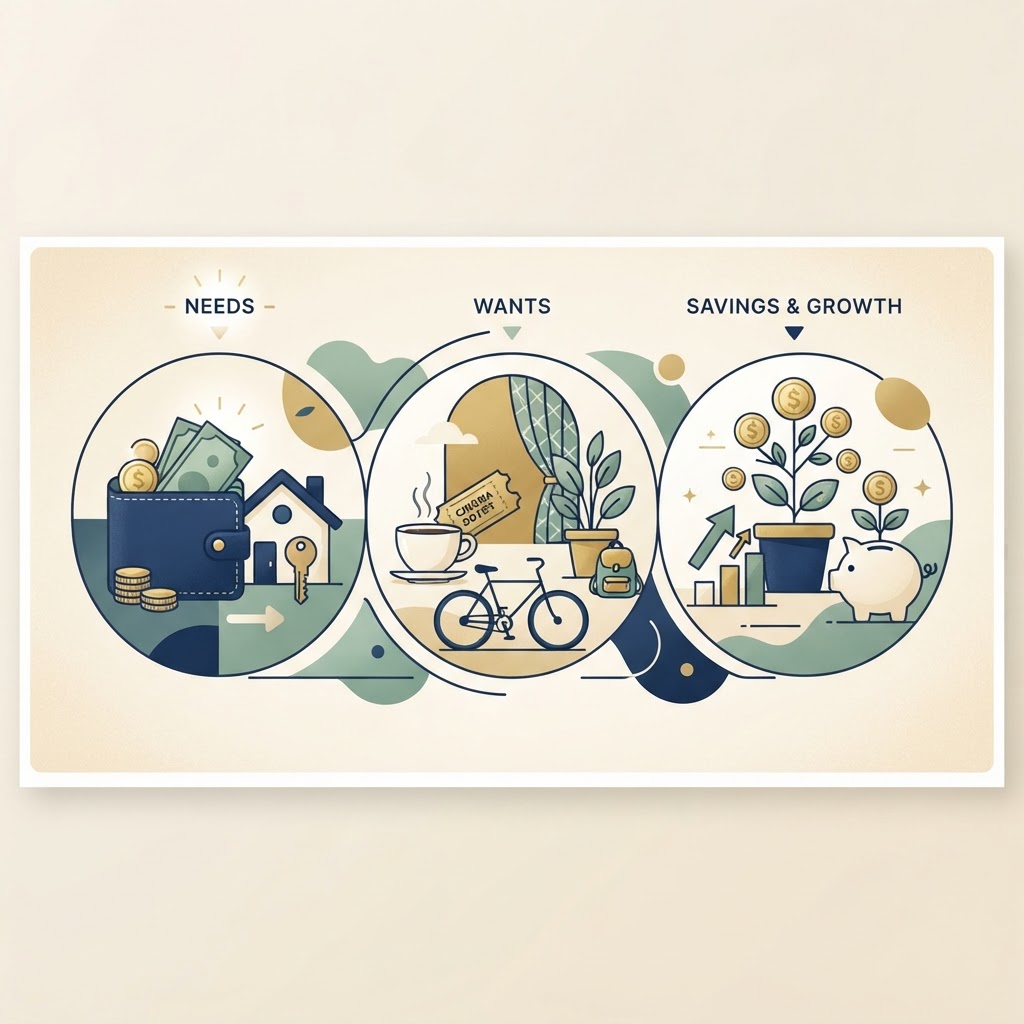
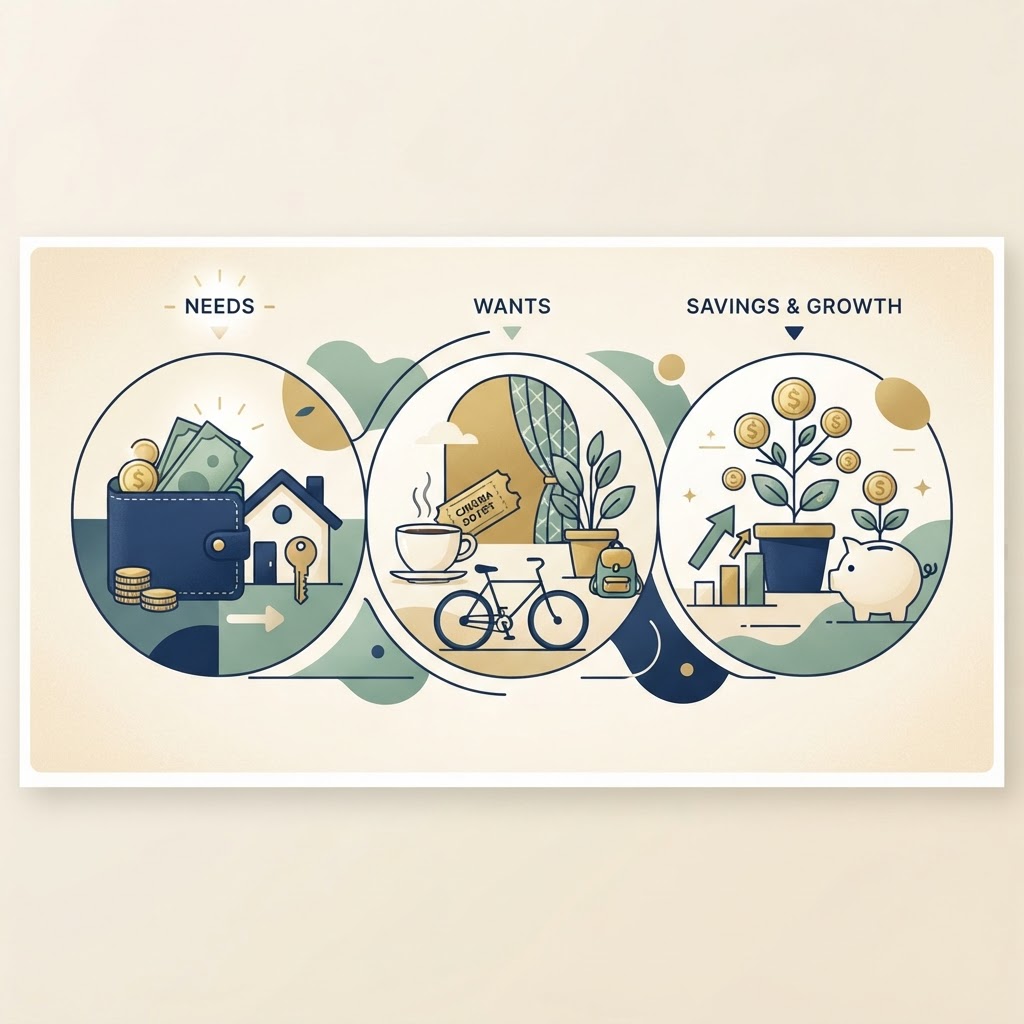
    Start with a short written map of your financial priorities. List recurring bills, minimum debt payments, near-term purchases, emergency cash, retirement, and flexible long-term investing. The purpose is not to create a perfect budget. It is to prevent a long-term investment contribution from quietly competing with a bill that is due next month.

    An emergency reserve is especially important because investments can decline at the exact moment you need cash. The appropriate amount depends on job stability, household obligations, insurance deductibles, dependents, and access to other resources. Someone with variable income may choose a larger reserve than someone with stable income and strong workplace benefits.

    High-interest debt deserves a deliberate comparison. Paying down a balance creates a more predictable benefit than investing in a volatile asset. Some people split the $500 between debt reduction and investing to preserve the habit and capture an employer match; others prioritize debt until the balance is manageable. The best decision depends on the interest rate, penalties, tax treatment, and personal risk tolerance.

    Separate time horizons. Money needed within the next few years generally deserves more stability than money intended for a retirement goal several decades away. A stock-heavy portfolio can be inappropriate for a down payment that must be available on a known date, even if stocks have strong long-run return potential.

    Choose the Right Account Order

    If your employer offers a retirement plan with a matching contribution, learn the match formula and eligibility rules first. A match can add value to your contribution, but it may have vesting, payroll, investment, and withdrawal rules. Read the plan documents instead of relying on a coworker’s summary.

    An individual retirement account may offer different tax treatment and investment choices. Traditional contributions can have tax implications at the time of contribution and withdrawal, while Roth-style contributions generally use after-tax money and may have qualified-withdrawal rules. Eligibility, limits, and treatment vary by jurisdiction and personal circumstances, so confirm details with official tax guidance.

    A taxable brokerage account offers flexibility but does not provide the same retirement tax structure. It may be useful after tax-advantaged space is used, for goals that do not fit retirement rules, or for investors who value access. Taxable dividends, realized gains, and recordkeeping should be part of the decision.

    A simple order for many households is: capture an available employer match, address urgent high-cost debt and essential cash needs, use suitable tax-advantaged accounts, and then invest additional long-term money in a taxable account. This is a framework, not a universal prescription.

    Build a Portfolio You Can Hold

    A portfolio is a collection of assets with different risks, not a list of exciting tickers. Diversification spreads exposure across companies, sectors, regions, and sometimes asset types. It cannot prevent losses, but it can reduce the damage caused by one company, industry, or country performing badly.

    A broad stock fund may provide exposure to many companies in one purchase. A bond fund or other more defensive holding may reduce portfolio swings, though it can also decline and is not a guaranteed cash substitute. The role of each holding should be clear before you buy it.

    Your time horizon and behavior matter. An investor with decades before needing the money may accept more stock-market volatility than someone who expects withdrawals soon. A theoretically aggressive allocation is not useful if a normal 25% decline causes the investor to panic-sell.

    Keep the number of holdings manageable. Five overlapping funds can provide less diversification than one broad fund while making the portfolio harder to monitor. Check what each fund actually owns, its expense ratio, tracking approach, tax consequences, and whether you understand the risks.

    Rebalancing means returning the portfolio toward its intended mix when market movements change it. A calendar review once or twice a year, or a threshold-based approach, can be more disciplined than constant trading. New contributions can often be directed toward underweight holdings without selling.

    Automate the $500 Contribution

    Automation turns a decision into a default. Schedule the transfer for a few days after reliable income arrives, leaving enough room for payroll timing and essential bills. If income is irregular, use a smaller automatic base and add a percentage of each payment when cash flow permits.

    Decide whether the money should be invested immediately or held briefly for a planned purchase. For a long-term goal, delaying every contribution while waiting for a better entry point is a form of market timing. Regular investing does not guarantee a profit, but it reduces the burden of making a fresh emotional decision every month.

    Create a failed-transfer rule. If a transfer bounces, pause the next contribution rather than allowing overdraft fees to compound the problem. The system should be resilient, not punitive. A temporary reduction is better than abandoning the plan because the original amount was too rigid.

    Increase the contribution gradually. A $25 or $50 increase after a raise, debt payoff, or lower recurring bill may be easier to sustain than a dramatic jump. Directing part of a bonus or tax refund to the account can accelerate progress without permanently increasing monthly obligations.

    Handle Market Declines

    Market declines are not a sign that an automatic plan has failed. They are one of the conditions that make long-term returns uncertain. The right response depends on whether the underlying goal, time horizon, income, and portfolio allocation have changed.

    Do not confuse a falling price with a broken investment thesis. A broad fund may decline because the market is repricing many assets. A single company may decline because its business has deteriorated. The distinction is one reason diversified funds can be easier for a busy investor to hold.

    Keep a written do-nothing plan before a stressful period. It can state that you will continue scheduled contributions, avoid checking balances daily, review the allocation on a defined date, and only change the plan if your goal or risk capacity changes. A rule written in calm conditions can be more useful than a decision made during a headline cycle.

    If a decline exposes that the allocation is too aggressive, adjust thoughtfully rather than selling everything. A more balanced allocation may be appropriate, but make the change because the plan was mismatched to your needs, not because you are trying to guess the exact bottom.

    Fees Taxes and Hidden Friction

    Small costs compound too. Compare expense ratios, account fees, transaction charges, advisory fees, and any platform costs. A low advertised fee does not automatically make an investment suitable, but unexplained costs deserve scrutiny before money is committed.

    Taxes depend on account type, asset, jurisdiction, holding period, distributions, and personal circumstances. Tax efficiency is not a reason to ignore diversification or a valuable employer match. Keep records, read tax forms, and use current official guidance or a qualified tax professional for decisions that materially affect your return.

    Turnover can create friction in taxable accounts. Frequent trading may produce more taxable events, spread costs, and emotional mistakes. A long-term contribution plan usually works better when the portfolio is designed to be held rather than constantly replaced.

    When $500 Is Not the Right Number

    The right contribution is one you can maintain without missing essentials. If $500 causes recurring overdrafts or credit-card balances, reduce it temporarily and repair cash flow. A smaller contribution with continuity can be more valuable than an ambitious amount that stops after two months.

    If you receive a large raise, revisit the number. Lifestyle improvements are reasonable, but automatically directing part of new income toward long-term goals can prevent every raise from disappearing into recurring expenses. Make the increase gradual enough that you can observe its effect on cash flow.

    If a major life event occurs, revise the plan rather than treating the original target as a moral obligation. Marriage, a child, a move, job loss, caregiving, or a health expense can change liquidity needs and risk capacity. Pausing or reducing contributions for a period is not failure; failing to update an outdated plan is the bigger problem.

    Common Mistakes to Avoid

    Chasing a past winner is a common mistake. An asset that performed well recently may be popular precisely because expectations are already high. Past performance does not establish what will happen next.

    Investing an emergency fund is another avoidable mismatch. Long-term assets can lose value, and a reserve exists to be available. Keep the two purposes distinct even if the reserve earns less than a volatile investment might earn in a favorable period.

    Ignoring beneficiaries, account access, and basic records can create problems for the people who depend on you. Review beneficiary designations where applicable, keep a secure inventory of accounts, and make sure your household knows how to find important documents without exposing passwords.

    Overcomplicating the plan can hide the real issue. If you cannot explain why an investment belongs in the portfolio, what risk it carries, and when you would sell it, pause before buying. Complexity is not the same as sophistication.

    A 30-Day Setup Checklist

    During week one, write down the goal, deadline, monthly amount, current cash reserve, high-interest debt, and employer benefits. During week two, compare account options and read the fee schedule. During week three, select a diversified allocation that fits the time horizon and set a test transfer. During week four, automate the full contribution and schedule a review six months away.

    At the review, check whether the transfer amount was comfortable, whether the portfolio still matches the goal, and whether any fees or account rules were misunderstood. Do not judge the plan solely by a short-term balance. The first month is about building a reliable process.

    After the system works, add one improvement at a time: increase the amount after a raise, consolidate overlapping holdings, update beneficiaries, or create a separate bucket for a known goal. Small operational improvements can matter more than searching for a perfect forecast.

    Holding period Total deposits at $500/month Planning focus
    1 year $6,000 Automate and build the habit
    5 years $30,000 Match the goal and time horizon
    10 years $60,000 Review fees and allocation
    20 years $120,000 Stay diversified through cycles
    30 years $180,000 Manage risk near the goal

    Illustrative deposits only. These figures exclude investment returns and are not a prediction of account value.

    Frequently Asked Questions

    Is $500 a month enough to retire? It may become an important part of a retirement plan, but no fixed contribution guarantees retirement. The answer depends on starting age, current savings, retirement date, spending needs, taxes, inflation, future contributions, and investment results.

    Should I wait for a market dip? Waiting requires correctly identifying both the dip and the recovery. For money intended for a long-term goal, a regular schedule can reduce hesitation and keep the plan moving.

    Should I pay debt or invest? Compare the debt cost, tax effects, employer match, emergency reserve, and risk tolerance. Capturing an available match may be attractive, while high-cost debt can deserve priority.

    What if I cannot invest every month? Automate a smaller sustainable amount, then add extra contributions when income allows. Fix the process rather than abandoning the habit.

    How often should I check investments? A formal review once or twice a year is enough for many long-term plans, with additional reviews after major life changes. Daily checking can encourage reactions to noise.

    Can I use this for a house deposit? Only after matching investments to the purchase timeline. Money needed soon may require more stable and liquid choices than retirement money.

    Are hypothetical returns reliable? No. They illustrate how time and contributions interact, not what an account will earn. Real returns vary, fees reduce results, taxes may apply, and losses can occur.

    Conclusion

    A $500 monthly investment plan works best as a system, not a prediction. Start by protecting essential cash flow, choose an account that fits the goal, use a diversified allocation you can hold, automate the contribution, and review the arrangement on a sensible schedule.

    The most important decision is the one you can repeat. As income, debt, family responsibilities, and goals change, adjust the plan without abandoning the underlying habit. Consistency does not remove risk, but it gives your savings a chance to participate in long-term growth while keeping the process understandable.

    Financial disclaimer: This article is for educational and informational purposes only and is not financial, investment, tax, or legal advice. Illustrative amounts and hypothetical return scenarios are examples, not promises or forecasts. Investment values can rise or fall, and you may lose money. Consider your own circumstances and consult a qualified, appropriately licensed professional before making decisions. Verify current account rules, fees, limits, and product details directly with the relevant provider or official authority.

    By WealthSimplyPut Editorial Team

    Match the Plan to Your Real-Life Goals

    An investment plan becomes easier to follow when each account has a named purpose. “Build wealth” is inspiring but too broad to guide a decision when the market is noisy. Give the $500 a job such as retirement, financial independence, a future education expense, or a long-term home upgrade. The label should include a rough time horizon and the condition that would cause you to use the money.

    Different goals may deserve different allocations. A retirement goal several decades away can usually tolerate more short-term fluctuation than a tuition payment due next year. A house deposit with a firm purchase date has a different risk problem from a flexible goal. Separating buckets can prevent a decline in one long-term account from forcing a sale to fund an unrelated near-term expense.

    Write down what “enough” means for each goal. For a retirement bucket, that might involve estimating future spending and other income sources. For a home goal, it might include the deposit, closing costs, moving expenses, repairs, and a reserve after the purchase. Estimates will change. Their value is not precision; it is making hidden expenses visible before they become urgent.

    Use a Contribution Ladder

    A contribution ladder gives you a sequence for handling different levels of cash flow. At the base is an amount you can invest even during an ordinary difficult month. The next level might be the portion of a raise, a bonus, a tax refund, or freelance income that you decide to invest. The top level can be an occasional extra contribution when your reserve and obligations are already healthy.

    For example, a household might automate $300 as its dependable base, increase that to $500 after several months of stable expenses, and direct half of windfalls to the account. Another household with predictable income might automate the entire $500 and add a small annual increase. The point is not the exact ladder. The point is making increases systematic instead of depending on motivation.

    Review the ladder after major changes, not every time the market moves. A promotion, a paid-off loan, a new dependent, a job change, or a rent increase can justify a review. If the base amount repeatedly creates stress, lower it. A plan that respects cash flow has a better chance of surviving long enough for time to matter.

    How to Compare Investment Options Without Getting Lost

    Start with the job of the investment. Is it meant to provide broad growth exposure, reduce portfolio volatility, preserve liquidity, or hedge a particular risk? If the job is unclear, a persuasive performance chart can make an unsuitable product look attractive.

    Next, inspect diversification. A fund may hold many securities while still concentrating heavily in one country, sector, company size, or theme. Look beyond the marketing label. Read the provider’s objective, holdings, fees, risks, and tax information. Compare like with like: a broad stock fund is not a direct substitute for a cash reserve, and a bond fund is not identical to a bank deposit.

    Then consider behavior. Ask how you would react if the investment lost 10%, 20%, or more during a broad market decline. This is not a prediction; it is a stress test. If you know you would sell immediately, a less volatile mix may be more suitable even if its long-run growth potential is lower. The best theoretical allocation is not the best practical allocation if you cannot hold it.

    Finally, check the exit rules. Some products may have lockups, penalties, withdrawal restrictions, bid-ask spreads, or tax consequences. Understanding how money comes out is as important as understanding how it goes in.

    Keeping Records and Reviewing the System

    Good records reduce avoidable mistakes. Keep a list of account names, ownership, beneficiaries where applicable, the purpose of each account, contribution instructions, and the location of important documents. Store the information securely and update it after a move, marriage, divorce, birth, death, or account change.

    Use a simple review worksheet. Record the current contribution, the goal and deadline, the intended allocation, major fees, emergency-reserve target, and any debt priority. At the review date, ask five questions: Did the transfer happen? Did cash flow remain comfortable? Has the goal changed? Does the allocation still fit the timeline? Is there any fee or rule I do not understand?

    Do not turn the review into a prediction contest. A one-year result can be dominated by market conditions and says little about whether the process is sound. A contribution that happened on time, a diversified portfolio that remained understandable, and an allocation that still matches the goal are meaningful evidence of progress even when the balance is temporarily down.

    What to Do When You Have Multiple Financial Priorities

    Most households do not have one goal. They may be paying down debt, saving for a move, supporting family, building retirement assets, and trying to enjoy the present. A good plan acknowledges those priorities instead of pretending that every dollar can be optimized for one outcome.

    Make the trade-offs explicit. You could assign the $500 entirely to a retirement account, split it between retirement and a home goal, or use a temporary debt-first phase. Compare each option by asking what risk it reduces, what opportunity it may give up, and how reversible it is. Missing an employer match may be difficult to recover. Delaying a flexible purchase may be easier. A high-cost debt balance may require attention because its cost continues regardless of market conditions.

    There is also a behavioral trade-off. A small investment contribution can preserve momentum and confidence while a larger amount goes toward debt. Conversely, someone overwhelmed by too many transfers may benefit from one priority at a time. Choose a system you can explain to yourself and your household, then put a review date on it so a temporary decision does not become permanent by accident.

    Build a Plan for Changing Markets and Changing Life

    Long-term investing is not a contract to keep the same allocation forever. It is a commitment to make deliberate decisions as the goal approaches. As the date for using the money gets closer, consider whether the portfolio still has enough stability and liquidity for the planned withdrawal. A gradual adjustment can be easier to manage than waiting until the final year and making a rushed change.

    Also distinguish a market change from a life change. A headline may alter prices without altering your goal. A job loss, new caregiving responsibility, or major health expense can alter your ability to accept risk. Review the plan when your circumstances change, and avoid changing it simply because someone online sounds certain about the next market move.

    The $500 habit can remain useful through these transitions even if its destination changes. It might move from a taxable account to a retirement account, from growth-oriented investments to a more balanced mix, or temporarily toward rebuilding cash. A flexible system is not a failed system. It is a system doing its job.

    Final Decision Framework

    Before putting the next $500 to work, answer four questions in writing. What is this money for? When might I need it? What loss could I tolerate without abandoning the plan? Which account and investment make that purpose easiest to understand? If the answers are unclear, keep the money in a suitable liquid place while you research rather than buying something you do not understand.

    Then choose the smallest action that creates momentum: open the appropriate account, confirm the employer match, set the automatic transfer, or make the first contribution. Schedule a future review and stop searching for a perfect answer after the plan is good enough for the goal. Progress comes from repeated sensible actions, not from predicting every turn in the market.

    Build a Plan for Changing Markets and Changing Life

    Long-term investing is not a contract to keep the same allocation forever. It is a commitment to make deliberate decisions as the goal approaches. As the date for using the money gets closer, consider whether the portfolio still has enough stability and liquidity for the planned withdrawal. A gradual adjustment can be easier to manage than waiting until the final year and making a rushed change.

    Also distinguish a market change from a life change. A headline may alter prices without altering your goal. A job loss, new caregiving responsibility, or major health expense can alter your ability to accept risk. Review the plan when your circumstances change, and avoid changing it simply because someone online sounds certain about the next market move.

    The $500 habit can remain useful through these transitions even if its destination changes. It might move from a taxable account to a retirement account, from growth-oriented investments to a more balanced mix, or temporarily toward rebuilding cash. A flexible system is not a failed system. It is a system doing its job.

    Final Decision Framework

    Before putting the next $500 to work, answer four questions in writing. What is this money for? When might I need it? What loss could I tolerate without abandoning the plan? Which account and investment make that purpose easiest to understand? If the answers are unclear, keep the money in a suitable liquid place while you research rather than buying something you do not understand.

    Then choose the smallest action that creates momentum: open the appropriate account, confirm the employer match, set the automatic transfer, or make the first contribution. Schedule a future review and stop searching for a perfect answer after the plan is good enough for the goal. Progress comes from repeated sensible actions, not from predicting every turn in the market.

    Keep expectations realistic. Even a disciplined investor will experience periods when the balance falls, contributions feel slow, or an important goal changes. Review the controllable pieces: the amount saved, the cost paid, the account used, the diversification, and the decision to remain invested. These habits do not guarantee a result, but they improve the quality of the decisions that shape one.

    Finally, communicate the plan with anyone who shares the household budget. Agreement about the purpose, monthly amount, emergency reserve, and review date can prevent one person from treating investing as a secret experiment. A shared plan is easier to maintain when both people understand the trade-offs and know what to do if income or priorities change.


  • How Much House Can I Afford? A Practical Home-Buying Budget Guide

    How Much House Can I Afford? A Practical Home-Buying Budget Guide

    🏷️ Category: Budgeting

    By WealthSimplyPut Editorial Team

    Financial disclaimer: This article is for general educational purposes only and is not personalized financial, tax, legal, lending, or housing advice. Examples and figures are illustrative, not current quotes or promises. Mortgage rules, rates, insurance costs, taxes, and eligibility vary by location and borrower. Verify current details with qualified professionals and official providers before making a decision.

    Buying a home is one of the largest financial decisions most households make, yet many people begin with the wrong question. They ask, “What mortgage payment would a lender approve?” A better question is, “What monthly housing cost can my household comfortably carry while still saving, handling surprises, and enjoying normal life?” The difference between approval and affordability is where many future homeowners get into trouble.

    This guide gives you a practical framework for answering that question. It covers income, recurring debt, down payment, closing costs, property taxes, insurance, maintenance, reserves, credit, loan structure, and the non-financial realities of homeownership. The goal is not to produce a magical maximum price. It is to help you set a ceiling that fits your actual priorities and leaves room for the unexpected.

    Key Takeaways

    • A lender’s maximum approval is not the same as a sustainable household budget.
    • Calculate the full housing cost: principal, interest, taxes, insurance, association fees, maintenance, utilities, and a reserve contribution.
    • Use conservative income assumptions and include every recurring debt payment before choosing a target price.
    • Keep emergency savings separate from the down payment whenever possible; a house can create large expenses immediately after closing.
    • Compare scenarios rather than relying on one calculator. Test higher taxes, insurance, repairs, income changes, and a less favorable loan estimate.
    • The right home is one that supports your broader plan, not one that consumes every available dollar.

    1. Start With a Comfortable Monthly Housing Budget

    Begin with the payment your life can support, not with a listing price. Review the last three months of bank and card statements and identify reliable take-home income, recurring obligations, flexible spending, savings contributions, and irregular expenses. If income varies because of commissions, overtime, self-employment, seasonal work, or bonuses, build the budget around a conservative baseline. Treat unusually strong months as upside rather than as money required to make the payment.

    A useful first pass is to choose a housing target as a portion of stable gross income, but percentages are only guardrails. A household with childcare, student loans, medical costs, or an irregular income may need a lower target. Another household with no consumer debt and substantial reserves may have more room. The number should be tested against actual cash flow, not defended because a rule of thumb says it is acceptable.

    Write down three numbers: a comfortable monthly housing budget, a maximum payment you would tolerate for a short period, and a payment that would make you feel financially trapped. Use the first number for your search. The second is a stress-test boundary, not a goal. The third helps you recognize a deal that may look attractive on paper but would reduce your flexibility.

    Do not forget that rent often bundles some costs that ownership separates. A homeowner may pay utilities directly, arrange trash service, handle pest control, buy tools, and pay for repairs. If your current rent is lower than your proposed mortgage payment, compare the full ownership cost rather than comparing rent with principal and interest alone.

    2. Calculate the Full Cost of Owning a Home

    The principal-and-interest payment is only one line on the housing budget. Your complete monthly estimate should include property taxes, homeowners insurance, mortgage insurance if applicable, association dues, utilities, routine maintenance, and a reserve for larger replacements. Some costs are collected by the lender in escrow and others are paid directly, but they all come from the same household cash flow.

    Cost What to check Budget treatment
    Principal and interest Loan amount, term, rate, points Fixed monthly estimate
    Property taxes Local assessment and reassessment rules Use a conservative estimate
    Insurance Replacement coverage, deductible, hazards Verify with providers
    Association fees Dues, special assessments, restrictions Include monthly and irregular charges
    Maintenance Age, condition, systems, exterior Create a separate reserve

    Maintenance is particularly easy to underestimate because it is uneven. A home may be inexpensive for several months and then need a plumbing repair, appliance replacement, roof work, or heating and cooling service. A simple reserve contribution makes the budget more honest. The appropriate amount depends on the home’s age, size, condition, climate, and your ability to do minor work yourself; use a range and increase it for an older property.

    Utilities also change with the property. A larger home, different insulation, electric heating, a pool, or a long commute can materially change monthly spending. Ask for recent utility history when possible, but treat it as a reference rather than a guarantee.

    3. Understand the Income and Debt Side of the Equation

    Lenders review income and recurring debts using underwriting rules. Your household should perform a broader review. Include car loans, student loans, credit-card minimums, personal loans, alimony or support obligations, recurring medical payments, and any installment debt that may not appear in a quick mental calculation. Also include financial commitments you voluntarily make, such as retirement contributions, family support, tuition savings, or regular charitable giving.

    Debt-to-income ratios can help you understand how a lender may view the application, but passing a ratio test does not guarantee comfort. A ratio may not capture childcare, groceries, transportation, subscriptions, travel, or the cost of maintaining an older vehicle. It also may not reflect a future goal such as changing careers, starting a business, or reducing work hours.

    Use reliable income rather than aspirational income. For a two-income household, run at least one scenario using only the stronger or more stable income. This does not mean the second income is unimportant; it shows whether the household has a plan if one job disappears, a caregiver role changes, or a major life event interrupts earnings.

    If you are self-employed, newly employed, paid in restricted stock, or relying on variable compensation, ask a lender how income will be documented, then make your own conservative calculation. Approval documentation and personal affordability are related but different questions.

    4. Down Payment, Closing Costs, and Cash Reserves

    The down payment is only one part of the cash required to buy. Buyers may also face lender fees, appraisal and inspection costs, title or settlement charges, prepaid interest, insurance premiums, property-tax adjustments, moving expenses, immediate repairs, furnishings, and deposits for utilities or services. The exact structure varies by transaction and location, so obtain a written estimate and ask what could change.

    A larger down payment can reduce the loan balance and may affect mortgage insurance, but using every dollar for the down payment can leave a household exposed. Homeownership is safer when you retain a separate emergency fund and a property reserve after closing. If the purchase would leave you with almost no liquid cash, lower the price, delay the purchase, increase savings, or reconsider the structure.

    Think in layers of cash. Layer one is the transaction money required to close. Layer two is your general emergency fund for job loss, health events, and ordinary life surprises. Layer three is a home reserve for repairs and replacements. The layers do not need to be identical for every buyer, but combining all three into one depleted account creates avoidable risk.

    Gift funds, assistance programs, and low-down-payment options can be useful, but understand their conditions. Some programs have income, location, occupancy, repayment, or resale requirements. Ask for the long-term cost, not only the amount needed on closing day.

    5. Compare Loan Scenarios Instead of Chasing a Maximum

    Compare at least two or three realistic financing scenarios. A longer loan term may lower the required payment but increase total interest over time. A shorter term may build equity faster but reduce monthly flexibility. Adjustable structures can begin with a different payment and later change according to their terms. Points and credits can alter upfront and ongoing costs. None is automatically best; the right choice depends on how long you expect to own the property, how stable your income is, and how much liquidity you value.

    Scenario Potential advantage Question to ask
    Lower upfront cash Preserves liquidity Are monthly insurance or other costs higher?
    Larger down payment Smaller loan balance Will reserves remain adequate?
    Longer term Lower required payment How will you use the monthly flexibility?
    Shorter term Faster principal reduction Can income handle interruptions?

    Use the same home price when comparing loans so you can isolate financing differences. Then use the same loan structure while comparing homes. This prevents a low payment from hiding a higher purchase price or a cheaper home from hiding unfavorable terms.

    Never treat an advertised rate or payment as your personal quote. Rates, fees, points, credit, property type, occupancy, loan-to-value, and market conditions matter. Request official estimates, confirm assumptions, and verify all current terms directly with the lender.

    6. A Worked Illustrative Example

    Consider a fictional household with stable gross income of $90,000 per year, no credit-card balance, one auto payment, and a goal of continuing retirement savings. These numbers are illustrative only and are not a recommendation. The household first sets a comfortable all-in housing budget of $2,300 per month. It then estimates principal and interest at $1,650, taxes and insurance at $350, association dues at $100, and a maintenance reserve of $200. The total is $2,300.

    Before shopping, the household tests a less favorable case: taxes and insurance are $125 higher, utilities are $75 higher, and the home needs an average of $150 more in reserve contributions than expected. The stress-tested cost becomes $2,650. If that amount would require stopping retirement contributions, using credit cards for ordinary repairs, or eliminating every discretionary activity, the original target is too high even if a lender approves it.

    Next, the household tests a job interruption. One income temporarily falls, and the household uses its emergency fund rather than borrowing. The question is not whether the budget remains perfect; it is whether there is a credible plan and enough liquidity to avoid a crisis. If the answer is no, the buyers may choose a smaller home, wait and save, or preserve a larger cash cushion.

    The value of this exercise is not the exact numbers. It is the habit of testing the purchase against multiple futures. A home decision should survive reasonable bad news, not only the best month of your financial life.

    7. Location Changes Affordability

    The same purchase price can represent very different monthly costs in different areas. Property taxes, insurance availability, association fees, transportation, utilities, and local assessments vary widely. A home farther from work may have a lower price but higher commuting costs and less time. A neighborhood with lower dues may require more owner responsibility for roads, services, or exterior maintenance.

    Build a location comparison that includes the costs you will actually experience. Estimate commuting miles, parking, transit, childcare logistics, school-related expenses, and the time cost of the move. If the home changes your vehicle needs, include the payment, insurance, fuel, and maintenance difference. Housing is not isolated from the rest of the budget.

    Also research insurance conditions and local hazards. A property may require additional coverage, have a high deductible, or face costs connected to flooding, wind, wildfire, earthquakes, or other risks. Do not assume a standard policy covers every hazard. Ask providers for current quotes and coverage explanations before becoming emotionally committed to a property.

    8. Credit, Inspection, and Negotiation Preparation

    Your credit profile can influence loan eligibility and pricing, but improving it should not mean taking on new debt or making unexplained financial moves shortly before applying. Review reports for errors, pay obligations on time, keep balances manageable, and ask lenders how major changes could affect underwriting. Avoid opening unnecessary accounts or financing large purchases while a mortgage application is active unless you understand the impact.

    An inspection is not a guarantee that nothing will break. It is a way to learn about condition, safety, age, and likely maintenance. Pay attention to the roof, foundation, drainage, electrical system, plumbing, heating and cooling, windows, appliances, and signs of moisture. Ask which items are immediate, which are likely within several years, and which are normal upkeep.

    Use inspection information to improve the budget, not only to negotiate the price. A repair credit may help at closing, but it does not remove the long-term cost of ownership. If the home needs major work, ask whether you have the cash, time, skills, and contractor access to handle it. A house can be affordable at purchase and unaffordable after necessary repairs.

    9. Red Flags That the Home Is Too Expensive

    • You would need bonuses, overtime, or side income every month to make the payment.
    • Closing would leave you with no emergency fund or no capacity for repairs.
    • You would stop retirement contributions or miss other important goals indefinitely.
    • The budget works only if taxes, insurance, utilities, and maintenance stay at unusually low levels.
    • You are counting on refinancing, a future raise, a roommate, or a quick home-value increase to make the purchase work.
    • You are using credit cards for moving, furnishing, repairs, or ordinary expenses immediately after closing.
    • You feel pressure to waive reasonable due diligence because of competition or urgency.

    Any one of these deserves a pause. Several together are a strong signal to reduce the target price or wait. The purpose of a budget is to protect your future self from decisions made under excitement or fear.

    10. A Home Affordability Worksheet

    Complete this worksheet before requesting serious loan estimates:

    1. Monthly stable take-home income: ______
    2. Monthly recurring debt payments: ______
    3. Monthly essential living costs excluding housing: ______
    4. Monthly savings and investing goals: ______
    5. Monthly flexible spending you want to preserve: ______
    6. Target all-in housing budget: ______
    7. Estimated taxes and insurance: ______
    8. Association fees and utilities: ______
    9. Maintenance and replacement reserve: ______
    10. Amount available for closing while preserving emergency savings: ______
    11. Stress-tested housing budget after higher costs: ______

    Subtract the non-housing commitments from stable income first. The remaining amount is not automatically available for housing; it must also accommodate irregular costs and a margin for uncertainty. Once you choose an all-in target, work backward with a lender or calculator to estimate a purchase-price range. Recheck the result using local taxes, insurance quotes, and actual property listings.

    Frequently Asked Questions

    What percentage of income should go to housing?

    There is no universal percentage that fits every household. Common guidelines can provide a starting point, but debt, taxes, childcare, health costs, income stability, and savings goals matter more than a single ratio. Use the guideline as a screening tool, then validate it against your actual monthly budget and a stress test.

    Should I use gross or take-home income?

    Gross income is often used in lender calculations, while take-home income is more useful for everyday cash-flow planning. Review both: gross income helps you understand underwriting, and take-home income shows what must cover housing, food, transportation, savings, and life.

    Is a 20% down payment always necessary?

    No. Different loan and assistance options may allow different down payments, but a smaller down payment can affect monthly insurance, loan cost, cash reserves, and total interest. Compare the complete cost and avoid using all available cash simply to reach a target percentage.

    How much should I keep after closing?

    The appropriate reserve depends on income stability, dependents, health, the home’s age, and the likely repair profile. Keep general emergency savings separate from a home reserve when possible. A buyer who has no liquidity after closing is exposed even if the monthly payment looks manageable.

    Can I count rental income or a roommate?

    Only count it if the arrangement is legal, realistic, and sustainable, and understand that a lender may apply its own documentation rules. Your personal budget should also work if the room is vacant, the tenant leaves, or expenses are higher than expected.

    Should I buy now or wait?

    Market timing is uncertain. Focus on readiness: stable income, adequate cash, manageable debt, a long enough expected ownership period, and a home that fits your budget. Waiting can be wise if the purchase would leave you financially fragile; buying can make sense when the fundamentals are sound and the home serves your needs.

    Conclusion: Choose Flexibility Over the Maximum

    How much house you can afford is not a number a calculator can decide for you. It is the intersection of stable income, complete ownership costs, cash reserves, debt, priorities, and tolerance for uncertainty. The best purchase price is usually below the maximum a lender will approve because a comfortable household needs room for savings, repairs, career changes, family needs, and ordinary enjoyment.

    Build your budget from the inside out. Start with the life you want to protect, subtract the commitments that matter, price the full cost of ownership, and test the result against realistic bad news. Compare financing options carefully, verify current costs, and keep enough liquidity after closing to handle the home you are buying.

    A home should be a place to live, not a permanent financial emergency. Choosing a sustainable payment may mean buying less house, waiting longer, or saving more. Those choices are not failures. They are how you make homeownership support your broader financial life.

    11. Stress-Test the Budget Before You Make an Offer

    A strong affordability process tests more than the payment shown by an online calculator. Build a base case, a cautious case, and a difficult-but-plausible case. In the base case, use the best information you have for income, taxes, insurance, utilities, and maintenance. In the cautious case, use higher estimates for costs that are uncertain and assume savings goals continue. In the difficult case, model a temporary income reduction, a major repair, or an insurance renewal that costs more than expected.

    For example, imagine a household whose proposed all-in payment is $2,400 per month. The base case may look manageable. The cautious case might add $150 for taxes and insurance uncertainty, $100 for utilities, and $200 for a repair reserve. The difficult case might also remove one income for three months. The purpose is not to predict the future with precision. It is to determine whether the household has a buffer, a reserve, or a plan when conditions are not ideal.

    Review the stress test with anyone sharing financial responsibility for the home. A budget can fail when one person understands only the principal-and-interest figure while the other is carrying the full list of taxes, maintenance, and irregular bills. Agreement before the offer is healthier than conflict after closing.

    Questions for your stress test

    • What happens if property taxes are reassessed?
    • What happens if the insurance premium rises or a separate hazard policy is required?
    • Could the household cover a deductible and a major repair in the same year?
    • Could you keep making the payment after a job change or temporary leave?
    • What spending would you reduce first, and would those reductions be realistic?

    If the answers depend on borrowing, selling investments at a bad time, or receiving money that is not guaranteed, reduce the target. A home budget should have a plan for uncertainty that does not rely on optimism.

    12. Renting Versus Buying: Compare the Lives, Not Just the Payments

    Renting and buying provide different combinations of cost, control, mobility, and responsibility. Renting may offer flexibility and predictable maintenance responsibilities, while buying may provide stability and the opportunity to build equity. Neither is automatically the financially superior choice in every market or for every person. The comparison depends on how long you expect to stay, transaction costs, the property’s condition, local rents, financing terms, and what you would do with money not invested in the home.

    Consideration Renting Buying
    Mobility Usually easier to move at lease end Selling takes time and costs money
    Maintenance Often handled by the owner Owner carries repairs and replacements
    Payment risk Rent can change at renewal Some loan payments are more predictable, but taxes and insurance can change
    Equity No ownership equity from rent itself Principal payments may build equity over time

    When comparing, include the opportunity cost of the down payment and closing cash. Money used for a home cannot simultaneously remain available for an emergency, investment, education, or business opportunity. On the other hand, ownership can create stability that is valuable even when it is not captured in a spreadsheet. A household that expects to move soon may value flexibility more than a household settling near family for many years.

    Avoid comparing rent with only principal and interest. Compare rent with taxes, insurance, dues, maintenance, utilities, and the opportunity cost of cash. Also avoid assuming every dollar of a mortgage payment is “lost”; principal reduction changes your balance sheet, while interest and operating costs are expenses. The fair comparison is complicated, which is why a simple slogan rarely answers the question.

    13. Plan for the First Two Years After Closing

    The first two years of ownership deserve their own plan. New owners often underestimate the combined cost of moving, furnishing, tools, window coverings, small repairs, service calls, and improvements that seemed optional until daily life began. Set a furnishing budget and prioritize safety, function, and durability over completing every room immediately.

    Create a home maintenance calendar. Record the age and condition of major systems, change filters according to manufacturer guidance, inspect for leaks or moisture, clean and service equipment as appropriate, and keep receipts and warranties in one place. A calendar turns maintenance into a manageable routine instead of a series of emergencies. Do not undertake major work solely because a social-media renovation looks appealing; understand permits, insurance, resale implications, and total cost first.

    Keep a separate list of future replacements. If the roof, water heater, heating system, or appliances are older, their remaining life may be uncertain. Assign each item a rough planning horizon and contribute regularly to a reserve. The figures are estimates, not promises, but planning is better than being surprised by a known aging system.

    Revisit the household budget quarterly during the first year. Compare actual spending with the estimate, update insurance and tax assumptions, and identify categories that changed because of the move. If the home is consistently more expensive than expected, act early by adjusting discretionary spending, rebuilding reserves, or seeking professional guidance. Small corrections are easier than recovering from a large balance on high-cost debt.

    14. How to Use Online Affordability Calculators Wisely

    Online calculators are useful for exploring scenarios, but they are not approval decisions or personal advice. Before trusting a result, inspect its assumptions. Does it include taxes and insurance? Does it assume a down payment, loan term, or rate that may not apply? Does it include association dues, mortgage insurance, maintenance, utilities, and other debts? Does it use gross income while presenting the output as spendable cash?

    Run the calculator several times rather than entering one number and treating it as an answer. Change the down payment, price, term, tax estimate, insurance estimate, and interest assumption. Observe which inputs have the largest impact. Then take the results to a written household budget. A calculator cannot know whether you plan to support a parent, save for a child’s education, change careers, or retire early.

    When speaking with lenders, ask for the total monthly payment and the estimated cash to close, not just the interest rate. Ask which costs are included, which may change, what is escrowed, and whether there are points, credits, mortgage insurance, or other charges. Compare official estimates on the same assumptions. Keep copies so you can see what changed as the purchase progresses.

    15. A Decision Checklist for the Final Week

    Before committing, complete a final review when emotions are high and the transaction feels urgent:

    1. Confirm stable income and list every recurring debt.
    2. Review the complete payment, including taxes, insurance, dues, utilities, and reserves.
    3. Confirm cash needed to close and cash remaining afterward.
    4. Review inspection findings and expected near-term repairs.
    5. Verify current insurance availability and deductibles.
    6. Run the cautious and difficult budget scenarios.
    7. Confirm the home fits your expected time horizon and daily routine.
    8. Read the loan and purchase documents carefully and ask about unfamiliar terms.
    9. Decide which financial goals will continue after closing.
    10. Give yourself permission to walk away if the numbers no longer work.

    Walking away from a home is emotionally difficult, but changing course before closing is usually less costly than accepting a payment that strains the household for years. A good purchase can survive careful questions. A fragile purchase often depends on avoiding them.

    Editorial note: Housing decisions involve substantial and sometimes irreversible commitments. Review the actual property documents, obtain current written estimates, and consult appropriately qualified professionals for your situation. WealthSimplyPut Editorial Team does not receive an endorsement from, or represent, any lender, insurer, real-estate brokerage, or financial institution mentioned by readers or third parties.

  • How Much House Can I Afford? A Practical Home-Buying Budget Guide

    How Much House Can I Afford? A Practical Home-Buying Budget Guide

    🏷️ Category: Budgeting

    By WealthSimplyPut Editorial Team

    Financial disclaimer: This article is for general educational purposes only and is not personalized financial, tax, legal, lending, or housing advice. Examples and figures are illustrative, not current quotes or promises. Mortgage rules, rates, insurance costs, taxes, and eligibility vary by location and borrower. Verify current details with qualified professionals and official providers before making a decision.

    Buying a home is one of the largest financial decisions most households make, yet many people begin with the wrong question. They ask, “What mortgage payment would a lender approve?” A better question is, “What monthly housing cost can my household comfortably carry while still saving, handling surprises, and enjoying normal life?” The difference between approval and affordability is where many future homeowners get into trouble.

    This guide gives you a practical framework for answering that question. It covers income, recurring debt, down payment, closing costs, property taxes, insurance, maintenance, reserves, credit, loan structure, and the non-financial realities of homeownership. The goal is not to produce a magical maximum price. It is to help you set a ceiling that fits your actual priorities and leaves room for the unexpected.

    Key Takeaways

    • A lender’s maximum approval is not the same as a sustainable household budget.
    • Calculate the full housing cost: principal, interest, taxes, insurance, association fees, maintenance, utilities, and a reserve contribution.
    • Use conservative income assumptions and include every recurring debt payment before choosing a target price.
    • Keep emergency savings separate from the down payment whenever possible; a house can create large expenses immediately after closing.
    • Compare scenarios rather than relying on one calculator. Test higher taxes, insurance, repairs, income changes, and a less favorable loan estimate.
    • The right home is one that supports your broader plan, not one that consumes every available dollar.

    1. Start With a Comfortable Monthly Housing Budget

    Begin with the payment your life can support, not with a listing price. Review the last three months of bank and card statements and identify reliable take-home income, recurring obligations, flexible spending, savings contributions, and irregular expenses. If income varies because of commissions, overtime, self-employment, seasonal work, or bonuses, build the budget around a conservative baseline. Treat unusually strong months as upside rather than as money required to make the payment.

    A useful first pass is to choose a housing target as a portion of stable gross income, but percentages are only guardrails. A household with childcare, student loans, medical costs, or an irregular income may need a lower target. Another household with no consumer debt and substantial reserves may have more room. The number should be tested against actual cash flow, not defended because a rule of thumb says it is acceptable.

    Write down three numbers: a comfortable monthly housing budget, a maximum payment you would tolerate for a short period, and a payment that would make you feel financially trapped. Use the first number for your search. The second is a stress-test boundary, not a goal. The third helps you recognize a deal that may look attractive on paper but would reduce your flexibility.

    Do not forget that rent often bundles some costs that ownership separates. A homeowner may pay utilities directly, arrange trash service, handle pest control, buy tools, and pay for repairs. If your current rent is lower than your proposed mortgage payment, compare the full ownership cost rather than comparing rent with principal and interest alone.

    2. Calculate the Full Cost of Owning a Home

    The principal-and-interest payment is only one line on the housing budget. Your complete monthly estimate should include property taxes, homeowners insurance, mortgage insurance if applicable, association dues, utilities, routine maintenance, and a reserve for larger replacements. Some costs are collected by the lender in escrow and others are paid directly, but they all come from the same household cash flow.

    Cost What to check Budget treatment
    Principal and interest Loan amount, term, rate, points Fixed monthly estimate
    Property taxes Local assessment and reassessment rules Use a conservative estimate
    Insurance Replacement coverage, deductible, hazards Verify with providers
    Association fees Dues, special assessments, restrictions Include monthly and irregular charges
    Maintenance Age, condition, systems, exterior Create a separate reserve

    Maintenance is particularly easy to underestimate because it is uneven. A home may be inexpensive for several months and then need a plumbing repair, appliance replacement, roof work, or heating and cooling service. A simple reserve contribution makes the budget more honest. The appropriate amount depends on the home’s age, size, condition, climate, and your ability to do minor work yourself; use a range and increase it for an older property.

    Utilities also change with the property. A larger home, different insulation, electric heating, a pool, or a long commute can materially change monthly spending. Ask for recent utility history when possible, but treat it as a reference rather than a guarantee.

    3. Understand the Income and Debt Side of the Equation

    Lenders review income and recurring debts using underwriting rules. Your household should perform a broader review. Include car loans, student loans, credit-card minimums, personal loans, alimony or support obligations, recurring medical payments, and any installment debt that may not appear in a quick mental calculation. Also include financial commitments you voluntarily make, such as retirement contributions, family support, tuition savings, or regular charitable giving.

    Debt-to-income ratios can help you understand how a lender may view the application, but passing a ratio test does not guarantee comfort. A ratio may not capture childcare, groceries, transportation, subscriptions, travel, or the cost of maintaining an older vehicle. It also may not reflect a future goal such as changing careers, starting a business, or reducing work hours.

    Use reliable income rather than aspirational income. For a two-income household, run at least one scenario using only the stronger or more stable income. This does not mean the second income is unimportant; it shows whether the household has a plan if one job disappears, a caregiver role changes, or a major life event interrupts earnings.

    If you are self-employed, newly employed, paid in restricted stock, or relying on variable compensation, ask a lender how income will be documented, then make your own conservative calculation. Approval documentation and personal affordability are related but different questions.

    4. Down Payment, Closing Costs, and Cash Reserves

    The down payment is only one part of the cash required to buy. Buyers may also face lender fees, appraisal and inspection costs, title or settlement charges, prepaid interest, insurance premiums, property-tax adjustments, moving expenses, immediate repairs, furnishings, and deposits for utilities or services. The exact structure varies by transaction and location, so obtain a written estimate and ask what could change.

    A larger down payment can reduce the loan balance and may affect mortgage insurance, but using every dollar for the down payment can leave a household exposed. Homeownership is safer when you retain a separate emergency fund and a property reserve after closing. If the purchase would leave you with almost no liquid cash, lower the price, delay the purchase, increase savings, or reconsider the structure.

    Think in layers of cash. Layer one is the transaction money required to close. Layer two is your general emergency fund for job loss, health events, and ordinary life surprises. Layer three is a home reserve for repairs and replacements. The layers do not need to be identical for every buyer, but combining all three into one depleted account creates avoidable risk.

    Gift funds, assistance programs, and low-down-payment options can be useful, but understand their conditions. Some programs have income, location, occupancy, repayment, or resale requirements. Ask for the long-term cost, not only the amount needed on closing day.

    5. Compare Loan Scenarios Instead of Chasing a Maximum

    Compare at least two or three realistic financing scenarios. A longer loan term may lower the required payment but increase total interest over time. A shorter term may build equity faster but reduce monthly flexibility. Adjustable structures can begin with a different payment and later change according to their terms. Points and credits can alter upfront and ongoing costs. None is automatically best; the right choice depends on how long you expect to own the property, how stable your income is, and how much liquidity you value.

    Scenario Potential advantage Question to ask
    Lower upfront cash Preserves liquidity Are monthly insurance or other costs higher?
    Larger down payment Smaller loan balance Will reserves remain adequate?
    Longer term Lower required payment How will you use the monthly flexibility?
    Shorter term Faster principal reduction Can income handle interruptions?

    Use the same home price when comparing loans so you can isolate financing differences. Then use the same loan structure while comparing homes. This prevents a low payment from hiding a higher purchase price or a cheaper home from hiding unfavorable terms.

    Never treat an advertised rate or payment as your personal quote. Rates, fees, points, credit, property type, occupancy, loan-to-value, and market conditions matter. Request official estimates, confirm assumptions, and verify all current terms directly with the lender.

    6. A Worked Illustrative Example

    Consider a fictional household with stable gross income of $90,000 per year, no credit-card balance, one auto payment, and a goal of continuing retirement savings. These numbers are illustrative only and are not a recommendation. The household first sets a comfortable all-in housing budget of $2,300 per month. It then estimates principal and interest at $1,650, taxes and insurance at $350, association dues at $100, and a maintenance reserve of $200. The total is $2,300.

    Before shopping, the household tests a less favorable case: taxes and insurance are $125 higher, utilities are $75 higher, and the home needs an average of $150 more in reserve contributions than expected. The stress-tested cost becomes $2,650. If that amount would require stopping retirement contributions, using credit cards for ordinary repairs, or eliminating every discretionary activity, the original target is too high even if a lender approves it.

    Next, the household tests a job interruption. One income temporarily falls, and the household uses its emergency fund rather than borrowing. The question is not whether the budget remains perfect; it is whether there is a credible plan and enough liquidity to avoid a crisis. If the answer is no, the buyers may choose a smaller home, wait and save, or preserve a larger cash cushion.

    The value of this exercise is not the exact numbers. It is the habit of testing the purchase against multiple futures. A home decision should survive reasonable bad news, not only the best month of your financial life.

    7. Location Changes Affordability

    The same purchase price can represent very different monthly costs in different areas. Property taxes, insurance availability, association fees, transportation, utilities, and local assessments vary widely. A home farther from work may have a lower price but higher commuting costs and less time. A neighborhood with lower dues may require more owner responsibility for roads, services, or exterior maintenance.

    Build a location comparison that includes the costs you will actually experience. Estimate commuting miles, parking, transit, childcare logistics, school-related expenses, and the time cost of the move. If the home changes your vehicle needs, include the payment, insurance, fuel, and maintenance difference. Housing is not isolated from the rest of the budget.

    Also research insurance conditions and local hazards. A property may require additional coverage, have a high deductible, or face costs connected to flooding, wind, wildfire, earthquakes, or other risks. Do not assume a standard policy covers every hazard. Ask providers for current quotes and coverage explanations before becoming emotionally committed to a property.

    8. Credit, Inspection, and Negotiation Preparation

    Your credit profile can influence loan eligibility and pricing, but improving it should not mean taking on new debt or making unexplained financial moves shortly before applying. Review reports for errors, pay obligations on time, keep balances manageable, and ask lenders how major changes could affect underwriting. Avoid opening unnecessary accounts or financing large purchases while a mortgage application is active unless you understand the impact.

    An inspection is not a guarantee that nothing will break. It is a way to learn about condition, safety, age, and likely maintenance. Pay attention to the roof, foundation, drainage, electrical system, plumbing, heating and cooling, windows, appliances, and signs of moisture. Ask which items are immediate, which are likely within several years, and which are normal upkeep.

    Use inspection information to improve the budget, not only to negotiate the price. A repair credit may help at closing, but it does not remove the long-term cost of ownership. If the home needs major work, ask whether you have the cash, time, skills, and contractor access to handle it. A house can be affordable at purchase and unaffordable after necessary repairs.

    9. Red Flags That the Home Is Too Expensive

    • You would need bonuses, overtime, or side income every month to make the payment.
    • Closing would leave you with no emergency fund or no capacity for repairs.
    • You would stop retirement contributions or miss other important goals indefinitely.
    • The budget works only if taxes, insurance, utilities, and maintenance stay at unusually low levels.
    • You are counting on refinancing, a future raise, a roommate, or a quick home-value increase to make the purchase work.
    • You are using credit cards for moving, furnishing, repairs, or ordinary expenses immediately after closing.
    • You feel pressure to waive reasonable due diligence because of competition or urgency.

    Any one of these deserves a pause. Several together are a strong signal to reduce the target price or wait. The purpose of a budget is to protect your future self from decisions made under excitement or fear.

    10. A Home Affordability Worksheet

    Complete this worksheet before requesting serious loan estimates:

    1. Monthly stable take-home income: ______
    2. Monthly recurring debt payments: ______
    3. Monthly essential living costs excluding housing: ______
    4. Monthly savings and investing goals: ______
    5. Monthly flexible spending you want to preserve: ______
    6. Target all-in housing budget: ______
    7. Estimated taxes and insurance: ______
    8. Association fees and utilities: ______
    9. Maintenance and replacement reserve: ______
    10. Amount available for closing while preserving emergency savings: ______
    11. Stress-tested housing budget after higher costs: ______

    Subtract the non-housing commitments from stable income first. The remaining amount is not automatically available for housing; it must also accommodate irregular costs and a margin for uncertainty. Once you choose an all-in target, work backward with a lender or calculator to estimate a purchase-price range. Recheck the result using local taxes, insurance quotes, and actual property listings.

    Frequently Asked Questions

    What percentage of income should go to housing?

    There is no universal percentage that fits every household. Common guidelines can provide a starting point, but debt, taxes, childcare, health costs, income stability, and savings goals matter more than a single ratio. Use the guideline as a screening tool, then validate it against your actual monthly budget and a stress test.

    Should I use gross or take-home income?

    Gross income is often used in lender calculations, while take-home income is more useful for everyday cash-flow planning. Review both: gross income helps you understand underwriting, and take-home income shows what must cover housing, food, transportation, savings, and life.

    Is a 20% down payment always necessary?

    No. Different loan and assistance options may allow different down payments, but a smaller down payment can affect monthly insurance, loan cost, cash reserves, and total interest. Compare the complete cost and avoid using all available cash simply to reach a target percentage.

    How much should I keep after closing?

    The appropriate reserve depends on income stability, dependents, health, the home’s age, and the likely repair profile. Keep general emergency savings separate from a home reserve when possible. A buyer who has no liquidity after closing is exposed even if the monthly payment looks manageable.

    Can I count rental income or a roommate?

    Only count it if the arrangement is legal, realistic, and sustainable, and understand that a lender may apply its own documentation rules. Your personal budget should also work if the room is vacant, the tenant leaves, or expenses are higher than expected.

    Should I buy now or wait?

    Market timing is uncertain. Focus on readiness: stable income, adequate cash, manageable debt, a long enough expected ownership period, and a home that fits your budget. Waiting can be wise if the purchase would leave you financially fragile; buying can make sense when the fundamentals are sound and the home serves your needs.

    Conclusion: Choose Flexibility Over the Maximum

    How much house you can afford is not a number a calculator can decide for you. It is the intersection of stable income, complete ownership costs, cash reserves, debt, priorities, and tolerance for uncertainty. The best purchase price is usually below the maximum a lender will approve because a comfortable household needs room for savings, repairs, career changes, family needs, and ordinary enjoyment.

    Build your budget from the inside out. Start with the life you want to protect, subtract the commitments that matter, price the full cost of ownership, and test the result against realistic bad news. Compare financing options carefully, verify current costs, and keep enough liquidity after closing to handle the home you are buying.

    A home should be a place to live, not a permanent financial emergency. Choosing a sustainable payment may mean buying less house, waiting longer, or saving more. Those choices are not failures. They are how you make homeownership support your broader financial life.

    11. Stress-Test the Budget Before You Make an Offer

    A strong affordability process tests more than the payment shown by an online calculator. Build a base case, a cautious case, and a difficult-but-plausible case. In the base case, use the best information you have for income, taxes, insurance, utilities, and maintenance. In the cautious case, use higher estimates for costs that are uncertain and assume savings goals continue. In the difficult case, model a temporary income reduction, a major repair, or an insurance renewal that costs more than expected.

    For example, imagine a household whose proposed all-in payment is $2,400 per month. The base case may look manageable. The cautious case might add $150 for taxes and insurance uncertainty, $100 for utilities, and $200 for a repair reserve. The difficult case might also remove one income for three months. The purpose is not to predict the future with precision. It is to determine whether the household has a buffer, a reserve, or a plan when conditions are not ideal.

    Review the stress test with anyone sharing financial responsibility for the home. A budget can fail when one person understands only the principal-and-interest figure while the other is carrying the full list of taxes, maintenance, and irregular bills. Agreement before the offer is healthier than conflict after closing.

    Questions for your stress test

    • What happens if property taxes are reassessed?
    • What happens if the insurance premium rises or a separate hazard policy is required?
    • Could the household cover a deductible and a major repair in the same year?
    • Could you keep making the payment after a job change or temporary leave?
    • What spending would you reduce first, and would those reductions be realistic?

    If the answers depend on borrowing, selling investments at a bad time, or receiving money that is not guaranteed, reduce the target. A home budget should have a plan for uncertainty that does not rely on optimism.

    12. Renting Versus Buying: Compare the Lives, Not Just the Payments

    Renting and buying provide different combinations of cost, control, mobility, and responsibility. Renting may offer flexibility and predictable maintenance responsibilities, while buying may provide stability and the opportunity to build equity. Neither is automatically the financially superior choice in every market or for every person. The comparison depends on how long you expect to stay, transaction costs, the property’s condition, local rents, financing terms, and what you would do with money not invested in the home.

    Consideration Renting Buying
    Mobility Usually easier to move at lease end Selling takes time and costs money
    Maintenance Often handled by the owner Owner carries repairs and replacements
    Payment risk Rent can change at renewal Some loan payments are more predictable, but taxes and insurance can change
    Equity No ownership equity from rent itself Principal payments may build equity over time

    When comparing, include the opportunity cost of the down payment and closing cash. Money used for a home cannot simultaneously remain available for an emergency, investment, education, or business opportunity. On the other hand, ownership can create stability that is valuable even when it is not captured in a spreadsheet. A household that expects to move soon may value flexibility more than a household settling near family for many years.

    Avoid comparing rent with only principal and interest. Compare rent with taxes, insurance, dues, maintenance, utilities, and the opportunity cost of cash. Also avoid assuming every dollar of a mortgage payment is “lost”; principal reduction changes your balance sheet, while interest and operating costs are expenses. The fair comparison is complicated, which is why a simple slogan rarely answers the question.

    13. Plan for the First Two Years After Closing

    The first two years of ownership deserve their own plan. New owners often underestimate the combined cost of moving, furnishing, tools, window coverings, small repairs, service calls, and improvements that seemed optional until daily life began. Set a furnishing budget and prioritize safety, function, and durability over completing every room immediately.

    Create a home maintenance calendar. Record the age and condition of major systems, change filters according to manufacturer guidance, inspect for leaks or moisture, clean and service equipment as appropriate, and keep receipts and warranties in one place. A calendar turns maintenance into a manageable routine instead of a series of emergencies. Do not undertake major work solely because a social-media renovation looks appealing; understand permits, insurance, resale implications, and total cost first.

    Keep a separate list of future replacements. If the roof, water heater, heating system, or appliances are older, their remaining life may be uncertain. Assign each item a rough planning horizon and contribute regularly to a reserve. The figures are estimates, not promises, but planning is better than being surprised by a known aging system.

    Revisit the household budget quarterly during the first year. Compare actual spending with the estimate, update insurance and tax assumptions, and identify categories that changed because of the move. If the home is consistently more expensive than expected, act early by adjusting discretionary spending, rebuilding reserves, or seeking professional guidance. Small corrections are easier than recovering from a large balance on high-cost debt.

    14. How to Use Online Affordability Calculators Wisely

    Online calculators are useful for exploring scenarios, but they are not approval decisions or personal advice. Before trusting a result, inspect its assumptions. Does it include taxes and insurance? Does it assume a down payment, loan term, or rate that may not apply? Does it include association dues, mortgage insurance, maintenance, utilities, and other debts? Does it use gross income while presenting the output as spendable cash?

    Run the calculator several times rather than entering one number and treating it as an answer. Change the down payment, price, term, tax estimate, insurance estimate, and interest assumption. Observe which inputs have the largest impact. Then take the results to a written household budget. A calculator cannot know whether you plan to support a parent, save for a child’s education, change careers, or retire early.

    When speaking with lenders, ask for the total monthly payment and the estimated cash to close, not just the interest rate. Ask which costs are included, which may change, what is escrowed, and whether there are points, credits, mortgage insurance, or other charges. Compare official estimates on the same assumptions. Keep copies so you can see what changed as the purchase progresses.

    15. A Decision Checklist for the Final Week

    Before committing, complete a final review when emotions are high and the transaction feels urgent:

    1. Confirm stable income and list every recurring debt.
    2. Review the complete payment, including taxes, insurance, dues, utilities, and reserves.
    3. Confirm cash needed to close and cash remaining afterward.
    4. Review inspection findings and expected near-term repairs.
    5. Verify current insurance availability and deductibles.
    6. Run the cautious and difficult budget scenarios.
    7. Confirm the home fits your expected time horizon and daily routine.
    8. Read the loan and purchase documents carefully and ask about unfamiliar terms.
    9. Decide which financial goals will continue after closing.
    10. Give yourself permission to walk away if the numbers no longer work.

    Walking away from a home is emotionally difficult, but changing course before closing is usually less costly than accepting a payment that strains the household for years. A good purchase can survive careful questions. A fragile purchase often depends on avoiding them.

    Editorial note: Housing decisions involve substantial and sometimes irreversible commitments. Review the actual property documents, obtain current written estimates, and consult appropriately qualified professionals for your situation. WealthSimplyPut Editorial Team does not receive an endorsement from, or represent, any lender, insurer, real-estate brokerage, or financial institution mentioned by readers or third parties.

  • How to Stress-Test a Home-Buying Budget Before Making an Offer

    How to Stress-Test a Home-Buying Budget Before Making an Offer

    🏷️ Category: Budgeting

    By WealthSimplyPut Editorial Team

    Financial disclaimer: This article is for general educational purposes only and is not personalized financial, tax, legal, lending, or housing advice. Examples and figures are illustrative, not current quotes or promises. Mortgage rules, rates, insurance costs, taxes, and eligibility vary by location and borrower. Verify current details with qualified professionals and official providers before making a decision.

    Buying a home is one of the largest financial decisions most households make, yet many people begin with the wrong question. They ask, “What mortgage payment would a lender approve?” A better question is, “What monthly housing cost can my household comfortably carry while still saving, handling surprises, and enjoying normal life?” The difference between approval and affordability is where many future homeowners get into trouble.

    This guide gives you a practical framework for answering that question. It covers income, recurring debt, down payment, closing costs, property taxes, insurance, maintenance, reserves, credit, loan structure, and the non-financial realities of homeownership. The goal is not to produce a magical maximum price. It is to help you set a ceiling that fits your actual priorities and leaves room for the unexpected.

    Key Takeaways

    • A lender’s maximum approval is not the same as a sustainable household budget.
    • Calculate the full housing cost: principal, interest, taxes, insurance, association fees, maintenance, utilities, and a reserve contribution.
    • Use conservative income assumptions and include every recurring debt payment before choosing a target price.
    • Keep emergency savings separate from the down payment whenever possible; a house can create large expenses immediately after closing.
    • Compare scenarios rather than relying on one calculator. Test higher taxes, insurance, repairs, income changes, and a less favorable loan estimate.
    • The right home is one that supports your broader plan, not one that consumes every available dollar.

    1. Start With a Comfortable Monthly Housing Budget

    Begin with the payment your life can support, not with a listing price. Review the last three months of bank and card statements and identify reliable take-home income, recurring obligations, flexible spending, savings contributions, and irregular expenses. If income varies because of commissions, overtime, self-employment, seasonal work, or bonuses, build the budget around a conservative baseline. Treat unusually strong months as upside rather than as money required to make the payment.

    A useful first pass is to choose a housing target as a portion of stable gross income, but percentages are only guardrails. A household with childcare, student loans, medical costs, or an irregular income may need a lower target. Another household with no consumer debt and substantial reserves may have more room. The number should be tested against actual cash flow, not defended because a rule of thumb says it is acceptable.

    Write down three numbers: a comfortable monthly housing budget, a maximum payment you would tolerate for a short period, and a payment that would make you feel financially trapped. Use the first number for your search. The second is a stress-test boundary, not a goal. The third helps you recognize a deal that may look attractive on paper but would reduce your flexibility.

    Do not forget that rent often bundles some costs that ownership separates. A homeowner may pay utilities directly, arrange trash service, handle pest control, buy tools, and pay for repairs. If your current rent is lower than your proposed mortgage payment, compare the full ownership cost rather than comparing rent with principal and interest alone.

    2. Calculate the Full Cost of Owning a Home

    The principal-and-interest payment is only one line on the housing budget. Your complete monthly estimate should include property taxes, homeowners insurance, mortgage insurance if applicable, association dues, utilities, routine maintenance, and a reserve for larger replacements. Some costs are collected by the lender in escrow and others are paid directly, but they all come from the same household cash flow.

    Cost What to check Budget treatment
    Principal and interest Loan amount, term, rate, points Fixed monthly estimate
    Property taxes Local assessment and reassessment rules Use a conservative estimate
    Insurance Replacement coverage, deductible, hazards Verify with providers
    Association fees Dues, special assessments, restrictions Include monthly and irregular charges
    Maintenance Age, condition, systems, exterior Create a separate reserve

    Maintenance is particularly easy to underestimate because it is uneven. A home may be inexpensive for several months and then need a plumbing repair, appliance replacement, roof work, or heating and cooling service. A simple reserve contribution makes the budget more honest. The appropriate amount depends on the home’s age, size, condition, climate, and your ability to do minor work yourself; use a range and increase it for an older property.

    Utilities also change with the property. A larger home, different insulation, electric heating, a pool, or a long commute can materially change monthly spending. Ask for recent utility history when possible, but treat it as a reference rather than a guarantee.

    3. Understand the Income and Debt Side of the Equation

    Lenders review income and recurring debts using underwriting rules. Your household should perform a broader review. Include car loans, student loans, credit-card minimums, personal loans, alimony or support obligations, recurring medical payments, and any installment debt that may not appear in a quick mental calculation. Also include financial commitments you voluntarily make, such as retirement contributions, family support, tuition savings, or regular charitable giving.

    Debt-to-income ratios can help you understand how a lender may view the application, but passing a ratio test does not guarantee comfort. A ratio may not capture childcare, groceries, transportation, subscriptions, travel, or the cost of maintaining an older vehicle. It also may not reflect a future goal such as changing careers, starting a business, or reducing work hours.

    Use reliable income rather than aspirational income. For a two-income household, run at least one scenario using only the stronger or more stable income. This does not mean the second income is unimportant; it shows whether the household has a plan if one job disappears, a caregiver role changes, or a major life event interrupts earnings.

    If you are self-employed, newly employed, paid in restricted stock, or relying on variable compensation, ask a lender how income will be documented, then make your own conservative calculation. Approval documentation and personal affordability are related but different questions.

    4. Down Payment, Closing Costs, and Cash Reserves

    The down payment is only one part of the cash required to buy. Buyers may also face lender fees, appraisal and inspection costs, title or settlement charges, prepaid interest, insurance premiums, property-tax adjustments, moving expenses, immediate repairs, furnishings, and deposits for utilities or services. The exact structure varies by transaction and location, so obtain a written estimate and ask what could change.

    A larger down payment can reduce the loan balance and may affect mortgage insurance, but using every dollar for the down payment can leave a household exposed. Homeownership is safer when you retain a separate emergency fund and a property reserve after closing. If the purchase would leave you with almost no liquid cash, lower the price, delay the purchase, increase savings, or reconsider the structure.

    Think in layers of cash. Layer one is the transaction money required to close. Layer two is your general emergency fund for job loss, health events, and ordinary life surprises. Layer three is a home reserve for repairs and replacements. The layers do not need to be identical for every buyer, but combining all three into one depleted account creates avoidable risk.

    Gift funds, assistance programs, and low-down-payment options can be useful, but understand their conditions. Some programs have income, location, occupancy, repayment, or resale requirements. Ask for the long-term cost, not only the amount needed on closing day.

    5. Compare Loan Scenarios Instead of Chasing a Maximum

    Compare at least two or three realistic financing scenarios. A longer loan term may lower the required payment but increase total interest over time. A shorter term may build equity faster but reduce monthly flexibility. Adjustable structures can begin with a different payment and later change according to their terms. Points and credits can alter upfront and ongoing costs. None is automatically best; the right choice depends on how long you expect to own the property, how stable your income is, and how much liquidity you value.

    Scenario Potential advantage Question to ask
    Lower upfront cash Preserves liquidity Are monthly insurance or other costs higher?
    Larger down payment Smaller loan balance Will reserves remain adequate?
    Longer term Lower required payment How will you use the monthly flexibility?
    Shorter term Faster principal reduction Can income handle interruptions?

    Use the same home price when comparing loans so you can isolate financing differences. Then use the same loan structure while comparing homes. This prevents a low payment from hiding a higher purchase price or a cheaper home from hiding unfavorable terms.

    Never treat an advertised rate or payment as your personal quote. Rates, fees, points, credit, property type, occupancy, loan-to-value, and market conditions matter. Request official estimates, confirm assumptions, and verify all current terms directly with the lender.

    6. A Worked Illustrative Example

    Consider a fictional household with stable gross income of $90,000 per year, no credit-card balance, one auto payment, and a goal of continuing retirement savings. These numbers are illustrative only and are not a recommendation. The household first sets a comfortable all-in housing budget of $2,300 per month. It then estimates principal and interest at $1,650, taxes and insurance at $350, association dues at $100, and a maintenance reserve of $200. The total is $2,300.

    Before shopping, the household tests a less favorable case: taxes and insurance are $125 higher, utilities are $75 higher, and the home needs an average of $150 more in reserve contributions than expected. The stress-tested cost becomes $2,650. If that amount would require stopping retirement contributions, using credit cards for ordinary repairs, or eliminating every discretionary activity, the original target is too high even if a lender approves it.

    Next, the household tests a job interruption. One income temporarily falls, and the household uses its emergency fund rather than borrowing. The question is not whether the budget remains perfect; it is whether there is a credible plan and enough liquidity to avoid a crisis. If the answer is no, the buyers may choose a smaller home, wait and save, or preserve a larger cash cushion.

    The value of this exercise is not the exact numbers. It is the habit of testing the purchase against multiple futures. A home decision should survive reasonable bad news, not only the best month of your financial life.

    7. Location Changes Affordability

    The same purchase price can represent very different monthly costs in different areas. Property taxes, insurance availability, association fees, transportation, utilities, and local assessments vary widely. A home farther from work may have a lower price but higher commuting costs and less time. A neighborhood with lower dues may require more owner responsibility for roads, services, or exterior maintenance.

    Build a location comparison that includes the costs you will actually experience. Estimate commuting miles, parking, transit, childcare logistics, school-related expenses, and the time cost of the move. If the home changes your vehicle needs, include the payment, insurance, fuel, and maintenance difference. Housing is not isolated from the rest of the budget.

    Also research insurance conditions and local hazards. A property may require additional coverage, have a high deductible, or face costs connected to flooding, wind, wildfire, earthquakes, or other risks. Do not assume a standard policy covers every hazard. Ask providers for current quotes and coverage explanations before becoming emotionally committed to a property.

    8. Credit, Inspection, and Negotiation Preparation

    Your credit profile can influence loan eligibility and pricing, but improving it should not mean taking on new debt or making unexplained financial moves shortly before applying. Review reports for errors, pay obligations on time, keep balances manageable, and ask lenders how major changes could affect underwriting. Avoid opening unnecessary accounts or financing large purchases while a mortgage application is active unless you understand the impact.

    An inspection is not a guarantee that nothing will break. It is a way to learn about condition, safety, age, and likely maintenance. Pay attention to the roof, foundation, drainage, electrical system, plumbing, heating and cooling, windows, appliances, and signs of moisture. Ask which items are immediate, which are likely within several years, and which are normal upkeep.

    Use inspection information to improve the budget, not only to negotiate the price. A repair credit may help at closing, but it does not remove the long-term cost of ownership. If the home needs major work, ask whether you have the cash, time, skills, and contractor access to handle it. A house can be affordable at purchase and unaffordable after necessary repairs.

    9. Red Flags That the Home Is Too Expensive

    • You would need bonuses, overtime, or side income every month to make the payment.
    • Closing would leave you with no emergency fund or no capacity for repairs.
    • You would stop retirement contributions or miss other important goals indefinitely.
    • The budget works only if taxes, insurance, utilities, and maintenance stay at unusually low levels.
    • You are counting on refinancing, a future raise, a roommate, or a quick home-value increase to make the purchase work.
    • You are using credit cards for moving, furnishing, repairs, or ordinary expenses immediately after closing.
    • You feel pressure to waive reasonable due diligence because of competition or urgency.

    Any one of these deserves a pause. Several together are a strong signal to reduce the target price or wait. The purpose of a budget is to protect your future self from decisions made under excitement or fear.

    10. A Home Affordability Worksheet

    Complete this worksheet before requesting serious loan estimates:

    1. Monthly stable take-home income: ______
    2. Monthly recurring debt payments: ______
    3. Monthly essential living costs excluding housing: ______
    4. Monthly savings and investing goals: ______
    5. Monthly flexible spending you want to preserve: ______
    6. Target all-in housing budget: ______
    7. Estimated taxes and insurance: ______
    8. Association fees and utilities: ______
    9. Maintenance and replacement reserve: ______
    10. Amount available for closing while preserving emergency savings: ______
    11. Stress-tested housing budget after higher costs: ______

    Subtract the non-housing commitments from stable income first. The remaining amount is not automatically available for housing; it must also accommodate irregular costs and a margin for uncertainty. Once you choose an all-in target, work backward with a lender or calculator to estimate a purchase-price range. Recheck the result using local taxes, insurance quotes, and actual property listings.

    Frequently Asked Questions

    What percentage of income should go to housing?

    There is no universal percentage that fits every household. Common guidelines can provide a starting point, but debt, taxes, childcare, health costs, income stability, and savings goals matter more than a single ratio. Use the guideline as a screening tool, then validate it against your actual monthly budget and a stress test.

    Should I use gross or take-home income?

    Gross income is often used in lender calculations, while take-home income is more useful for everyday cash-flow planning. Review both: gross income helps you understand underwriting, and take-home income shows what must cover housing, food, transportation, savings, and life.

    Is a 20% down payment always necessary?

    No. Different loan and assistance options may allow different down payments, but a smaller down payment can affect monthly insurance, loan cost, cash reserves, and total interest. Compare the complete cost and avoid using all available cash simply to reach a target percentage.

    How much should I keep after closing?

    The appropriate reserve depends on income stability, dependents, health, the home’s age, and the likely repair profile. Keep general emergency savings separate from a home reserve when possible. A buyer who has no liquidity after closing is exposed even if the monthly payment looks manageable.

    Can I count rental income or a roommate?

    Only count it if the arrangement is legal, realistic, and sustainable, and understand that a lender may apply its own documentation rules. Your personal budget should also work if the room is vacant, the tenant leaves, or expenses are higher than expected.

    Should I buy now or wait?

    Market timing is uncertain. Focus on readiness: stable income, adequate cash, manageable debt, a long enough expected ownership period, and a home that fits your budget. Waiting can be wise if the purchase would leave you financially fragile; buying can make sense when the fundamentals are sound and the home serves your needs.

    Conclusion: Choose Flexibility Over the Maximum

    How much house you can afford is not a number a calculator can decide for you. It is the intersection of stable income, complete ownership costs, cash reserves, debt, priorities, and tolerance for uncertainty. The best purchase price is usually below the maximum a lender will approve because a comfortable household needs room for savings, repairs, career changes, family needs, and ordinary enjoyment.

    Build your budget from the inside out. Start with the life you want to protect, subtract the commitments that matter, price the full cost of ownership, and test the result against realistic bad news. Compare financing options carefully, verify current costs, and keep enough liquidity after closing to handle the home you are buying.

    A home should be a place to live, not a permanent financial emergency. Choosing a sustainable payment may mean buying less house, waiting longer, or saving more. Those choices are not failures. They are how you make homeownership support your broader financial life.

    11. Stress-Test the Budget Before You Make an Offer

    A strong affordability process tests more than the payment shown by an online calculator. Build a base case, a cautious case, and a difficult-but-plausible case. In the base case, use the best information you have for income, taxes, insurance, utilities, and maintenance. In the cautious case, use higher estimates for costs that are uncertain and assume savings goals continue. In the difficult case, model a temporary income reduction, a major repair, or an insurance renewal that costs more than expected.

    For example, imagine a household whose proposed all-in payment is $2,400 per month. The base case may look manageable. The cautious case might add $150 for taxes and insurance uncertainty, $100 for utilities, and $200 for a repair reserve. The difficult case might also remove one income for three months. The purpose is not to predict the future with precision. It is to determine whether the household has a buffer, a reserve, or a plan when conditions are not ideal.

    Review the stress test with anyone sharing financial responsibility for the home. A budget can fail when one person understands only the principal-and-interest figure while the other is carrying the full list of taxes, maintenance, and irregular bills. Agreement before the offer is healthier than conflict after closing.

    Questions for your stress test

    • What happens if property taxes are reassessed?
    • What happens if the insurance premium rises or a separate hazard policy is required?
    • Could the household cover a deductible and a major repair in the same year?
    • Could you keep making the payment after a job change or temporary leave?
    • What spending would you reduce first, and would those reductions be realistic?

    If the answers depend on borrowing, selling investments at a bad time, or receiving money that is not guaranteed, reduce the target. A home budget should have a plan for uncertainty that does not rely on optimism.

    12. Renting Versus Buying: Compare the Lives, Not Just the Payments

    Renting and buying provide different combinations of cost, control, mobility, and responsibility. Renting may offer flexibility and predictable maintenance responsibilities, while buying may provide stability and the opportunity to build equity. Neither is automatically the financially superior choice in every market or for every person. The comparison depends on how long you expect to stay, transaction costs, the property’s condition, local rents, financing terms, and what you would do with money not invested in the home.

    Consideration Renting Buying
    Mobility Usually easier to move at lease end Selling takes time and costs money
    Maintenance Often handled by the owner Owner carries repairs and replacements
    Payment risk Rent can change at renewal Some loan payments are more predictable, but taxes and insurance can change
    Equity No ownership equity from rent itself Principal payments may build equity over time

    When comparing, include the opportunity cost of the down payment and closing cash. Money used for a home cannot simultaneously remain available for an emergency, investment, education, or business opportunity. On the other hand, ownership can create stability that is valuable even when it is not captured in a spreadsheet. A household that expects to move soon may value flexibility more than a household settling near family for many years.

    Avoid comparing rent with only principal and interest. Compare rent with taxes, insurance, dues, maintenance, utilities, and the opportunity cost of cash. Also avoid assuming every dollar of a mortgage payment is “lost”; principal reduction changes your balance sheet, while interest and operating costs are expenses. The fair comparison is complicated, which is why a simple slogan rarely answers the question.

    13. Plan for the First Two Years After Closing

    The first two years of ownership deserve their own plan. New owners often underestimate the combined cost of moving, furnishing, tools, window coverings, small repairs, service calls, and improvements that seemed optional until daily life began. Set a furnishing budget and prioritize safety, function, and durability over completing every room immediately.

    Create a home maintenance calendar. Record the age and condition of major systems, change filters according to manufacturer guidance, inspect for leaks or moisture, clean and service equipment as appropriate, and keep receipts and warranties in one place. A calendar turns maintenance into a manageable routine instead of a series of emergencies. Do not undertake major work solely because a social-media renovation looks appealing; understand permits, insurance, resale implications, and total cost first.

    Keep a separate list of future replacements. If the roof, water heater, heating system, or appliances are older, their remaining life may be uncertain. Assign each item a rough planning horizon and contribute regularly to a reserve. The figures are estimates, not promises, but planning is better than being surprised by a known aging system.

    Revisit the household budget quarterly during the first year. Compare actual spending with the estimate, update insurance and tax assumptions, and identify categories that changed because of the move. If the home is consistently more expensive than expected, act early by adjusting discretionary spending, rebuilding reserves, or seeking professional guidance. Small corrections are easier than recovering from a large balance on high-cost debt.

    14. How to Use Online Affordability Calculators Wisely

    Online calculators are useful for exploring scenarios, but they are not approval decisions or personal advice. Before trusting a result, inspect its assumptions. Does it include taxes and insurance? Does it assume a down payment, loan term, or rate that may not apply? Does it include association dues, mortgage insurance, maintenance, utilities, and other debts? Does it use gross income while presenting the output as spendable cash?

    Run the calculator several times rather than entering one number and treating it as an answer. Change the down payment, price, term, tax estimate, insurance estimate, and interest assumption. Observe which inputs have the largest impact. Then take the results to a written household budget. A calculator cannot know whether you plan to support a parent, save for a child’s education, change careers, or retire early.

    When speaking with lenders, ask for the total monthly payment and the estimated cash to close, not just the interest rate. Ask which costs are included, which may change, what is escrowed, and whether there are points, credits, mortgage insurance, or other charges. Compare official estimates on the same assumptions. Keep copies so you can see what changed as the purchase progresses.

    15. A Decision Checklist for the Final Week

    Before committing, complete a final review when emotions are high and the transaction feels urgent:

    1. Confirm stable income and list every recurring debt.
    2. Review the complete payment, including taxes, insurance, dues, utilities, and reserves.
    3. Confirm cash needed to close and cash remaining afterward.
    4. Review inspection findings and expected near-term repairs.
    5. Verify current insurance availability and deductibles.
    6. Run the cautious and difficult budget scenarios.
    7. Confirm the home fits your expected time horizon and daily routine.
    8. Read the loan and purchase documents carefully and ask about unfamiliar terms.
    9. Decide which financial goals will continue after closing.
    10. Give yourself permission to walk away if the numbers no longer work.

    Walking away from a home is emotionally difficult, but changing course before closing is usually less costly than accepting a payment that strains the household for years. A good purchase can survive careful questions. A fragile purchase often depends on avoiding them.

    Editorial note: Housing decisions involve substantial and sometimes irreversible commitments. Review the actual property documents, obtain current written estimates, and consult appropriately qualified professionals for your situation. WealthSimplyPut Editorial Team does not receive an endorsement from, or represent, any lender, insurer, real-estate brokerage, or financial institution mentioned by readers or third parties.

  • How Much House Can I Afford? A Practical Home-Buying Budget Guide

    How Much House Can I Afford? A Practical Home-Buying Budget Guide

    🏷️ Category: Budgeting

    By WealthSimplyPut Editorial Team

    Financial disclaimer: This article is for general educational purposes only and is not personalized financial, tax, legal, lending, or housing advice. Examples and figures are illustrative, not current quotes or promises. Mortgage rules, rates, insurance costs, taxes, and eligibility vary by location and borrower. Verify current details with qualified professionals and official providers before making a decision.

    Buying a home is one of the largest financial decisions most households make, yet many people begin with the wrong question. They ask, “What mortgage payment would a lender approve?” A better question is, “What monthly housing cost can my household comfortably carry while still saving, handling surprises, and enjoying normal life?” The difference between approval and affordability is where many future homeowners get into trouble.

    This guide gives you a practical framework for answering that question. It covers income, recurring debt, down payment, closing costs, property taxes, insurance, maintenance, reserves, credit, loan structure, and the non-financial realities of homeownership. The goal is not to produce a magical maximum price. It is to help you set a ceiling that fits your actual priorities and leaves room for the unexpected.

    Key Takeaways

    • A lender’s maximum approval is not the same as a sustainable household budget.
    • Calculate the full housing cost: principal, interest, taxes, insurance, association fees, maintenance, utilities, and a reserve contribution.
    • Use conservative income assumptions and include every recurring debt payment before choosing a target price.
    • Keep emergency savings separate from the down payment whenever possible; a house can create large expenses immediately after closing.
    • Compare scenarios rather than relying on one calculator. Test higher taxes, insurance, repairs, income changes, and a less favorable loan estimate.
    • The right home is one that supports your broader plan, not one that consumes every available dollar.

    1. Start With a Comfortable Monthly Housing Budget

    Begin with the payment your life can support, not with a listing price. Review the last three months of bank and card statements and identify reliable take-home income, recurring obligations, flexible spending, savings contributions, and irregular expenses. If income varies because of commissions, overtime, self-employment, seasonal work, or bonuses, build the budget around a conservative baseline. Treat unusually strong months as upside rather than as money required to make the payment.

    A useful first pass is to choose a housing target as a portion of stable gross income, but percentages are only guardrails. A household with childcare, student loans, medical costs, or an irregular income may need a lower target. Another household with no consumer debt and substantial reserves may have more room. The number should be tested against actual cash flow, not defended because a rule of thumb says it is acceptable.

    Write down three numbers: a comfortable monthly housing budget, a maximum payment you would tolerate for a short period, and a payment that would make you feel financially trapped. Use the first number for your search. The second is a stress-test boundary, not a goal. The third helps you recognize a deal that may look attractive on paper but would reduce your flexibility.

    Do not forget that rent often bundles some costs that ownership separates. A homeowner may pay utilities directly, arrange trash service, handle pest control, buy tools, and pay for repairs. If your current rent is lower than your proposed mortgage payment, compare the full ownership cost rather than comparing rent with principal and interest alone.

    2. Calculate the Full Cost of Owning a Home

    The principal-and-interest payment is only one line on the housing budget. Your complete monthly estimate should include property taxes, homeowners insurance, mortgage insurance if applicable, association dues, utilities, routine maintenance, and a reserve for larger replacements. Some costs are collected by the lender in escrow and others are paid directly, but they all come from the same household cash flow.

    Cost What to check Budget treatment
    Principal and interest Loan amount, term, rate, points Fixed monthly estimate
    Property taxes Local assessment and reassessment rules Use a conservative estimate
    Insurance Replacement coverage, deductible, hazards Verify with providers
    Association fees Dues, special assessments, restrictions Include monthly and irregular charges
    Maintenance Age, condition, systems, exterior Create a separate reserve

    Maintenance is particularly easy to underestimate because it is uneven. A home may be inexpensive for several months and then need a plumbing repair, appliance replacement, roof work, or heating and cooling service. A simple reserve contribution makes the budget more honest. The appropriate amount depends on the home’s age, size, condition, climate, and your ability to do minor work yourself; use a range and increase it for an older property.

    Utilities also change with the property. A larger home, different insulation, electric heating, a pool, or a long commute can materially change monthly spending. Ask for recent utility history when possible, but treat it as a reference rather than a guarantee.

    3. Understand the Income and Debt Side of the Equation

    Lenders review income and recurring debts using underwriting rules. Your household should perform a broader review. Include car loans, student loans, credit-card minimums, personal loans, alimony or support obligations, recurring medical payments, and any installment debt that may not appear in a quick mental calculation. Also include financial commitments you voluntarily make, such as retirement contributions, family support, tuition savings, or regular charitable giving.

    Debt-to-income ratios can help you understand how a lender may view the application, but passing a ratio test does not guarantee comfort. A ratio may not capture childcare, groceries, transportation, subscriptions, travel, or the cost of maintaining an older vehicle. It also may not reflect a future goal such as changing careers, starting a business, or reducing work hours.

    Use reliable income rather than aspirational income. For a two-income household, run at least one scenario using only the stronger or more stable income. This does not mean the second income is unimportant; it shows whether the household has a plan if one job disappears, a caregiver role changes, or a major life event interrupts earnings.

    If you are self-employed, newly employed, paid in restricted stock, or relying on variable compensation, ask a lender how income will be documented, then make your own conservative calculation. Approval documentation and personal affordability are related but different questions.

    4. Down Payment, Closing Costs, and Cash Reserves

    The down payment is only one part of the cash required to buy. Buyers may also face lender fees, appraisal and inspection costs, title or settlement charges, prepaid interest, insurance premiums, property-tax adjustments, moving expenses, immediate repairs, furnishings, and deposits for utilities or services. The exact structure varies by transaction and location, so obtain a written estimate and ask what could change.

    A larger down payment can reduce the loan balance and may affect mortgage insurance, but using every dollar for the down payment can leave a household exposed. Homeownership is safer when you retain a separate emergency fund and a property reserve after closing. If the purchase would leave you with almost no liquid cash, lower the price, delay the purchase, increase savings, or reconsider the structure.

    Think in layers of cash. Layer one is the transaction money required to close. Layer two is your general emergency fund for job loss, health events, and ordinary life surprises. Layer three is a home reserve for repairs and replacements. The layers do not need to be identical for every buyer, but combining all three into one depleted account creates avoidable risk.

    Gift funds, assistance programs, and low-down-payment options can be useful, but understand their conditions. Some programs have income, location, occupancy, repayment, or resale requirements. Ask for the long-term cost, not only the amount needed on closing day.

    5. Compare Loan Scenarios Instead of Chasing a Maximum

    Compare at least two or three realistic financing scenarios. A longer loan term may lower the required payment but increase total interest over time. A shorter term may build equity faster but reduce monthly flexibility. Adjustable structures can begin with a different payment and later change according to their terms. Points and credits can alter upfront and ongoing costs. None is automatically best; the right choice depends on how long you expect to own the property, how stable your income is, and how much liquidity you value.

    Scenario Potential advantage Question to ask
    Lower upfront cash Preserves liquidity Are monthly insurance or other costs higher?
    Larger down payment Smaller loan balance Will reserves remain adequate?
    Longer term Lower required payment How will you use the monthly flexibility?
    Shorter term Faster principal reduction Can income handle interruptions?

    Use the same home price when comparing loans so you can isolate financing differences. Then use the same loan structure while comparing homes. This prevents a low payment from hiding a higher purchase price or a cheaper home from hiding unfavorable terms.

    Never treat an advertised rate or payment as your personal quote. Rates, fees, points, credit, property type, occupancy, loan-to-value, and market conditions matter. Request official estimates, confirm assumptions, and verify all current terms directly with the lender.

    6. A Worked Illustrative Example

    Consider a fictional household with stable gross income of $90,000 per year, no credit-card balance, one auto payment, and a goal of continuing retirement savings. These numbers are illustrative only and are not a recommendation. The household first sets a comfortable all-in housing budget of $2,300 per month. It then estimates principal and interest at $1,650, taxes and insurance at $350, association dues at $100, and a maintenance reserve of $200. The total is $2,300.

    Before shopping, the household tests a less favorable case: taxes and insurance are $125 higher, utilities are $75 higher, and the home needs an average of $150 more in reserve contributions than expected. The stress-tested cost becomes $2,650. If that amount would require stopping retirement contributions, using credit cards for ordinary repairs, or eliminating every discretionary activity, the original target is too high even if a lender approves it.

    Next, the household tests a job interruption. One income temporarily falls, and the household uses its emergency fund rather than borrowing. The question is not whether the budget remains perfect; it is whether there is a credible plan and enough liquidity to avoid a crisis. If the answer is no, the buyers may choose a smaller home, wait and save, or preserve a larger cash cushion.

    The value of this exercise is not the exact numbers. It is the habit of testing the purchase against multiple futures. A home decision should survive reasonable bad news, not only the best month of your financial life.

    7. Location Changes Affordability

    The same purchase price can represent very different monthly costs in different areas. Property taxes, insurance availability, association fees, transportation, utilities, and local assessments vary widely. A home farther from work may have a lower price but higher commuting costs and less time. A neighborhood with lower dues may require more owner responsibility for roads, services, or exterior maintenance.

    Build a location comparison that includes the costs you will actually experience. Estimate commuting miles, parking, transit, childcare logistics, school-related expenses, and the time cost of the move. If the home changes your vehicle needs, include the payment, insurance, fuel, and maintenance difference. Housing is not isolated from the rest of the budget.

    Also research insurance conditions and local hazards. A property may require additional coverage, have a high deductible, or face costs connected to flooding, wind, wildfire, earthquakes, or other risks. Do not assume a standard policy covers every hazard. Ask providers for current quotes and coverage explanations before becoming emotionally committed to a property.

    8. Credit, Inspection, and Negotiation Preparation

    Your credit profile can influence loan eligibility and pricing, but improving it should not mean taking on new debt or making unexplained financial moves shortly before applying. Review reports for errors, pay obligations on time, keep balances manageable, and ask lenders how major changes could affect underwriting. Avoid opening unnecessary accounts or financing large purchases while a mortgage application is active unless you understand the impact.

    An inspection is not a guarantee that nothing will break. It is a way to learn about condition, safety, age, and likely maintenance. Pay attention to the roof, foundation, drainage, electrical system, plumbing, heating and cooling, windows, appliances, and signs of moisture. Ask which items are immediate, which are likely within several years, and which are normal upkeep.

    Use inspection information to improve the budget, not only to negotiate the price. A repair credit may help at closing, but it does not remove the long-term cost of ownership. If the home needs major work, ask whether you have the cash, time, skills, and contractor access to handle it. A house can be affordable at purchase and unaffordable after necessary repairs.

    9. Red Flags That the Home Is Too Expensive

    • You would need bonuses, overtime, or side income every month to make the payment.
    • Closing would leave you with no emergency fund or no capacity for repairs.
    • You would stop retirement contributions or miss other important goals indefinitely.
    • The budget works only if taxes, insurance, utilities, and maintenance stay at unusually low levels.
    • You are counting on refinancing, a future raise, a roommate, or a quick home-value increase to make the purchase work.
    • You are using credit cards for moving, furnishing, repairs, or ordinary expenses immediately after closing.
    • You feel pressure to waive reasonable due diligence because of competition or urgency.

    Any one of these deserves a pause. Several together are a strong signal to reduce the target price or wait. The purpose of a budget is to protect your future self from decisions made under excitement or fear.

    10. A Home Affordability Worksheet

    Complete this worksheet before requesting serious loan estimates:

    1. Monthly stable take-home income: ______
    2. Monthly recurring debt payments: ______
    3. Monthly essential living costs excluding housing: ______
    4. Monthly savings and investing goals: ______
    5. Monthly flexible spending you want to preserve: ______
    6. Target all-in housing budget: ______
    7. Estimated taxes and insurance: ______
    8. Association fees and utilities: ______
    9. Maintenance and replacement reserve: ______
    10. Amount available for closing while preserving emergency savings: ______
    11. Stress-tested housing budget after higher costs: ______

    Subtract the non-housing commitments from stable income first. The remaining amount is not automatically available for housing; it must also accommodate irregular costs and a margin for uncertainty. Once you choose an all-in target, work backward with a lender or calculator to estimate a purchase-price range. Recheck the result using local taxes, insurance quotes, and actual property listings.

    Frequently Asked Questions

    What percentage of income should go to housing?

    There is no universal percentage that fits every household. Common guidelines can provide a starting point, but debt, taxes, childcare, health costs, income stability, and savings goals matter more than a single ratio. Use the guideline as a screening tool, then validate it against your actual monthly budget and a stress test.

    Should I use gross or take-home income?

    Gross income is often used in lender calculations, while take-home income is more useful for everyday cash-flow planning. Review both: gross income helps you understand underwriting, and take-home income shows what must cover housing, food, transportation, savings, and life.

    Is a 20% down payment always necessary?

    No. Different loan and assistance options may allow different down payments, but a smaller down payment can affect monthly insurance, loan cost, cash reserves, and total interest. Compare the complete cost and avoid using all available cash simply to reach a target percentage.

    How much should I keep after closing?

    The appropriate reserve depends on income stability, dependents, health, the home’s age, and the likely repair profile. Keep general emergency savings separate from a home reserve when possible. A buyer who has no liquidity after closing is exposed even if the monthly payment looks manageable.

    Can I count rental income or a roommate?

    Only count it if the arrangement is legal, realistic, and sustainable, and understand that a lender may apply its own documentation rules. Your personal budget should also work if the room is vacant, the tenant leaves, or expenses are higher than expected.

    Should I buy now or wait?

    Market timing is uncertain. Focus on readiness: stable income, adequate cash, manageable debt, a long enough expected ownership period, and a home that fits your budget. Waiting can be wise if the purchase would leave you financially fragile; buying can make sense when the fundamentals are sound and the home serves your needs.

    Conclusion: Choose Flexibility Over the Maximum

    How much house you can afford is not a number a calculator can decide for you. It is the intersection of stable income, complete ownership costs, cash reserves, debt, priorities, and tolerance for uncertainty. The best purchase price is usually below the maximum a lender will approve because a comfortable household needs room for savings, repairs, career changes, family needs, and ordinary enjoyment.

    Build your budget from the inside out. Start with the life you want to protect, subtract the commitments that matter, price the full cost of ownership, and test the result against realistic bad news. Compare financing options carefully, verify current costs, and keep enough liquidity after closing to handle the home you are buying.

    A home should be a place to live, not a permanent financial emergency. Choosing a sustainable payment may mean buying less house, waiting longer, or saving more. Those choices are not failures. They are how you make homeownership support your broader financial life.

    11. Stress-Test the Budget Before You Make an Offer

    A strong affordability process tests more than the payment shown by an online calculator. Build a base case, a cautious case, and a difficult-but-plausible case. In the base case, use the best information you have for income, taxes, insurance, utilities, and maintenance. In the cautious case, use higher estimates for costs that are uncertain and assume savings goals continue. In the difficult case, model a temporary income reduction, a major repair, or an insurance renewal that costs more than expected.

    For example, imagine a household whose proposed all-in payment is $2,400 per month. The base case may look manageable. The cautious case might add $150 for taxes and insurance uncertainty, $100 for utilities, and $200 for a repair reserve. The difficult case might also remove one income for three months. The purpose is not to predict the future with precision. It is to determine whether the household has a buffer, a reserve, or a plan when conditions are not ideal.

    Review the stress test with anyone sharing financial responsibility for the home. A budget can fail when one person understands only the principal-and-interest figure while the other is carrying the full list of taxes, maintenance, and irregular bills. Agreement before the offer is healthier than conflict after closing.

    Questions for your stress test

    • What happens if property taxes are reassessed?
    • What happens if the insurance premium rises or a separate hazard policy is required?
    • Could the household cover a deductible and a major repair in the same year?
    • Could you keep making the payment after a job change or temporary leave?
    • What spending would you reduce first, and would those reductions be realistic?

    If the answers depend on borrowing, selling investments at a bad time, or receiving money that is not guaranteed, reduce the target. A home budget should have a plan for uncertainty that does not rely on optimism.

    12. Renting Versus Buying: Compare the Lives, Not Just the Payments

    Renting and buying provide different combinations of cost, control, mobility, and responsibility. Renting may offer flexibility and predictable maintenance responsibilities, while buying may provide stability and the opportunity to build equity. Neither is automatically the financially superior choice in every market or for every person. The comparison depends on how long you expect to stay, transaction costs, the property’s condition, local rents, financing terms, and what you would do with money not invested in the home.

    Consideration Renting Buying
    Mobility Usually easier to move at lease end Selling takes time and costs money
    Maintenance Often handled by the owner Owner carries repairs and replacements
    Payment risk Rent can change at renewal Some loan payments are more predictable, but taxes and insurance can change
    Equity No ownership equity from rent itself Principal payments may build equity over time

    When comparing, include the opportunity cost of the down payment and closing cash. Money used for a home cannot simultaneously remain available for an emergency, investment, education, or business opportunity. On the other hand, ownership can create stability that is valuable even when it is not captured in a spreadsheet. A household that expects to move soon may value flexibility more than a household settling near family for many years.

    Avoid comparing rent with only principal and interest. Compare rent with taxes, insurance, dues, maintenance, utilities, and the opportunity cost of cash. Also avoid assuming every dollar of a mortgage payment is “lost”; principal reduction changes your balance sheet, while interest and operating costs are expenses. The fair comparison is complicated, which is why a simple slogan rarely answers the question.

    13. Plan for the First Two Years After Closing

    The first two years of ownership deserve their own plan. New owners often underestimate the combined cost of moving, furnishing, tools, window coverings, small repairs, service calls, and improvements that seemed optional until daily life began. Set a furnishing budget and prioritize safety, function, and durability over completing every room immediately.

    Create a home maintenance calendar. Record the age and condition of major systems, change filters according to manufacturer guidance, inspect for leaks or moisture, clean and service equipment as appropriate, and keep receipts and warranties in one place. A calendar turns maintenance into a manageable routine instead of a series of emergencies. Do not undertake major work solely because a social-media renovation looks appealing; understand permits, insurance, resale implications, and total cost first.

    Keep a separate list of future replacements. If the roof, water heater, heating system, or appliances are older, their remaining life may be uncertain. Assign each item a rough planning horizon and contribute regularly to a reserve. The figures are estimates, not promises, but planning is better than being surprised by a known aging system.

    Revisit the household budget quarterly during the first year. Compare actual spending with the estimate, update insurance and tax assumptions, and identify categories that changed because of the move. If the home is consistently more expensive than expected, act early by adjusting discretionary spending, rebuilding reserves, or seeking professional guidance. Small corrections are easier than recovering from a large balance on high-cost debt.

    14. How to Use Online Affordability Calculators Wisely

    Online calculators are useful for exploring scenarios, but they are not approval decisions or personal advice. Before trusting a result, inspect its assumptions. Does it include taxes and insurance? Does it assume a down payment, loan term, or rate that may not apply? Does it include association dues, mortgage insurance, maintenance, utilities, and other debts? Does it use gross income while presenting the output as spendable cash?

    Run the calculator several times rather than entering one number and treating it as an answer. Change the down payment, price, term, tax estimate, insurance estimate, and interest assumption. Observe which inputs have the largest impact. Then take the results to a written household budget. A calculator cannot know whether you plan to support a parent, save for a child’s education, change careers, or retire early.

    When speaking with lenders, ask for the total monthly payment and the estimated cash to close, not just the interest rate. Ask which costs are included, which may change, what is escrowed, and whether there are points, credits, mortgage insurance, or other charges. Compare official estimates on the same assumptions. Keep copies so you can see what changed as the purchase progresses.

    15. A Decision Checklist for the Final Week

    Before committing, complete a final review when emotions are high and the transaction feels urgent:

    1. Confirm stable income and list every recurring debt.
    2. Review the complete payment, including taxes, insurance, dues, utilities, and reserves.
    3. Confirm cash needed to close and cash remaining afterward.
    4. Review inspection findings and expected near-term repairs.
    5. Verify current insurance availability and deductibles.
    6. Run the cautious and difficult budget scenarios.
    7. Confirm the home fits your expected time horizon and daily routine.
    8. Read the loan and purchase documents carefully and ask about unfamiliar terms.
    9. Decide which financial goals will continue after closing.
    10. Give yourself permission to walk away if the numbers no longer work.

    Walking away from a home is emotionally difficult, but changing course before closing is usually less costly than accepting a payment that strains the household for years. A good purchase can survive careful questions. A fragile purchase often depends on avoiding them.

    Editorial note: Housing decisions involve substantial and sometimes irreversible commitments. Review the actual property documents, obtain current written estimates, and consult appropriately qualified professionals for your situation. WealthSimplyPut Editorial Team does not receive an endorsement from, or represent, any lender, insurer, real-estate brokerage, or financial institution mentioned by readers or third parties.

  • 50/30/20 Budget Rule Explained: How to Build a Budget That Actually Works

    50/30/20 Budget Rule Explained: How to Build a Budget That Actually Works

    🏷️ Category: Budgeting

    Financial Disclaimer: This article is educational information, not personalized financial, tax, legal, or investment advice. All dollar amounts, percentages, timelines, and examples are illustrative only—not current rates, guarantees, or recommendations. Your plan depends on your income, taxes, location, household, debt, benefits, goals, and risk tolerance. Verify current details with official sources or a qualified professional.

    The 50/30/20 budgeting rule explained

    Key Takeaways

    • The 50/30/20 rule divides take-home income among needs, wants, and savings or extra debt payments.
    • It is a flexible starting framework, not a pass-or-fail test; high housing costs or irregular income may require a different ratio.
    • Use actual spending, sinking funds, and automation to turn the framework into a working monthly system.
    • Minimum debt payments are obligations; extra payments are usually part of the financial-progress bucket.
    • The best budget is one you can repeat while still allowing reasonable enjoyment and flexibility.

    What the 50/30/20 Rule Means

    The 50/30/20 rule assigns about half of after-tax income to needs, about thirty percent to wants, and about twenty percent to savings and additional debt payments. If a household takes home an illustrative $5,000 per month, the three starting amounts would be $2,500, $1,500, and $1,000. These are simple examples, not affordability standards or predictions. The purpose is to make tradeoffs visible quickly.

    A percentage framework is useful because the same dollar amount means different things at different incomes. It also prevents a budget from becoming a list of tiny decisions before you understand the big picture. If your current ratio is 65/25/10, that is information—not failure. It may show that housing or childcare is high, that savings need attention, or that your current priorities are temporary.

    Use the rule as a first draft. After measuring real spending, you may decide that 60/25/15, 55/20/25, or another ratio fits your life better. A realistic plan that protects cash flow is more useful than a theoretically perfect plan you abandon.

    Needs: The 50 Percent Bucket

    Needs are expenses required for basic safety, housing, food, transportation, health, employment, and legal obligations. They commonly include rent or a mortgage, basic utilities, groceries, required insurance, essential medical care, commuting, childcare needed to work, and minimum debt payments.

    Classification requires judgment. A phone may be necessary for employment, while a premium device or unlimited entertainment package may be optional. A vehicle may be necessary in one city and unnecessary in another. The label is not a moral judgment; it is a way to see which costs are difficult to remove and which are choices.

    Include the full cost of major needs. Housing may include fees, utilities, taxes, and maintenance. Transportation may include fuel, registration, repairs, and insurance. Ignoring these costs makes the budget look healthier than it is and leaves predictable bills to become emergencies.

    Wants: The 30 Percent Bucket

    Wants are discretionary expenses that add enjoyment, convenience, or lifestyle upgrades. Examples include restaurants, travel, hobbies, entertainment, premium subscriptions, nonessential shopping, upgraded electronics, and many convenience services.

    Wants are not automatically wasteful. A budget that removes every enjoyable activity can become so restrictive that it fails. The better question is whether a purchase supports your values and fits the amount you chose in advance. Someone may value travel more than clothing; another person may prioritize hobbies, family meals, or live events.

    Create smaller limits if needed. Your wants bucket might contain dining out, entertainment, personal spending, and travel funds. This keeps one category from consuming all discretionary money and reduces the need to make a fresh decision every time you want something.

    Savings and Extra Debt: The 20 Percent Bucket

    The final bucket improves your future financial position. It may include an emergency reserve, retirement contributions, taxable investing, short-term goal funds, sinking funds, and extra debt payments. Give each portion a name and time horizon so you know why the money is being set aside.

    An emergency fund serves a different purpose from retirement savings. A sinking fund for vehicle repairs is different from a long-term investment account. Extra payments on high-cost debt may have a different priority from a home deposit. The framework groups these actions together, but your personal plan should separate them.

    If payroll already removes retirement contributions before your paycheck arrives, do not count the same money twice. Start with the amount deposited into your account and add only savings funded from take-home pay. For self-employed income, reserve taxes before dividing the remaining cash.

    Use Take-Home Pay Correctly

    Use net or take-home pay as your starting point. That is the money available after ordinary taxes and payroll deductions. Review several pay statements rather than relying on a salary headline. If you are paid weekly or biweekly, calculate annual take-home pay and divide by twelve so extra-paycheck months are not overlooked.

    For commissions, freelance work, or seasonal income, budget from a conservative baseline. Keep taxes and business expenses separate from personal spending. When a strong month arrives, send the surplus to reserves, debt, or a named goal instead of immediately increasing fixed lifestyle costs.

    Irregular windfalls should not be treated as guaranteed income. Decide in advance how bonuses, gifts, refunds, or unusually large freelance payments will be split. A written rule reduces impulsive decisions while still allowing part of a windfall to be enjoyed.

    Build Your First Draft in Six Steps

    First, gather three months of statements, pay records, bills, and debt balances. Second, list fixed and variable expenses separately. Third, assign each expense to needs, wants, savings, or extra debt. Fourth, add annual costs such as insurance, gifts, maintenance, and memberships. Fifth, compare actual totals with the 50/30/20 starting point. Sixth, make one or two high-impact changes rather than attempting a total life overhaul.

    A budget is a forecast, not a report card. The first month will contain errors because you are learning how your household actually spends. Record surprises without hiding them. If groceries are consistently higher than expected, update the category. If a subscription is unused, cancel it. If savings transfers create overdrafts, lower the amount and change the timing.

    Keep the system easy to maintain. A simple spreadsheet, envelope system, or budgeting application can work. The tool matters less than reviewing it and making decisions before money is spent.

    Illustrative Monthly Examples

    Illustrative Take-Home Needs 50% Wants 30% Savings/Debt 20%
    $3,000 $1,500 $900 $600
    $4,000 $2,000 $1,200 $800
    $7,500 $3,750 $2,250 $1,500
    $10,000 $5,000 $3,000 $2,000

    These figures show the arithmetic only. They are not suggested budgets, current interest rates, or claims about what a household can afford. Actual needs can be much higher or lower depending on housing, dependents, medical costs, taxes, and geography. Use your statements to replace the illustrative numbers with your own.

    When Needs Are Above 50 Percent

    Many households cannot keep needs at half of take-home pay, especially in high-cost areas or during periods of childcare, illness, unemployment, or family support. Forcing the number down immediately may be impossible and can cause a budget to ignore reality.

    Use a temporary ratio that reflects your current situation. A 65/20/15 plan can still preserve saving while you work on large costs. Review housing, transportation, insurance, utilities, and debt terms when a contract or renewal allows a change. Keep a small, sustainable savings habit if possible; consistency matters even when the amount is modest.

    When income rises, direct part of the increase to the savings bucket before expanding recurring expenses. This gradual approach can improve the ratio without requiring a sudden and painful lifestyle change.

    How to Lower Essential Costs

    Start with the largest recurring expenses because small cancellations cannot compensate for a structurally unaffordable home or vehicle. At renewal, compare insurance coverage and prices while keeping protection appropriate. Review transportation as a total package: payment, fuel, repairs, registration, and insurance. Reduce utility waste and compare service plans where practical.

    Grocery savings can come from planning meals, using what is already on hand, comparing unit prices, and reducing waste. These strategies should not compromise medically necessary food or adequate nutrition. For housing, consider timing: a move, roommate arrangement, or renegotiation may reduce costs, but relocation expenses and commute changes must be included in the calculation.

    Do not cut essential insurance or medical care blindly to hit a percentage. A lower monthly bill can create a much larger risk later. Budgeting is about managing risk as well as reducing spending.

    Debt and the 50/30/20 Framework

    Treat minimum payments as needs because they are required obligations. Extra payments generally belong in the savings and debt bucket. If you carry expensive revolving debt, a temporary reduction in wants may allow faster progress. List each balance, interest rate, minimum payment, and due date before choosing an approach.

    The avalanche method directs extra money to the highest interest rate and can reduce interest mathematically. The snowball method targets the smallest balance and can create motivating quick wins. Neither is universally best; the plan you follow consistently is more valuable than a theoretically optimal method you abandon.

    Avoid treating a balance transfer or consolidation loan as a solution by itself. Lower-cost debt can help, but only if new borrowing stops and fees, promotional periods, repayment terms, and credit effects are understood. Verify current terms directly with the provider.

    Emergency Savings and Sinking Funds

    An emergency fund is for unexpected, necessary costs or income disruption. A sinking fund is for expenses you can anticipate, such as annual premiums, holiday gifts, tuition, vehicle maintenance, or a professional renewal. Separating them prevents a known bill from consuming emergency cash.

    Estimate annual costs conservatively and divide by the months available. An illustrative $1,200 annual bill could be funded with an average of $100 per month, but your actual bill and timing may differ. Keep near-term money accessible and appropriate for its purpose rather than chasing returns that could fluctuate when the money is needed.

    Build the first reserve at a pace you can sustain. Once you have a basic buffer, consider the risks specific to your job, health, household, transportation, and income stability when deciding whether a larger reserve is appropriate.

    Automate Without Losing Control

    Automation can make good intentions reliable. Schedule a savings transfer shortly after payday, when cash is available, and keep enough in the checking account for upcoming bills. Use separate labeled accounts or categories for emergency savings, annual expenses, and longer-term goals.

    Automation should not be set and forgotten. Review transfers when income, rent, debt, or benefits change. A transfer that was safe last year could now cause a shortfall, while an old small transfer may no longer match your goal. Reconcile the account monthly and keep alerts for low balances and upcoming payments.

    If income varies, automate a conservative base amount and add discretionary transfers after strong months. This creates progress without depending on optimistic projections.

    Budgeting for Couples and Families

    Couples should agree on what needs, wants, and savings mean before comparing percentages. One person may classify a fitness membership as a need while another calls it a want. Either approach can work if both people understand the tradeoff and the total remains affordable.

    A useful structure has shared needs, shared goals, and personal spending. Shared categories cover housing and household bills. Shared goals cover emergency savings, debt, travel, or education. Personal allowances provide autonomy without requiring approval for every small purchase.

    With children, explain that money has competing jobs without creating fear. Involve them in simple choices such as comparing prices, waiting for a purchase, or saving for a goal. The aim is to model intentional spending, not to make children responsible for adult financial stress.

    Variable Income and Self-Employment

    Variable income requires a cash-flow plan. Use a conservative income floor for essential costs and reserve taxes before calculating personal spending. Maintain a buffer for slow months, delayed invoices, equipment, and business obligations. Do not spend projected income before it arrives.

    When income exceeds the baseline, use a predetermined order: taxes, operating reserve, emergency savings, debt or long-term goals, and a controlled amount for wants. The exact order depends on your obligations and professional advice. The important idea is to convert unpredictable income into predictable personal spending.

    Review cash weekly when income fluctuates. A profitable month can still create a shortage if several bills arrive before invoices are collected. Liquidity and timing matter as much as annual totals.

    Alternatives to 50/30/20

    A zero-based budget assigns every expected dollar to a category and can be useful for detailed debt payoff or variable expenses. A pay-yourself-first system automates saving before discretionary spending and works well for people with stable fixed costs. A values-based budget begins with priorities such as security, family, travel, generosity, or independence.

    An anti-budget uses a few guardrails instead of detailed tracking—for example, automating savings and keeping discretionary purchases within the remaining cash. It requires awareness of spending and is less suitable when cash flow is tight or debt is high.

    The right method is the one you can maintain. You can also combine methods: use 50/30/20 for a broad check, zero-based planning for a high-debt month, and automation for long-term savings.

    Common Mistakes

    The first mistake is using gross salary instead of take-home pay. The second is treating percentages as a moral score. The third is ignoring annual expenses. The fourth is counting minimum debt payments as if they were wealth-building savings. The fifth is cutting wants to zero and creating a plan that cannot survive normal life.

    Another mistake is changing too many things at once. If you cancel services, move, refinance, change vehicles, and impose strict food limits in the same month, you will not know which change helped. Start with one major recurring cost and one easy behavior.

    Finally, do not use a budget to justify unsafe decisions. Maintaining basic insurance, necessary healthcare, and a reasonable cash buffer can matter more than reaching an arbitrary percentage.

    A 30-Day Implementation Plan

    During days one through three, gather statements, pay records, debt information, and recurring bills. During the first week, classify spending and add annual costs. In week two, choose one primary goal and one supporting goal. In week three, automate a realistic transfer and adjust one or two high-impact expenses. In week four, compare the plan with reality and revise it.

    Write down what surprised you. Perhaps groceries were higher, subscriptions were lower, or a forgotten annual bill appeared. A revision is evidence that the system is working, not proof that you failed. Repeat the review monthly until the process becomes routine.

    After three months, revisit the big picture. Ask whether fixed costs are sustainable, whether savings are reaching the right goals, and whether the wants allowance supports a life you can actually enjoy.

    How to Measure Progress

    Track a few controllable indicators: savings transferred, debt principal reduced, bills paid on time, and the amount of cash available for predictable expenses. These measures are usually more useful than obsessing over one month of spending.

    A quarterly review can examine net worth, but remember that investment values fluctuate. A market decline does not necessarily mean your spending plan failed. Focus on the behaviors you control and use a long enough horizon to judge progress.

    Also measure how the budget feels. If it creates constant stress, adjust categories or simplify the system. Financial planning should support your life and reduce uncertainty, not become an additional source of anxiety.

    Frequently Asked Questions

    Is 50/30/20 realistic?

    It is realistic as a starting framework for some households, but not all. Use your actual costs and create an adjusted ratio when necessary.

    Does 20 percent include retirement?

    Usually yes, but do not count payroll deductions twice. Begin with take-home pay and add savings funded from that amount.

    Are minimum payments savings?

    They are generally treated as needs because they are required. Extra payments are usually part of the financial-progress bucket.

    What if I cannot save 20 percent?

    Save a sustainable amount, even if smaller, and focus on improving income, fixed costs, and high-cost debt over time.

    Can couples use the rule?

    Yes. Agree on definitions, shared goals, and personal spending allowances.

    How often should I update a budget?

    Check cash flow monthly and review the structure quarterly or after a major life change.

    Should annual bills be included?

    Yes. Divide expected annual costs into monthly sinking-fund contributions so they do not become surprises.

    Conclusion

    The 50/30/20 rule makes budgeting approachable by separating essential costs, lifestyle choices, and financial progress. It is not a universal law and it cannot account for every household’s location, health, family responsibilities, income pattern, or goals. Its value is as a clear starting point.

    Use take-home pay, review real statements, classify expenses honestly, add sinking funds, automate a sustainable amount, and revise after each month. Protect necessary insurance and healthcare, keep room for enjoyment, and direct extra money toward the priorities that matter most to your household.

    Whether your final ratio is 50/30/20 or something different, a repeatable plan can help you spend intentionally, prepare for predictable costs, reduce unnecessary borrowing, and move steadily toward greater financial flexibility.

    WealthSimplyPut Editorial Team. Educational content only; illustrative figures are not current provider rates or individualized recommendations.

    Putting the Framework Into Practice

    A budget becomes useful when it answers everyday questions before they become stressful. Before signing a new lease, replacing a vehicle, or adding a subscription, ask which bucket will absorb the cost and whether the commitment is recurring. A one-time purchase can be planned differently from a new monthly obligation. Fixed commitments deserve special caution because they reduce future flexibility.

    Use a weekly spending checkpoint. Look at the checking balance, bills due before the next payday, and the amount remaining for variable needs and wants. This small habit is more effective than discovering at the end of the month that several categories have already been exhausted. A checkpoint is not a restriction; it is early information that lets you adjust calmly.

    Keep a written “not now” list for purchases that are desirable but not urgent. Waiting 48 hours for a nonessential purchase can separate a genuine priority from an impulse. If the item still matters after the waiting period, assign it to a category and decide when it can be purchased without borrowing.

    Budgeting After a Pay Raise

    A pay raise is an opportunity to improve several parts of your financial life at once. Before the extra money disappears into recurring expenses, decide how it will be divided. You might increase retirement saving, strengthen an emergency fund, pay down debt, and reserve a smaller portion for lifestyle improvements. The exact split depends on your goals and circumstances.

    Be careful with lifestyle inflation. A larger apartment, a new vehicle payment, and several upgraded services can consume a raise permanently. One-time enjoyment is easier to reverse than multiple new monthly commitments. Consider directing a portion of every increase to financial progress before changing fixed costs.

    Update the budget after the first full pay cycle with the raise. Payroll deductions, tax withholding, benefits, and retirement contributions can change the actual amount deposited. Use the new take-home amount rather than the headline salary when recalculating the buckets.

    Budgeting During a Financial Emergency

    When income drops or a major expense arrives, switch from an ordinary budget to a short-term stabilization plan. Protect housing, utilities, food, healthcare, transportation, insurance, and minimum debt obligations first. Pause or reduce discretionary categories and contact creditors or service providers before missing a payment when possible.

    Use cash reserves for their intended purpose rather than feeling guilty about drawing them down. An emergency fund is successful when it prevents high-cost borrowing during a genuine emergency. After the situation stabilizes, rebuild the reserve gradually and review whether the previous target still fits your risk level.

    A temporary emergency budget should have a review date. Without one, temporary cuts can become confusing and the household may not know when to restore important goals. Write down what changed, what bills are due, and what signal will indicate that the normal plan can resume.

    Taxes, Benefits, and the Budget

    Take-home pay can change because of tax withholding, health insurance, retirement contributions, flexible spending accounts, bonuses, or other benefits. Review pay statements at least when employment or benefits change. If you receive a tax refund, remember that a refund often means more was withheld during the year than necessary; it is not automatically extra income.

    Workplace benefits can affect the best allocation of money. An employer retirement match, health savings account rules, insurance premiums, and commuter benefits may alter your priorities. Read current plan documents and verify limits, eligibility, and tax treatment rather than relying on old figures or general internet advice.

    Self-employed households should keep a dedicated tax reserve and avoid treating gross business receipts as personal income. Professional tax guidance can be especially valuable when income, deductions, estimated payments, or business structure are complicated.

    Digital Tools and Privacy

    Budgeting apps can import transactions and reduce manual entry, while spreadsheets offer control and transparency. Choose a tool that you will actually review. Before connecting financial accounts, read the provider’s privacy and security information, understand what access is requested, use strong unique passwords, and enable multifactor authentication when available.

    Manual tracking is still a valid option. A weekly note with starting balance, bills, variable spending, and savings transfer can be enough for a simple household. The goal is clarity, not the most advanced software. Avoid sharing account passwords or sensitive personal details with untrusted services.

    Review Questions for Every Quarter

    • Did take-home income change, and are taxes or benefits different?
    • Which three expenses changed most from the previous quarter?
    • Are recurring costs still providing value?
    • Are emergency, sinking-fund, and long-term goals clearly separated?
    • Did debt balances fall, remain stable, or grow?
    • Are upcoming annual expenses funded?
    • Does the current wants allowance support a sustainable life?
    • What single change would improve next quarter most?

    Quarterly reviews are also a good time to check beneficiaries, insurance coverage, account fees, and household documents. Verify current terms directly with the relevant provider. Do not make changes solely because a general budgeting article suggests them.

    Final Practical Checklist

    1. Calculate a realistic monthly take-home amount.
    2. List every recurring bill and predictable annual expense.
    3. Separate needs, wants, minimum debt, extra debt, and savings.
    4. Choose a ratio that reflects reality rather than chasing a perfect number.
    5. Build an initial cash buffer appropriate to your circumstances.
    6. Automate savings after confirming the transfer will not cause a cash shortfall.
    7. Review large fixed expenses before obsessing over tiny purchases.
    8. Keep a reasonable amount for enjoyment.
    9. Review the budget monthly and the structure quarterly.
    10. Update it after a raise, move, new debt, job change, marriage, birth, or other major event.

    Budgeting is a practical form of decision-making. It helps you decide what your income should accomplish before circumstances decide for you. The 50/30/20 rule can provide the first sketch, but your statements, priorities, and changing life provide the final design.

    Making the Budget Sustainable

    Sustainability comes from designing around real behavior. If you usually spend more on weekends, reflect that in the weekly plan instead of pretending every week is identical. If your household has cultural, family, or community obligations, include them openly. Hidden priorities create hidden overspending; named priorities can be planned and funded.

    Use separate decision rules for small and large purchases. A small routine purchase may fit inside a weekly allowance, while a large purchase deserves a cooling-off period, comparison shopping, and a check against upcoming bills. This prevents a single exciting purchase from disrupting rent, debt payments, or savings transfers.

    When a month goes well, do not assume every future month will be perfect. Keep some flexibility for repairs, medical costs, travel, and income changes. A durable budget has a plan for ordinary surprises. It also has a process for recovery: identify what happened, protect the next essential payment, adjust the category, and continue rather than abandoning the system.

    The most valuable result is not a particular percentage. It is a household that knows what money is available, understands what obligations are coming, and makes deliberate choices about the future. That clarity is the foundation on which saving, investing, and debt reduction can become consistent habits.

    Start small, stay consistent, and review your plan.

  • How to Get Out of Debt: Step-by-Step Guide to Becoming Debt-Free

    How to Get Out of Debt: Step-by-Step Guide to Becoming Debt-Free

    Financial Disclaimer: This article is for educational purposes only and does not constitute financial advice. Always consult a qualified financial advisor for personalized guidance.

    How to get out of debt

    Key Takeaways

    • The average American household carries over $100,000 in total debt including mortgages, car loans, credit cards, and student loans
    • The two most effective debt payoff strategies are the avalanche method (highest interest first) and the snowball method (smallest balance first)
    • Balance transfer cards and personal loans can reduce interest costs by 50% or more
    • Creating a budget is the foundation of any debt payoff plan
    • Negotiating with creditors can reduce total debt by 20-50% in some cases
    • Building an emergency fund prevents new debt while paying off old debt
    • Debt consolidation simplifies payments but only works if you stop accumulating new debt

    The Debt Problem in America

    Americans carry significant debt. According to Federal Reserve data, total household debt in the United States exceeds $17 trillion. The average household with credit card debt owes over $7,000. Student loan debt averages over $37,000 per borrower. Auto loans average $20,000. Mortgages account for the largest share, with the average mortgage balance exceeding $200,000.

    Not all debt is bad. A mortgage at a low interest rate can be a tool for building wealth. Student loans that lead to higher earnings can be an investment. But high-interest consumer debt — credit cards, payday loans, and high-rate personal loans — drains wealth and creates financial stress. This guide focuses on eliminating harmful debt while managing necessary debt efficiently.

    Step 1: Assess Your Total Debt

    You cannot fix what you don’t understand. The first step is listing every debt you owe. Create a spreadsheet or write on paper:

    • Creditor name
    • Current balance
    • Interest rate (APR)
    • Minimum monthly payment
    • Due date

    Include credit cards, student loans, car loans, personal loans, medical bills, and any other debt. Don’t include your mortgage or low-interest loans in your debt payoff plan initially — focus on high-interest debt first. Seeing all your debts in one place is often motivating — or sobering — but either way, it’s the starting point for your plan.

    Step 2: Choose a Debt Payoff Strategy

    The Avalanche Method (Mathematically Optimal)

    The avalanche method targets the highest-interest debt first. You make minimum payments on all debts and put every extra dollar toward the debt with the highest interest rate. Once that debt is paid off, you redirect that payment to the next-highest-rate debt. This method saves the most money because you reduce the most expensive interest first.

    Example: If you have a credit card at 24% APR, a personal loan at 12%, and a car loan at 6%, the avalanche method puts extra payments toward the credit card first. This saves more money than any other method.

    The Snowball Method (Psychologically Powerful)

    The snowball method targets the smallest balance first, regardless of interest rate. You pay off your smallest debt completely, then redirect that payment to the next smallest. This creates quick wins that build motivation. While it costs more in interest than the avalanche method, many people stick with it longer because of the psychological satisfaction of eliminating debts.

    Example: If you have a $500 medical bill, a $2,000 credit card, and a $10,000 car loan, the snowball method pays off the $500 bill first, then the credit card, then the car loan.

    Which Method Should You Choose?

    If you’re motivated by saving money and can stick with a long-term plan, choose the avalanche method. If you need quick wins to stay motivated, choose the snowball method. The best method is the one you’ll actually follow through to completion.

    Step 3: Create a Budget That Prioritizes Debt

    A budget reveals where your money goes and identifies extra cash for debt payoff. Use the 50/30/20 framework: 50% for needs, 30% for wants, 20% for savings and debt. During aggressive debt payoff, you may temporarily shift to 50/20/30 (reducing wants to increase debt payment) or even more aggressive allocations.

    Track every expense for one month to see where your money goes. Most people are surprised by how much they spend on dining out, subscriptions, and impulse purchases. Even small reductions — $10/day in spending equals $300/month for debt payoff.

    Step 4: Find Extra Money for Debt Payoff

    Cut Discretionary Spending

    Temporarily reduce or eliminate: dining out, subscriptions you don’t use, premium cable, new clothing, gym memberships (workout at home), expensive coffee. Redirect every saved dollar to debt.

    Increase Your Income

    A side hustle, overtime, selling unused items, or freelance work can generate hundreds of extra dollars per month. Even an extra $200/month applied to debt can save years of payments and thousands in interest.

    Use Windfalls Strategically

    Tax refunds, bonuses, gifts, and rebates should go directly to debt. The average tax refund is about $2,800 — applied to credit card debt, it could save $700+ per year in interest.

    Step 5: Reduce Your Interest Rates

    Balance Transfer Credit Cards

    Many credit cards offer 0% introductory APR for 12-21 months on balance transfers. Transferring high-interest debt to a 0% card eliminates interest during the promotional period, meaning every dollar goes to principal. Look for cards with no or low transfer fees (typically 3-5% of the transfer amount). Pay off the balance before the promotional period ends.

    Personal Consolidation Loans

    A personal loan with a lower interest rate than your credit cards can reduce your rate from 20%+ to 8-12%. You’ll have one monthly payment instead of many, and the lower rate means more of your payment goes to principal. Check rates at credit unions, online lenders, and banks.

    Call Your Creditors

    Sometimes simply calling your credit card company and asking for a lower rate works. Explain that you’re working to pay off your debt and ask if they can reduce your APR. Many companies will lower rates by 1-5 percentage points to retain customers who are committed to paying.

    Step 6: Stop Accumulating New Debt

    Payoff plans fail when new debt accumulates while old debt is being paid off. To prevent this:

    • Cut up or freeze your credit cards (literally put them in a block of ice)
    • Use cash or a debit card for all purchases
    • Build a $1,000 starter emergency fund to cover unexpected expenses
    • Commit to a “no new debt” rule until existing debt is eliminated
    • Avoid buy-now-pay-later services (Afterpay, Klarna, etc.)

    Step 7: Negotiate and Settle

    If you’re struggling to pay, you may be able to negotiate with creditors. Some will accept a lump-sum settlement for less than the full balance, particularly if the debt is in collections. Settlements of 40-60% of the balance are common for old debts in collections. However, settled debt may be reported as “settled for less than full” on your credit report, and forgiven debt may be taxable as income. Consult a financial advisor or attorney before settling.

    How Long Will It Take to Become Debt-Free?

    Total Debt Monthly Payment Avg Interest Rate Time to Pay Off
    $5,000 $200 20% ~3 years
    $10,000 $300 18% ~4 years
    $20,000 $500 15% ~5 years
    $50,000 $1,000 12% ~6 years

    These are estimates. Increasing your monthly payment dramatically reduces both time and total interest paid.

    Frequently Asked Questions

    Should I save or pay off debt first?

    Start with a $1,000 emergency fund, then focus on high-interest debt. Once high-interest debt is gone, build a full 3-6 month emergency fund while paying off remaining lower-interest debt.

    Will paying off debt hurt my credit score?

    Paying off debt generally improves your credit score over time. You may see a small dip when you close a credit card account, but the long-term benefit of lower debt far outweighs any temporary score change.

    Should I use my retirement savings to pay off debt?

    Generally no. Withdrawing retirement funds triggers taxes and penalties, and you lose the power of compound growth. The exception: if your debt interest rate significantly exceeds your expected investment returns, it may be worth considering — but consult a financial advisor first.

    Is debt consolidation the same as debt settlement?

    No. Consolidation combines multiple debts into one loan, typically at a lower interest rate. You still owe the full amount. Settlement involves negotiating with creditors to pay less than the full balance. Settlement damages your credit; consolidation generally doesn’t.

    The Bottom Line

    Getting out of debt is a journey that requires discipline, patience, and a clear plan. Start by assessing your total debt, choose a payoff strategy that works for your psychology, create a budget that prioritizes debt, and find ways to increase payments. Reduce interest rates through balance transfers or consolidation, and most importantly, stop accumulating new debt.

    The freedom of being debt-free is worth every sacrifice along the way. No more interest payments draining your income, no more stress about minimum payments, no more being trapped by debt. Start today, stay consistent, and you will get there.

    WealthSimplyPut Editorial Team. This article is for educational purposes only.

    The Psychology of Debt: Why We Get Trapped

    Understanding why people fall into debt helps prevent relapse. Debt isn’t just a math problem — it’s a behavioral and psychological challenge. Several psychological factors contribute to debt accumulation:

    Instant Gratification

    The human brain is wired to value immediate rewards over future security. Credit cards exploit this by letting you enjoy purchases now while deferring payment. The pleasure of buying something new is immediate and tangible; the pain of paying interest is delayed and abstract. Recognizing this bias is the first step to overcoming it.

    Lifestyle Creep

    As income grows, spending grows with it. A promotion that adds $500/month to your income easily disappears into a nicer apartment, better restaurants, and upgraded gadgets. Meanwhile, the debt stays the same or grows. The solution: when your income increases, direct at least half of the increase to debt before adjusting your lifestyle.

    The Minimum Payment Trap

    Credit card minimum payments are designed to keep you paying for years. On a $5,000 balance at 20% interest, the minimum payment might be just $100/month. At that rate, it takes over 30 years to pay off, and you pay more than $15,000 in interest — three times the original debt. The minimum payment creates the illusion that your debt is manageable while interest compounds against you.

    Emotional Spending

    Many people use spending as a coping mechanism for stress, boredom, sadness, or celebration. Retail therapy provides a temporary mood boost that fades quickly, while the debt remains. Identifying emotional spending triggers and finding alternative coping mechanisms — exercise, hobbies, socializing, meditation — breaks this cycle.

    Social Pressure

    Keeping up with friends and colleagues drives many spending decisions. Social media amplifies this by showcasing everyone’s best moments. The neighbor’s new car, the coworker’s vacation photos, the friend’s designer clothes — all create subtle pressure to spend. Remember that much of this spending is funded by debt, not wealth. True financial security comes from living below your means, not above them.

    Debt Payoff Tools and Resources

    Debt Payoff Calculators

    Free online calculators show how long it takes to pay off debt and how different strategies compare. Bankrate, NerdWallet, and Undebt.it all offer free calculators that model avalanche and snowball strategies. Seeing the exact payoff date and total interest helps you commit to a plan.

    Budgeting Apps

    Apps like YNAB (You Need A Budget), Mint (now Credit Karma), and EveryDollar help you track spending and allocate money to debt payoff. These apps reveal where your money goes and identify savings opportunities you might miss.

    Debt Tracker Spreadsheets

    A simple spreadsheet can track debts, payments, and progress. Create columns for creditor, balance, rate, minimum payment, actual payment, and payoff date. Update it monthly and watch the balances decrease. Visualizing progress is highly motivating.

    Credit Counseling

    If your debt feels overwhelming, non-profit credit counseling agencies can help. Organizations like the National Foundation for Credit Counseling (NFCC) provide free or low-cost consultations, budgeting help, and debt management plans. They can negotiate with creditors on your behalf and create a structured payoff plan. Avoid for-profit debt settlement companies that charge high fees and may damage your credit.

    Dealing with Specific Types of Debt

    Credit Card Debt

    Credit cards typically have the highest interest rates (15-25%+) and should be your top priority. Strategies: transfer to a 0% balance transfer card, pay more than the minimum, stop using the card while paying it off, and consider a personal consolidation loan if you qualify for a lower rate. Pay credit cards off completely before moving to other debts.

    Student Loans

    Student loans typically have lower interest rates (4-8%) and more flexible repayment options. Strategies: income-driven repayment plans, refinancing to a lower rate (if you qualify), making biweekly payments to add one extra payment per year, and using any windfalls to pay down principal. For federal loans, explore forgiveness programs like Public Service Loan Forgiveness if you work in qualifying employment.

    Auto Loans

    Auto loans (5-10% average) are moderate priority. Strategies: refinance if rates have dropped or your credit has improved, make biweekly payments to pay off faster, and avoid rolling negative equity into a new car loan. Keep your car after paying off the loan — those years without a car payment are prime savings years.

    Medical Debt

    Medical debt is unique because it’s often unexpected and may be negotiable. Strategies: negotiate with the hospital for a lower bill or payment plan, check for billing errors, apply for financial assistance (many hospitals have charity care programs), and consider that medical debt on your credit report has less impact than other types. Always respond to medical bills — ignoring them leads to collections.

    Payday Loans and Title Loans

    These predatory loans have astronomical interest rates (300-500%+ APR) and are designed to trap borrowers in a cycle of debt. If you have payday loans, prioritize paying them off immediately, even before credit cards. Consider a personal loan from a credit union to consolidate and escape the payday loan cycle. Never roll over a payday loan — it just compounds the problem.

    Building Wealth After Debt

    Once you’re debt-free (except possibly a mortgage), redirect the money you were paying toward debt into savings and investments. If you were paying $500/month toward debt, that $500 now goes to your future. This “debt payment to investment” transition is one of the most powerful financial moves you can make.

    Start by building a full 3-6 month emergency fund so you never need to borrow again. Then begin investing in retirement accounts: contribute enough to your 401(k) to get any employer match, then max out a Roth IRA. The same discipline that got you out of debt will build your wealth — consistent, automated, patient.

    The average person who pays off $20,000 in debt and redirects that payment to investing for 20 years at 8% return accumulates approximately $300,000. The money that was destroying your financial future becomes the foundation of your financial freedom.

    Maintaining a Debt-Free Life

    Getting out of debt is an achievement. Staying out of debt requires permanent changes:
    Use credit cards only if you pay the full balance every month
    Maintain an emergency fund to handle unexpected expenses
    Save for large purchases instead of financing them
    Avoid lifestyle inflation — keep your expenses stable as income grows
    Review your budget monthly and adjust as needed
    Set financial goals that motivate you to stay disciplined
    Celebrate milestones — financial freedom is a journey worth celebrating

    Living debt-free doesn’t mean never borrowing again. A mortgage for a home you can afford, or a car loan at a low rate, can be reasonable financial tools. The key is being intentional about borrowing — borrowing for appreciating assets or necessities at favorable rates, not for depreciating consumer goods at high rates.

    Debt Consolidation: Is It Right for You?

    Debt consolidation combines multiple debts into a single loan, ideally at a lower interest rate. This simplifies payments (one instead of many) and can reduce total interest paid. Common consolidation methods include: personal loans from banks or credit unions (typically 6-15% APR), balance transfer credit cards (0% introductory APR for 12-21 months), home equity loans or HELOCs (using home equity as collateral, lower rates but risk of foreclosure), and 401(k) loans (borrowing from retirement, no credit check but risk to retirement savings).

    Consolidation only works if you address the underlying behavior that caused the debt. If you consolidate credit cards into a personal loan but continue using the credit cards, you’ll end up with both the loan payment and new credit card debt — worse than before. Close or freeze the credit cards when you consolidate, and treat the consolidation as a fresh start, not a free pass.

    Negotiating with Creditors: A Practical Guide

    Many people don’t realize that creditors are often willing to negotiate. Here’s how to approach it:

    1. Know Your Position

    Before calling, know your balance, interest rate, and what you can realistically pay. Creditors respond better to specific proposals than vague requests for help.

    2. Ask for a Hardship Program

    Most major creditors have hardship programs that temporarily reduce interest rates or minimum payments. These are usually available for people experiencing job loss, medical emergencies, or other financial setbacks. Call and ask: “I’m experiencing financial hardship and want to stay current on my account. Do you have a hardship program?”

    3. Request a Lower Interest Rate

    For credit cards, simply calling and asking for a lower rate works about 50% of the time. Be polite, mention your history of on-time payments, and say you’re considering transferring your balance to another card with a lower rate.

    4. Consider Debt Settlement for Old Debts

    If a debt is already in collections and you can’t pay it, you may be able to settle for less than the full amount. Collection agencies often buy debt for pennies on the dollar, so they may accept 25-50% of the balance as full payment. Get any settlement agreement in writing before paying.

    5. Get Everything in Writing

    Never make a payment based on a verbal agreement. Always get the terms in writing before sending money. If a creditor won’t put the agreement in writing, the agreement doesn’t exist.

    Bankruptcy: The Last Resort

    Bankruptcy is a legal process that can eliminate or restructure debt. It’s not a decision to take lightly, but it’s also not the end of your financial life. Chapter 7 bankruptcy eliminates most unsecured debt (credit cards, medical bills, personal loans) but may require selling some assets. Chapter 13 restructures debt into a 3-5 year repayment plan and lets you keep your assets.

    Bankruptcy stays on your credit report for 7-10 years, but its impact diminishes over time. Many people who file bankruptcy see their credit score recover to the 700s within 2-3 years, because eliminating debt improves credit utilization and removing collections removes negative marks. If your debt exceeds 50% of your annual income and you can’t pay it off in 5 years, bankruptcy may be worth discussing with a bankruptcy attorney.

    Bankruptcy is not right for everyone. It doesn’t eliminate student loans (except in rare cases of undue hardship), tax debt (usually), or child support obligations. Consult a bankruptcy attorney for a free consultation to understand whether it’s the right option for your situation. Never pay a company upfront for bankruptcy help — legitimate attorneys collect fees through the court process.

    The Emotional Journey of Debt Payoff

    Getting out of debt is an emotional process as much as a financial one. Understanding the emotional stages helps you persist through difficult times:

    Stage 1: Denial

    Most people start by ignoring their debt. Minimum payments feel manageable, and avoiding the full picture prevents anxiety. Breaking through denial requires listing every debt — the shock of seeing the total is often the catalyst for change.

    Stage 2: Overwhelm

    When you first see the total, it can feel insurmountable. This is normal. Break the total into smaller milestones: first $1,000, then $5,000, then $10,000. Focus on the next milestone, not the final number.

    Stage 3: Motivation and Momentum

    As the first debts disappear and the total decreases, motivation builds. Each paid-off debt feels like a victory. Use this momentum to increase your efforts — add more to payments, find extra income, cut more expenses.

    Stage 4: Fatigue

    Months or years into the process, fatigue sets in. The novelty has worn off, and the remaining debt still feels large. This is the most common point for people to quit. Push through by reminding yourself how far you’ve come, celebrating progress, and visualizing the debt-free finish line.

    Stage 5: Freedom

    The day you make your final debt payment is transformative. The sense of freedom and accomplishment is difficult to describe. You control your income, your choices, and your future in a way that debt never allowed. This feeling is worth every sacrifice along the way.

    Success Stories: Real Debt Payoff Scenarios

    These composite scenarios illustrate realistic debt payoff journeys:

    The Young Professional: $15,000 in Credit Card Debt

    A 28-year-old earning $55,000 had accumulated $15,000 across three credit cards at 18-24% interest. Using the avalanche method, they transferred balances to a 0% card, cut expenses by $400/month (dining out, subscriptions), and increased income by $300/month (freelance work). Total payment of $700/month eliminated the debt in 26 months, saving approximately $6,000 in interest compared to minimum payments.

    The Family: $40,000 in Mixed Debt

    A couple in their 30s with two children had $20,000 in credit card debt, $15,000 in car loans, and $5,000 in medical bills. They used the snowball method for motivation: paid off medical bills first ($5,000 in 4 months), then credit cards ($20,000 in 18 months), then the car loan ($15,000 in 12 months). Total time to debt freedom: 34 months. They redirected the freed-up $1,200/month to an emergency fund and retirement.

    A recent graduate with $35,000 in student loans at 6% interest refinanced to 4.5%, started biweekly payments, and directed $500/month extra toward principal. The loan was paid off in 5 years instead of 10, saving approximately $7,000 in interest. They immediately began investing the freed-up payment and built $35,000 in investment savings within 5 years after that.

    The Impact of Debt on Relationships

    Debt affects more than just your finances — it impacts your relationships, mental health, and quality of life. Financial stress is one of the leading causes of divorce and relationship conflict. When one partner has debt the other didn’t know about, it creates trust issues. When both partners disagree on spending priorities, it creates ongoing tension. Open communication about debt is essential for healthy relationships.

    If you’re in a relationship, tackle debt together. Have honest conversations about what you owe, what you earn, and what your financial goals are. Create a joint budget that accounts for both incomes and both debts. Set shared milestones and celebrate together when you reach them. If one partner has significantly more debt, agree on how to handle it — whether the other partner helps pay it off or not. The key is communication and shared commitment to financial health.

    How Debt Affects Your Credit Score

    Debt and credit scores are closely linked. The two biggest factors in your credit score are payment history (35%) and amounts owed (30%). High debt balances, especially on credit cards, lower your score through high credit utilization. Late payments and collections stay on your report for 7 years. As you pay off debt, your credit utilization drops and your score improves. Every debt you eliminate also frees up income that can be redirected to savings, reducing financial stress and improving your overall financial health. The relationship between debt and credit is cyclical — high debt lowers your score, making future borrowing more expensive, which can lead to more debt. Breaking this cycle by paying off debt improves your score, making future borrowing cheaper and creating a virtuous financial cycle.

    Final Words: Your Debt-Free Future Awaits

    Getting out of debt requires sacrifice, discipline, and time. But the reward — financial freedom, reduced stress, and the ability to direct your income toward your future instead of your past — is worth every effort. Start today, no matter how small. List your debts. Choose a strategy. Make your first extra payment. The journey of a thousand miles begins with a single step, and your journey to financial freedom begins with the decision to take that step today.

  • What Is Compound Interest and How Does It Work: The Complete Guide to Growing Your Money

    What Is Compound Interest and How Does It Work: The Complete Guide to Growing Your Money

    Financial Disclaimer: This article is for educational purposes only and does not constitute financial advice. Investment returns are not guaranteed. Always do your own research and consider consulting a qualified financial advisor before making investment decisions.

    Key Takeaways

    • Compound interest is the process of earning interest on both your original investment and accumulated interest over time
    • It’s often called the “eighth wonder of the world” because it can turn modest savings into significant wealth over long time periods
    • Starting early matters more than investing large amounts — time is the most powerful factor in compounding
    • The Rule of 72 helps you estimate how long it takes to double your money at a given interest rate
    • Even small, consistent contributions can grow substantially thanks to the compounding effect
    • Compound interest works against you with debt — credit cards and loans compound what you owe
    • Tax-advantaged accounts like IRAs and 401(k)s amplify compounding by eliminating tax drag
    Compound interest growth chart

    What Is Compound Interest?

    Compound interest is the financial equivalent of a snowball rolling down a hill. As the snowball rolls, it picks up more snow, growing larger and faster the longer it rolls. In finance, compound interest works the same way: you earn a return on your initial investment, and then you earn returns on those returns. Over time, this creates exponential growth that can transform modest savings into substantial wealth.

    To understand the difference between simple interest and compound interest, consider an example. If you invest $10,000 at 8% simple interest for 30 years, you earn $800 per year (8% of $10,000) every year, for a total of $24,000 in interest plus your original $10,000 — a final balance of $34,000. But with compound interest, you earn 8% on your growing balance each year. After 30 years, your $10,000 grows to $100,627 — nearly triple the simple interest result. That’s the power of compounding.

    The formula for compound interest is: A = P(1 + r/n)^(nt), where A is the final amount, P is the principal, r is the annual interest rate, n is the number of times interest is compounded per year, and t is the number of years. While the formula looks intimidating, the concept is simple: the more frequently interest is compounded and the longer your money grows, the more it earns.

    How Compound Interest Works: Step by Step

    Let’s break down exactly how compound interest builds over time, using a simple example. Imagine you invest $1,000 at an annual return of 10%, compounded annually.

    YearStarting BalanceInterest EarnedEnding Balance
    1$1,000$100$1,100
    2$1,100$110$1,210
    3$1,210$121$1,331
    5$1,464$146$1,611
    10$2,358$236$2,594
    20$6,727$673$7,400
    30$17,449$1,745$19,194
    40$45,259$4,526$49,785

    Notice that in year 1, you earn $100 in interest. But by year 10, you’re earning $236 per year — more than double your initial interest. By year 40, you’re earning $4,526 per year, which is more than your original investment. This accelerating growth is the hallmark of compound interest. The longer you stay invested, the more dramatic the growth becomes.

    The Rule of 72: A Quick Mental Math Shortcut

    The Rule of 72 is a simple shortcut for estimating how long it takes to double your money at a given annual return. Simply divide 72 by the annual interest rate (expressed as a whole number). For example, at 8% annual return, your money doubles in approximately 72/8 = 9 years. At 10%, it doubles in about 7.2 years. At 6%, it takes 12 years.

    Annual ReturnYears to Double (Rule of 72)
    3%24 years
    5%14.4 years
    6%12 years
    7%10.3 years
    8%9 years
    10%7.2 years
    12%6 years

    The Rule of 72 also works in reverse: divide 72 by the number of years you want to double your money to find the required annual return. Want to double your money in 10 years? You need approximately 7.2% annual return. This is useful for setting investment goals and evaluating whether your expected returns are realistic.

    Why Starting Early Is Critical

    Time is the single most powerful factor in compound interest. Starting early — even with small amounts — produces dramatically better results than starting later with larger amounts. This is because compounding is exponential, not linear. The longer your money compounds, the steeper the growth curve becomes.

    Consider a classic example: two investors, Alex and Taylor. Alex starts investing $200/month at age 25 and stops at age 35, having contributed $24,000 total. Taylor starts at age 35 and invests $200/month until age 65, contributing $72,000 total. Assuming an 8% annual return, at age 65 Alex has approximately $344,000 while Taylor has approximately $300,000. Alex invested less than half as much money but ended up with more because those early dollars had 30 extra years to compound.

    This doesn’t mean you should give up if you’re starting late — compounding still works at any age. But it does illustrate that the earlier you start, the less money you need to invest to reach the same goal. If you’re in your 20s or 30s and haven’t started investing, start now. Even $50 or $100 per month can grow into a meaningful sum over decades.

    Compound Interest in Real-World Investments

    Index Funds and ETFs

    Index funds and ETFs are ideal vehicles for harnessing compound interest. They provide broad market exposure at very low cost, allowing more of your returns to compound. The S&P 500 has historically returned about 10% annually before inflation, or about 7% after inflation. At 7% real return, $10,000 grows to $76,123 in 30 years in inflation-adjusted dollars — all from a single initial investment with no additional contributions.

    The key advantage of index funds is low fees. An expense ratio of 0.03% (common for index funds) versus 1.5% (common for actively managed funds) may seem small, but over 30 years, that 1.47% difference means the high-fee fund investor gives up roughly 30% of their potential wealth to fees. Low fees allow compounding to work at maximum efficiency.

    Dividend Reinvestment

    Dividend reinvestment is a powerful form of compounding. When you reinvest dividends automatically, you buy more shares with each dividend payment, which then generate their own dividends, which buy more shares, and so on. Over decades, this can significantly increase your total return. Many dividend-paying stocks and funds offer automatic reinvestment plans (DRIPs) at no cost.

    A stock with a 3% dividend yield might seem modest, but reinvested over 30 years at an assumed total return of 8%, the dividends compound dramatically. The reinvested portion of your return can account for more than 40% of your total wealth accumulation over long periods. This is why dividend-focused investors emphasize the importance of starting early and reinvesting consistently.

    High-Yield Savings Accounts and CDs

    While investment accounts offer higher long-term returns, savings accounts and certificates of deposit (CDs) also compound interest — just at lower rates. High-yield savings accounts may offer rates in the range of 4-5% (rates fluctuate over time — verify current rates with your bank or credit union), which can help your emergency fund grow while remaining accessible. CDs lock in a rate for a set period, which can be useful in a falling-rate environment but may limit flexibility.

    The compounding frequency matters more at lower rates. An account that compounds daily will grow slightly faster than one that compounds monthly, even at the same nominal rate. While the difference is small, it adds up over years. Look for accounts with daily or continuous compounding for maximum growth.

    How to Maximize Compound Interest

    1. Start Now, Even If It’s Small

    The most important step is simply starting. Even $50 per month compounds significantly over 30-40 years. At 8% annual return, $50/month becomes $98,000 over 40 years. $100/month becomes $196,000. The key is to begin as soon as possible — every year you delay means less time for compounding to work.

    2. Invest Consistently

    Dollar-cost averaging — investing a fixed amount at regular intervals — is a powerful strategy for compounding. By investing consistently, you buy more shares when prices are low and fewer when prices are high, which can improve your average cost per share over time. Set up automatic contributions from your checking account to your investment account to ensure consistency without relying on willpower.

    3. Keep Fees Low

    Fees are the enemy of compound interest. Every dollar you pay in fees is a dollar that doesn’t compound. A 1% annual fee reduces a $100,000 portfolio by roughly $28,000 over 20 years. Look for index funds and ETFs with expense ratios below 0.10%. Avoid high-fee mutual funds, variable annuities, and products with sales loads. If you work with a financial advisor, understand their fee structure — a 1% advisory fee has the same compounding effect as a 1% fund fee.

    4. Use Tax-Advantaged Accounts

    Taxes also reduce compounding. In a taxable account, you pay taxes on dividends and capital gains each year, reducing the amount that compounds. Tax-advantaged accounts eliminate or defer this drag. A Roth IRA or 401(k) allows your investments to grow tax-free, meaning every dollar of growth compounds without being reduced by annual taxes. Over 30 years, the difference between tax-free and taxable compounding can amount to tens or hundreds of thousands of dollars.

    5. Reinvest All Returns

    Whenever possible, reinvest dividends and interest rather than taking them as cash. Automatic reinvestment ensures that every dollar keeps working for you. Most brokerages and mutual fund companies offer automatic reinvestment at no cost. If you need income from your investments, consider reinvesting in your accumulation years and only taking withdrawals when you need the income.

    6. Avoid Interrupting Compounding

    Every time you sell investments and move to cash, you interrupt the compounding process. Market timing — trying to predict market movements — almost always reduces returns compared to staying invested. Missing just the 10 best days in the market over a 20-year period can cut your total return in half. Stay invested through market downturns, and remember that downturns can actually enhance long-term returns if you continue investing through them, buying shares at lower prices.

    Compound Interest on Debt: The Dark Side

    Compound interest works against you when you owe money. Credit cards typically compound interest daily at rates of 15-25% or more. If you carry a balance, interest is charged on the principal plus accumulated interest, creating a debt snowball that grows faster the longer you carry it. This is why minimum payments on credit cards can keep you in debt for decades.

    Consider a $5,000 credit card balance at 20% interest. If you make only minimum payments (typically 2% of the balance), it will take over 30 years to pay off, and you’ll pay more than $15,000 in interest — three times the original debt. This is compound interest working against you with devastating efficiency.

    To avoid the dark side of compounding, prioritize paying off high-interest debt before investing. The 20% interest rate on a credit card is guaranteed, while investment returns are not. Paying off a credit card is equivalent to earning a guaranteed 20% return — something no investment can match. Once high-interest debt is eliminated, redirect those payments to investments and let compounding work in your favor.

    Compound Interest Scenarios to Illustrate the Power

    ScenarioMonthly InvestmentAnnual ReturnYearsFinal Value
    Start at 25, retire at 65$2008%40~$698,000
    Start at 35, retire at 65$2008%30~$300,000
    Start at 45, retire at 65$2008%20~$118,000
    Start at 25, invest $500/mo$5008%40~$1,745,000
    Start at 25, invest $1000/mo$1,0008%40~$3,490,000
    Lump sum $10,000 at 25$08%40~$217,000

    These scenarios illustrate two key lessons: first, starting early is far more important than the amount you invest (note the huge difference between starting at 25 vs 35 with the same monthly amount). Second, increasing your monthly contribution dramatically increases the outcome — $500/month produces nearly 3 times the result of $200/month over 40 years.

    Frequently Asked Questions

    What’s the difference between compound interest and simple interest?

    Simple interest is calculated only on the principal — your original investment. Compound interest is calculated on the principal plus accumulated interest. Over short periods, the difference is small, but over decades, compounding produces dramatically more growth. A $10,000 investment at 8% for 30 years yields $34,000 with simple interest but $100,627 with compound interest — nearly three times as much.

    What annual return should I expect from investments?

    Historically, the S&P 500 has averaged about 10% annually before inflation, or roughly 7% after inflation. However, past performance doesn’t guarantee future results. Many financial planners use 6-8% as a planning assumption. Be conservative in your projections — it’s better to be pleasantly surprised than disappointed. Diversification across stocks, bonds, and other asset classes can help manage risk while still capturing compounding returns.

    How often should I check my investment balance?

    For long-term investments, checking too frequently can lead to emotional decisions. Quarterly or semi-annually is sufficient for most investors. The compounding effect works best when you leave your investments alone. Resist the urge to react to short-term market movements, which are noise in the context of long-term compounding.

    Does compound interest work with bonds?

    Yes. Bond interest (coupons) can be reinvested to purchase more bonds, creating a compounding effect. Bond funds automatically reinvest interest. Individual bonds pay periodic interest that you can reinvest, though the mechanics are less automatic than with funds. Bond returns are typically lower than stock returns, so the compounding effect is smaller but more predictable.

    What if I can only afford to invest a small amount?

    Start with whatever you can afford. Even $25 or $50 per month compounds into a meaningful sum over 30-40 years. The habit of regular investing is more important than the amount — once you’re in the habit, you can increase contributions as your income grows. Many brokerages now offer fractional shares and no minimum investment, making it easy to start with very small amounts.

    The Bottom Line

    Compound interest is the most powerful force in personal finance — and it’s available to everyone. You don’t need to be wealthy to benefit from it; you just need time and consistency. Start investing as early as possible, even if the amount seems small. Keep fees low, use tax-advantaged accounts, reinvest all returns, and don’t interrupt the compounding process by trying to time the market.

    The most expensive mistake in investing is waiting. Every year you delay costs you exponentially more in lost compounding. Whether you’re 25 or 55, the best time to start is today. Open an investment account, set up automatic contributions, and let the most powerful force in finance work for you. Your future self will thank you.

    WealthSimplyPut Editorial Team provides general financial education for informational purposes. Investment returns are not guaranteed and past performance does not guarantee future results. Always consider consulting a qualified financial advisor for personalized advice.

    Real Estate and Compound Interest

    Real estate provides compound growth through property appreciation and reinvested rental income. When rental income exceeds expenses, the surplus can be reinvested into additional properties or used to pay down mortgages faster, accelerating equity growth. Property appreciation compounds as well — a property purchased for $200,000 that appreciates 4% annually is worth $296,000 after 10 years and $438,000 after 20 years, without any additional investment.

    Real estate also offers the power of leverage — using borrowed money to increase your investment. A $200,000 property purchased with a $40,000 down payment (20% down) that appreciates 4% generates a 20% return on your invested cash in the first year ($8,000 appreciation on $40,000 invested). This leverage amplifies compounding, though it also increases risk — the property can decline in value, and mortgage payments must be maintained regardless of market conditions.

    REITs (Real Estate Investment Trusts) offer a simpler way to invest in real estate without managing properties. REITs pay dividends that can be reinvested, creating a compounding effect similar to dividend stocks. Many REITs offer automatic reinvestment plans, making it easy to compound your returns without additional capital.

    The Psychology of Compounding: Why People Quit Too Early

    One of the biggest challenges with compound interest is psychological. In the early years, progress seems painfully slow. If you invest $200/month at 8%, after 5 years you have about $14,700 — which feels underwhelming after investing $12,000. After 10 years, you have about $36,600. After 20 years, $118,000. After 30 years, $300,000. The dramatic growth happens in the later years, when compounding is working at full force.

    This creates a “J-curve” effect where the line stays nearly flat for years before shooting upward. Many people lose motivation during the flat years, withdraw their money, or stop contributing. Those who persist through the flat years are rewarded with the exponential growth that defines compound interest. Understanding this pattern beforehand helps you stay the course when progress seems slow.

    Visualizing your progress can help maintain motivation. Use a compound interest calculator to project your balance at 5, 10, 20, and 30 years. Print the chart and keep it somewhere visible. When the temptation to stop investing arises, look at the chart and remember that the flat years are laying the foundation for the explosive growth that comes later.

    Compound Interest and Inflation

    Inflation erodes the purchasing power of money over time, which means your nominal investment returns overstate your real (inflation-adjusted) returns. If your investments grow 8% annually but inflation is 3%, your real return is approximately 5%. Over 30 years, $10,000 invested at 8% nominal grows to $100,627, but in real terms (adjusted for 3% inflation), it’s worth about $41,000 in today’s dollars.

    This doesn’t mean compounding doesn’t work — it means you need to account for inflation in your planning. Use real (inflation-adjusted) returns when projecting future wealth to set realistic goals. Historically, stocks have returned about 7% real (after inflation), while bonds have returned about 3% real. Cash and savings accounts typically return less than inflation, meaning they lose purchasing power over time despite earning interest.

    To combat inflation, invest in assets that historically outpace it — primarily stocks and real estate. These assets tend to increase in value with inflation because the companies and properties they represent can raise prices. Fixed-income investments like bonds and CDs struggle with inflation because their returns are locked in at purchase time. Maintain an asset allocation appropriate for your time horizon and risk tolerance, with a higher allocation to stocks for long-term growth.

    Building a Compound Interest Strategy for Different Life Stages

    In your 20s: Your greatest asset is time. Even small contributions compound for 40+ years. Focus on building the habit of regular investing. Open a Roth IRA and automate contributions. If your employer offers a 401(k) match, contribute at least enough to get the full match. Prioritize paying off high-interest debt, which compounds against you. Don’t worry about perfect investment selection — a low-cost S&P 500 index fund is sufficient.

    In your 30s: Your income likely has grown — increase contributions proportionally. Aim to invest 15-20% of your gross income. If you haven’t started, start now — you still have 30 years of compounding ahead. Consider increasing your 401(k) contribution by 1% each year. If you have children, start 529 college savings plans, which also benefit from compounding.

    In your 40s: Maximize contributions to tax-advantaged accounts. If you’re behind, take advantage of catch-up contributions (available at 50+, but start planning now). Review your asset allocation to ensure it’s still appropriate for your goals and risk tolerance. Consider whether you need additional investment accounts beyond your 401(k) and IRA.

    In your 50s and beyond: Take full advantage of catch-up contributions. Shift your portfolio gradually toward more conservative allocations to protect what you’ve accumulated. But don’t abandon stocks entirely — at 60, you may still need 30 years of growth. Consider working with a financial advisor to develop a retirement withdrawal strategy that maximizes the remaining compounding years while providing the income you need.

    Tax-Advantaged Accounts That Amplify Compounding

    Tax-advantaged accounts are one of the most powerful tools for maximizing compound interest because they eliminate or reduce the tax drag that slows compounding in taxable accounts. In a taxable investment account, you pay taxes on dividends and realized capital gains each year, which reduces the amount available to compound. Over 30 years, taxes can reduce your total return by 25-30% or more compared to a tax-free account.

    A Roth IRA allows you to contribute after-tax money and then enjoy tax-free growth and tax-free withdrawals in retirement. Every dollar of growth compounds without being reduced by annual taxes. In 2026, you can contribute up to $7,000 per year ($8,000 if you’re 50 or older). While contribution limits may seem modest, consistent contributions over 30-40 years with tax-free compounding can build substantial wealth. For example, $7,000/year for 35 years at 8% return grows to approximately $1.2 million — completely tax-free.

    A Traditional IRA or 401(k) provides a different advantage: tax-deductible contributions. You reduce your current taxable income by the amount you contribute, and the money grows tax-deferred until withdrawal. While you’ll pay taxes on withdrawals in retirement, many people are in a lower tax bracket then. Additionally, the higher initial investment (since you’re investing pre-tax dollars) means more money compounds from the start.

    A Health Savings Account (HSA) offers the best of both worlds — triple tax advantage. Contributions are tax-deductible, growth is tax-free, and withdrawals for qualified medical expenses are tax-free. If you don’t need the money for current medical expenses, you can invest it and let it compound for decades. At age 65, you can withdraw HSA funds for any purpose (not just medical) without the 20% penalty, though non-medical withdrawals are taxed as income — essentially making it function like a Traditional IRA with a bonus medical tax exemption.

    For self-employed individuals, a Solo 401(k) or SEP-IRA can allow much larger contributions than a standard IRA. A Solo 401(k) allows you to contribute both as an employee and as an employer, potentially reaching $69,000 or more in 2026 (verify current limits). This dramatically increases the amount of money compounding in a tax-advantaged account, which can make a significant difference over decades.

    Compound Interest Calculators and Tools

    Several free online tools can help you visualize and plan your compound interest strategy. Investor.gov offers a compound interest calculator that lets you input initial investment, monthly contribution, expected return, and time period to see projected growth. The SEC’s Investor.gov compound calculator is straightforward and educational.

    Many investment platforms include built-in calculators and projections. Fidelity, Vanguard, and Charles Schwab all offer retirement calculators that model compound growth with various assumptions. These tools can help you set realistic goals and track progress. Some also factor in inflation, taxes, and other real-world factors to give a more accurate projection.

    For more detailed modeling, spreadsheet software like Excel or Google Sheets can create custom compound interest models. The formula is straightforward: future value = present value × (1 + rate)^periods. With a spreadsheet, you can model scenarios with variable contributions, changing return rates, and different tax scenarios. This flexibility helps you understand how different factors affect long-term outcomes and make informed decisions about your investment strategy.

    Regardless of which tool you use, the key insight remains the same: time and consistency are the most powerful factors in building wealth through compound interest. The specific return rate matters less than you might think — the difference between 7% and 8% over 30 years is significant, but it’s dwarfed by the difference between starting at 25 vs 35. Focus on what you can control: starting early, investing consistently, keeping costs low, and not interrupting the process.

    The bottom line is this: compound interest is not a get-rich-quick scheme. It’s a get-rich-slowly, reliably, and inevitably strategy — but only if you give it the time it needs to work. Start today, stay consistent, and let the math do the heavy lifting. Your future financial security depends on the decisions you make right now, not on some perfect moment in the future when everything aligns. The best time to start investing was twenty years ago. The second best time is today.

  • How to Build an Emergency Fund: A Complete Guide for Beginners

    How to Build an Emergency Fund: A Complete Guide for Beginners

    WealthSimplyPut Editorial Team | July 31, 2026

    Emergency fund guide

    Disclaimer: This article is for educational purposes only and does not constitute financial advice. Always consult a qualified financial advisor for guidance specific to your situation.

    Key Takeaways

    1. According to Bankrate, 56 percent of Americans cannot cover a $1,000 emergency expense from savings, making emergency funds one of the most critical personal finance priorities.
    2. Financial experts recommend 3 to 6 months of essential expenses in an emergency fund, though the exact amount depends on your situation and risk factors.
    3. The best place for an emergency fund is a high-yield savings account that offers easy access while earning competitive interest.
    4. Starting small matters more than starting big. Even a $1,000 starter emergency fund dramatically improves financial resilience.
    5. Automation is the key to building an emergency fund without relying on willpower or motivation.
    6. An emergency fund is not investment money. Its purpose is safety and accessibility, not growth.

    What Is an Emergency Fund and Why You Need One

    An emergency fund is money set aside specifically to cover unexpected expenses or income loss. It is your financial safety net, the buffer between you and financial disaster when life throws the unexpected your way. Car repairs, medical bills, job loss, home repairs, and family emergencies are not rare misfortunes. They are statistical certainties that happen to everyone eventually.

    According to Bankrate annual emergency savings survey, 56 percent of Americans would need to borrow money to cover a $1,000 unexpected expense. This means more than half of Americans are one small emergency away from debt. The consequences of not having savings extend beyond the immediate expense. People without emergency savings often turn to high-interest credit cards, payday loans, or retirement account withdrawals, each of which creates a cycle of financial damage that can take months or years to escape.

    An emergency fund breaks this cycle. When unexpected expenses arise, you pay from savings rather than debt. When income is interrupted, you have time to find new employment without panic. The psychological benefit is equally important. Having savings reduces financial stress, improves decision-making, and provides a sense of security that permeates every aspect of your life.

    How Much Should You Save?

    The General Guideline: 3 to 6 Months

    Most financial experts recommend keeping 3 to 6 months of essential expenses in your emergency fund. Essential expenses include housing, food, utilities, insurance, transportation, minimum debt payments, and other non-negotiable costs. They do not include entertainment, dining out, or discretionary spending.

    When to Aim for 3 Months

    A 3-month fund may be sufficient if you have a stable income, are in a dual-income household, have low job risk, are in good health, and have access to other financial resources. Some financial situations allow for a smaller buffer because the risk of income loss is low.

    When to Aim for 6 Months or More

    Consider a larger emergency fund if you are a single-income household, work in an industry with high layoff risk, are self-employed or have irregular income, have health conditions, have dependents, or live in an area with a high cost of living or limited job opportunities. Self-employed individuals and freelancers should typically aim for 6 to 12 months because income fluctuations are more common.

    The Starter Emergency Fund: $1,000 First

    If you are starting from zero or have debt, do not try to save 6 months of expenses immediately. Start with a $1,000 starter emergency fund. This covers most minor emergencies like car repairs, small medical bills, or appliance replacements. Once you have $1,000 saved, focus on paying off high-interest debt, then return to building the full emergency fund.

    How to Calculate Your Target Amount

    1. List your essential monthly expenses (rent/mortgage, food, utilities, insurance, transportation, minimum debt payments)
    2. Add them up to get your monthly essential expense total
    3. Decide on your target months (3, 6, or more based on your situation)
    4. Multiply monthly essential expenses by target months
    5. That is your emergency fund target

    Example: If your essential expenses are $3,500/month and you want 6 months of coverage, your target is $21,000.

    Where to Keep Your Emergency Fund

    High-Yield Savings Account (Best Choice)

    A high-yield savings account is the ideal home for your emergency fund. It offers easy access when you need the money, earns competitive interest (many accounts offer rates above 4% as of 2026), and is FDIC-insured up to $250,000. Online banks typically offer higher rates than traditional brick-and-mortar banks because they have lower overhead costs.

    Money Market Account

    Similar to a savings account but may offer check-writing privileges and debit card access, making it slightly more convenient for accessing funds. Interest rates are typically comparable to high-yield savings accounts.

    What to Avoid

    • Checking account: Earns little or no interest and is too easily spent
    • Investment account: Market fluctuations could mean your fund is worth less when you need it most
    • Certificate of deposit (CD): Locks up your money for a set period, reducing accessibility
    • Cash under the mattress: No interest, no insurance, and risk of theft or loss

    How to Build Your Emergency Fund: Step by Step

    Step 1: Start With a Goal

    Calculate your target amount using the formula above. Write it down. Having a specific number makes the goal concrete and measurable.

    Step 2: Automate Your Savings

    Set up an automatic transfer from your checking account to your emergency fund savings account on payday. Start with an amount you will not miss, even if it is just $50 per paycheck. The key is consistency, not the initial amount.

    Step 3: Use Windfalls Strategically

    Direct all or part of windfalls toward your emergency fund: tax refunds, bonuses, gifts, side income, and rebates. These irregular sources of money can dramatically accelerate your progress without affecting your day-to-day budget.

    Step 4: Cut Expenses Temporarily

    If you want to build your fund faster, identify 2-3 expenses you can reduce or eliminate temporarily. Direct the savings to your emergency fund. Once the fund is built, you can decide whether to resume those expenses.

    Step 5: Increase Income

    A side hustle, overtime, or selling unused items can provide extra money for your emergency fund. Even a few hundred extra dollars per month can cut months off your timeline.

    Step 6: Celebrate Milestones

    Set milestones along the way: $1,000, $5,000, $10,000, and your final target. Celebrate each milestone to maintain motivation. Building an emergency fund takes time, and acknowledging progress keeps you going.

    How Long Should It Take to Build an Emergency Fund?

    Building a full emergency fund typically takes 6 to 24 months, depending on your income, expenses, and savings rate. Here is a realistic timeline:

    Monthly Savings Time to $10,000 Time to $20,000
    $200/month 50 months 100 months
    $500/month 20 months 40 months
    $1,000/month 10 months 20 months

    These are simplified estimates that do not account for interest earned on your savings. In reality, interest earned accelerates your progress slightly.

    When to Use Your Emergency Fund (and When Not To)

    What Counts as an Emergency

    • Job loss or income reduction
    • Medical or dental emergencies not covered by insurance
    • Essential car repairs needed for work
    • Emergency home repairs (roof leak, broken furnace, plumbing)
    • Unexpected travel for family emergency or funeral
    • Insurance deductibles after an accident or disaster
    • Tax bill that you did not anticipate

    What Does NOT Count as an Emergency

    • Vacations or holiday spending
    • New car, furniture, or electronics
    • Routine car maintenance or planned repairs
    • Cosmetic home improvements
    • Gifts or celebrations
    • Investment opportunities
    • Routine medical expenses (use a separate sinking fund)

    Rebuilding After Using Your Emergency Fund

    Using your emergency fund is not a failure. It means the fund served its purpose. The goal after an emergency is to rebuild as quickly as possible. Temporarily increase your savings rate by cutting discretionary spending or increasing income. Once the fund is restored to your target, return to your normal savings rate.

    Emergency Funds and Debt: Which Comes First?

    The standard recommendation is:
    1. Save $1,000 starter emergency fund first
    2. Pay off all high-interest debt (credit cards, personal loans)
    3. Build full emergency fund (3-6 months)
    4. Begin investing for retirement and other goals

    This order prevents you from accumulating new debt while paying off old debt. The $1,000 starter fund covers minor emergencies while you focus on debt elimination.

    Frequently Asked Questions

    Should I invest my emergency fund for higher returns?

    No. An emergency fund is for safety, not growth. Investment volatility means your fund could be worth less when you need it most. Keep it in a high-yield savings account where it is safe and accessible.

    What if I have credit card debt?

    Save $1,000 first, then focus on paying off high-interest debt. Once the debt is eliminated, build your full emergency fund. Paying 20 percent interest on credit cards while earning 4 percent on savings is a losing proposition.

    Should couples have separate emergency funds?

    Most couples benefit from a shared emergency fund that covers joint expenses. However, individual emergency funds can provide financial autonomy and security in uncertain situations. Discuss with your partner what works best for your relationship.

    How is an emergency fund different from savings?

    An emergency fund is specifically reserved for unexpected expenses and income loss. General savings might be for planned purchases, vacations, or gifts. Keeping these separate prevents you from spending emergency money on planned expenses.

    Can I use a HELOC instead of an emergency fund?

    A home equity line of credit is not a substitute for an emergency fund. It creates debt that must be repaid with interest, and it may not be available during economic downturns when you need it most. True financial security comes from having liquid savings.

    Conclusion

    An emergency fund is the foundation of financial security. It protects you from debt when unexpected expenses arise, provides a buffer during income interruptions, and reduces financial stress in every aspect of your life. Building one requires patience and consistency, but the peace of mind it provides is invaluable.

    Start today, even if it is just $50. Open a high-yield savings account, set up an automatic transfer, and begin building your safety net. Every dollar you save is a dollar of financial security that no emergency can take away from you.

    This article was written by the WealthSimplyPut Editorial Team. Last updated July 2026. Interest rates mentioned are illustrative and subject to change.

    The Psychology of Emergency Fund Building

    Building an emergency fund is as much a psychological challenge as a financial one. Understanding the mental barriers can help you overcome them:

    The Optimism Bias

    Most people believe emergencies are unlikely to happen to them. This optimism bias prevents saving because the need feels abstract and distant. Combat this by looking at statistics: approximately 60 percent of Americans experience a significant financial shock each year. Emergencies are not rare misfortunes. They are predictable life events that happen to everyone.

    Present Bias

    The human brain prioritizes immediate rewards over future security. Saving money for a hypothetical future emergency feels less rewarding than spending it on something enjoyable today. Overcome present bias by automating savings so the money is gone before you can spend it, and by making the future emergency feel more real by imagining specific scenarios.

    All-or-Nothing Thinking

    Many people do not start saving because they think they cannot save enough to matter. If you cannot save $500 per month, you save $50. If you cannot save $50, you save $10. The amount matters less than the habit. Small, consistent savings build both your fund and your confidence over time.

    Perfectionism

    Some people never start building an emergency fund because they are waiting for the perfect time, the perfect budget, or the perfect savings account. There is no perfect time. Start now, with what you have, where you are. Imperfect action beats perfect inaction every time.

    Emergency Fund Strategies for Different Income Levels

    Low Income (Under $40,000)

    On a lower income, building an emergency fund is harder but even more important because you have less financial cushion. Focus on the $1,000 starter fund first. Save small amounts consistently. Use tax refunds and any windfalls strategically. Cut expenses where possible without depriving yourself of necessities. Every dollar saved provides enormous peace of mind when income is tight.

    Middle Income ($40,000-$100,000)

    Middle-income earners should aim for 3-6 months of expenses. The challenge is balancing emergency savings with retirement contributions, debt paydown, and living expenses. Automate savings, use the 50/30/20 budget framework, and direct raises and bonuses to the emergency fund until the target is reached.

    High Income ($100,000+)

    Higher-income earners can build emergency funds faster but may also have higher expenses. The key is avoiding lifestyle inflation. Direct a significant portion of income to savings, and aim for 6 months of expenses. High-income earners may also benefit from splitting their emergency fund between a savings account (3 months) and a conservative investment account (3+ months) for slightly higher returns.

    Self-Employed and Freelancers

    Irregular income requires a larger emergency fund. Aim for 6-12 months of expenses. Build the fund during high-income months and draw on it during low-income months. Consider having two separate funds: one for true emergencies and one for income smoothing during slow months.

    How to Stay Motivated While Building Your Emergency Fund

    Visualize Your Progress

    Use a visual tracker, spreadsheet, or app to watch your fund grow. Seeing the number increase month after month is motivating. Some people create physical visual representations like coloring in a thermometer or chart that fills as they approach their goal.

    Set Mini-Goals

    Breaking the total goal into smaller milestones makes it feel achievable. Celebrate reaching $1,000, $5,000, $10,000, and each subsequent milestone. These celebrations reinforce the saving habit and make the process feel rewarding rather than sacrificial.

    Automate and Forget

    The best motivation strategy is removing the need for motivation entirely. When savings are automated, you do not have to decide to save every month. The money moves automatically, and your fund grows without requiring willpower or ongoing decisions.

    Remember Why You Are Saving

    Keep your motivation specific. Are you saving so you never have to borrow from family again? So you can leave a bad job without fear? So you can handle medical bills without panic? Write down your reasons and review them when motivation wanes.

    The Relationship Between Emergency Funds and Mental Health

    Financial stress is one of the leading causes of anxiety, depression, and relationship conflict. Having an emergency fund directly reduces financial stress and its mental health impacts. Studies show that people with emergency savings report lower levels of anxiety, better sleep quality, and improved relationship satisfaction.

    The security of knowing you can handle unexpected expenses provides peace of mind that extends far beyond finances. It affects how you approach your job, your relationships, and your life decisions. People with emergency funds are more likely to make thoughtful decisions rather than reactive ones driven by financial anxiety.

    Emergency Fund Mistakes to Avoid

    Mistake 1: Not Having Separate Accounts

    If your emergency fund is in your checking account, it is too easy to spend on non-emergencies. Keep your emergency fund in a separate high-yield savings account, ideally at a different bank from your checking. This creates a small but meaningful barrier to accessing the funds for non-emergencies.

    Mistake 2: Using the Fund for Planned Expenses

    Vacations, holidays, and car maintenance are not emergencies. They are predictable expenses. Use separate sinking funds for planned irregular expenses, and keep your emergency fund reserved for true emergencies only.

    Mistake 3: Investing the Emergency Fund

    The stock market can drop 20-40 percent in a short period. If your emergency fund is invested and the market drops when you need the money, you face a double emergency. Keep your emergency fund in safe, liquid accounts even though the returns are lower.

    Mistake 4: Never Replenishing After Use

    Using your emergency fund is not a failure. Failing to rebuild it is. After using the fund, make rebuilding a priority. Temporarily reduce discretionary spending and increase savings until the fund is restored.

    Mistake 5: Stopping All Other Financial Goals

    While building an emergency fund is important, do not stop all other financial progress. Continue contributing to retirement accounts at least enough to get any employer match. Balance emergency fund building with debt paydown and retirement savings.

    Frequently Asked Questions (Additional)

    Should I keep my emergency fund in multiple accounts?

    Some people split their emergency fund between 2-3 accounts at different banks. This provides redundancy in case of bank issues and can take advantage of sign-up bonuses or rate differences. However, for most people, a single high-yield savings account is simpler and sufficient.

    What if my spouse and I disagree on emergency fund size?

    Have an open conversation about your different risk tolerances and financial experiences. One person may feel comfortable with 3 months while the other wants 6. Compromise by starting with the lower amount and building toward the higher one. The important thing is to start and communicate openly.

    Can I use a Roth IRA as an emergency fund?

    You can withdraw your Roth IRA contributions (not earnings) at any time without penalty. However, using retirement savings for emergencies means those funds cannot grow tax-free for retirement. Only use this strategy as a last resort, and replenish the account as soon as possible.

    How do I balance paying off debt with building an emergency fund?

    Start with $1,000 in emergency savings, then focus on high-interest debt. Once the debt is cleared, build the full emergency fund. This sequence prevents new debt accumulation while paying off existing debt.

    Building an Emergency Fund on an Irregular Income

    If you are self-employed, a freelancer, or have variable income, building an emergency fund requires a different approach. Your income fluctuates month to month, making it harder to set a fixed savings amount. Here is how to handle it:

    Calculate Based on Average Income, Not Peak

    When calculating your emergency fund target, use your average monthly essential expenses over the past 12 months, not your highest-earning month. This gives a realistic baseline. For the fund size, aim for 6-12 months of expenses rather than 3-6, because income gaps are more likely when income is irregular.

    Save More During High-Income Months

    When you have a great month, save aggressively. Put 30-50 percent of income toward your emergency fund during high-earning months. During low-earning months, you can reduce savings contributions and even draw from the fund if needed. The key is building a buffer during good times.

    Create Two Funds

    Consider maintaining two separate savings: one for true emergencies (3-6 months) and one for income smoothing (3-6 months). The income smoothing fund bridges gaps during low-earning months, while the emergency fund is reserved for true unexpected expenses. This separation prevents you from depleting your emergency fund during normal business fluctuations.

    Pay Yourself a Salary

    Instead of spending whatever you earn each month, pay yourself a fixed monthly salary from your business or freelance income. During high-earning months, the excess goes into savings. During low-earning months, you draw from savings to maintain your salary. This approach stabilizes your personal finances despite variable business income.

    Emergency Fund Myths That Hold People Back

    Myth: I Need to Build My Entire Emergency Fund Before Investing

    Fact: While you should have a starter fund before investing, you do not need the full 6 months before starting to invest. Build $1,000-$5,000 as a starter, then balance saving and investing. Continue building the emergency fund while also contributing to retirement accounts, especially if your employer offers a match.

    Myth: An Emergency Fund Is Only for Job Loss

    Fact: Job loss is one use, but emergency funds cover many unexpected expenses: medical bills, car repairs, home repairs, family emergencies, legal expenses, and tax bills. The fund is for any expense you did not plan for that cannot wait.

    Myth: Credit Cards Can Serve as My Emergency Fund

    Fact: Credit cards are borrowed money at high interest rates. Using credit cards for emergencies creates a debt cycle that costs far more than the original expense. A true emergency fund means having liquid savings, not available credit.

    Myth: I Am Too Young to Need an Emergency Fund

    Fact: Emergencies can happen at any age. Young adults face job transitions, car repairs, medical bills, and unexpected moves. Building the habit early means your emergency fund grows with you and provides security throughout your life.

    Myth: My Investments Can Serve as My Emergency Fund

    Fact: Investments fluctuate in value. If the market drops 30 percent at the same time you lose your job, your investment emergency fund is worth 30 percent less. Keep emergency funds in safe, liquid accounts that do not fluctuate with the market.

    Tools and Apps for Building Your Emergency Fund

    Several tools can help automate and manage your emergency fund:

    • Your bank automatic transfer: The simplest and most effective tool. Set up a recurring transfer from checking to savings on payday.
    • Digit (or similar smart savings apps): Analyze your spending and automatically save small amounts you will not miss. Good for people who struggle to save manually.
    • Qapital: Round up purchases and save the difference. Create rules that trigger savings (e.g., save $5 every time you buy coffee).
    • Mint or YNAB: Budget tracking apps that help you identify money available for savings and track your emergency fund growth.
    • Simple spreadsheet: For people who prefer manual tracking, a spreadsheet tracking income, expenses, savings rate, and emergency fund balance works perfectly.

    The best tool is the one you will actually use. If a simple automatic transfer works, you do not need an app. If you need help staying motivated, a visual tracking tool may help.

    Emergency Fund Success Stories

    These composite examples illustrate how building an emergency fund transforms financial security. They are illustrative and based on common experiences:

    From Zero to $10,000 in 14 Months

    A teacher earning $52,000 started by setting up a $100 automatic transfer to a high-yield savings account. She directed her tax refund ($2,400) and a summer school bonus ($1,800) to the fund. She cut three unused subscriptions ($45/month saved) and redirected that money. After 14 months, her fund reached $10,000. When her car needed a $2,000 repair, she paid from the fund without going into debt. She described the experience as the first time in her life she felt financially secure.

    Freelancer Building a 12-Month Buffer

    A freelance graphic designer with variable income built two separate funds over 2 years. During high-earning months, she saved 40 percent of income. The income smoothing fund helped her through three low-income months without stress. The emergency fund covered an unexpected dental bill and a laptop replacement. She now maintains both funds and describes them as her professional safety net.

    Couple Paying Off Debt and Building Savings Simultaneously

    A married couple with $30,000 in credit card debt started with a $1,000 starter emergency fund, then focused on debt paydown using the avalanche method. After 18 months, they eliminated the credit card debt. They then redirected the same monthly amount they had been paying toward debt into their emergency fund. Within 10 months, they built a full 6-month emergency fund. The combination of the starter fund and debt elimination gave them the financial stability to complete the full fund.

    The Bottom Line

    An emergency fund is not optional. It is the foundation of financial security that makes everything else possible. Without it, unexpected expenses become debt, and debt prevents you from building wealth. With it, you have the stability and peace of mind to make long-term financial decisions without panic.

    Start today. Open a high-yield savings account if you do not have one. Set up an automatic transfer, even if it is just $25 per paycheck. The amount does not matter at first. What matters is starting the habit, watching the balance grow, and experiencing the peace of mind that comes from knowing you have a financial safety net.

    Building an emergency fund is a journey, not a destination. Start small, be consistent, and let the power of compound growth work in your favor. Your future self will thank you for every dollar you set aside today. The financial security and peace of mind that come from having a fully funded emergency account are worth every sacrifice along the way.

  • Side Hustle Ideas 2026: 30 Ways to Earn Extra Income From Home

    Side Hustle Ideas 2026: 30 Ways to Earn Extra Income From Home

    WealthSimplyPut Editorial Team | July 31, 2026

    Side hustle ideas

    Disclaimer: This article is for informational purposes only and does not constitute financial, tax, or legal advice. Earnings figures mentioned are illustrative and not guaranteed. Always research opportunities and consult a professional before making financial decisions.

    Key Takeaways

    1. Side hustles generate an average of $1,122 per month in additional income, according to a 2025 survey by Zapier, making them one of the most effective ways to supplement primary income.
    2. The best side hustles leverage existing skills, require minimal upfront investment, and offer flexible scheduling around your primary job.
    3. Online side hustles such as freelance writing, virtual assistance, and digital product sales offer the lowest barrier to entry and the highest geographic flexibility.
    4. Passive income side hustles like selling digital products or building niche websites can generate income even while you sleep, though they require significant upfront effort.
    5. Tax obligations apply to all side hustle income. Setting aside 25-30% of earnings for taxes prevents surprises at tax time.
    6. Consistency matters more than perfection. Earning an extra $200 per month consistently builds to $2,400 per year, which can significantly impact financial goals.

    Why Start a Side Hustle in 2026?

    The economic landscape of 2026 makes side hustles more relevant than ever. Inflation has reached a three-year high according to Experian, wages have not kept pace with rising costs of living, and many Americans are looking for ways to build financial security outside their primary employment. A side hustle offers something a raise or a budget cut cannot: unlimited earning potential controlled entirely by you.

    The side hustle economy has exploded. According to a Bankrate survey, approximately 39% of Americans now have a side hustle, up from 31% in 2023. The motivations vary: 36% do it to cover everyday living expenses, 31% to build savings, and 25% to pay down debt. Whatever your financial goal, a well-chosen side hustle can help you reach it faster.

    Beyond the financial benefits, side hustles offer professional growth, skill development, and the opportunity to test business ideas with low risk. Many successful businesses started as side hustles, tested on evenings and weekends before becoming full-time ventures.

    Category 1: Freelance and Service-Based Side Hustles

    1. Freelance Writing

    Freelance writing remains one of the most accessible side hustles. Businesses need blog posts, website copy, email newsletters, product descriptions, and social media content. If you can write clearly and research effectively, you can earn money. Rates range from $0.05 to $1.00+ per word depending on expertise and niche. Technical, medical, and finance writers command premium rates.

    Getting started: Build a portfolio on Medium or a personal blog, join platforms like Upwork and Contently, and pitch directly to businesses in your area of expertise. Niche expertise pays more than general writing.

    Potential income: $500-$3,000+ per month

    2. Virtual Assistant

    Virtual assistants (VAs) provide administrative support to busy professionals and businesses. Tasks include email management, calendar scheduling, data entry, customer service, social media management, and bookkeeping. The demand for VAs has grown significantly as more businesses operate remotely.

    Getting started: Create a profile on platforms like Belay, Time Etc, or Upwork. Define your services clearly and start with competitive pricing, then increase rates as you gain experience and testimonials.

    Potential income: $500-$2,500 per month

    3. Graphic Design

    If you have design skills, businesses need logos, social media graphics, marketing materials, and presentations. Tools like Canva have made basic design accessible to non-designers, but professional designers who understand branding, typography, and composition still command premium rates.

    Getting started: Build a portfolio on Dribbble or Behance, offer services on Fiverr or 99designs, and network with local businesses. Branding packages can sell for $500-$2,000.

    Potential income: $500-$4,000+ per month

    4. Web Development

    Web development skills are in high demand. Small businesses need websites, and many are willing to pay $1,000-$5,000 for a professional site. WordPress, Shopify, and Wix sites can be built relatively quickly once you learn the platforms. For developers who can code, custom development pays even more.

    Getting started: Learn HTML, CSS, and JavaScript through free resources like freeCodeCamp. Build a few sample sites, then reach out to local businesses that need web presence.

    Potential income: $1,000-$5,000+ per month

    5. Social Media Management

    Many small business owners know they need social media presence but lack the time or skills to manage it. Social media managers create content, schedule posts, engage with followers, and run advertising campaigns. This role combines creativity with analytical skills.

    Getting started: Build your own social media presence, create sample content calendars, and pitch to local businesses. Managing 3-5 accounts can generate significant monthly income.

    Potential income: $500-$3,000 per month

    6. Online Tutoring

    If you excel in a particular subject, online tutoring can be lucrative. Math, science, and test preparation (SAT, GRE) are in high demand. Language tutoring for English, Spanish, and Mandarin also has strong markets. Platforms like Wyzant, Tutor.com, and Preply connect tutors with students.

    Potential income: $400-$2,000 per month

    7. Bookkeeping

    Small businesses need bookkeeping services to track income, expenses, and prepare for tax season. QuickBooks certification can be obtained in a few weeks, and bookkeepers charge $30-$75 per hour. This side hustle is particularly appealing because work can be done evenings and weekends.

    Potential income: $500-$3,000 per month

    Category 2: E-Commerce and Product-Based Side Hustles

    8. Print on Demand

    Print on demand (POD) allows you to sell custom-designed products without holding inventory. You create designs, upload them to platforms like Printful or Printify, and when a customer orders, the platform prints and ships. You keep the profit margin between your selling price and the platform cost.

    Getting started: Create designs using Canva or Adobe Illustrator. Focus on niche audiences (pet lovers, specific professions, hobbyists) for better conversion rates.

    Potential income: $200-$2,000 per month

    9. Dropshipping

    Dropshipping involves selling products through an online store without holding inventory. When a customer orders, you purchase the product from a supplier who ships directly to the customer. Shopify makes setting up a dropshipping store relatively straightforward.

    Getting started: Research trending products, set up a Shopify store, and use apps like Oberlo or DSers to connect with suppliers. Focus on products with good margins and low return rates.

    Potential income: $500-$5,000+ per month (highly variable)

    10. Etsy Handmade Shop

    If you make handmade items like jewelry, candles, soap, or art, Etsy provides a built-in marketplace of buyers. The platform charges listing fees and transaction fees, but it handles payment processing and provides a storefront.

    Potential income: $200-$3,000 per month

    11. Amazon FBA

    Fulfillment by Amazon (FBA) allows you to sell products on Amazon while Amazon handles storage, shipping, and returns. You source products (often private label from suppliers), send them to Amazon warehouses, and Amazon handles the rest.

    Potential income: $1,000-$10,000+ per month (requires more upfront capital)

    Category 3: Digital Products and Passive Income

    12. Digital Products

    Digital products have nearly 100% profit margins after initial creation. Types include ebooks, templates, presets, courses, printables, and stock photography. Once created, they can be sold unlimited times with no inventory or shipping costs.

    Getting started: Identify a skill or knowledge area you can package. Create the product, set up a sales page on Gumroad, Etsy, or your own website, and promote through social media and email lists.

    Potential income: $200-$5,000+ per month

    13. Online Courses

    Online courses represent one of the highest-potential passive income streams. Platforms like Teachable, Kajabi, and Udemy make it easy to create and sell courses. If you have expertise that others want to learn, a well-structured course can generate income for years.

    Potential income: $500-$10,000+ per month

    14. YouTube Channel

    YouTube offers multiple income streams: ad revenue, sponsorships, affiliate marketing, and merchandise. Building a channel takes time, but consistent quality content in a niche can grow into a significant income source.

    Potential income: $100-$10,000+ per month (after building an audience)

    15. Affiliate Marketing

    Affiliate marketing involves promoting other companies products and earning commissions on sales. You can do this through a blog, YouTube channel, email list, or social media. The key is building trust with an audience and recommending products you genuinely use and value.

    Potential income: $200-$5,000+ per month

    16. Niche Blog

    Building a blog around a specific niche can generate income through advertising, affiliate marketing, and digital product sales. While it takes time to build traffic, a well-established blog can earn significant passive income. This is a long-term play that requires patience.

    Potential income: $0 for first 6-12 months, then $500-$5,000+ per month

    Category 4: Local and In-Person Side Hustles

    17. Pet Sitting and Dog Walking

    Apps like Rover and Wag make it easy to find pet sitting and dog walking clients. If you love animals, this side hustle offers flexibility and enjoyment alongside income.

    Potential income: $300-$2,000 per month

    18. House Cleaning

    Residential cleaning services are in constant demand. You can start with basic supplies and build a client base through word of mouth and local advertising. Specialized services like move-out cleaning or post-construction cleaning command higher rates.

    Potential income: $500-$3,000 per month

    19. Lawn Care and Landscaping

    Lawn mowing, hedge trimming, and basic landscaping services are seasonal but can generate significant income in spring through fall. Many homeowners are willing to pay for regular maintenance they do not want to do themselves.

    Potential income: $500-$3,000 per month (seasonal)

    20. Photography

    If you have a good camera and an eye for composition, photography can be a profitable side hustle. Portrait sessions, event photography, real estate photography, and stock photography all offer income opportunities.

    Potential income: $300-$3,000 per month

    Category 5: Tech and Specialized Side Hustles

    21. AI Consulting and Prompt Engineering

    As AI tools become ubiquitous, businesses need help integrating AI into their workflows. If you understand tools like ChatGPT, Claude, and automation platforms, you can help businesses save time and increase productivity. This is one of the fastest-growing side hustle categories in 2026.

    Potential income: $1,000-$5,000+ per month

    22. App Development

    Mobile and web app development pays well, especially if you target specific business problems. No-code tools like Bubble and FlutterFlow have lowered the barrier to entry for building functional apps without traditional coding.

    Potential income: $1,000-$5,000+ per month

    23. SEO Consulting

    Search engine optimization is a high-value skill. Businesses want to rank higher on Google but often do not know how. If you understand SEO fundamentals, keyword research, and content strategy, you can help businesses improve their visibility.

    Potential income: $500-$5,000 per month

    24. Podcast Production

    Podcasting continues to grow, and many podcasters need help with editing, show notes, and distribution. If you have audio editing skills, this niche service can be quite profitable.

    Potential income: $300-$2,000 per month

    Category 6: Creative and Content Side Hustles

    25. Voice-Over Acting

    If you have a good voice and a quiet recording space, voice-over work for commercials, audiobooks, and online content is in demand. Platforms like Voices.com and Fiverr connect voice talent with clients.

    Potential income: $200-$2,000 per month

    26. Translation Services

    If you are fluent in two or more languages, translation and interpretation services are in high demand. Legal, medical, and business translation pays particularly well. Platforms like ProZ and TranslatorsCafe connect translators with clients.

    Potential income: $400-$3,000 per month

    27. Music Lessons

    If you play an instrument proficiently, teaching music lessons locally or online can be rewarding and profitable. Video conferencing tools make online lessons viable, expanding your potential student base beyond your local area.

    Potential income: $300-$2,000 per month

    28. Content Creation on TikTok or Instagram

    Building a following on social media platforms can lead to sponsorships, brand deals, and product sales. The key is consistency, authenticity, and finding a niche that resonates with an audience.

    Potential income: $0 for first several months, then $200-$10,000+ per month

    Category 7: Investment and Rental Side Hustles

    29. Rent Out Spare Space

    If you have a spare room, garage, or storage space, you can rent it out. Airbnb for rooms, Neighbor for storage, and Sniffspot for yard space (for dogs) all offer platforms to monetize unused space.

    Potential income: $200-$2,000 per month

    30. Dividend Investing

    While not a traditional side hustle, dividend investing can build passive income over time. Reinvesting dividends compounds growth, and many dividend stocks pay 3-6% annually. This is a long-term wealth-building strategy rather than a quick income source. Earnings are illustrative and depend on investment amount and market performance.

    Potential income: Varies based on investment amount

    How to Balance a Side Hustle With Your Full-Time Job

    One of the biggest challenges of side hustling is time management. Here are strategies to help you succeed without burning out:

    Set Realistic Goals

    Start with a modest income goal. Aiming for $200-$500 per month initially is more sustainable than trying to earn thousands right away. As you build systems and efficiency, you can scale up.

    Time Block Your Schedule

    Dedicate specific blocks of time to your side hustle. Early mornings, lunch breaks, and evenings are common time slots. Protecting this time from other demands is essential for consistency.

    Automate and Delegate

    As your side hustle grows, look for opportunities to automate repetitive tasks or delegate lower-value work. Tools like Zapier can automate workflows, and hiring a VA for a few hours per week can free up your time for higher-value activities.

    Check Your Employment Contract

    Some employment contracts restrict outside work or moonlighting. Review your contract and company policies before starting a side hustle. Even if your contract allows it, avoid working on your side hustle during company time or using company resources.

    Tax Considerations for Side Hustles

    All side hustle income is taxable. Here are key points to understand:

    • You must report all income, even cash payments. The IRS receives 1099 forms from platforms like Uber, Etsy, and PayPal for earnings above certain thresholds
    • Set aside 25-30% of earnings for taxes. This covers both income tax and self-employment tax (15.3%)
    • Track all business expenses. Many side hustle costs are deductible: home office, internet, software subscriptions, equipment, and mileage
    • Consider making quarterly estimated tax payments to avoid underpayment penalties at year-end
    • Opening a separate business bank account simplifies tracking income and expenses
    • Consult a tax professional to ensure compliance and maximize deductions

    Frequently Asked Questions

    How much can I realistically earn from a side hustle?

    According to a Zapier survey, the average side hustler earns about $1,122 per month. However, earnings vary widely based on the type of work, hours invested, and skill level. Some earn $100 per month while others earn $5,000+.

    Do I need to register a business for my side hustle?

    For most side hustles, you can operate as a sole proprietor without formally registering. However, if you are using a business name different from your own, you may need a doing business as (DBA) registration. An LLC can provide liability protection and may be worth considering as income grows.

    Which side hustle is best for beginners?

    Freelance writing, virtual assistance, and pet sitting have the lowest barriers to entry. They require minimal upfront investment and can be started with skills you likely already have. Choose based on your interests and schedule flexibility.

    How many hours per week should I dedicate to a side hustle?

    Most successful side hustlers invest 5-15 hours per week. Starting with 5 hours per week is sustainable for most people with full-time jobs. You can increase as you build momentum and systems.

    Can a side hustle become a full-time business?

    Absolutely. Many successful businesses started as side hustles. The key is building consistent income that exceeds your expenses before making the jump. A general rule is to wait until your side hustle income matches or exceeds your full-time income for 6-12 months.

    What if I fail at my side hustle?

    Failure is part of the process. Most successful side hustlers tried multiple ideas before finding the right one. Each attempt teaches valuable skills and lessons. The financial risk is typically low, and the experience gained is valuable regardless of outcome.

    Conclusion

    A side hustle is one of the most powerful tools for building financial security in 2026. Whether your goal is paying off debt, building an emergency fund, saving for a home, or creating the foundation for a full-time business, the opportunities are enormous. The key is choosing a side hustle that matches your skills and schedule, starting small, and being consistent.

    Remember that every successful side hustle started with a first step. Pick one idea from this list that resonates with you, commit to working on it for 30 days, and see where it takes you. The only way to fail is to never start.

    This article was written by the WealthSimplyPut Editorial Team. Earnings figures are illustrative and not guaranteed. Last updated July 2026.

    Common Side Hustle Mistakes to Avoid

    Starting a side hustle is exciting, but many beginners make mistakes that limit their success. Learning from common pitfalls helps you avoid wasting time and money:

    Mistake 1: Choosing a Side Hustle You Have No Interest In

    Picking a side hustle solely for potential income without considering your interests and skills often leads to burnout. You are already working a full-time job. A side hustle you dislike will quickly feel like a second job rather than an opportunity. Choose something you genuinely enjoy or that leverages skills you already have.

    Mistake 2: Underpricing Your Services

    Many beginners set prices too low, thinking it will help them attract clients. Instead, it signals low quality and makes it difficult to raise rates later. Research market rates, start at competitive-but-fair prices, and increase rates as you build experience and testimonials. Remember that clients who choose based on lowest price are often the most demanding.

    Mistake 3: Not Treating It Like a Business

    A side hustle is a business, even if it is small. Failing to track income and expenses, not having a separate bank account, and ignoring tax obligations create problems later. Set up basic business systems from day one, even if they are simple spreadsheets and a separate checking account.

    Mistake 4: Trying to Do Too Many Things at Once

    Starting three side hustles simultaneously is a recipe for failure. Focus on one, learn it thoroughly, and build it to a sustainable level before exploring additional opportunities. Spreading yourself too thin means nothing gets the attention it needs to succeed.

    Mistake 5: Neglecting Your Health and Relationships

    Working full-time plus a side hustle is demanding. Burning out helps no one. Set boundaries, take days off, and protect time for family, friends, and self-care. A sustainable pace beats a sprint that leads to exhaustion.

    Mistake 6: Not Investing in Learning

    The skills that got you started may not be enough to scale. Invest a portion of your side hustle income in courses, books, and tools that help you improve. Continuous learning is what separates hobbyists from successful entrepreneurs.

    Scaling Your Side Hustle: From Extra Income to Full-Time Business

    Many people start a side hustle for extra income and discover they have built something with the potential to become much more. If you want to scale, here are the key steps:

    Step 1: Establish Consistent Revenue

    Before scaling, you need predictable revenue. If your income fluctuates wildly from month to month, focus on stabilizing first. Build recurring client relationships, create subscription or retainer offerings, and develop a consistent pipeline of work.

    Step 2: Systematize Your Processes

    Document how you do everything. Create standard operating procedures, checklists, and templates. This documentation becomes the foundation for delegating work and scaling without being the bottleneck in your own business.

    Step 3: Reinvest in Growth

    Reinvest a portion of your profits in growth. This might mean hiring help, purchasing better tools, running advertising, or investing in training. Treat your side hustle revenue as business capital, not just personal spending money.

    Step 4: Build a Brand

    A brand differentiates you from competitors and builds trust. Invest in a professional website, consistent social media presence, and content that demonstrates your expertise. A strong brand allows you to charge premium rates.

    Step 5: Plan the Transition

    Before quitting your day job, save 6-12 months of living expenses as a buffer. Ensure your side hustle income consistently exceeds your expenses for at least 6 months. Consider health insurance, retirement savings, and other benefits you may lose when leaving employment. The transition should be planned, not impulsive.

    The Psychology of Side Hustle Success: Mindset Matters

    Technical skills and market opportunities matter, but the right mindset separates successful side hustlers from those who give up after a few months. Understanding and cultivating the right psychology is essential:

    Growth Mindset

    Side hustles involve constant learning. Whether it is mastering a new platform, learning to market your services, or understanding pricing, every day brings new challenges. Approaching these challenges with curiosity rather than frustration is what allows you to persist and grow. People with a fixed mindset who believe their abilities are static tend to give up when faced with difficulty.

    Comfort With Imperfection

    Your first client, first product, or first project will not be perfect. Waiting for perfection before launching means you never start. Successful side hustlers launch imperfectly, learn from feedback, and improve iteratively. The market will tell you what needs improvement, but only if you put something out there.

    Long-Term Thinking

    Side hustles rarely generate significant income in the first few months. The people who succeed are those who think in terms of months and years, not days and weeks. Setting realistic expectations and celebrating small wins along the way helps maintain motivation during the early building phase.

    Resilience to Rejection

    Whether you are pitching clients, submitting proposals, or launching products, you will face rejection. Some prospects will say no. Some products will not sell. Successful side hustlers understand that rejection is part of the process and not a personal judgment. Each rejection provides information that helps you refine your approach.

    Discipline Over Motivation

    Motivation is unreliable. It comes and goes based on mood, energy, and circumstances. Discipline is what keeps you working on your side hustle on a Tuesday evening when you would rather watch television. Building habits and routines around your side hustle work better than waiting to feel motivated.

    Tools and Resources for Side Hustle Success

    The right tools can dramatically increase your productivity and professionalism. Here are essential tools across categories:

    Productivity and Organization

    • Notion or Trello: Project management and note-taking
    • Google Workspace: Email, documents, and cloud storage
    • Calendly: Scheduling client calls without back-and-forth emails
    • Todoist: Task management and daily planning

    Financial Management

    • Wave or QuickBooks Self-Employed: Accounting and invoicing
    • PayPal or Stripe: Payment processing
    • Expensify: Receipt scanning and expense tracking
    • Separate business bank account: Essential for clean bookkeeping

    Marketing and Client Acquisition

    • LinkedIn: Professional networking and client acquisition
    • Canva: Design social media graphics and marketing materials
    • Mailchimp: Email marketing for client communication
    • Google Business Profile: Local visibility for service businesses

    Learning and Skill Development

    • Coursera and edX: University-level courses on business and technology
    • Skillshare and Udemy: Practical courses on creative and business skills
    • YouTube: Free tutorials on nearly any skill you need to learn
    • Podcasts: Listen to business and industry podcasts during commute or exercise

    Side Hustle Success Stories: Real Inspiration

    Real-world examples illustrate what is possible with persistence and the right approach. These composite examples are illustrative and based on common patterns from side hustle communities:

    From Freelance Writer to Agency Owner

    A marketing professional started writing blog posts for small businesses on evenings and weekends. Within 6 months, she was earning $1,500 per month. At 12 months, demand exceeded her capacity, so she hired two freelance writers. By 18 months, she had a small agency with 5 contractors earning $8,000 per month in revenue while maintaining her full-time job. After 2 years, she transitioned to full-time entrepreneurship.

    From Digital Products to Passive Income

    A graphic designer created a set of Notion templates and sold them on Gumroad. Initial sales were slow, but after sharing her work on social media and building an email list, monthly revenue grew from $200 to $3,500 over 8 months. With no inventory or fulfillment costs, nearly all revenue is profit. The templates continue to sell with minimal ongoing effort, generating true passive income.

    From Pet Sitting to Specialized Service

    A dog lover started offering pet sitting through Rover. After 3 months, she noticed demand for specialized care of senior dogs and dogs with medical needs. She completed a pet first aid certification and began charging premium rates for specialized care. Within a year, she was earning $2,500 per month working only with senior and special needs dogs, a niche she finds more rewarding than general pet sitting.

    From YouTube Hobby to Business

    A hobby woodworker started posting project videos on YouTube. After 8 months of consistent posting, he reached 1,000 subscribers. At 18 months and 10,000 subscribers, he started earning ad revenue. By 24 months, he added sponsored content and a digital plans store, earning $4,000 per month from a hobby he was already doing for fun.

    Final Thoughts: Your Side Hustle Journey Starts Today

    The most important step in any side hustle journey is the first one. Reading about side hustle ideas is useful, but taking action is what creates results. Choose one idea from this guide that resonates with you, commit to spending 30 minutes on it today, and see where it leads.

    Remember that every successful business, every YouTube channel, every freelance career, and every online store started with a single action by someone who was not sure if it would work. The difference between people who dream about extra income and people who earn it is simply that the latter group started and kept going.

    Your financial goals are achievable. Whether you want to pay off debt, build an emergency fund, save for a home, or create the foundation for a full-time business, a side hustle can help you get there. The opportunities have never been greater, the tools have never been more accessible, and the barriers to entry have never been lower. The only question is which path you will choose.