🏷️ Category: Budgeting
Financial Disclaimer: This article is educational information, not personalized financial, tax, legal, or investment advice. All dollar amounts, percentages, timelines, and examples are illustrative only—not current rates, guarantees, or recommendations. Your plan depends on your income, taxes, location, household, debt, benefits, goals, and risk tolerance. Verify current details with official sources or a qualified professional.
Key Takeaways
- The 50/30/20 rule divides take-home income among needs, wants, and savings or extra debt payments.
- It is a flexible starting framework, not a pass-or-fail test; high housing costs or irregular income may require a different ratio.
- Use actual spending, sinking funds, and automation to turn the framework into a working monthly system.
- Minimum debt payments are obligations; extra payments are usually part of the financial-progress bucket.
- The best budget is one you can repeat while still allowing reasonable enjoyment and flexibility.
What the 50/30/20 Rule Means
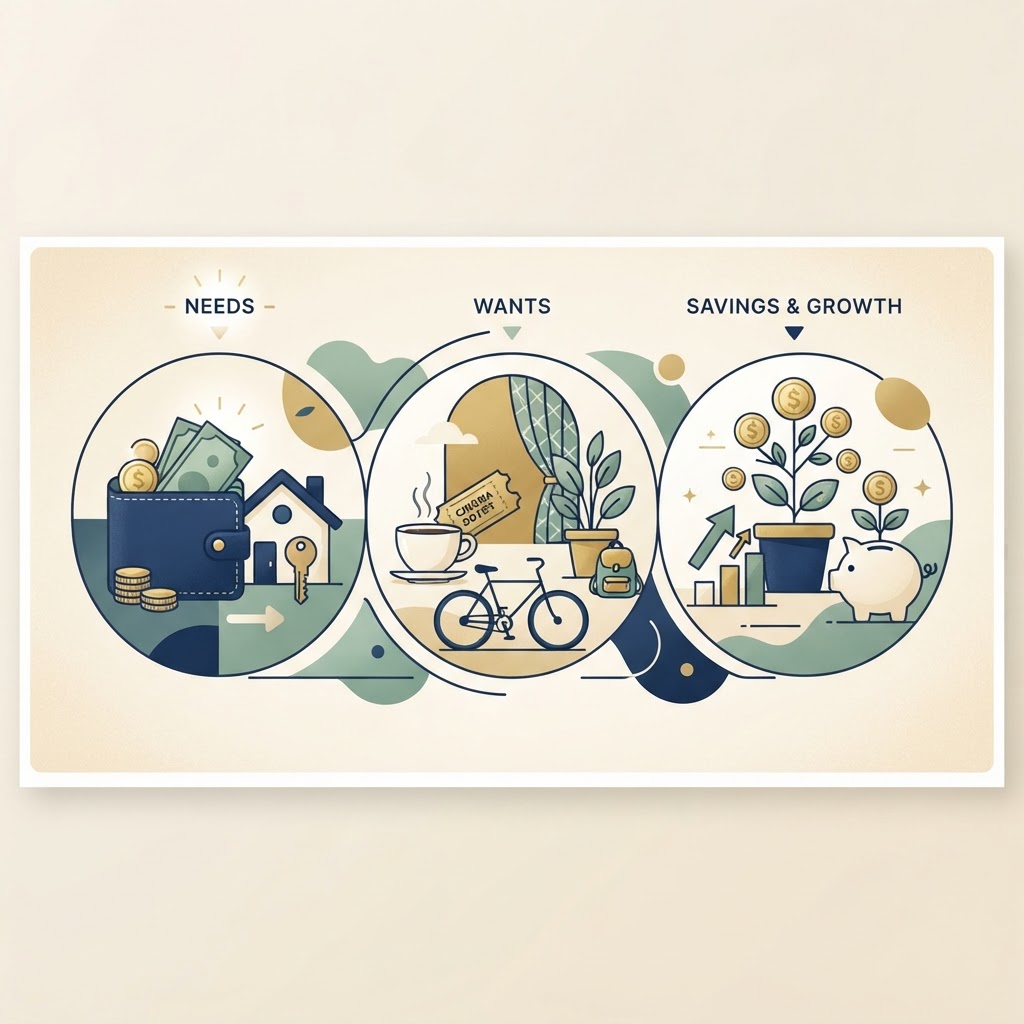
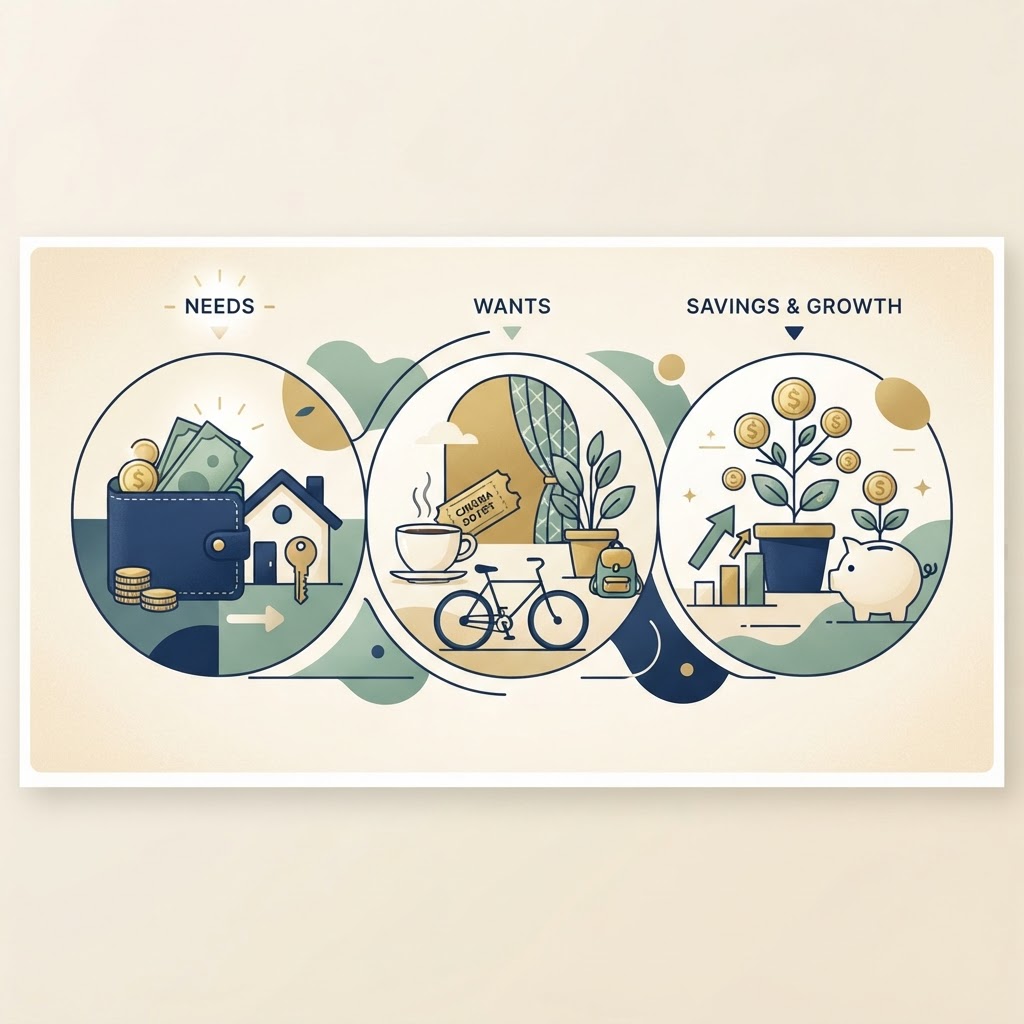
The 50/30/20 rule assigns about half of after-tax income to needs, about thirty percent to wants, and about twenty percent to savings and additional debt payments. If a household takes home an illustrative $5,000 per month, the three starting amounts would be $2,500, $1,500, and $1,000. These are simple examples, not affordability standards or predictions. The purpose is to make tradeoffs visible quickly.
A percentage framework is useful because the same dollar amount means different things at different incomes. It also prevents a budget from becoming a list of tiny decisions before you understand the big picture. If your current ratio is 65/25/10, that is information—not failure. It may show that housing or childcare is high, that savings need attention, or that your current priorities are temporary.
Use the rule as a first draft. After measuring real spending, you may decide that 60/25/15, 55/20/25, or another ratio fits your life better. A realistic plan that protects cash flow is more useful than a theoretically perfect plan you abandon.
Needs: The 50 Percent Bucket
Needs are expenses required for basic safety, housing, food, transportation, health, employment, and legal obligations. They commonly include rent or a mortgage, basic utilities, groceries, required insurance, essential medical care, commuting, childcare needed to work, and minimum debt payments.
Classification requires judgment. A phone may be necessary for employment, while a premium device or unlimited entertainment package may be optional. A vehicle may be necessary in one city and unnecessary in another. The label is not a moral judgment; it is a way to see which costs are difficult to remove and which are choices.
Include the full cost of major needs. Housing may include fees, utilities, taxes, and maintenance. Transportation may include fuel, registration, repairs, and insurance. Ignoring these costs makes the budget look healthier than it is and leaves predictable bills to become emergencies.
Wants: The 30 Percent Bucket
Wants are discretionary expenses that add enjoyment, convenience, or lifestyle upgrades. Examples include restaurants, travel, hobbies, entertainment, premium subscriptions, nonessential shopping, upgraded electronics, and many convenience services.
Wants are not automatically wasteful. A budget that removes every enjoyable activity can become so restrictive that it fails. The better question is whether a purchase supports your values and fits the amount you chose in advance. Someone may value travel more than clothing; another person may prioritize hobbies, family meals, or live events.
Create smaller limits if needed. Your wants bucket might contain dining out, entertainment, personal spending, and travel funds. This keeps one category from consuming all discretionary money and reduces the need to make a fresh decision every time you want something.
Savings and Extra Debt: The 20 Percent Bucket
The final bucket improves your future financial position. It may include an emergency reserve, retirement contributions, taxable investing, short-term goal funds, sinking funds, and extra debt payments. Give each portion a name and time horizon so you know why the money is being set aside.
An emergency fund serves a different purpose from retirement savings. A sinking fund for vehicle repairs is different from a long-term investment account. Extra payments on high-cost debt may have a different priority from a home deposit. The framework groups these actions together, but your personal plan should separate them.
If payroll already removes retirement contributions before your paycheck arrives, do not count the same money twice. Start with the amount deposited into your account and add only savings funded from take-home pay. For self-employed income, reserve taxes before dividing the remaining cash.
Use Take-Home Pay Correctly
Use net or take-home pay as your starting point. That is the money available after ordinary taxes and payroll deductions. Review several pay statements rather than relying on a salary headline. If you are paid weekly or biweekly, calculate annual take-home pay and divide by twelve so extra-paycheck months are not overlooked.
For commissions, freelance work, or seasonal income, budget from a conservative baseline. Keep taxes and business expenses separate from personal spending. When a strong month arrives, send the surplus to reserves, debt, or a named goal instead of immediately increasing fixed lifestyle costs.
Irregular windfalls should not be treated as guaranteed income. Decide in advance how bonuses, gifts, refunds, or unusually large freelance payments will be split. A written rule reduces impulsive decisions while still allowing part of a windfall to be enjoyed.
Build Your First Draft in Six Steps
First, gather three months of statements, pay records, bills, and debt balances. Second, list fixed and variable expenses separately. Third, assign each expense to needs, wants, savings, or extra debt. Fourth, add annual costs such as insurance, gifts, maintenance, and memberships. Fifth, compare actual totals with the 50/30/20 starting point. Sixth, make one or two high-impact changes rather than attempting a total life overhaul.
A budget is a forecast, not a report card. The first month will contain errors because you are learning how your household actually spends. Record surprises without hiding them. If groceries are consistently higher than expected, update the category. If a subscription is unused, cancel it. If savings transfers create overdrafts, lower the amount and change the timing.
Keep the system easy to maintain. A simple spreadsheet, envelope system, or budgeting application can work. The tool matters less than reviewing it and making decisions before money is spent.
Illustrative Monthly Examples
| Illustrative Take-Home | Needs 50% | Wants 30% | Savings/Debt 20% |
|---|---|---|---|
| $3,000 | $1,500 | $900 | $600 |
| $4,000 | $2,000 | $1,200 | $800 |
| $7,500 | $3,750 | $2,250 | $1,500 |
| $10,000 | $5,000 | $3,000 | $2,000 |
These figures show the arithmetic only. They are not suggested budgets, current interest rates, or claims about what a household can afford. Actual needs can be much higher or lower depending on housing, dependents, medical costs, taxes, and geography. Use your statements to replace the illustrative numbers with your own.
When Needs Are Above 50 Percent
Many households cannot keep needs at half of take-home pay, especially in high-cost areas or during periods of childcare, illness, unemployment, or family support. Forcing the number down immediately may be impossible and can cause a budget to ignore reality.
Use a temporary ratio that reflects your current situation. A 65/20/15 plan can still preserve saving while you work on large costs. Review housing, transportation, insurance, utilities, and debt terms when a contract or renewal allows a change. Keep a small, sustainable savings habit if possible; consistency matters even when the amount is modest.
When income rises, direct part of the increase to the savings bucket before expanding recurring expenses. This gradual approach can improve the ratio without requiring a sudden and painful lifestyle change.
How to Lower Essential Costs
Start with the largest recurring expenses because small cancellations cannot compensate for a structurally unaffordable home or vehicle. At renewal, compare insurance coverage and prices while keeping protection appropriate. Review transportation as a total package: payment, fuel, repairs, registration, and insurance. Reduce utility waste and compare service plans where practical.
Grocery savings can come from planning meals, using what is already on hand, comparing unit prices, and reducing waste. These strategies should not compromise medically necessary food or adequate nutrition. For housing, consider timing: a move, roommate arrangement, or renegotiation may reduce costs, but relocation expenses and commute changes must be included in the calculation.
Do not cut essential insurance or medical care blindly to hit a percentage. A lower monthly bill can create a much larger risk later. Budgeting is about managing risk as well as reducing spending.
Debt and the 50/30/20 Framework
Treat minimum payments as needs because they are required obligations. Extra payments generally belong in the savings and debt bucket. If you carry expensive revolving debt, a temporary reduction in wants may allow faster progress. List each balance, interest rate, minimum payment, and due date before choosing an approach.
The avalanche method directs extra money to the highest interest rate and can reduce interest mathematically. The snowball method targets the smallest balance and can create motivating quick wins. Neither is universally best; the plan you follow consistently is more valuable than a theoretically optimal method you abandon.
Avoid treating a balance transfer or consolidation loan as a solution by itself. Lower-cost debt can help, but only if new borrowing stops and fees, promotional periods, repayment terms, and credit effects are understood. Verify current terms directly with the provider.
Emergency Savings and Sinking Funds
An emergency fund is for unexpected, necessary costs or income disruption. A sinking fund is for expenses you can anticipate, such as annual premiums, holiday gifts, tuition, vehicle maintenance, or a professional renewal. Separating them prevents a known bill from consuming emergency cash.
Estimate annual costs conservatively and divide by the months available. An illustrative $1,200 annual bill could be funded with an average of $100 per month, but your actual bill and timing may differ. Keep near-term money accessible and appropriate for its purpose rather than chasing returns that could fluctuate when the money is needed.
Build the first reserve at a pace you can sustain. Once you have a basic buffer, consider the risks specific to your job, health, household, transportation, and income stability when deciding whether a larger reserve is appropriate.
Automate Without Losing Control
Automation can make good intentions reliable. Schedule a savings transfer shortly after payday, when cash is available, and keep enough in the checking account for upcoming bills. Use separate labeled accounts or categories for emergency savings, annual expenses, and longer-term goals.
Automation should not be set and forgotten. Review transfers when income, rent, debt, or benefits change. A transfer that was safe last year could now cause a shortfall, while an old small transfer may no longer match your goal. Reconcile the account monthly and keep alerts for low balances and upcoming payments.
If income varies, automate a conservative base amount and add discretionary transfers after strong months. This creates progress without depending on optimistic projections.
Budgeting for Couples and Families
Couples should agree on what needs, wants, and savings mean before comparing percentages. One person may classify a fitness membership as a need while another calls it a want. Either approach can work if both people understand the tradeoff and the total remains affordable.
A useful structure has shared needs, shared goals, and personal spending. Shared categories cover housing and household bills. Shared goals cover emergency savings, debt, travel, or education. Personal allowances provide autonomy without requiring approval for every small purchase.
With children, explain that money has competing jobs without creating fear. Involve them in simple choices such as comparing prices, waiting for a purchase, or saving for a goal. The aim is to model intentional spending, not to make children responsible for adult financial stress.
Variable Income and Self-Employment
Variable income requires a cash-flow plan. Use a conservative income floor for essential costs and reserve taxes before calculating personal spending. Maintain a buffer for slow months, delayed invoices, equipment, and business obligations. Do not spend projected income before it arrives.
When income exceeds the baseline, use a predetermined order: taxes, operating reserve, emergency savings, debt or long-term goals, and a controlled amount for wants. The exact order depends on your obligations and professional advice. The important idea is to convert unpredictable income into predictable personal spending.
Review cash weekly when income fluctuates. A profitable month can still create a shortage if several bills arrive before invoices are collected. Liquidity and timing matter as much as annual totals.
Alternatives to 50/30/20
A zero-based budget assigns every expected dollar to a category and can be useful for detailed debt payoff or variable expenses. A pay-yourself-first system automates saving before discretionary spending and works well for people with stable fixed costs. A values-based budget begins with priorities such as security, family, travel, generosity, or independence.
An anti-budget uses a few guardrails instead of detailed tracking—for example, automating savings and keeping discretionary purchases within the remaining cash. It requires awareness of spending and is less suitable when cash flow is tight or debt is high.
The right method is the one you can maintain. You can also combine methods: use 50/30/20 for a broad check, zero-based planning for a high-debt month, and automation for long-term savings.
Common Mistakes
The first mistake is using gross salary instead of take-home pay. The second is treating percentages as a moral score. The third is ignoring annual expenses. The fourth is counting minimum debt payments as if they were wealth-building savings. The fifth is cutting wants to zero and creating a plan that cannot survive normal life.
Another mistake is changing too many things at once. If you cancel services, move, refinance, change vehicles, and impose strict food limits in the same month, you will not know which change helped. Start with one major recurring cost and one easy behavior.
Finally, do not use a budget to justify unsafe decisions. Maintaining basic insurance, necessary healthcare, and a reasonable cash buffer can matter more than reaching an arbitrary percentage.
A 30-Day Implementation Plan
During days one through three, gather statements, pay records, debt information, and recurring bills. During the first week, classify spending and add annual costs. In week two, choose one primary goal and one supporting goal. In week three, automate a realistic transfer and adjust one or two high-impact expenses. In week four, compare the plan with reality and revise it.
Write down what surprised you. Perhaps groceries were higher, subscriptions were lower, or a forgotten annual bill appeared. A revision is evidence that the system is working, not proof that you failed. Repeat the review monthly until the process becomes routine.
After three months, revisit the big picture. Ask whether fixed costs are sustainable, whether savings are reaching the right goals, and whether the wants allowance supports a life you can actually enjoy.
How to Measure Progress
Track a few controllable indicators: savings transferred, debt principal reduced, bills paid on time, and the amount of cash available for predictable expenses. These measures are usually more useful than obsessing over one month of spending.
A quarterly review can examine net worth, but remember that investment values fluctuate. A market decline does not necessarily mean your spending plan failed. Focus on the behaviors you control and use a long enough horizon to judge progress.
Also measure how the budget feels. If it creates constant stress, adjust categories or simplify the system. Financial planning should support your life and reduce uncertainty, not become an additional source of anxiety.
Frequently Asked Questions
Is 50/30/20 realistic?
It is realistic as a starting framework for some households, but not all. Use your actual costs and create an adjusted ratio when necessary.
Does 20 percent include retirement?
Usually yes, but do not count payroll deductions twice. Begin with take-home pay and add savings funded from that amount.
Are minimum payments savings?
They are generally treated as needs because they are required. Extra payments are usually part of the financial-progress bucket.
What if I cannot save 20 percent?
Save a sustainable amount, even if smaller, and focus on improving income, fixed costs, and high-cost debt over time.
Can couples use the rule?
Yes. Agree on definitions, shared goals, and personal spending allowances.
How often should I update a budget?
Check cash flow monthly and review the structure quarterly or after a major life change.
Should annual bills be included?
Yes. Divide expected annual costs into monthly sinking-fund contributions so they do not become surprises.
Conclusion
The 50/30/20 rule makes budgeting approachable by separating essential costs, lifestyle choices, and financial progress. It is not a universal law and it cannot account for every household’s location, health, family responsibilities, income pattern, or goals. Its value is as a clear starting point.
Use take-home pay, review real statements, classify expenses honestly, add sinking funds, automate a sustainable amount, and revise after each month. Protect necessary insurance and healthcare, keep room for enjoyment, and direct extra money toward the priorities that matter most to your household.
Whether your final ratio is 50/30/20 or something different, a repeatable plan can help you spend intentionally, prepare for predictable costs, reduce unnecessary borrowing, and move steadily toward greater financial flexibility.
WealthSimplyPut Editorial Team. Educational content only; illustrative figures are not current provider rates or individualized recommendations.
Putting the Framework Into Practice
A budget becomes useful when it answers everyday questions before they become stressful. Before signing a new lease, replacing a vehicle, or adding a subscription, ask which bucket will absorb the cost and whether the commitment is recurring. A one-time purchase can be planned differently from a new monthly obligation. Fixed commitments deserve special caution because they reduce future flexibility.
Use a weekly spending checkpoint. Look at the checking balance, bills due before the next payday, and the amount remaining for variable needs and wants. This small habit is more effective than discovering at the end of the month that several categories have already been exhausted. A checkpoint is not a restriction; it is early information that lets you adjust calmly.
Keep a written “not now” list for purchases that are desirable but not urgent. Waiting 48 hours for a nonessential purchase can separate a genuine priority from an impulse. If the item still matters after the waiting period, assign it to a category and decide when it can be purchased without borrowing.
Budgeting After a Pay Raise
A pay raise is an opportunity to improve several parts of your financial life at once. Before the extra money disappears into recurring expenses, decide how it will be divided. You might increase retirement saving, strengthen an emergency fund, pay down debt, and reserve a smaller portion for lifestyle improvements. The exact split depends on your goals and circumstances.
Be careful with lifestyle inflation. A larger apartment, a new vehicle payment, and several upgraded services can consume a raise permanently. One-time enjoyment is easier to reverse than multiple new monthly commitments. Consider directing a portion of every increase to financial progress before changing fixed costs.
Update the budget after the first full pay cycle with the raise. Payroll deductions, tax withholding, benefits, and retirement contributions can change the actual amount deposited. Use the new take-home amount rather than the headline salary when recalculating the buckets.
Budgeting During a Financial Emergency
When income drops or a major expense arrives, switch from an ordinary budget to a short-term stabilization plan. Protect housing, utilities, food, healthcare, transportation, insurance, and minimum debt obligations first. Pause or reduce discretionary categories and contact creditors or service providers before missing a payment when possible.
Use cash reserves for their intended purpose rather than feeling guilty about drawing them down. An emergency fund is successful when it prevents high-cost borrowing during a genuine emergency. After the situation stabilizes, rebuild the reserve gradually and review whether the previous target still fits your risk level.
A temporary emergency budget should have a review date. Without one, temporary cuts can become confusing and the household may not know when to restore important goals. Write down what changed, what bills are due, and what signal will indicate that the normal plan can resume.
Taxes, Benefits, and the Budget
Take-home pay can change because of tax withholding, health insurance, retirement contributions, flexible spending accounts, bonuses, or other benefits. Review pay statements at least when employment or benefits change. If you receive a tax refund, remember that a refund often means more was withheld during the year than necessary; it is not automatically extra income.
Workplace benefits can affect the best allocation of money. An employer retirement match, health savings account rules, insurance premiums, and commuter benefits may alter your priorities. Read current plan documents and verify limits, eligibility, and tax treatment rather than relying on old figures or general internet advice.
Self-employed households should keep a dedicated tax reserve and avoid treating gross business receipts as personal income. Professional tax guidance can be especially valuable when income, deductions, estimated payments, or business structure are complicated.
Digital Tools and Privacy
Budgeting apps can import transactions and reduce manual entry, while spreadsheets offer control and transparency. Choose a tool that you will actually review. Before connecting financial accounts, read the provider’s privacy and security information, understand what access is requested, use strong unique passwords, and enable multifactor authentication when available.
Manual tracking is still a valid option. A weekly note with starting balance, bills, variable spending, and savings transfer can be enough for a simple household. The goal is clarity, not the most advanced software. Avoid sharing account passwords or sensitive personal details with untrusted services.
Review Questions for Every Quarter
- Did take-home income change, and are taxes or benefits different?
- Which three expenses changed most from the previous quarter?
- Are recurring costs still providing value?
- Are emergency, sinking-fund, and long-term goals clearly separated?
- Did debt balances fall, remain stable, or grow?
- Are upcoming annual expenses funded?
- Does the current wants allowance support a sustainable life?
- What single change would improve next quarter most?
Quarterly reviews are also a good time to check beneficiaries, insurance coverage, account fees, and household documents. Verify current terms directly with the relevant provider. Do not make changes solely because a general budgeting article suggests them.
Final Practical Checklist
- Calculate a realistic monthly take-home amount.
- List every recurring bill and predictable annual expense.
- Separate needs, wants, minimum debt, extra debt, and savings.
- Choose a ratio that reflects reality rather than chasing a perfect number.
- Build an initial cash buffer appropriate to your circumstances.
- Automate savings after confirming the transfer will not cause a cash shortfall.
- Review large fixed expenses before obsessing over tiny purchases.
- Keep a reasonable amount for enjoyment.
- Review the budget monthly and the structure quarterly.
- Update it after a raise, move, new debt, job change, marriage, birth, or other major event.
Budgeting is a practical form of decision-making. It helps you decide what your income should accomplish before circumstances decide for you. The 50/30/20 rule can provide the first sketch, but your statements, priorities, and changing life provide the final design.
Making the Budget Sustainable
Sustainability comes from designing around real behavior. If you usually spend more on weekends, reflect that in the weekly plan instead of pretending every week is identical. If your household has cultural, family, or community obligations, include them openly. Hidden priorities create hidden overspending; named priorities can be planned and funded.
Use separate decision rules for small and large purchases. A small routine purchase may fit inside a weekly allowance, while a large purchase deserves a cooling-off period, comparison shopping, and a check against upcoming bills. This prevents a single exciting purchase from disrupting rent, debt payments, or savings transfers.
When a month goes well, do not assume every future month will be perfect. Keep some flexibility for repairs, medical costs, travel, and income changes. A durable budget has a plan for ordinary surprises. It also has a process for recovery: identify what happened, protect the next essential payment, adjust the category, and continue rather than abandoning the system.
The most valuable result is not a particular percentage. It is a household that knows what money is available, understands what obligations are coming, and makes deliberate choices about the future. That clarity is the foundation on which saving, investing, and debt reduction can become consistent habits.
Start small, stay consistent, and review your plan.
Leave a Reply