Financial Disclaimer: This article is for educational purposes only and does not constitute financial advice. Investment returns are not guaranteed. Always do your own research and consider consulting a qualified financial advisor before making investment decisions.
Key Takeaways
- Compound interest is the process of earning interest on both your original investment and accumulated interest over time
- It’s often called the “eighth wonder of the world” because it can turn modest savings into significant wealth over long time periods
- Starting early matters more than investing large amounts — time is the most powerful factor in compounding
- The Rule of 72 helps you estimate how long it takes to double your money at a given interest rate
- Even small, consistent contributions can grow substantially thanks to the compounding effect
- Compound interest works against you with debt — credit cards and loans compound what you owe
- Tax-advantaged accounts like IRAs and 401(k)s amplify compounding by eliminating tax drag
What Is Compound Interest?
Compound interest is the financial equivalent of a snowball rolling down a hill. As the snowball rolls, it picks up more snow, growing larger and faster the longer it rolls. In finance, compound interest works the same way: you earn a return on your initial investment, and then you earn returns on those returns. Over time, this creates exponential growth that can transform modest savings into substantial wealth.
To understand the difference between simple interest and compound interest, consider an example. If you invest $10,000 at 8% simple interest for 30 years, you earn $800 per year (8% of $10,000) every year, for a total of $24,000 in interest plus your original $10,000 — a final balance of $34,000. But with compound interest, you earn 8% on your growing balance each year. After 30 years, your $10,000 grows to $100,627 — nearly triple the simple interest result. That’s the power of compounding.
The formula for compound interest is: A = P(1 + r/n)^(nt), where A is the final amount, P is the principal, r is the annual interest rate, n is the number of times interest is compounded per year, and t is the number of years. While the formula looks intimidating, the concept is simple: the more frequently interest is compounded and the longer your money grows, the more it earns.
How Compound Interest Works: Step by Step
Let’s break down exactly how compound interest builds over time, using a simple example. Imagine you invest $1,000 at an annual return of 10%, compounded annually.
| Year | Starting Balance | Interest Earned | Ending Balance |
|---|---|---|---|
| 1 | $1,000 | $100 | $1,100 |
| 2 | $1,100 | $110 | $1,210 |
| 3 | $1,210 | $121 | $1,331 |
| 5 | $1,464 | $146 | $1,611 |
| 10 | $2,358 | $236 | $2,594 |
| 20 | $6,727 | $673 | $7,400 |
| 30 | $17,449 | $1,745 | $19,194 |
| 40 | $45,259 | $4,526 | $49,785 |
Notice that in year 1, you earn $100 in interest. But by year 10, you’re earning $236 per year — more than double your initial interest. By year 40, you’re earning $4,526 per year, which is more than your original investment. This accelerating growth is the hallmark of compound interest. The longer you stay invested, the more dramatic the growth becomes.
The Rule of 72: A Quick Mental Math Shortcut
The Rule of 72 is a simple shortcut for estimating how long it takes to double your money at a given annual return. Simply divide 72 by the annual interest rate (expressed as a whole number). For example, at 8% annual return, your money doubles in approximately 72/8 = 9 years. At 10%, it doubles in about 7.2 years. At 6%, it takes 12 years.
| Annual Return | Years to Double (Rule of 72) |
|---|---|
| 3% | 24 years |
| 5% | 14.4 years |
| 6% | 12 years |
| 7% | 10.3 years |
| 8% | 9 years |
| 10% | 7.2 years |
| 12% | 6 years |
The Rule of 72 also works in reverse: divide 72 by the number of years you want to double your money to find the required annual return. Want to double your money in 10 years? You need approximately 7.2% annual return. This is useful for setting investment goals and evaluating whether your expected returns are realistic.
Why Starting Early Is Critical
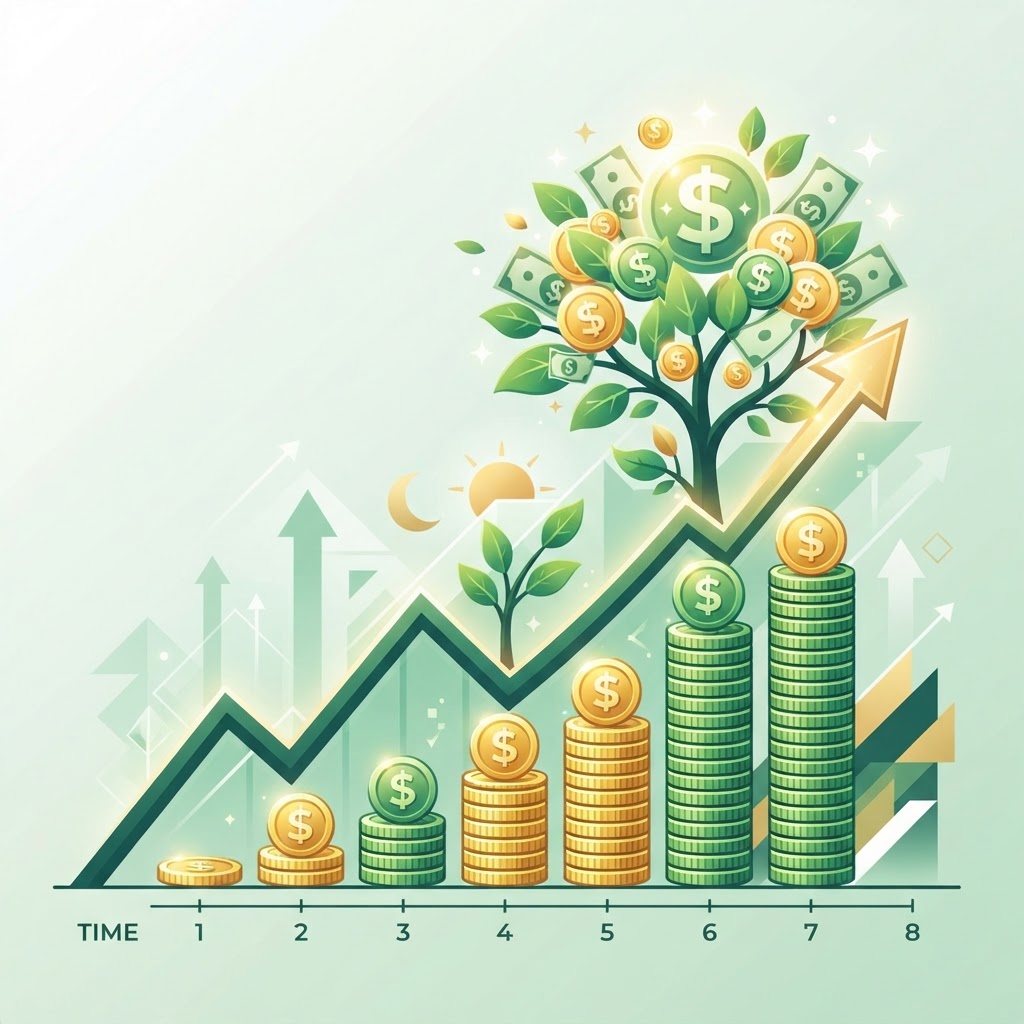
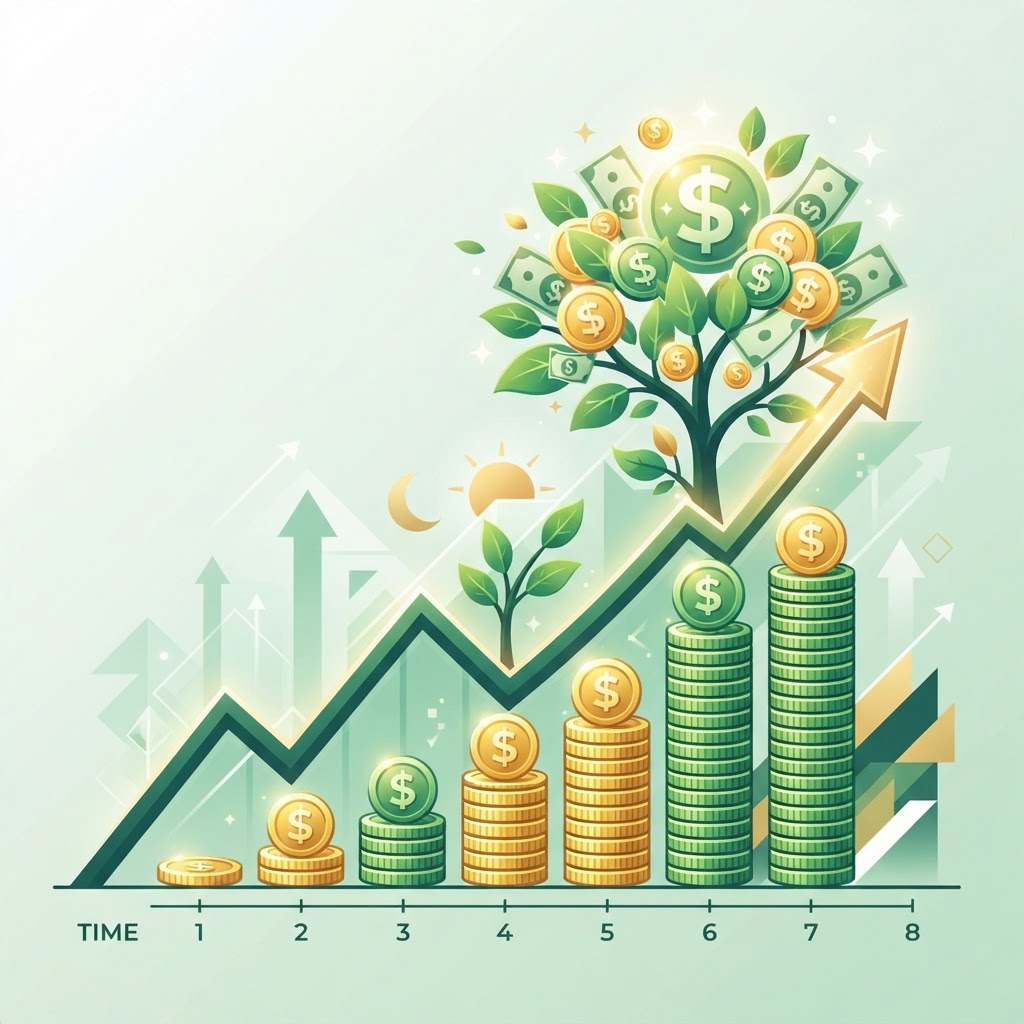
Time is the single most powerful factor in compound interest. Starting early — even with small amounts — produces dramatically better results than starting later with larger amounts. This is because compounding is exponential, not linear. The longer your money compounds, the steeper the growth curve becomes.
Consider a classic example: two investors, Alex and Taylor. Alex starts investing $200/month at age 25 and stops at age 35, having contributed $24,000 total. Taylor starts at age 35 and invests $200/month until age 65, contributing $72,000 total. Assuming an 8% annual return, at age 65 Alex has approximately $344,000 while Taylor has approximately $300,000. Alex invested less than half as much money but ended up with more because those early dollars had 30 extra years to compound.
This doesn’t mean you should give up if you’re starting late — compounding still works at any age. But it does illustrate that the earlier you start, the less money you need to invest to reach the same goal. If you’re in your 20s or 30s and haven’t started investing, start now. Even $50 or $100 per month can grow into a meaningful sum over decades.
Compound Interest in Real-World Investments
Index Funds and ETFs
Index funds and ETFs are ideal vehicles for harnessing compound interest. They provide broad market exposure at very low cost, allowing more of your returns to compound. The S&P 500 has historically returned about 10% annually before inflation, or about 7% after inflation. At 7% real return, $10,000 grows to $76,123 in 30 years in inflation-adjusted dollars — all from a single initial investment with no additional contributions.
The key advantage of index funds is low fees. An expense ratio of 0.03% (common for index funds) versus 1.5% (common for actively managed funds) may seem small, but over 30 years, that 1.47% difference means the high-fee fund investor gives up roughly 30% of their potential wealth to fees. Low fees allow compounding to work at maximum efficiency.
Dividend Reinvestment
Dividend reinvestment is a powerful form of compounding. When you reinvest dividends automatically, you buy more shares with each dividend payment, which then generate their own dividends, which buy more shares, and so on. Over decades, this can significantly increase your total return. Many dividend-paying stocks and funds offer automatic reinvestment plans (DRIPs) at no cost.
A stock with a 3% dividend yield might seem modest, but reinvested over 30 years at an assumed total return of 8%, the dividends compound dramatically. The reinvested portion of your return can account for more than 40% of your total wealth accumulation over long periods. This is why dividend-focused investors emphasize the importance of starting early and reinvesting consistently.
High-Yield Savings Accounts and CDs
While investment accounts offer higher long-term returns, savings accounts and certificates of deposit (CDs) also compound interest — just at lower rates. High-yield savings accounts may offer rates in the range of 4-5% (rates fluctuate over time — verify current rates with your bank or credit union), which can help your emergency fund grow while remaining accessible. CDs lock in a rate for a set period, which can be useful in a falling-rate environment but may limit flexibility.
The compounding frequency matters more at lower rates. An account that compounds daily will grow slightly faster than one that compounds monthly, even at the same nominal rate. While the difference is small, it adds up over years. Look for accounts with daily or continuous compounding for maximum growth.
How to Maximize Compound Interest
1. Start Now, Even If It’s Small
The most important step is simply starting. Even $50 per month compounds significantly over 30-40 years. At 8% annual return, $50/month becomes $98,000 over 40 years. $100/month becomes $196,000. The key is to begin as soon as possible — every year you delay means less time for compounding to work.
2. Invest Consistently
Dollar-cost averaging — investing a fixed amount at regular intervals — is a powerful strategy for compounding. By investing consistently, you buy more shares when prices are low and fewer when prices are high, which can improve your average cost per share over time. Set up automatic contributions from your checking account to your investment account to ensure consistency without relying on willpower.
3. Keep Fees Low
Fees are the enemy of compound interest. Every dollar you pay in fees is a dollar that doesn’t compound. A 1% annual fee reduces a $100,000 portfolio by roughly $28,000 over 20 years. Look for index funds and ETFs with expense ratios below 0.10%. Avoid high-fee mutual funds, variable annuities, and products with sales loads. If you work with a financial advisor, understand their fee structure — a 1% advisory fee has the same compounding effect as a 1% fund fee.
4. Use Tax-Advantaged Accounts
Taxes also reduce compounding. In a taxable account, you pay taxes on dividends and capital gains each year, reducing the amount that compounds. Tax-advantaged accounts eliminate or defer this drag. A Roth IRA or 401(k) allows your investments to grow tax-free, meaning every dollar of growth compounds without being reduced by annual taxes. Over 30 years, the difference between tax-free and taxable compounding can amount to tens or hundreds of thousands of dollars.
5. Reinvest All Returns
Whenever possible, reinvest dividends and interest rather than taking them as cash. Automatic reinvestment ensures that every dollar keeps working for you. Most brokerages and mutual fund companies offer automatic reinvestment at no cost. If you need income from your investments, consider reinvesting in your accumulation years and only taking withdrawals when you need the income.
6. Avoid Interrupting Compounding
Every time you sell investments and move to cash, you interrupt the compounding process. Market timing — trying to predict market movements — almost always reduces returns compared to staying invested. Missing just the 10 best days in the market over a 20-year period can cut your total return in half. Stay invested through market downturns, and remember that downturns can actually enhance long-term returns if you continue investing through them, buying shares at lower prices.
Compound Interest on Debt: The Dark Side
Compound interest works against you when you owe money. Credit cards typically compound interest daily at rates of 15-25% or more. If you carry a balance, interest is charged on the principal plus accumulated interest, creating a debt snowball that grows faster the longer you carry it. This is why minimum payments on credit cards can keep you in debt for decades.
Consider a $5,000 credit card balance at 20% interest. If you make only minimum payments (typically 2% of the balance), it will take over 30 years to pay off, and you’ll pay more than $15,000 in interest — three times the original debt. This is compound interest working against you with devastating efficiency.
To avoid the dark side of compounding, prioritize paying off high-interest debt before investing. The 20% interest rate on a credit card is guaranteed, while investment returns are not. Paying off a credit card is equivalent to earning a guaranteed 20% return — something no investment can match. Once high-interest debt is eliminated, redirect those payments to investments and let compounding work in your favor.
Compound Interest Scenarios to Illustrate the Power
| Scenario | Monthly Investment | Annual Return | Years | Final Value |
|---|---|---|---|---|
| Start at 25, retire at 65 | $200 | 8% | 40 | ~$698,000 |
| Start at 35, retire at 65 | $200 | 8% | 30 | ~$300,000 |
| Start at 45, retire at 65 | $200 | 8% | 20 | ~$118,000 |
| Start at 25, invest $500/mo | $500 | 8% | 40 | ~$1,745,000 |
| Start at 25, invest $1000/mo | $1,000 | 8% | 40 | ~$3,490,000 |
| Lump sum $10,000 at 25 | $0 | 8% | 40 | ~$217,000 |
These scenarios illustrate two key lessons: first, starting early is far more important than the amount you invest (note the huge difference between starting at 25 vs 35 with the same monthly amount). Second, increasing your monthly contribution dramatically increases the outcome — $500/month produces nearly 3 times the result of $200/month over 40 years.
Frequently Asked Questions
What’s the difference between compound interest and simple interest?
Simple interest is calculated only on the principal — your original investment. Compound interest is calculated on the principal plus accumulated interest. Over short periods, the difference is small, but over decades, compounding produces dramatically more growth. A $10,000 investment at 8% for 30 years yields $34,000 with simple interest but $100,627 with compound interest — nearly three times as much.
What annual return should I expect from investments?
Historically, the S&P 500 has averaged about 10% annually before inflation, or roughly 7% after inflation. However, past performance doesn’t guarantee future results. Many financial planners use 6-8% as a planning assumption. Be conservative in your projections — it’s better to be pleasantly surprised than disappointed. Diversification across stocks, bonds, and other asset classes can help manage risk while still capturing compounding returns.
How often should I check my investment balance?
For long-term investments, checking too frequently can lead to emotional decisions. Quarterly or semi-annually is sufficient for most investors. The compounding effect works best when you leave your investments alone. Resist the urge to react to short-term market movements, which are noise in the context of long-term compounding.
Does compound interest work with bonds?
Yes. Bond interest (coupons) can be reinvested to purchase more bonds, creating a compounding effect. Bond funds automatically reinvest interest. Individual bonds pay periodic interest that you can reinvest, though the mechanics are less automatic than with funds. Bond returns are typically lower than stock returns, so the compounding effect is smaller but more predictable.
What if I can only afford to invest a small amount?
Start with whatever you can afford. Even $25 or $50 per month compounds into a meaningful sum over 30-40 years. The habit of regular investing is more important than the amount — once you’re in the habit, you can increase contributions as your income grows. Many brokerages now offer fractional shares and no minimum investment, making it easy to start with very small amounts.
The Bottom Line
Compound interest is the most powerful force in personal finance — and it’s available to everyone. You don’t need to be wealthy to benefit from it; you just need time and consistency. Start investing as early as possible, even if the amount seems small. Keep fees low, use tax-advantaged accounts, reinvest all returns, and don’t interrupt the compounding process by trying to time the market.
The most expensive mistake in investing is waiting. Every year you delay costs you exponentially more in lost compounding. Whether you’re 25 or 55, the best time to start is today. Open an investment account, set up automatic contributions, and let the most powerful force in finance work for you. Your future self will thank you.
WealthSimplyPut Editorial Team provides general financial education for informational purposes. Investment returns are not guaranteed and past performance does not guarantee future results. Always consider consulting a qualified financial advisor for personalized advice.
Real Estate and Compound Interest
Real estate provides compound growth through property appreciation and reinvested rental income. When rental income exceeds expenses, the surplus can be reinvested into additional properties or used to pay down mortgages faster, accelerating equity growth. Property appreciation compounds as well — a property purchased for $200,000 that appreciates 4% annually is worth $296,000 after 10 years and $438,000 after 20 years, without any additional investment.
Real estate also offers the power of leverage — using borrowed money to increase your investment. A $200,000 property purchased with a $40,000 down payment (20% down) that appreciates 4% generates a 20% return on your invested cash in the first year ($8,000 appreciation on $40,000 invested). This leverage amplifies compounding, though it also increases risk — the property can decline in value, and mortgage payments must be maintained regardless of market conditions.
REITs (Real Estate Investment Trusts) offer a simpler way to invest in real estate without managing properties. REITs pay dividends that can be reinvested, creating a compounding effect similar to dividend stocks. Many REITs offer automatic reinvestment plans, making it easy to compound your returns without additional capital.
The Psychology of Compounding: Why People Quit Too Early
One of the biggest challenges with compound interest is psychological. In the early years, progress seems painfully slow. If you invest $200/month at 8%, after 5 years you have about $14,700 — which feels underwhelming after investing $12,000. After 10 years, you have about $36,600. After 20 years, $118,000. After 30 years, $300,000. The dramatic growth happens in the later years, when compounding is working at full force.
This creates a “J-curve” effect where the line stays nearly flat for years before shooting upward. Many people lose motivation during the flat years, withdraw their money, or stop contributing. Those who persist through the flat years are rewarded with the exponential growth that defines compound interest. Understanding this pattern beforehand helps you stay the course when progress seems slow.
Visualizing your progress can help maintain motivation. Use a compound interest calculator to project your balance at 5, 10, 20, and 30 years. Print the chart and keep it somewhere visible. When the temptation to stop investing arises, look at the chart and remember that the flat years are laying the foundation for the explosive growth that comes later.
Compound Interest and Inflation
Inflation erodes the purchasing power of money over time, which means your nominal investment returns overstate your real (inflation-adjusted) returns. If your investments grow 8% annually but inflation is 3%, your real return is approximately 5%. Over 30 years, $10,000 invested at 8% nominal grows to $100,627, but in real terms (adjusted for 3% inflation), it’s worth about $41,000 in today’s dollars.
This doesn’t mean compounding doesn’t work — it means you need to account for inflation in your planning. Use real (inflation-adjusted) returns when projecting future wealth to set realistic goals. Historically, stocks have returned about 7% real (after inflation), while bonds have returned about 3% real. Cash and savings accounts typically return less than inflation, meaning they lose purchasing power over time despite earning interest.
To combat inflation, invest in assets that historically outpace it — primarily stocks and real estate. These assets tend to increase in value with inflation because the companies and properties they represent can raise prices. Fixed-income investments like bonds and CDs struggle with inflation because their returns are locked in at purchase time. Maintain an asset allocation appropriate for your time horizon and risk tolerance, with a higher allocation to stocks for long-term growth.
Building a Compound Interest Strategy for Different Life Stages
In your 20s: Your greatest asset is time. Even small contributions compound for 40+ years. Focus on building the habit of regular investing. Open a Roth IRA and automate contributions. If your employer offers a 401(k) match, contribute at least enough to get the full match. Prioritize paying off high-interest debt, which compounds against you. Don’t worry about perfect investment selection — a low-cost S&P 500 index fund is sufficient.
In your 30s: Your income likely has grown — increase contributions proportionally. Aim to invest 15-20% of your gross income. If you haven’t started, start now — you still have 30 years of compounding ahead. Consider increasing your 401(k) contribution by 1% each year. If you have children, start 529 college savings plans, which also benefit from compounding.
In your 40s: Maximize contributions to tax-advantaged accounts. If you’re behind, take advantage of catch-up contributions (available at 50+, but start planning now). Review your asset allocation to ensure it’s still appropriate for your goals and risk tolerance. Consider whether you need additional investment accounts beyond your 401(k) and IRA.
In your 50s and beyond: Take full advantage of catch-up contributions. Shift your portfolio gradually toward more conservative allocations to protect what you’ve accumulated. But don’t abandon stocks entirely — at 60, you may still need 30 years of growth. Consider working with a financial advisor to develop a retirement withdrawal strategy that maximizes the remaining compounding years while providing the income you need.
Tax-Advantaged Accounts That Amplify Compounding
Tax-advantaged accounts are one of the most powerful tools for maximizing compound interest because they eliminate or reduce the tax drag that slows compounding in taxable accounts. In a taxable investment account, you pay taxes on dividends and realized capital gains each year, which reduces the amount available to compound. Over 30 years, taxes can reduce your total return by 25-30% or more compared to a tax-free account.
A Roth IRA allows you to contribute after-tax money and then enjoy tax-free growth and tax-free withdrawals in retirement. Every dollar of growth compounds without being reduced by annual taxes. In 2026, you can contribute up to $7,000 per year ($8,000 if you’re 50 or older). While contribution limits may seem modest, consistent contributions over 30-40 years with tax-free compounding can build substantial wealth. For example, $7,000/year for 35 years at 8% return grows to approximately $1.2 million — completely tax-free.
A Traditional IRA or 401(k) provides a different advantage: tax-deductible contributions. You reduce your current taxable income by the amount you contribute, and the money grows tax-deferred until withdrawal. While you’ll pay taxes on withdrawals in retirement, many people are in a lower tax bracket then. Additionally, the higher initial investment (since you’re investing pre-tax dollars) means more money compounds from the start.
A Health Savings Account (HSA) offers the best of both worlds — triple tax advantage. Contributions are tax-deductible, growth is tax-free, and withdrawals for qualified medical expenses are tax-free. If you don’t need the money for current medical expenses, you can invest it and let it compound for decades. At age 65, you can withdraw HSA funds for any purpose (not just medical) without the 20% penalty, though non-medical withdrawals are taxed as income — essentially making it function like a Traditional IRA with a bonus medical tax exemption.
For self-employed individuals, a Solo 401(k) or SEP-IRA can allow much larger contributions than a standard IRA. A Solo 401(k) allows you to contribute both as an employee and as an employer, potentially reaching $69,000 or more in 2026 (verify current limits). This dramatically increases the amount of money compounding in a tax-advantaged account, which can make a significant difference over decades.
Compound Interest Calculators and Tools
Several free online tools can help you visualize and plan your compound interest strategy. Investor.gov offers a compound interest calculator that lets you input initial investment, monthly contribution, expected return, and time period to see projected growth. The SEC’s Investor.gov compound calculator is straightforward and educational.
Many investment platforms include built-in calculators and projections. Fidelity, Vanguard, and Charles Schwab all offer retirement calculators that model compound growth with various assumptions. These tools can help you set realistic goals and track progress. Some also factor in inflation, taxes, and other real-world factors to give a more accurate projection.
For more detailed modeling, spreadsheet software like Excel or Google Sheets can create custom compound interest models. The formula is straightforward: future value = present value × (1 + rate)^periods. With a spreadsheet, you can model scenarios with variable contributions, changing return rates, and different tax scenarios. This flexibility helps you understand how different factors affect long-term outcomes and make informed decisions about your investment strategy.
Regardless of which tool you use, the key insight remains the same: time and consistency are the most powerful factors in building wealth through compound interest. The specific return rate matters less than you might think — the difference between 7% and 8% over 30 years is significant, but it’s dwarfed by the difference between starting at 25 vs 35. Focus on what you can control: starting early, investing consistently, keeping costs low, and not interrupting the process.
The bottom line is this: compound interest is not a get-rich-quick scheme. It’s a get-rich-slowly, reliably, and inevitably strategy — but only if you give it the time it needs to work. Start today, stay consistent, and let the math do the heavy lifting. Your future financial security depends on the decisions you make right now, not on some perfect moment in the future when everything aligns. The best time to start investing was twenty years ago. The second best time is today.
Leave a Reply