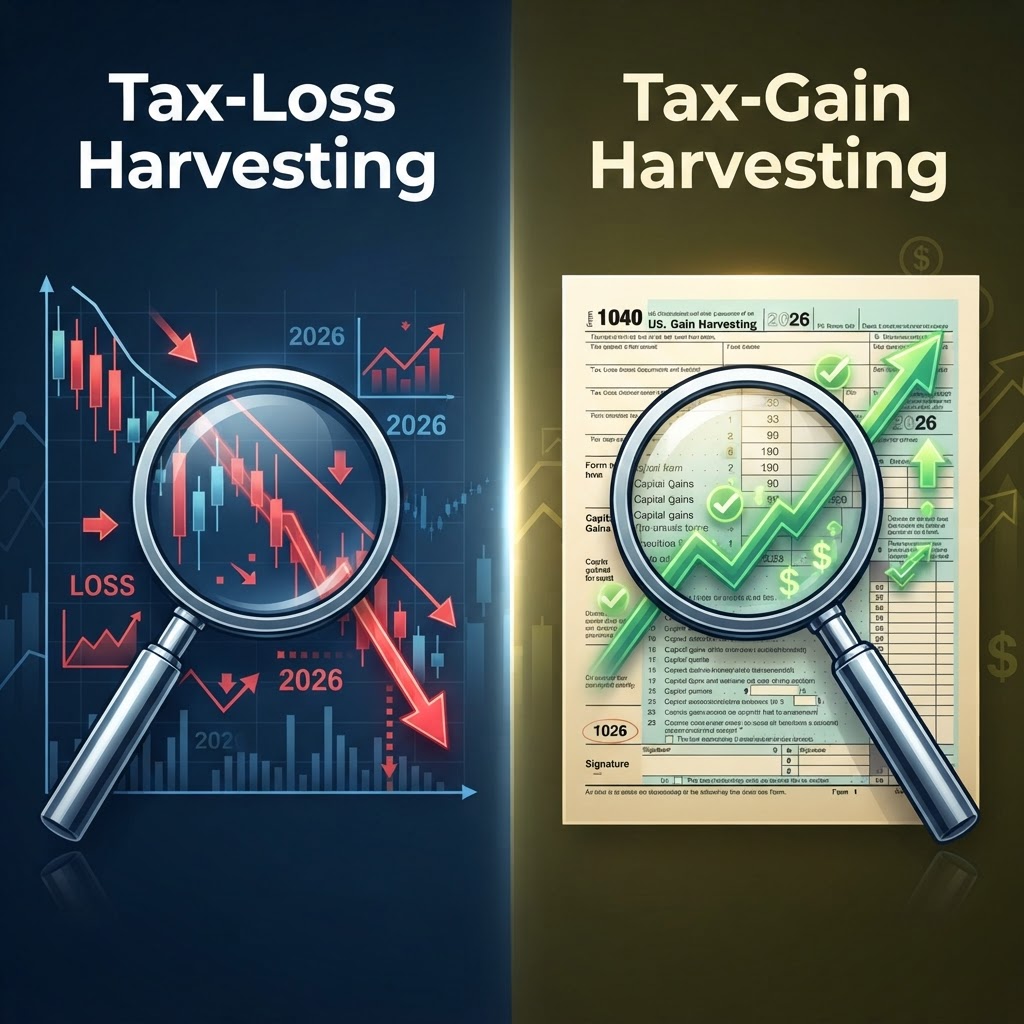
- Tax-loss harvesting allows investors to sell underperforming assets to offset capital gains, reducing their current tax liability.
- Tax-gain harvesting is a proactive strategy to reset the cost basis of investments, which can be highly effective in lower-income years.
- In high-interest rate environments, the opportunity cost of capital increases, making tax-efficient investing even more critical for long-term wealth.
- Strategic portfolio optimization requires a delicate balance between tax management and maintaining your long-term asset allocation.
- Always be wary of the wash-sale rule, which prohibits claiming a loss if you purchase a “substantially identical” security within 30 days.
As we navigate the complexities of 2026, the intersection of market volatility and macroeconomic shifts has placed a renewed focus on tax-efficient investing. For the modern investor, wealth is not merely about the returns a portfolio generates, but about how much of that gain remains in your pocket after accounting for the capital gains tax. Whether you are looking to mitigate your tax bill during a market downturn or strategically harvest gains to reset your basis, mastering the art of tax-loss harvesting and tax-gain harvesting is essential for anyone serious about wealth accumulation. This guide serves to clarify these strategies and help you determine which approach aligns with your broader financial trajectory in today’s high-interest rate climate.
Understanding the Basics of Tax-Loss Harvesting
Tax-loss harvesting is a fundamental pillar of modern portfolio optimization. At its simplest, it involves selling an investment that has lost value—a security currently trading below your original purchase price—to realize a loss for tax purposes. By doing so, you can use that loss to offset capital gains realized elsewhere in your portfolio. If your total losses exceed your total gains, you may often apply up to a specific amount of the excess loss to reduce your ordinary income, providing a multi-layered benefit to your annual tax filing.
The true value of this strategy lies in its ability to generate “tax alpha.” In a high-interest rate environment, where traditional fixed-income investments might be delivering higher yields, the pressure on your equity portfolio to remain efficient becomes even more pronounced. When you execute a tax-loss harvesting trade, you are not simply giving up on an asset; you are maintaining your desired market exposure while simultaneously capturing a tax benefit. The classic approach involves selling the losing asset and immediately purchasing a “proxy” investment—a similar but not identical asset—to ensure you remain invested in the market while waiting for your original position to potentially recover.
For those pursuing long-term wealth, the tax savings generated from these losses can be reinvested. This creates a compounding effect, where the money that would have otherwise been sent to the tax authorities instead stays within your brokerage account, contributing to your total portfolio growth over time. However, this strategy is not a “set it and forget it” tool. It requires consistent monitoring of your portfolio’s performance. As market conditions shift, the frequency with which you review your unrealized losses should increase. It is also important to consider the transaction costs and the potential impact of long-term vs. short-term capital gains tax rates. Expert practitioners of wealth management typically emphasize that tax-loss harvesting should never override your core investment thesis. You are harvesting losses to be more efficient, not to change your risk profile or deviate from your long-term wealth objectives. By staying disciplined and objective, investors can turn periods of market malaise into opportunities for significant tax relief.
When Tax-Gain Harvesting Makes Strategic Sense
While tax-loss harvesting focuses on the downside, tax-gain harvesting is a proactive maneuver designed to capitalize on lower tax brackets or periods of income fluctuation. In tax-gain harvesting, you intentionally sell an appreciated asset, realize the gain, and then immediately repurchase it. By doing so, you “reset” your cost basis to the current, higher market price. This might seem counterintuitive—why pay taxes on a gain before you have to?—but the math can be incredibly advantageous under the right circumstances.
The primary scenario where this approach shines is during years when your taxable income is significantly lower than usual. If you find yourself in a lower tax bracket for a specific year, you might trigger capital gains at a zero or highly reduced tax rate. By resetting your cost basis today, you effectively minimize the potential capital gains tax you would owe when you eventually sell the asset for a permanent exit years down the road. It is essentially a way to “pre-pay” your tax liability at a discount, clearing the path for greater net wealth in the future.
This strategy is particularly relevant for those in the accumulation phase of wealth building. Many experts suggest that investors view their portfolios as a long-term project where tax management is a continuous process. If you have been holding high-growth assets for many years and have built up a massive pile of unrealized gains, waiting until retirement to sell everything could push you into a much higher tax bracket, leading to a significant “tax trap.” By slowly harvesting gains in favorable tax years, you can smooth out your tax burden over a decade or more. Furthermore, if you are looking to rebalance your portfolio—perhaps moving from a growth-heavy allocation to one that is more conservative—tax-gain harvesting allows you to shift assets without the same looming threat of a massive, surprise tax bill later. This approach transforms tax strategy from a reactive, year-end scramble into a deliberate, multi-year plan that supports your overarching financial goals.
| Strategy | Primary Objective | Best For |
|---|---|---|
| Tax-Loss Harvesting | Offsetting realized gains to lower current tax liability. | Investors holding losing positions during market volatility. |
| Tax-Gain Harvesting | Resetting cost basis to reduce future tax exposure. | Investors in lower income brackets or those seeking to rebalance. |
How High Interest Rates Impact Your Harvesting Strategy
In an economic climate defined by higher interest rates, the landscape of investment tax strategy undergoes a subtle but vital transformation. When the risk-free rate—often represented by Treasury yields—is high, the hurdle rate for every asset in your portfolio increases. You are no longer just comparing your returns to a zero-percent interest environment; you are weighing your market investments against reliable, interest-bearing assets. This macro-shift changes the calculus for both tax-loss and tax-gain harvesting.
When interest rates are elevated, the opportunity cost of holding cash or underperforming assets becomes much more tangible. Tax-loss harvesting becomes an even more critical tool because the tax savings you generate can be deployed into high-yield instruments that are currently paying attractive returns. Essentially, the “tax alpha” you extract from your portfolio has more places to work for you. If you harvest a loss and save 15% to 20% on a capital gain that would have otherwise been paid to the government, that capital can be immediately put into high-interest money market funds or short-term notes, compounding your wealth while your core market positions recover.
Conversely, high interest rates can dampen the appeal of tax-gain harvesting for some. Because cash and bonds are providing a meaningful return, the “cost” of paying taxes early via gain harvesting might feel more painful. You are paying tax dollars now that could have been earning interest elsewhere. However, for the long-term wealth builder, the decision remains anchored in the delta between current and future tax rates. If you believe interest rates will eventually normalize downward and equity prices will continue to appreciate, the benefit of resetting your cost basis today to avoid a potential future “tax cliff” remains high.
Moreover, the high-interest environment often leads to increased volatility in equity markets, as investors adjust their valuation models for discounted future cash flows. This volatility is a double-edged sword: it creates more opportunities for price dips that allow for loss harvesting, but it also creates uncertainty about the timing of long-term gains. Investors must remain vigilant. In 2026, the most successful wealth builders are those who view these high-interest conditions not as a reason to panic, but as a reason to be more tactical. Portfolio optimization in this environment requires a disciplined look at the yield of your “cash” assets versus the tax-adjusted return of your “risky” assets. By integrating your tax strategy with your interest-rate exposure, you create a robust defense against the erosion of your wealth.
Calculating the Net Benefit of Offsetting Gains
Determining whether to harvest a loss or a gain is a mathematical exercise that requires a clear understanding of your personal financial situation. The net benefit is not just about the dollars saved in the current tax cycle; it is about the long-term preservation of your capital base. To calculate this, you must first look at your realized gains for the calendar year. If your realized gains are substantial, the immediate tax benefit of harvesting losses is obvious: you avoid writing a check to the tax authorities.
However, many investors fail to account for the “lost growth” on those tax dollars if they had remained invested. When you sell a losing position to harvest a loss, you might be selling an asset that has intrinsic value and is merely undergoing a temporary market correction. If that asset rebounds significantly shortly after you sell it, the “cost” of the loss harvest was the opportunity to participate in that recovery. This is why the “proxy” asset selection is so critical. If you can move your capital into an asset that tracks closely with your original holding, you effectively capture the tax benefit without sacrificing the long-term growth potential.
To properly analyze the net benefit, you should map out your estimated tax bracket for the next three to five years. If you expect your income to rise significantly, harvesting a gain now—while you are in a lower bracket—is almost always mathematically superior. The tax you pay today is effectively a “premium” you are paying to ensure you don’t pay a higher rate tomorrow. Conversely, if you are nearing retirement and expect your income to drop, your priority should be minimizing current tax bills through aggressive loss harvesting.
Furthermore, always factor in your local and state taxes. Capital gains are often taxed at both federal and state levels, which can significantly alter the net benefit. Many investors perform the math based on federal rates alone and underestimate the total impact. When you account for the combined impact of federal, state, and potential alternative minimum tax triggers, the benefit of an effective tax strategy becomes even more pronounced. This level of granular calculation is what separates passive index investors from sophisticated wealth builders. By maintaining a spreadsheet of your cost basis across all accounts, you can quickly identify which lots are optimal for harvesting at any given moment, ensuring you never leave money on the table.
Avoiding the Wash-Sale Rule During Market Volatility
The wash-sale rule is perhaps the most significant hurdle in the implementation of an effective tax-loss harvesting strategy. Under current regulations, you are prohibited from claiming a loss on a security if you purchase the same or a “substantially identical” security within 30 days before or after the sale. This rule applies to your entire portfolio, including IRAs, 401(k) plans, and spousal accounts. If you sell a stock in your taxable brokerage account for a loss and your spouse immediately buys the same stock in their IRA, the IRS considers that a wash sale, and you lose the ability to claim the tax benefit.
Market volatility often tempts investors into rapid-fire trading, which increases the likelihood of accidentally violating the wash-sale rule. When a market sector takes a hit, the urge to capture losses across multiple positions can lead to sloppy trade execution. To avoid this, you must be systematic. Many investors use the “swap” method, where they sell an ETF that tracks a specific index and simultaneously buy an ETF that tracks a different, but similar, index. For example, if you sell an S&P 500 index fund, you might move into a total stock market index fund for the 30-day window. While these two funds are not identical, they provide nearly identical market exposure, allowing you to stay in the market while safely harvesting your tax loss.
Documentation is your best defense against tax-related headaches. Keep meticulous records of the purchase and sale dates of every transaction, especially during the year-end period when many investors are frantically trying to optimize their tax positions. Many modern brokerage platforms now have built-in wash-sale trackers that flag potentially problematic trades, but you should never rely solely on automated systems. These tools can sometimes miss complex interactions, such as those involving automated dividend reinvestment plans (DRIP). If you have DRIPs enabled, a dividend payment occurring within that 30-day window could count as a “purchase” and trigger a wash sale.
For those serious about wealth preservation, the safest approach during highly volatile times is to disable automatic dividend reinvestment for the specific securities you are planning to harvest. Manually reinvesting those dividends after the 30-day window closes is a small administrative burden that provides significant peace of mind. By respecting the wash-sale rule and integrating these safeguards into your routine, you can execute your tax-loss harvesting strategy with confidence, knowing that your tax advantages will be fully recognized by the authorities, thereby maximizing the efficiency of your investment portfolio.
Integrating Harvesting Into Your Long-Term Portfolio Growth
To build lasting wealth, investors must shift their perspective from viewing tax-loss and tax-gain harvesting as isolated events to treating them as fundamental components of a broader portfolio optimization strategy. In a high-interest rate environment, the opportunity cost of capital is elevated, meaning every dollar surrendered to the tax authority is a dollar that cannot compound at today’s attractive yields. Integrating these strategies requires a disciplined, year-round approach rather than a frantic scramble during the final days of December.
A sophisticated integration strategy begins with systematic rebalancing. As your portfolio drifts due to market fluctuations, you inherently create opportunities. When an asset class outperforms, selling a portion of it to return to your target allocation may trigger a tax-gain harvesting event. If your portfolio is in a low-income year, this becomes a strategic moment to “reset” the cost basis of your holdings. Conversely, if you are in a high-income bracket, prioritizing tax-loss harvesting during these rebalancing periods can offset the drag of capital gains taxes, keeping more capital deployed in the market.
Furthermore, consider the implementation of “tax-aware” index tracking. Rather than holding identical funds across all accounts, investors should aim to hold high-growth, high-turnover assets in tax-advantaged accounts while keeping tax-efficient assets in taxable brokerage accounts. When you integrate harvesting, you are essentially “pruning” your portfolio. Just as a gardener trims a plant to encourage more vigorous growth, harvesting allows you to remove underperforming assets (via tax-loss harvesting) or realize gains on winners (via tax-gain harvesting) to better align your holdings with your long-term wealth goals.
The Role of Asset Location in Tax Management
Asset location is arguably the most overlooked pillar of tax-efficient investing. While asset allocation determines your risk-return profile, asset location determines how much of that return you actually get to keep after the government takes its share. In the context of harvesting, your choice of account type dictates whether a specific harvest is even possible or beneficial.
Taxable brokerage accounts are the primary theater for both tax-loss and tax-gain harvesting. Because these accounts are not shielded from capital gains taxes, they provide the flexibility to realize losses to offset future income or gains. Retirement accounts like Traditional IRAs or 401(k)s operate under a completely different paradigm. In these tax-deferred environments, harvesting is irrelevant because there is no immediate capital gains tax consequence for buying or selling. Therefore, attempting to “harvest” within a tax-deferred account is a waste of time and transaction costs.
To maximize your wealth, prioritize placing high-tax assets—such as bonds or high-turnover mutual funds—in tax-advantaged accounts. Conversely, tax-efficient assets like broad-market ETFs or municipal bonds are better suited for taxable accounts. By strategically locating assets, you create an environment where your taxable account becomes a lean, efficient engine for growth. In high-interest rate environments, where bond yields provide significant taxable interest income, this distinction becomes even more critical. Keep interest-bearing instruments in sheltered accounts to avoid “tax-drag” on your annual returns.
| Strategy | Primary Account Type | Main Objective | Best For |
|---|---|---|---|
| Tax-Loss Harvesting | Taxable Brokerage | Offsetting current/future tax liability | Investors in high-income tax brackets |
| Tax-Gain Harvesting | Taxable Brokerage | Resetting cost basis to zero-percent bracket | Investors in low-income tax brackets |
| Asset Location | Mixed (All) | Reducing overall annual tax drag | Anyone seeking long-term wealth accumulation |
Common Pitfalls That Destroy Tax-Harvesting Value
Even the most well-intentioned investors often sabotage their own success through common errors that negate the benefits of harvesting. The most pervasive danger is the “Wash Sale Rule.” In many jurisdictions, including the United States, if you sell a security at a loss and purchase a “substantially identical” security within 30 days before or after the sale, the IRS disallows the loss for tax purposes. Many investors lose track of automated dividend reinvestment plans, which can inadvertently trigger a wash sale by purchasing the same security shortly after a loss is realized.
Another pitfall is the pursuit of tax alpha at the expense of investment quality. Investors may hold onto a fundamentally flawed asset simply because they are waiting for a better time to harvest the loss, or they may sell a winning asset too early just to harvest a gain, potentially missing out on years of compounding growth. Always remember that investment decisions should be driven by the quality of the asset and its alignment with your risk profile. Taxes are a secondary consideration to fundamental investment performance.
Finally, transaction costs can easily erode the small percentages gained through harvesting. In an era where many brokerages offer commission-free trading, the hidden cost is often the bid-ask spread. If you are moving large positions, ensure that the potential tax savings significantly outweigh the friction costs of the trade. If the savings are marginal, the effort may not be worth the operational complexity.
Balancing Short-Term Tax Savings Against Long-Term Compounding
The ultimate goal of any wealth-building journey is to maximize the compounding effect. Tax-loss harvesting provides a short-term liquidity boost by reducing your tax bill, which can be reinvested immediately. This is the definition of putting your tax savings to work. However, the true danger lies in becoming overly obsessed with short-term tax minimization, which can lead to “portfolio drift.”
Consider the difference between a temporary tax deferral and a permanent reduction in capital gains. Tax-loss harvesting is essentially a tax-deferral strategy. You are pushing the tax liability into the future by lowering your cost basis today. If you are not careful, you may find yourself with a significantly higher potential tax bill down the road when you eventually sell those replacement assets. Therefore, this strategy works best when you maintain a long-term horizon and, if possible, hold assets until you are in a lower tax bracket or can utilize them for charitable giving or legacy planning.
Ultimately, high-interest rate environments reward patience. By maintaining a disciplined approach to harvesting, you capture incremental gains that compound over decades. Do not let the quarterly obsession with tax efficiency derail your long-term commitment to a diversified, growth-oriented portfolio. The wealthiest investors are those who can successfully navigate the tension between the immediate need to manage taxes and the long-term necessity of letting their compound growth run uninterrupted.
Frequently Asked Questions
Does tax-loss harvesting work the same way in a 401(k) or IRA?
No, tax-loss harvesting is ineffective in tax-advantaged accounts like 401(k)s or IRAs. Since these accounts do not trigger capital gains taxes on trades, there is no “taxable event” to offset. You should focus your tax-management efforts exclusively on your taxable brokerage accounts.
What exactly is a “substantially identical” security?
While the tax authorities do not provide an exhaustive list, a substantially identical security generally refers to the same stock or a fund that tracks the same index with very similar holdings. To avoid wash sales, many investors use “proxy” assets, such as switching from one S&P 500 index fund to another fund that tracks a different, though similar, index.
Can tax-gain harvesting actually save me money if I am in a high tax bracket?
Typically, tax-gain harvesting is most beneficial for those in lower income tax brackets who may qualify for a 0% long-term capital gains rate. If you are in a high tax bracket, realizing gains usually results in a tax bill that exceeds the benefit of resetting your cost basis. Always calculate your expected tax hit before executing this strategy.
How often should I review my portfolio for harvesting opportunities?
Many investors perform a comprehensive review at the end of the calendar year. However, in volatile markets, quarterly or monthly reviews can reveal more frequent opportunities. With modern portfolio management software, you can set alerts for when specific assets fall below your cost basis, allowing for a more proactive approach.
Do state taxes impact my harvesting strategy?
Yes, state taxes can significantly impact the net benefit of harvesting. Depending on where you live, you may have different rules regarding how capital losses are treated compared to federal law. Always consult with a tax professional who is familiar with your specific state’s tax code to ensure you are accounting for the total tax impact.
Is tax-loss harvesting worth it if I only have small losses to harvest?
It depends on your personal financial situation and the effort involved. If the tax savings are minimal, the time spent managing the wash sale rules and potential transaction costs might outweigh the benefit. Focus on larger positions where the tax-alpha is meaningful enough to justify the administrative overhead.
Conclusion
In the evolving financial landscape of 2026, the choice between tax-loss and tax-gain harvesting is not a binary decision. It is an exercise in balancing your current income profile with your long-term wealth aspirations. By understanding the mechanisms of each, respecting the constraints of asset location, and avoiding the common pitfalls of the wash sale rule, you can turn your tax strategy into a powerful engine for portfolio growth. Remember, the goal is not merely to pay less in taxes, but to maximize the amount of capital you have working for you in the market over the long haul. Stay disciplined, keep your long-term goals in sight, and consider speaking with a tax professional to tailor these strategies to your unique financial situation.
Are you ready to optimize your investment strategy for the years ahead? Begin by reviewing your current brokerage statements to identify potential harvesting opportunities, and ensure your asset location aligns with your overall goals. Your path to greater wealth starts with informed, proactive management.
By wealthsimplyput Editorial Team
This article is for informational purposes only and does not constitute financial advice. Consult a qualified financial professional before making financial decisions.
Leave a Reply