🏷️ Category: Budgeting
A
T
<
Key Takeaways
- An emergency fund is designed for an event you could not reasonably schedule: a job loss, urgent repair, or serious unexpected expense. A sinking fund is designed for something you can identify in advance, even if the exact date or amount is uncertain. Keeping the concepts separate prevents an annual bill from being treated as a crisis.
- Suppose vehicle registration is due every year. That belongs in a vehicle or annual-bills fund. A sudden transmission failure may use an emergency reserve if you have not built a separate maintenance fund, but it may also show that vehicle costs deserve their own category in the future.
- The distinction is not about which account is morally allowed to pay. Real life can force you to use whatever cash is available. The distinction helps you learn from the withdrawal: was the expense part of normal planning, or did something genuinely unusual happen?
What Is a Sinking Fund?
The phrase sinking fund can sound like a technical accounting term, but the household version is straightforward. If a $600 bill arrives once a year, saving $50 per month is easier than finding $600 in the month it is due. You are not spending more; you are changing when the money is reserved.
A sinking fund works best when the purpose is specific. “Savings” is a broad label, while “car repairs,” “annual bills,” or “holiday travel” tells you why the balance exists. Clear labels make it easier to decide whether a withdrawal is appropriate and whether the target needs to be rebuilt afterward.
The system also creates useful information. If a fund repeatedly runs short, your estimate may be too low, the deadline may be closer than you thought, or the category may be absorbing expenses that belong elsewhere. That feedback is valuable because it improves the next budget cycle rather than merely explaining the last surprise.
Sinking Fund vs. Emergency Fund
| Feature | Sinking fund | Emergency fund |
|---|---|---|
| Purpose | Expected or planned cost | Unexpected financial shock |
| Examples | Annual bills, repairs, gifts | Job loss, urgent major repair |
| Target | Specific cost and deadline | Essential monthly expenses |
| Withdrawals | Planned | Unplanned |
| Review | After each expense cycle | After an emergency withdrawal |
Choosing Your First Categories
Review the last year of bank and card transactions. Search for large purchases, annual renewals, seasonal costs, maintenance, school expenses, travel, gifts, and medical or professional bills. A calendar review can reveal expenses that do not stand out in a transaction list.
Rank possible categories by deadline, size, likelihood, and consequence. A bill with a fixed due date may outrank a flexible purchase. A repair that could interrupt work may outrank a cosmetic improvement. The priority is not to make every future want equal; it is to prevent the most disruptive shortfalls first.
A useful test is whether you would borrow if the expense arrived next month. If the answer is yes, it may deserve a sinking fund. Another test is whether the cost appears every year or two. Repetition makes a small monthly contribution more practical than a last-minute scramble.
Do not create a separate fund for every tiny expense. Combining related costs can reduce maintenance. A vehicle fund can include service, tires, registration, and repairs. An annual-bills fund can cover several renewals if the dates and balances are tracked clearly.
The Basic Calculation
The basic formula is: amount still needed divided by months remaining. If an illustrative annual bill is $720, six months remain, and nothing has been saved, the contribution is $120 per month. If $180 is already available, the remaining $540 divided by six months is $90 per month.
When the amount changes, use recent real evidence. Check receipts, renewal notices, maintenance history, and previous statements. If the exact number is uncertain, make the uncertainty visible with a buffer rather than presenting an estimate as a guaranteed price.
If the deadline is twelve months away and the target is $1,200, a starting contribution of $100 per month is a reasonable illustration. If you begin with only four months left, the same target requires $300 per month. Starting early is powerful because it lowers the monthly pressure.
For irregular income, divide the annual target by expected pay periods or use a percentage of each payment. A freelancer might save a portion of every invoice, while a seasonal worker might contribute more during high-income months and less during slow periods.
Illustrative Planning Examples
| Expense | Target | Months | Saved | Monthly amount |
|---|---|---|---|---|
| Vehicle registration | $360 | 12 | $0 | $30 |
| Travel | $1,200 | 10 | $200 | $100 |
| Appliance replacement | $900 | 18 | $180 | $40 |
| Gifts | $600 | 12 | $120 | $40 |
| Professional renewal | $480 | 8 | $80 | $50 |
Build a Calendar
Write down the expense, expected due month, target amount, current balance, and contribution schedule. Count the actual paydays before the deadline rather than assuming a full year remains. A calendar converts a vague future obligation into a sequence of actions.
After each cycle, record what the expense actually cost. If a renewal was higher than expected, revise next year’s target. If you saved more than necessary, confirm that the next cycle is covered before redirecting the surplus.
Add reminders before large deadlines. A reminder one month ahead gives you time to verify the balance, check the bill, and address a shortfall while options still exist. Waiting until the due date removes flexibility.
Where to Keep the Money
Near-term sinking-fund money generally benefits from stability and access. A separate savings account, labeled subaccount, or clearly tracked ledger can prevent accidental spending. Review the provider’s current terms, fees, access rules, and applicable protections rather than relying on a generic assumption.
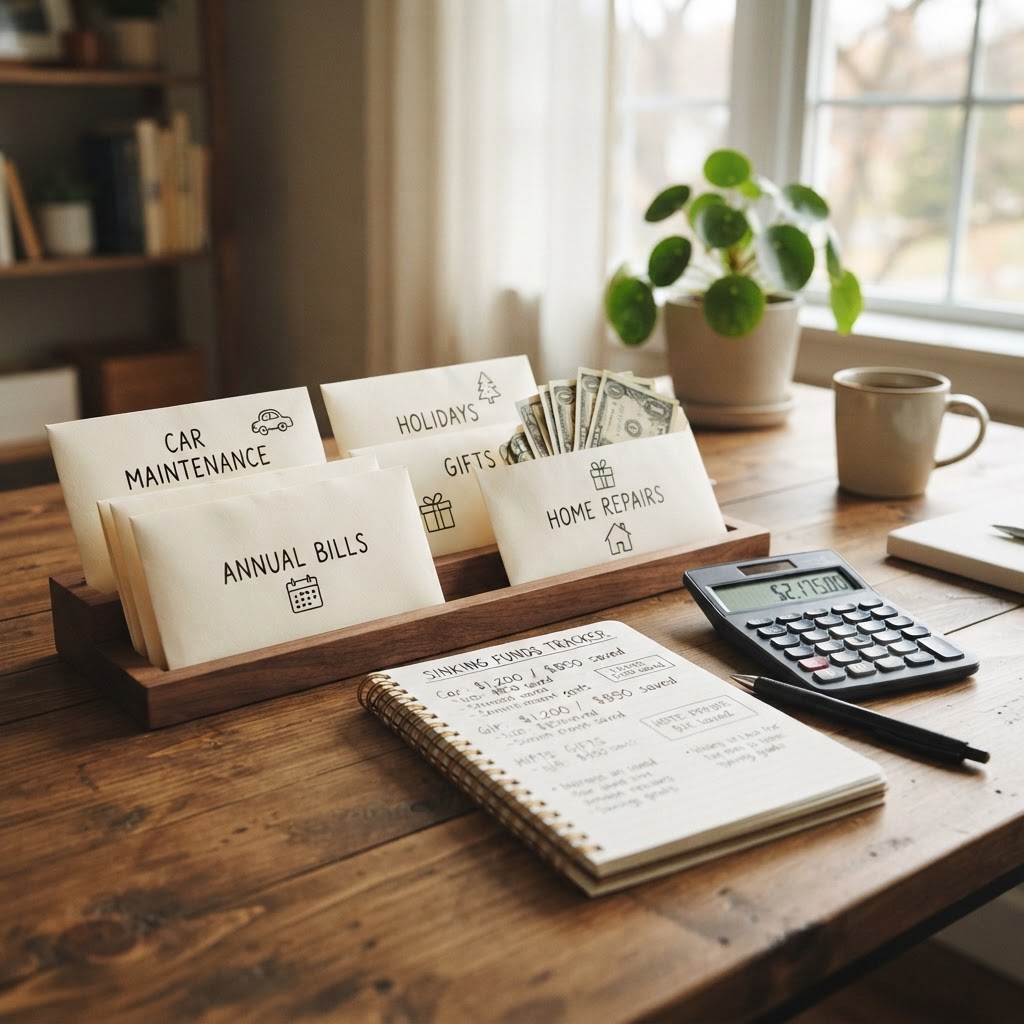
One account with a spreadsheet can work perfectly well. Multiple labeled pots can be helpful for people who prefer visual separation. Cash envelopes may suit small spending categories, while electronic savings may be more practical for large or recurring obligations.
Avoid taking unnecessary market risk with money that has a known near-term deadline. A temporary market decline could occur when the bill is due. The right choice depends on timing and circumstances, but the purpose of a sinking fund is usually availability, not maximum return.
Automate Without Losing Control
Schedule transfers shortly after payday, when possible. Automation removes the need to remember every contribution and moves the decision ahead of discretionary spending. Name the transfer so the transaction history explains the purpose.
Start with a sustainable amount. A contribution that looks impressive but fails after one difficult month is less useful than a smaller transfer that continues. You can increase it after reviewing cash flow and actual expenses.
Review failed or skipped transfers rather than letting them disappear. A missed contribution may be a temporary problem, or it may show that the target does not fit current income. Adjust deliberately and record the change.
When Money Is Tight
A sinking fund is a planning tool, not a test of character. If cash is limited, rank expenses instead of spreading a tiny amount across every category. Cover essential obligations first, then protect the category where a small contribution prevents the greatest future disruption.
You can change a discretionary target, simplify a celebration, delay a purchase, or combine categories. For unavoidable bills, investigate legitimate payment timing or lower-cost options early. Do not wait until the deadline to discover the gap.
If high-cost debt is competing with savings, the right balance depends on access to cash, interest, job stability, and the risk of another emergency. A small reserve can prevent new borrowing, while aggressive repayment may reduce expensive interest. Compare the trade-offs rather than following a one-size-fits-all slogan.
Irregular Income
People with commission, freelance, seasonal, or business income can still use sinking funds. Set annual targets, then contribute a percentage of each payment or use a priority waterfall. In strong months, catch up on upcoming deadlines; in weak months, protect essential categories.
Base essential targets on a conservative income assumption rather than the best month. This reduces the chance that an income dip forces you to withdraw money that was reserved for a bill. Extra income can then strengthen buffers or fund optional goals.
Keep tax reserves separate from ordinary sinking funds when you are responsible for estimated taxes. A clearly labeled reserve can prevent money intended for a government obligation from being mistaken for available spending.
Common Mistakes
The first mistake is treating a labeled fund as extra money. If you use the vehicle fund for an unrelated purchase, the vehicle expense still exists. Record withdrawals immediately and decide how the balance will be rebuilt.
The second mistake is using optimistic estimates. Review actual costs and allow for reasonable uncertainty. A transparent buffer is better than a precise-looking number with no evidence behind it.
The third mistake is creating too many categories. The system should reduce mental load. Combine related expenses and use a general irregular-expense reserve if that makes the plan easier to maintain.
The fourth mistake is forgetting the start date. A yearly expense may be only four months away when you begin. Count the remaining opportunities and adjust early.
The fifth mistake is assuming preparation makes a purchase affordable. A funded trip or replacement can still crowd out debt reduction, investing, or essential cash flow. Review the full budget before adding a recurring commitment.
Monthly Review Routine
Set aside fifteen to thirty minutes each month. Check balances, upcoming dates, transfer success, and changed estimates. This can happen alongside your normal bill review.
Ask four questions: What is due next? How much is available? Is the contribution realistic? Did an actual expense change the target? Those questions keep the system connected to real life.
Once a year, reset the structure. Remove completed goals, add newly discovered obligations, compare planned and actual costs, and decide whether your account setup is still clear.
Couples and Families
Everyone who spends shared money should understand the main categories. Agree on which expenses are shared, who monitors dates, and what requires a conversation before funds move. Clear ownership prevents one person from assuming a balance exists when it has already been used.
Separate household funds from personal discretionary money when helpful. The aim is not identical spending; it is shared visibility for shared obligations.
For children, sinking funds can teach that large expenses are supported by many small decisions. Let them help track a goal or compare choices without making them responsible for adult financial obligations.
30-Day Setup Plan
Week one is discovery: review statements, calendars, and recent irregular costs. Week two is prioritization: choose three to five categories and calculate targets. Week three is setup: label accounts or a spreadsheet and schedule transfers. Week four is testing: check timing and simplify anything confusing.
At the end of thirty days, success does not mean every future expense is fully funded. Success means you know what is coming, have started the highest-priority reserves, and can explain how the money will arrive before the deadline.
Frequently Asked Questions
How many sinking funds should I have?
There is no correct number. Start with categories that are meaningful, recurring, and disruptive if unfunded. Three to eight broad funds are often easier to maintain than dozens of small ones.
Should the money be in a separate bank account?
Not necessarily. A separate account can reduce accidental spending, while a labeled ledger can work just as well. Choose an accessible structure and verify current provider terms.
Can a sinking fund pay for an emergency?
Real life may require using any available cash. If that happens, record the withdrawal accurately and rebuild the reserve afterward. The distinction is useful for learning, not for judging yourself.
What if the actual cost is higher?
Pay the essential expense using the safest available option, record the shortfall, and revise the estimate or contribution. If it is optional, consider delaying or reducing it.
Should I invest a sinking fund?
Money needed on a near-term deadline generally calls for stability and access rather than market volatility. The appropriate account depends on your situation; verify details and seek qualified advice when needed.
Is a sinking fund different from a savings goal?
The terms overlap. A sinking fund usually emphasizes a known or expected expense, while a savings goal may describe a desired purchase. Both need a target, deadline, contribution, and review.
Conclusion: Make Irregular Expenses Routine
Sinking funds change the timing of a decision. Instead of asking where a large bill will come from when pressure arrives, you decide what manageable amount can be set aside now. That shift can make annual costs, maintenance, gifts, travel, and replacements far less disruptive.
Begin with the expenses that create the most stress, use realistic evidence, automate what you can, and review the plan monthly. You do not need a perfect forecast or a complicated spreadsheet. You need a clear purpose and a contribution you can repeat.
The most useful budget is not the one with the most categories. It is the one that helps you decide before pressure arrives. A modest sinking fund, funded consistently and reviewed honestly, can turn financial surprises into manageable planned expenses.
Final reminder: This article is not a recommendation to buy, sell, borrow, invest, or use a particular product. Verify current rates, fees, tax rules, account protections, prices, and provider terms directly before acting.
More Ways to Make Sinking Funds Work in Real Life
Consider a household with a semiannual insurance premium. The payment is not a surprise if the renewal notice arrives on a regular schedule, but it can still feel large because it competes with one month of ordinary bills. Record the due months, divide the expected premium by the number of paydays available, and transfer that amount consistently. If the insurer changes the premium, update the target as soon as the notice arrives rather than waiting for the next renewal.
A vehicle fund deserves special attention because transportation can affect income and family responsibilities. Separate routine service from a major replacement goal if the numbers are large enough to justify it. Keep receipts for oil changes, tires, inspections, and repairs. Over time, your own history is more useful than a generic rule about how much a vehicle should cost.
Homeowners and renters can both use a maintenance fund. Homeowners may face appliances, plumbing, heating, or exterior repairs. Renters may need money for moving costs, deposits, furniture, or a temporary hotel if a housing problem occurs. The category should reflect the risk you actually carry, not an idealized household profile.
Health-related sinking funds require careful boundaries. You might plan for deductibles, dental visits, glasses, prescriptions, or travel to appointments. Check your insurance documents and current provider terms rather than assuming a cost is covered. A fund can support preparation, but it should never replace necessary medical care or professional advice.
Gift planning becomes easier when you list the occasions instead of treating December as the only expensive month. Include birthdays, weddings, cultural celebrations, school events, and charitable commitments that matter to your household. A yearly total divided by the available months creates a calmer plan and makes generosity less dependent on a single pay period.
Holiday travel has several layers: transportation, lodging, food, activities, passports, luggage, and time away from work. A narrow travel target can look adequate until these secondary costs appear. Write down the complete trip budget, then decide which costs belong in the sinking fund and which will be paid from ordinary spending during the trip.
Annual subscriptions and memberships are small individually but easy to forget. List their renewal months and decide whether each still provides value. Canceling an unused service is one form of saving; funding a service you intentionally keep is another. The important point is to make the decision before the automatic renewal, not after.
If you are saving for a planned technology replacement, define the useful life and target model carefully. A phone, computer, or appliance fund should not assume that the most expensive option is necessary. Compare repair, replacement, refurbished, and delayed-purchase scenarios. A clear target protects the fund from becoming an excuse for an impulsive upgrade.
Professional expenses can be irregular even when employment is stable. Licenses, continuing education, uniforms, tools, conferences, and software may all support your ability to earn. Ask whether an employer reimburses any part of the cost and when reimbursement occurs. If you must pay first, reserve the cash before the deadline and track reimbursement separately.
For education planning, distinguish tuition from books, transport, equipment, applications, and lost work time. A broad education fund can be easier than several narrow ones, but write down the assumptions. If the course or program changes, update the target. Saving for education is valuable, but do not assume every credential produces a guaranteed financial outcome.
When a fund reaches its target, do not automatically stop paying attention. Decide whether the balance should remain as a buffer, whether future contributions should pause, or whether the next cycle begins immediately. A completed target can create useful cash flow, but redirecting it without checking upcoming obligations can recreate the original problem.
Windfalls can accelerate a sinking fund, but they should not make the regular contribution unrealistic. A tax refund, bonus, gift, or sale proceeds can cover part of a target and reduce future monthly pressure. Keep the normal plan visible so you know what happens after the one-time money is gone.
Use conservative timing for expenses with uncertain delivery or processing dates. If a payment must clear before a deadline, treat the practical deadline as earlier than the official due date. This small buffer can prevent late fees, rushed transfers, and unnecessary stress.
When a household has multiple goals, write the priority rules down. For example, essential annual bills may come before travel, and a required professional renewal may come before a discretionary purchase. Rules reduce repeated debates and make it easier to decide during a month when income is lower than expected.
A sinking-fund spreadsheet does not need complex formulas. Useful columns include category, due date, target, current balance, monthly contribution, last review, and notes. If you use a spreadsheet, protect it from accidental edits and keep a backup. If you use banking subaccounts, keep a separate list of dates and target amounts.
You can measure progress without turning the system into a performance contest. Track the percentage of each target funded, the number of deadlines met, and the difference between planned and actual costs. The purpose of measurement is to improve decisions, not to create shame when an income change interrupts the plan.
If you have a partner, schedule the review when both people can participate. Bring the upcoming calendar, current balances, and expected income changes. Agree on decisions in writing, even if the note is simple. A shared plan prevents one person from carrying all the memory and reduces the chance that an important deadline is missed.
A sinking fund can coexist with long-term investing. Short-term reserves serve near-term stability, while retirement or other long-term accounts serve future growth. Do not compare the balances as if they have the same job. A smaller cash reserve can be exactly right if it is fully prepared for the bill it was created to cover.
If you are paying down debt, planned expenses still matter. A large annual bill that is ignored may lead to new borrowing, which undermines the progress made through extra debt payments. A modest contribution to an essential sinking fund can protect the broader plan, while optional categories may pause temporarily.
Keep a written note about what counts as an eligible withdrawal. For a car fund, that might include maintenance and registration but not a restaurant meal. For a travel fund, it might include transport and lodging but not unrelated shopping. Clear rules reduce emotional spending and make the balance easier to trust.
When an expense is paid, reconcile the fund immediately. Note the amount, date, and remaining balance. If the payment was higher than expected, record why. This habit turns every withdrawal into data for the next target instead of allowing small discrepancies to accumulate unnoticed.
If a category repeatedly receives money but never gets used, investigate. The target may be unrealistic, the expense may have been canceled, or the category may be unnecessary. Redirecting the balance can be sensible after you verify that no related bill is still pending and that your household agrees with the change.
If a category repeatedly runs short, investigate the opposite possibilities. You may be missing a related cost, underestimating inflation or usage, starting too late, or using the fund for expenses that belong in monthly spending. The answer is usually a better definition and a revised contribution, not abandonment of the method.
Use reminders for renewal notices, not just payment dates. A renewal notice is an opportunity to compare coverage, cancel an unused service, request a quote, or adjust the target. Early information gives you choices; a last-minute bill gives you fewer.
The emotional benefit of a sinking fund is easy to underestimate. Prepared money can make a routine expense feel routine. It can also reduce the urge to make a rushed financial decision under pressure. The account balance is useful, but the confidence that comes from having a plan is often the bigger result.
Making the Habit Sustainable
One practical advantage is that sinking funds make budget conversations more concrete. Instead of arguing whether a purchase is affordable in the abstract, you can look at the target, deadline, current balance, and monthly cash flow. The conversation becomes a choice among dates, amounts, and priorities. That does not eliminate trade-offs, but it makes them visible and easier to revisit.
You can also use a sinking fund to protect a no-debt goal. If you know that a necessary purchase is coming, saving in advance reduces the chance that the purchase will become revolving debt. This works only when the target is realistic and the contribution does not cause missed essential bills. Preparation should improve resilience, not create a new strain.
For large household projects, break the target into stages. A home project might have separate amounts for planning, materials, labor, permits, and a contingency. Funding the stages in order prevents a low initial estimate from making the entire project appear affordable. It also gives you a natural point to pause if the total cost changes.
If you share finances with family members, explain that a sinking fund is not a secret account or a restriction on enjoyment. It is a visible agreement about future priorities. When the reason for a category is understood, people are more likely to respect the balance and suggest adjustments before spending creates a problem.
Use the first few months as a learning period. Your original targets will probably be imperfect. That is normal. Compare the plan with actual income, transfers, and expenses, then adjust one variable at a time. Small, evidence-based changes are easier to understand than a complete redesign every time something goes wrong.
When the system becomes stable, consider adding a modest buffer to categories with uncertain costs. The buffer should be explicit and reviewed, not an excuse to inflate every target indefinitely. If the buffer remains unused across several cycles, you can decide whether to reduce it or move it toward another goal.
The lasting habit is more important than the tool. You can use a bank app, spreadsheet, notebook, envelope system, or budgeting application. If the method helps you identify future costs, save before the deadline, and review the result afterward, it is doing its job.
A Simple Rule to Remember
The most reliable rule is to plan for known costs before they become urgent. List the expense, choose a realistic target, divide it across the time available, and review the result after payment. If the numbers change, change the plan early. This process is flexible enough for different incomes and households because it is based on actual timing and priorities rather than a rigid percentage.
Over time, the small transfers become a quiet form of financial organization. You may still have expensive months, but you are less likely to face them without options. That is the practical promise of a sinking fund: not perfection, but preparation that can be repeated.
Leave a Reply