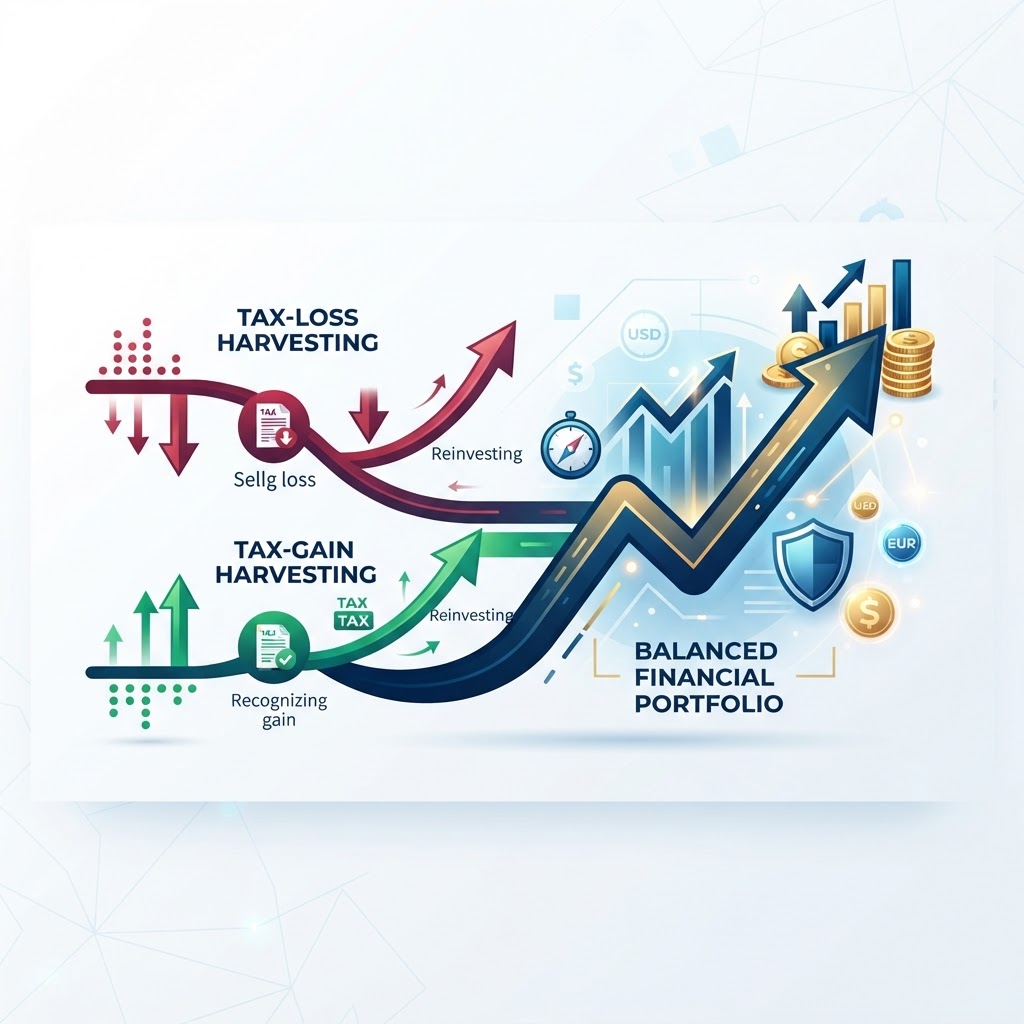
- Tax-loss harvesting involves selling underperforming assets to offset capital gains and lower your annual tax bill.
- Tax-gain harvesting is a proactive strategy to reset your cost basis in investments to a higher level, potentially reducing future taxes.
- The core difference lies in their purpose: one focuses on immediate tax relief, while the other focuses on long-term tax efficiency and future savings.
- Wash-sale rules are a critical consideration when implementing tax-loss harvesting to ensure your trades remain compliant with tax authorities.
- Effective wealth building requires balancing these strategies based on your current income, future tax bracket expectations, and overall financial goals.
Managing the intersection of your portfolio performance and your annual tax bill is a hallmark of sophisticated wealth building. While many investors focus primarily on asset allocation or security selection, the most successful individuals understand that keeping more of what you earn is just as important as how much you earn. Two of the most powerful tools in an investor’s arsenal are tax-loss harvesting and tax-gain harvesting. By strategically managing when you realize gains and losses, you can improve your overall tax efficiency, mitigate the impact of market volatility, and ultimately accelerate the growth of your net worth over the long term. This guide explores how these two distinct approaches work, when to deploy them, and how to integrate them into a cohesive financial plan.
What Is Tax-Loss Harvesting and How Does It Work
Tax-loss harvesting is a fundamental technique used in investment strategy to reduce the amount of capital gains tax an individual owes. At its core, the process involves selling investments that have declined in value—effectively “harvesting” the loss—to offset the taxes due on assets that have been sold for a profit. If your total losses exceed your total gains in a given tax year, you can typically use the remaining net loss to offset a portion of your ordinary income, providing a dual benefit for your tax planning efforts.
To implement this, an investor identifies securities within their taxable brokerage account that are trading below their original purchase price. By selling these positions, you create a realized loss. If you simultaneously sell an appreciated asset, the loss from the underperforming asset cancels out the gain from the profitable one, effectively lowering your taxable income for the year. This is particularly valuable during market downturns, as it allows you to turn a difficult financial period into a tax-saving opportunity.
However, simply selling and walking away is often not the goal. If you still believe in the long-term potential of the investment you just sold, you might consider repurchasing a “substantially identical” security to maintain your exposure to that sector or asset class. This is where investors must be exceptionally careful of the “wash-sale rule.” Tax authorities generally prohibit claiming a loss if you purchase the same or a substantially identical security within 30 days before or after the sale. Violating this rule results in the loss being disallowed for immediate tax purposes, rendering the harvesting attempt ineffective.
To avoid this, many investors use a strategy known as “tax-loss harvesting pair trading.” This involves selling a security and immediately purchasing a similar, but not identical, alternative. For example, if you sell an exchange-traded fund (ETF) that tracks a specific index, you might replace it with another ETF that tracks a different index covering the same sector. By doing this, you capture the tax benefit of the loss while keeping your market participation intact. This systematic approach to managing your portfolio creates significant tax efficiency over time, as the “tax alpha” generated by these transactions can compound just like investment returns.
It is important to remember that tax-loss harvesting is not about locking in a permanent loss. It is about timing. By deferring taxes to a future date, you are essentially obtaining an interest-free loan from the government, allowing that capital to remain invested and working for you. Over decades, this “tax drag” reduction can significantly enhance your total wealth, especially for those in higher tax brackets who face more aggressive capital gains taxation.
Understanding Tax-Gain Harvesting for Strategic Planning
While tax-loss harvesting is a defensive move often triggered by market volatility, tax-gain harvesting is a proactive, strategic decision used to reset your cost basis. In many tax jurisdictions, long-term capital gains are taxed at more favorable rates than ordinary income. Tax-gain harvesting involves intentionally selling assets that have appreciated in value, realizing the gain, and then immediately repurchasing those same assets.
The primary objective here is to increase your cost basis. By selling the asset, you pay tax on the gain you have accrued up to that point. By immediately buying the asset back, your new purchase price becomes the cost basis for that security. This is particularly useful for investors who expect their future tax rates to be higher than their current rates. If you are currently in a lower tax bracket—perhaps due to a temporary reduction in income or early retirement—you can “harvest” your gains now at a lower tax rate (or even zero percent, depending on your income level) to avoid paying a higher tax rate when you eventually sell those assets years down the road.
This strategy is the opposite of tax-loss harvesting in terms of immediate tax impact. Instead of lowering your tax bill for the current year, you are choosing to pay a tax bill now to secure a tax advantage later. This requires careful forecasting of your future financial situation. For example, a young professional who anticipates significant career growth might realize that they will be in a much higher tax bracket in ten years. By harvesting gains during their early career, they lock in current, lower capital gains tax rates, effectively “pre-paying” the tax at a discount.
Furthermore, tax-gain harvesting can be a powerful tool for portfolio rebalancing. When specific sectors or individual stocks perform exceptionally well, they often grow to represent a disproportionately large percentage of your portfolio, increasing your risk profile. By selling these winners to harvest the gains, you not only manage your tax basis but also return your portfolio to its target asset allocation. This dual-purpose strategy keeps your wealth building on track while ensuring your tax liability remains managed.
Unlike the wash-sale rule, which penalizes the rapid repurchase of assets sold for a loss, there is no such restriction on repurchasing assets sold for a gain. You can sell a stock, realize the gain, and buy it back seconds later without any tax consequences regarding the “wash-sale” rule. This makes tax-gain harvesting a cleaner, albeit more tax-heavy, transaction. It is an exercise in long-term planning, requiring you to weigh the immediate cost of taxes against the projected benefit of a higher cost basis in the future.
The Fundamental Differences Between Harvesting Gains and Losses
To master wealth building, you must distinguish between the tactical application of these two methods. While both fall under the umbrella of tax planning, their objectives and mechanics serve different roles in your overall financial ecosystem. Tax-loss harvesting is essentially a reaction to market performance, aimed at minimizing immediate tax burdens during periods of downward price pressure. Tax-gain harvesting, by contrast, is a planned exercise in tax optimization, aimed at managing the future cost basis of your portfolio.
| Feature | Tax-Loss Harvesting | Tax-Gain Harvesting | Best For |
|---|---|---|---|
| Primary Goal | Minimize current year taxes | Optimize future tax liability | Balancing portfolios |
| Market Context | Declining or volatile markets | Periods of lower income/tax rates | Long-term wealth building |
| Repurchase Rules | Must respect wash-sale rules | No wash-sale restrictions | Strategic execution |
The timing requirements are where many investors find the most difficulty. Tax-loss harvesting is most effective when the market provides opportunities to sell at a loss, which can be unpredictable. You must be nimble and ready to execute trades when your portfolio shows meaningful drops. Tax-gain harvesting, however, is often best executed on a predictable schedule—perhaps annually or during major life transitions—where you have a clear picture of your taxable income for the year. By assessing your income in November or December, you can determine if you have “room” in your current tax bracket to harvest gains without pushing yourself into a higher marginal rate.
Another layer of complexity involves the interaction between the two. In a given tax year, you might utilize both strategies simultaneously. If you have significant losses from one part of your portfolio, you might use that opportunity to harvest gains from another part without incurring any net tax cost. This is often called “tax-neutral harvesting.” By balancing realized losses against realized gains, you keep your net tax exposure at zero while effectively raising the cost basis of your long-term winners. This is considered the “gold standard” of tax efficiency, as it cleans up your portfolio’s cost basis without the immediate hit to your cash flow caused by tax payments.
When considering which to prioritize, look to your overall wealth building goals. If your priority is capital preservation during a market correction, tax-loss harvesting takes precedence. If your goal is to consolidate your assets before a major lifestyle change—like moving to a higher tax state or transitioning to a career with much higher compensation—tax-gain harvesting is the superior approach. Ultimately, your strategy should be dynamic. Market conditions change, tax laws evolve, and your personal financial situation will fluctuate. A rigid adherence to one strategy over the other is rarely as effective as an integrated approach that pulls from both toolkits as conditions permit.
When to Use Tax-Loss Harvesting to Offset Gains
The decision to trigger tax-loss harvesting should be rooted in a disciplined framework rather than panic. Many investors feel the urge to sell as soon as they see red in their portfolios. However, effective tax-loss harvesting requires you to look beyond the price drop and determine if the underlying investment thesis for that asset remains intact. If the investment is a high-quality asset that has merely suffered from short-term market fluctuation, harvesting the loss and replacing it with a similar asset allows you to maintain exposure while still securing the tax benefit.
One of the most opportune times to harvest losses is during annual rebalancing. When you review your portfolio at the end of the year, you may find that certain assets have underperformed, throwing your allocation out of balance. By selling these underperformers to rebalance, you naturally create a “tax-loss event” that can be used to offset any capital gains realized from the sale of your overperforming assets. This turns a routine administrative task into a tax-optimizing event.
Another strategic trigger is when your income changes dramatically. If you have experienced a year with lower-than-average income, you might find yourself in a lower tax bracket than usual. Some investors use this time to harvest not just losses, but also to balance their gains. If you have excess losses, you can apply up to a certain amount against your ordinary income, which provides an immediate cash flow benefit. This is particularly helpful for self-employed individuals or those with fluctuating bonuses who can predict when their “taxable income room” is at its maximum.
However, you must account for state-level taxes as well. While federal capital gains rules are uniform, state taxes can vary significantly. In some regions, capital gains are taxed as ordinary income, which can be quite steep. In these instances, tax-loss harvesting becomes even more valuable. The total tax savings—the sum of federal and state benefits—can significantly exceed what you might calculate by looking at federal brackets alone. This is where wealth building moves from a generic exercise to a highly personalized, geographic-specific strategy.
Finally, always perform a cost-benefit analysis before executing trades. Transaction costs, while lower today than in previous decades, still exist, and the time required to manage the trades and track the cost basis is not trivial. If the potential tax savings are negligible compared to the effort or the potential impact on your long-term compounding, it may be better to stay the course. The objective is to enhance long-term wealth, and excessive trading—even with tax benefits in mind—can sometimes lead to “strategy drift,” where your portfolio ends up looking nothing like your original, intended investment plan.
Strategic Scenarios for Harvesting Long-Term Capital Gains
Harvesting long-term capital gains is a nuanced activity that rewards the patient investor. Unlike loss harvesting, which is often done under duress, gain harvesting should be executed when you are in control of your financial calendar. One of the most effective scenarios for this is the “bracket management” strategy. Every year, tax brackets are adjusted for inflation, and your personal income will vary. If you can identify a year where your total income is low enough that a portion of your long-term capital gains could be taxed at a zero-percent rate, this is an ideal time to perform a “basis reset.”
This does not mean you have to divest entirely. You are simply selling and buying back to reset the price at which you bought the asset. By doing this, you essentially “wash” the taxes on those gains, paying zero now to ensure that when you eventually sell the asset for good in the future, you have a much higher cost basis. This is a brilliant move for wealth building because it effectively removes a future tax liability from your books while keeping your market exposure exactly where it was before the sale.
Another key scenario is when you are planning for a major liquidity event, such as a large purchase, tuition payments, or a business acquisition. If you have been accumulating gains over several years, selling everything in one lump sum in the future could push you into a significantly higher tax bracket, triggering the “alternative minimum tax” or simply a higher marginal rate on capital gains. By harvesting these gains incrementally over several years, you smooth out your tax impact, keeping your realized gains within lower tax bands.
For investors nearing retirement, tax-gain harvesting becomes a vital component of wealth distribution planning. Many individuals retire with a mix of tax-deferred accounts (like traditional IRAs) and taxable brokerage accounts. During the early years of retirement, before mandatory distributions from tax-deferred accounts kick in, your taxable income may be quite low. This “gap” period is a perfect window to harvest capital gains. By realizing these gains when your tax rate is at its lowest, you are effectively shifting wealth from a taxable environment to a more tax-efficient state, ensuring that your retirement withdrawals do not unnecessarily inflate your tax bill later in life.
Lastly, consider the scenario of estate planning. In many jurisdictions, assets held at death receive a “step-up” in basis, meaning your heirs inherit the asset at its current market value, effectively eliminating the capital gains tax on the appreciation that occurred during your lifetime. While this makes gain harvesting unnecessary for assets you intend to pass on, it changes the strategy for your lifetime spending. If you have assets that have significant built-in gains, it often makes sense to hold those for your heirs while harvesting gains on assets you intend to use for your own living expenses. This “bifurcated” approach to gain harvesting ensures that you are utilizing every available tax tool to optimize the transfer and consumption of your wealth.
How to Avoid the Wash-Sale Rule During Tax Optimization
One of the most critical barriers to effective tax-loss harvesting is the Internal Revenue Service (IRS) “wash-sale rule.” This regulation is designed to prevent investors from selling a security at a loss purely to claim a tax benefit, only to immediately repurchase the same or a “substantially identical” security to maintain their market position. If you violate this rule, the IRS will disallow the tax loss, effectively neutralizing your tax-planning efforts.
The wash-sale window is defined as 30 days before and 30 days after the date of the sale that generated the loss—a total 61-day window. If you purchase a substantially identical security within this timeframe, the loss is deferred and added to the cost basis of the new position. While this doesn’t mean the loss is gone forever, it does mean you cannot claim it on your taxes for the current year, which defeats the immediate purpose of your tax-loss harvesting strategy.
To navigate this complex landscape, investors often utilize the “substantially similar” loophole. While the IRS has not provided an exhaustive list of what qualifies as “substantially identical,” the consensus among tax experts is that buying a different fund that tracks a similar, but not identical, index is generally acceptable. For example, if you sell an ETF tracking the S&P 500 at a loss, you might consider buying an ETF that tracks a broader total market index or a different S&P 500 fund offered by a different provider. These funds are considered distinct enough that they are not typically classified as substantially identical by tax authorities.
Another way to avoid the rule is to simply wait out the 31-day period before repurchasing. However, this carries “market risk”—the possibility that the asset will significantly appreciate in value while you are sitting on the sidelines. For long-term wealth building, the best practice is to maintain a pre-planned list of “replacement assets” that align with your broader asset allocation goals. By swapping into a similar asset, you can capture your tax benefit while keeping your portfolio fully invested in the market, ensuring that your wealth strategy remains intact even when you are aggressively pursuing tax efficiency.
Balancing Harvesting Strategies With Your Long-Term Goals
Tax optimization is a powerful tool, but it should never be the “tail that wags the dog.” Your primary objective in wealth building is to reach your long-term financial milestones, such as retirement or major life transitions. If you find yourself frequently triggering transactions just to capture small tax savings, you may be falling into the trap of over-trading. Transaction costs, bid-ask spreads, and the risk of deviating from your target asset allocation can quickly erode any gains achieved through tax-loss or tax-gain harvesting.
The key is to integrate these harvesting strategies into a holistic investment policy statement. For instance, tax-gain harvesting is most effective when your income is temporarily low, potentially allowing you to trigger gains at a zero percent long-term capital gains tax rate. If you harvest gains simply because an asset has performed well, you might inadvertently push yourself into a higher tax bracket or trigger the Net Investment Income Tax (NIIT), which would negate your long-term efficiency goals.
Furthermore, tax-loss harvesting should be viewed as a way to enhance your long-term compounding, not as a shortcut to portfolio growth. By lowering your current tax bill, you have more capital to reinvest, which creates a “tax alpha”—the extra return generated by managing taxes effectively. However, if your harvesting leads you to hold assets that no longer align with your risk tolerance or financial goals, the costs will eventually outweigh the benefits.
Consider the following comparison table to help you decide which strategy is more appropriate for your current financial situation:
| Strategy | Primary Benefit | Best For | Risk Factor |
|---|---|---|---|
| Tax-Loss Harvesting | Reduces current taxable income | Investors with high income and unrealized losses | Wash-sale rule violations |
| Tax-Gain Harvesting | Resets cost basis to current market value | Investors in lower tax brackets or those anticipating future tax hikes | Paying immediate taxes you could have deferred |
| Portfolio Rebalancing | Aligns risk with long-term goals | All investors maintaining a target allocation | Tax friction from selling winners |
Tax-Efficient Portfolio Management for Year-Round Wealth
Building wealth through tax efficiency is not an end-of-year activity; it is a year-round discipline. Investors who treat tax planning as a constant process often experience higher net returns over the long term. This approach involves “asset location,” which refers to placing different types of investments in the accounts where they are taxed most efficiently. For example, high-dividend stocks or REITs, which generate ordinary income, are often better suited for tax-deferred accounts like IRAs, whereas tax-efficient index funds that generate primarily long-term capital gains are better suited for taxable brokerage accounts.
Year-round management also involves monitoring your dividend reinvestment settings. When dividends are reinvested automatically, they purchase fractional shares. If you are harvesting tax losses, you must be careful that your dividend reinvestment doesn’t trigger a wash sale. Many professional investors choose to disable automatic dividend reinvestment in accounts where they are actively harvesting losses, opting instead to manually reinvest those dividends once the 31-day window has cleared.
Finally, consider the role of tax-loss harvesting in your asset allocation. If you are selling an underperforming asset to realize a loss, you should already have a plan for how that capital will be redeployed. Having cash sitting in a settlement fund for too long can result in “cash drag,” where your overall portfolio performance lags because a portion of your capital is not exposed to market growth. Always ensure that your “tax-efficient” moves are keeping you on track to meet your wealth-building targets.
How to Track Your Capital Gains and Losses Effectively
One of the most common mistakes individuals make is relying solely on the tax documents provided by their brokerage firms. While these forms (such as the 1099-B) are essential, they do not always provide the full picture of your tax-planning activities, especially if you hold assets across multiple brokerage platforms. Keeping an independent, detailed ledger of your transactions is vital for ensuring accurate reporting.
To track your capital gains and losses effectively, you should maintain a digital spreadsheet or use dedicated portfolio management software that categorizes each trade by date, amount, and the specific asset class. This ledger should be updated every time a transaction occurs. Pay close attention to your “cost basis.” The IRS generally allows you to choose your cost basis method—such as “Average Cost” for mutual funds or “Specific Identification” for individual stocks. Specific identification is often the preferred choice for sophisticated investors, as it allows you to choose which specific shares to sell, thereby maximizing your tax efficiency by realizing the specific losses or gains that benefit your current tax situation.
Furthermore, ensure that you are tracking your “carryover losses.” If your total capital losses exceed your capital gains in a given year, you can use up to $3,000 of the excess loss to offset your ordinary income. Any remaining loss can be carried forward indefinitely into future tax years. Many investors forget about these carryover losses, failing to use them against gains in subsequent years. A robust tracking system will ensure that you never let these valuable tax assets go to waste, allowing you to systematically reduce your tax burden as you continue to build your wealth.
Frequently Asked Questions
Is tax-loss harvesting worth it for small portfolios?
While the administrative effort is the same regardless of portfolio size, the benefits of tax-loss harvesting are typically magnified as the portfolio grows. However, even for smaller accounts, developing the habit of tax-aware investing early can provide significant long-term advantages. The real question is whether the time spent managing the losses outweighs the potential tax savings; for many, automation through robo-advisors has made this accessible even for modest portfolios.
Can I harvest losses in a tax-advantaged account like an IRA or 401(k)?
No. Tax-loss harvesting is only applicable to taxable brokerage accounts. Because investments within IRAs, 401(k)s, and other tax-advantaged accounts are not taxed on an annual basis, there is no capital gain or loss to report to the IRS. Trying to harvest a loss in these accounts provides no immediate tax benefit and is generally not possible because you cannot claim losses on your tax return for these assets.
What is the “30-day rule” in simple terms?
The “30-day rule” (often referred to as the wash-sale rule) dictates that if you sell a security at a loss, you cannot buy it back—or a “substantially identical” security—within 30 days before or after the date of the sale. If you do, the IRS prevents you from claiming that loss on your current tax return, and the loss is added to the cost basis of the new shares instead.
What exactly does the IRS consider “substantially identical”?
The IRS does not provide a strict definition of “substantially identical,” which creates some ambiguity. However, most experts agree that selling an ETF that tracks one index and buying an ETF that tracks a completely different index is safe. The rule is generally intended to stop you from selling a stock and buying the exact same stock immediately after, just to manufacture a paper loss for tax purposes.
How does capital gains tax differ from ordinary income tax?
Ordinary income, such as wages or interest, is typically taxed at higher progressive rates. Long-term capital gains, which apply to assets held for more than one year, are taxed at preferential, lower rates. Tax-loss harvesting is a strategy used to offset these capital gains, potentially reducing your total tax liability and allowing more of your investment returns to remain in the market to compound over time.
Should I prioritize tax-gain harvesting over tax-loss harvesting?
It depends on your current tax bracket. Tax-loss harvesting is almost always beneficial for investors in high tax brackets to reduce their immediate tax liability. Tax-gain harvesting is a more strategic tool typically used by those in lower tax brackets who can reset their cost basis to a higher amount, effectively paying little to no tax now to avoid higher taxes when they sell those assets in the future.
Conclusion
Mastering the nuances of tax-loss and tax-gain harvesting is a cornerstone of modern wealth building. By understanding the interaction between market volatility, the wash-sale rule, and your individual tax situation, you can transform your portfolio into a tax-efficient engine for growth. Remember, the goal is not merely to avoid taxes today, but to maximize your after-tax wealth over the long horizon. Stay disciplined, track your basis accurately, and ensure that every tax-planning move you make is in service of your broader financial objectives.
Ready to take control of your financial future? Start by auditing your current portfolio for unrealized losses and gains, and speak with a qualified tax professional to create a strategy that fits your unique goals. Your path to greater wealth begins with being smarter about the taxes you pay.
By wealthsimplyput Editorial Team
This article is for informational purposes only and does not constitute financial advice. Consult a qualified financial professional before making financial decisions.
Leave a Reply